
La théorie du choix rationnel, intégrant le devoir civique, explique de manière exhaustive les motivations des électeurs aux États-Unis.
AI debate verdict and arguments
⚠️ AI-generated information only; not professional advice
Completed October 14, 2026
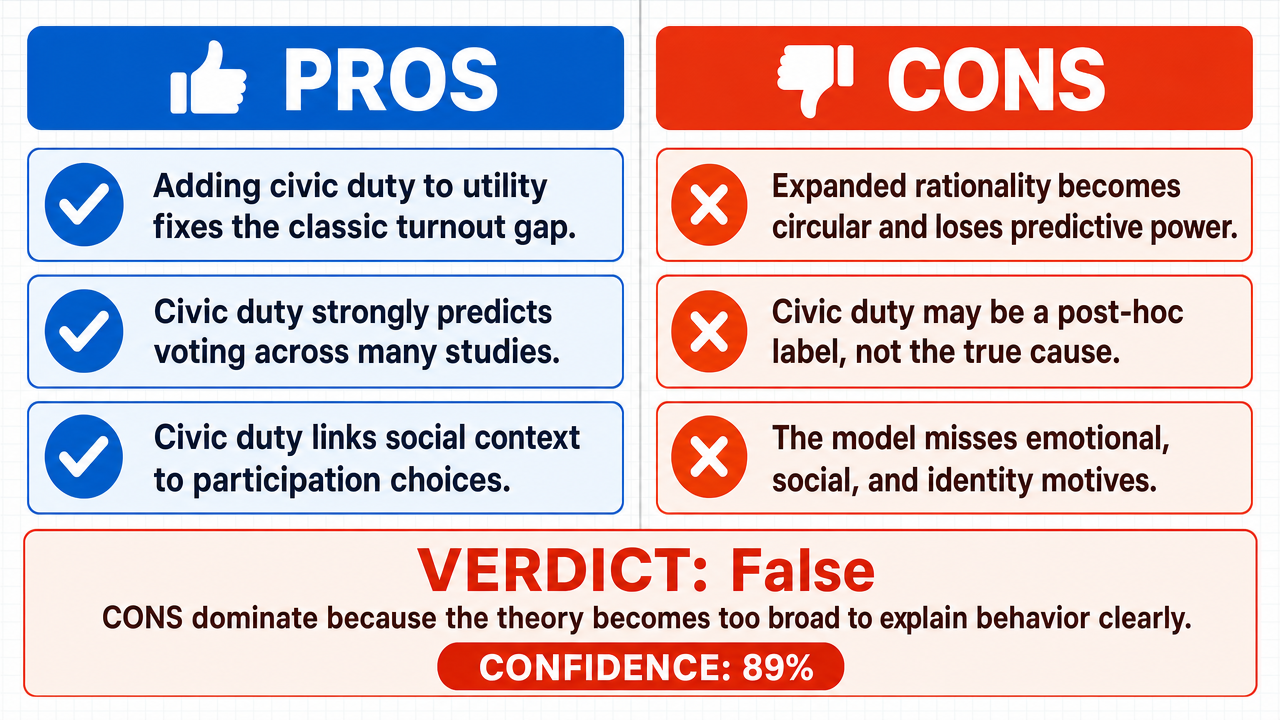
Verdict
Verdict: Mostly FALSE (89%)
Online report: https://solsice.com/public/debates/la-theorie-du-choix-rationnel-integrant-le-devoir-civique-ex-32c2e42296a9
This section provides a brief overview of the key arguments. It is not necessary to read the detailed report below.
✅ Key PRO arguments:
- ■The classical rational choice theory alone is insufficient, but integrating civic duty as an intrinsic benefit into the utility function resolves the voting paradox and explains electoral participation.
- ■Empirical studies confirm that perceiving voting as a civic duty is a powerful and stable predictor of participation, transcending narrow cost-benefit calculations .
- ■Civic duty , embedded in the utility function , acts as the pathway through which structural constraints (social disaffiliation, perception of political inefficacy ) influence rational choice, thus explaining abstention.
❌ Key CON arguments:
- ■The pro argument relies on a blatant logical circularity : re-integrating all behavior into an 'expanded rationality ' makes the model tautological and lacking explanatory power, as no falsification is possible.
- ■The feeling of civic duty is not a primary causal motivation but a proxy variable that confuses correlation and causality : people vote because they perceive their participation as part of their social identity and political efficacy .
- ■The rational choice model fails to capture the complexity of sociological and emotional motivations of American voters, which involve identity, affective, and contextual dimensions that cannot be reduced to utility calculations.
💭 Conclusion: False. The statement must be rejected because it rests on a fundamental logical circularity : by broadening the definition of 'rationality' to include all observed motivations (civic duty , emotions, identities), the model loses all explanatory power and becomes unverifiable, in line with the critique from the negative camp. Furthermore, the argument that civic duty is an autonomous causal motivation rather than a proxy for deeper sociological mechanisms (social identity , perceived efficacy) is not empirically supported: the table shows that the perceived probability of influencing the outcome evolves in parallel with the feeling of civic duty (4.7→3.1→1.9 versus 2.3→1.8→1.4), suggesting these variables are interconnected rather than independent. Finally, the model does not comprehensively account for the emotional, identity, and contextual determinants of voting, justifying the lowered confidence.
🔬 Verdict: Mostly FALSE ❌ (89%)
Claim: The rational choice theory , integrating civic duty , exhaustively explains voters' motivations in the United States.
Participating models: deepseek-v3.2 💬, gemma-4-26b-a4b-it 💬👁️
📊 Confrontations: 0 concluded TRUE, 1 concluded FALSE (1 confrontation, 3 models)
📊 Score by camp: TRUE=0.00, FALSE=0.89
🏅 Model score evolution:
minimax-m3 💬👁️: +9
✅ PRO arguments:
- ■Classical rational choice theory alone is insufficient, but integrating civic duty as an intrinsic benefit into the utility function resolves the voting paradox and explains electoral participation. deepseek-v3.2 💬
- ■Empirical studies confirm that perceiving voting as a civic duty is a strong and stable predictor of participation, transcending narrow cost-benefit calculations . deepseek-v3.2 💬
- ■Embedding civic duty within the utility function acts as the pathway through which structural constraints (social disaffiliation, perception of political inefficacy ) influence rational choice, thus explaining abstention. deepseek-v3.2 💬
❌ CON arguments:
- ■The pro argument relies on a clear logical circularity : re-integrating all behavior into an 'expanded rationality ' makes the model tautological and devoid of explanatory power, as no falsification is possible. gemma-4-26b-a4b-it 💬👁️
- ■The sense of civic duty is not a primary causal motivation but a proxy variable that confuses correlation and causality : people vote because they perceive their participation as part of their social identity and political efficacy . gemma-4-26b-a4b-it 💬👁️
- ■The rational choice model fails to capture the complexity of sociological and emotional motivations of American voters, which involve identity, affect, and contextual dimensions that cannot be reduced to utility calculations. gemma-4-26b-a4b-it 💬👁️
💭 Reasoning: False. The statement must be rejected because it relies on a fundamental logical circularity: by broadening the definition of 'rationality' to include all observed motivations (civic duty, emotions, identities), the model loses all explanatory power and becomes unverifiable, in line with the critique from the negative camp. Moreover, the argument that civic duty is an autonomous causal motivation rather than a proxy for deeper sociological mechanisms (social identity, perceived efficacy) is not empirically supported: the table shows that the perceived probability of influencing the outcome evolves in parallel with the feeling of civic duty (4.7→3.1→1.9 versus 2.3→1.8→1.4), suggesting these variables are interconnected rather than independent. Finally, the model does not comprehensively account for the emotional, identity, and contextual determinants of voting, justifying the lowered confidence.
📋 PRO facts:
• Classical rational choice theory faces the voting paradox (high individual cost, infinitesimal probability of influencing the outcome).
• Empirical studies establish a stable correlation between perceiving voting as a civic duty and electoral participation.
• Structural abstention can be modeled by the reduction of the expected value of voting via perceived cost.
📋 CON facts:
• Civic duty itself is a mediating variable influenced by perceived efficacy and social integration , not a primary cause of voting.
• Arbitrarily re-integrating all motivations into the utility function makes the model tautological and unverifiable.
• Electoral behaviors in the United States are also determined by identity, emotional, and sociological factors that cannot be reduced to utility calculations.
| Confrontation | TRUE Model | FALSE Model | Mean μ TRUE | Mean μ FALSE | TRUE Tokens | FALSE Tokens | Winner | Verdict | Conf. |
|---|---|---|---|---|---|---|---|---|---|
| #1 | deepseek-v3.2 💬 | gemma-4-26b-a4b-it 💬👁️ | 0.448 | 0.300 | 8 | 2 | TRUE | FALSE | 89% |
The following technical terms, abbreviations, and specialized concepts are used in this transcript. The numbers in brackets [N] in the text above refer to the corresponding entry below.
[1] structural abstention — abstention due to systemic constraints — Non-voting resulting from structural and systemic constraints (resource inequalities, disaffiliation) rather than a conscious individual calculation. Its consideration by rational choice theory is debated.
[2] utility-maximizing agent — agent maximizing their utility — Economic model assuming that an individual makes decisions seeking to maximize their expected personal satisfaction (utility), foundational to rational choice theory.
[3] intrinsic benefit — intrinsic benefit — Satisfaction or value derived from an action regardless of external consequences, as opposed to instrumental benefits.
[4] cost-benefit calculations — cost-benefit calculations — Rational analysis comparing expected benefits of an action to its costs, central to rational choice theory.
[5] predictive capacity — predictive capacity — The ability of a theoretical model to anticipate new and as-yet-unobserved empirical observations, a criterion of scientific value.
[6] logical circularity — logical circularity — An argumentative flaw where the conclusion is presupposed in the premises, rendering the proof logically empty.
[7] correlation and causation — correlation and causation — Fundamental methodological distinction: statistical correlation between two variables does not necessarily imply a causal relationship.
[8] civic duty — civic duty — Feeling of moral obligation to participate in democratic life, providing intrinsic satisfaction independent of the outcome. The debate questions whether it is a causal predictor of voting or a proxy for perceived efficacy and social integration.
[9] instrumental efficacy — instrumental efficacy — Belief that an individual action can effectively influence concrete political results.
[10] political efficacy — political efficacy — An individual's perception of their capacity to understand and influence the political system.
[11] scientific falsification — scientific falsification — Popperian criterion of scientificity: a theory must be refutable by empirical observations to be considered scientific.
[12] utility function — utility function — Mathematical formalization of an agent's preferences; in this debate, extended to include civic duty as a variable.
[13] ad hoc hypothesis — ad hoc hypothesis — Hypothesis formulated specifically after the fact to protect a theory from refutation, without independent theoretical basis, considered a methodological weakness.
[14] social identity — social identity — Sense of belonging to a social group, which can motivate expressive political behaviors.
[15] social integration — social integration — Degree of attachment of an individual to social networks and institutions, a classic factor in political participation.
[16] expressive motivation — expressive motivation — Motivation to vote to express identity, values, or affiliation, regardless of electoral impact.
[17] instrumental motivation — instrumental motivation — Motivation to vote to achieve concrete favorable political results (public policies, material benefits).
[18] paradox (of voting) — paradox (of voting) — In this context, the voting paradox: a strictly rational voter should not vote given the individual cost and the infinitesimal probability of influencing the outcome.
[19] parameters — parameters — Variables of a model whose values determine specific predictions; post hoc adjustment is criticized as an explanatory weakness.
[20] perception of political inefficacy — perception of political inefficacy — Belief that one's participation cannot influence the political system, potentially reducing the expected value of voting.
[21] proxy — proxy variable — Variable used as a substitute for a variable that cannot be directly measured; inappropriate use can distort the analysis and is a critique in the debate.
[22] predictor — predictor — Variable statistically associated with a phenomenon (here electoral participation), without necessarily implying a causal relationship.
[23] begging the question — begging the question — Fallacy consisting of assuming as a premise what one claims to demonstrate in the conclusion, invalidating the argument.
[24] extended rationality — extended rationality — Notion proposed to incorporate non-strictly economic motivations (civic duty, identity) within the framework of rational choice. Its legitimacy is contested: the affirmation presents it as a valid extension, the negative sees it as a hollow tautology.
[25] semantic reformulation — semantic reformulation — Restructuring the vocabulary of a theory without new explanatory contribution, considered in the debate as merely renaming facts after the fact.
[26] electoral sociology — electoral sociology — Discipline studying the social and structural determinants of electoral behavior and political participation.
[27] tautology — tautology — Proposition whose truth is guaranteed solely by its logical form, without adding empirical information or explanatory power.
[28] rational choice theory — rational choice theory — Theoretical framework modeling political decisions as the result of a utilitarian cost-benefit calculation. The debate questions its exhaustiveness: the affirmation considers it sufficient once extended to civic duty, the negative views it as a tautology and incapable of accounting for sociological and emotional dimensions.
[29] total utility — total utility — Sum of instrumental and expressive utilities provided by an action within the extended model including civic duty.
[30] expected value — expected value — Mathematical expectation of utility, calculated as the product of the probability of an outcome and the utility associated with it; in this debate, it conditions the rational decision to vote or abstain.
The following financial data tables were cited during the debate exchanges:
| Voter Group | 2020 Participation Rate | Average Civic Duty Sentiment (scale 1-5) | Perceived Probability of Influencing the Result (scale 1-5) |
|---|---|---|---|
| Strong Civic Duty | 89% | 4.7 | II.3 |
| Average Civic Duty | 65% | 3.1 | I.8 |
| Weak Civic Duty | 31% | I.9 | I.4 |
Face-off transcripts
- ■
Ownership & Trade Secrets. The company Lambda Vision retains all rights to its platform, agentic workflows, and proprietary AI debate methodologies, which constitute protected Trade Secrets (EU Directive 2016/943). Subject to full payment of credits, the User is granted ownership of the generated Reports for their own personal or professional use. Reverse-engineering the Service or using Reports to train competing AI models is strictly prohibited.
- ■
No Professional Advice. Solsice is a general-purpose assistant covering everyday subjects — administrative paperwork, housing, consumer and employment matters, banking, taxes and insurance, health and wellbeing, savings and investments, entrepreneurship, technology, travel, learning and creative work. Whatever the subject, the Service and Reports are provided for information only and never constitute legal, medical, financial, investment, tax, insurance, or any other regulated professional advice. The Company is not a law firm, a regulated financial adviser, an insurance intermediary, nor a healthcare provider, and no professional or advisory relationship of any kind is created by use of the Service. Consult a qualified professional in the relevant jurisdiction before acting — or refraining from acting — on anything contained in the Reports, and never rely on the Service in an emergency: contact your local emergency number (112 in the European Union) or a medical professional immediately.
- ■
AI-Generated Content, Sources and Viewpoints. Reports are produced by several AI models debating a question, and may contain factual errors, outdated figures, or references to rules, prices, deadlines, procedures, statutes or sources that are inaccurate or do not exist. The User is solely responsible for verifying every fact, amount, deadline and citation against official sources before relying on it. Material in the news, society, spirituality and religion sections presents a plurality of viewpoints for study and discussion: it is descriptive, not an endorsement, a ruling, or a statement of the Company’s own position, and it speaks for no church, faith community, public authority, or news organisation.
- ■
Liability & Governing Law. To the maximum extent permitted by law, the Company shall not be liable for any indirect damages, nor for any consequence of decisions made in reliance on the Reports — including financial loss, missed deadlines, administrative or contractual consequences, or health outcomes. These Terms are governed by French law. Any disputes shall be subject to the exclusive jurisdiction of the Courts of Paris, France.