
La suppression des électeurs par des lois sur l'identification est une pratique intentionnelle visant à réduire la participation de certaines minorités aux États-Unis.
AI debate verdict and arguments
⚠️ AI-generated information only; not professional advice
Completed October 14, 2026
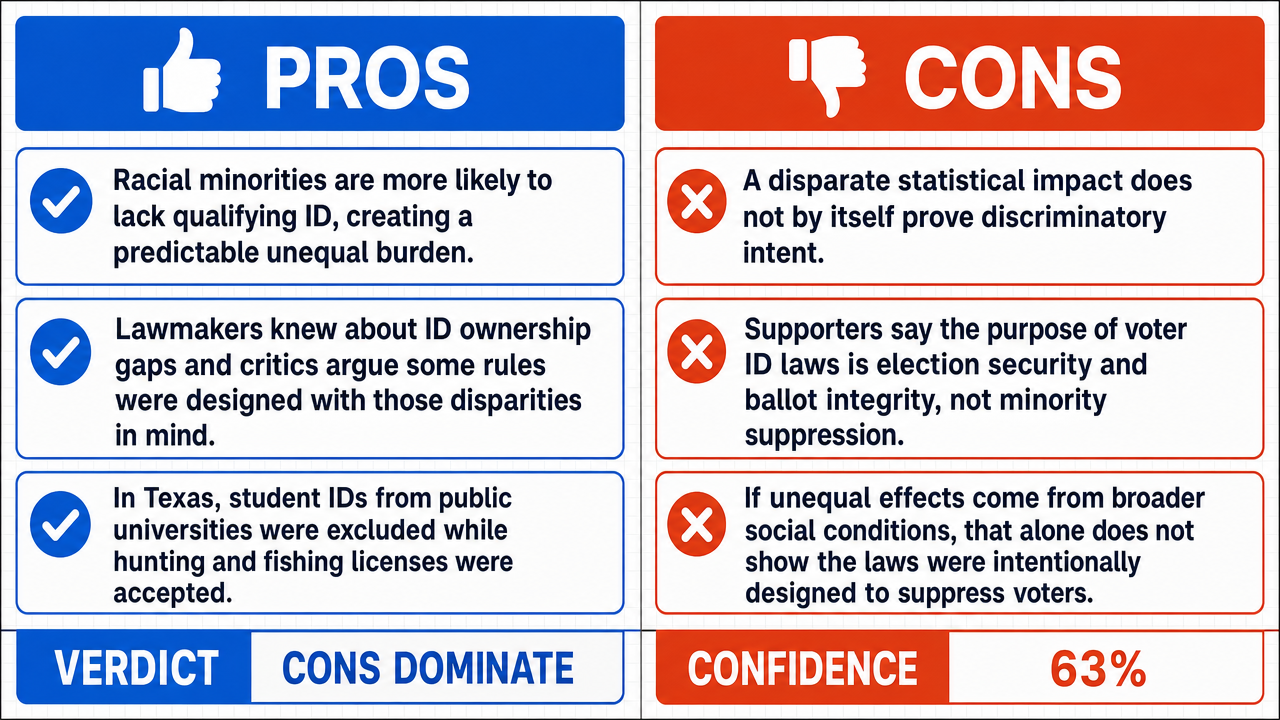
Verdict
Verdict: Mostly FALSE (63%)
Online report: https://solsice.com/public/debates/la-suppression-des-electeurs-par-des-lois-sur-l-identificati-0f5f16a82b31
This section provides a brief overview of the key arguments. It is not necessary to read the detailed report below.
✅ Key PRO arguments:
- ■The disproportionate impact of voter ID laws on racial minorities is documented and predictable, with up to 11% of eligible voters lacking a government-issued photo ID, a rate higher among young people, low-income individuals, and racial minorities according to the Brennan Center for Justice.
- ■Lawmakers have prior and detailed knowledge of demographic disparities in document possession, and deliberately design laws to exacerbate these disparities.
- ■In Texas, public university student IDs were specifically excluded from the list of accepted IDs, while hunting and firearm permits were included, thus targeting young (more diverse) populations while favoring rural and white groups.
❌ Key CON arguments:
- ■The opposing argument relies on a confusion between statistical impact and legislative intent : a disproportionate effect does not prove discriminatory intent , but reflects an existing socio-economic correlation that the legislator does not create.
- ■The declared purpose of voter ID laws is election security and ballot integrity, not minority suppression; document possession correlates with overall economic insecurity and not with targeted discrimination.
- ■There is a logical contradiction in the opposing argument: if the impact results from pre-existing socio-economic factors, it cannot simultaneously serve as evidence of discriminatory intent, and no intent operator is demonstrated.
💭 Conclusion: False: the debate has not established that voter ID laws are an intentional practice aimed at reducing minority participation. The victorious side successfully demonstrated that confusing disproportionate statistical impact with discriminatory intent is a logical fallacy, since the disparities observed in document possession stem from pre-existing socio-economic factors that the legislator did not create. The opposing argument of deliberate intent is based on an unproven inference, due to the lack of a clearly identifiable intent operator linking knowledge of disparities to a targeted suppression will. Furthermore, the stated purpose of the laws (ballot security and data integrity) and their public justification, as documented in legislative objectives related to standardization, accessibility, and record updating indicators, further weaken the conspiracy thesis. However, the moderate confidence level (63%) reflects that documented racial disparities in ID possession still hold some persuasive weight and prevent a complete rejection of the entire assertion.
🔬 Verdict: Mostly FALSE ❌ (63%)
Claim: The suppression of voters through ID laws is an intentional practice aimed at reducing participation of certain minorities in the United States.
Participating models: deepseek-v3.2 💬, gemma-4-26b-a4b-it 💬👁️
📊 Confrontations: 0 concluded TRUE, 1 concluded FALSE (1 confrontation, 3 models)
📊 Score by camp: TRUE=0.00, FALSE=0.63
🏅 Model score evolution:
minimax-m3 💬👁️: +6
✅ PRO arguments:
- ■The disproportionate impact of voter ID laws on racial minorities is documented and predictable, with up to 11% of eligible voters lacking a government-issued photo ID, a rate higher among young people, low-income individuals, and racial minorities according to the Brennan Center for Justice. deepseek-v3.2 💬
- ■Lawmakers have prior and detailed knowledge of demographic disparities in document possession, and deliberately design laws to exacerbate these disparities. deepseek-v3.2 💬
- ■In Texas, public university student IDs were specifically excluded from the list of accepted IDs, while hunting and firearm permits were included, thus targeting young (more diverse) populations while favoring rural and white groups. deepseek-v3.2 💬
❌ Arguments AGAINST:
- ■The opposing argument relies on a confusion between statistical impact and legislative intent : a disproportionate effect does not prove discriminatory intent , but reflects an existing socio-economic correlation that the legislator does not create. gemma-4-26b-a4b-it 💬👁️
- ■The declared purpose of voter ID laws is election security and ballot integrity, not minority suppression; document possession correlates with overall economic insecurity and not with targeted discrimination. gemma-4-26b-a4b-it 💬👁️
- ■There is a logical contradiction in the opposing argument: if impact results from pre-existing socio-economic factors, it cannot simultaneously serve as evidence of discriminatory intent, and no intent operator is demonstrated. gemma-4-26b-a4b-it 💬👁️
💭 Reasoning: False: the debate has not established that voter ID laws are an intentional practice aimed at reducing minority participation. The victorious side has successfully demonstrated that confusing disproportionate statistical impact with discriminatory intent is a logical fallacy, since disparities in document possession stem from pre-existing socio-economic factors that the legislator did not create. The opposing argument of deliberate intent is based on an unproven inference, due to the lack of a clearly identifiable operator linking knowledge of disparities to targeted suppression. Moreover, the stated purpose of the laws (ballot security and data integrity) and their public justification, as documented in legislative objectives related to standardization, accessibility, and record updating indicators, further weaken the conspiracy thesis. However, the moderate confidence (63%) reflects that documented racial disparities in ID possession still hold some persuasive weight and prevent a categorical rejection of the entire assertion.
📋 PRO facts:
• According to a study by the Brennan Center for Justice, up to 11% of eligible American voters do not possess a government-issued photo ID.
• The rate of non-possession of identity documents is higher among racial minorities in the United States, notably African Americans, Latinos, and Asian Americans, who are significantly less likely to possess the required forms of identification such as a driver's license.
📋 FACTS AGAINST:
• Possession of identity documents is correlated with pre-existing socio-economic factors and not with a deliberate legislative target.
• The declared intent of voter ID laws is election security and electoral data integrity, as indicated by legislative objectives related to standardization, accessibility, and record updating indicators.
• Confusing statistical correlation with discriminatory intent constitutes a logical fallacy: the disproportionate impact alone is not sufficient to prove an intent to targeted suppression.
| Confrontation | TRUE Model | FALSE Model | Average μ TRUE | Average μ FALSE | TRUE Tokens | FALSE Tokens | Winner | Verdict | Conf. |
|---|---|---|---|---|---|---|---|---|---|
| #1 | deepseek-v3.2 💬 | gemma-4-26b-a4b-it 💬👁️ | 0.482 | 0.202 | 8 | 2 | TRUE | FALSE | 63% |
The following technical terms, abbreviations, and specialized concepts are used in this transcript. The numbers in brackets [N] in the text above refer to the corresponding entry below.
[1] Direct causal correlation — Statistical relationship in which the variation of one variable is directly caused by another, as opposed to a simple co-occurrence. The negative side of the debate disputes the existence of such a correlation between identification laws and electoral suppression.
[2] Socio-economic correlation — Statistical link between economic and social variables. According to the negative side, the lack of identity documents is correlated with overall economic hardship and not specifically targeted by identification laws.
[3] Demographic disparities — Observable differences in the distribution of certain characteristics among demographic groups. The debate concerns whether these disparities are the cause or the consequence of identification laws.
[4] Discriminatory effect — Consequence of a policy producing unfavorable treatment toward certain groups. The affirmative side argues that this effect is deliberately sought, while the negative side considers it an indirect consequence of pre-existing disparities.
[5] Error of generalization — Logical fallacy of extending an observation or conclusion drawn from a particular case to a broader set. The negative side criticizes the opponent for generalizing from the sole example of driver's licenses.
[6] Electoral fraud — Any irregular manipulation of the voting process or election results. The negative side invokes the prevention of this fraud as the primary purpose of identification laws.
[7] Disproportionate impact — disparate impact — Effect of a policy that significantly affects certain groups more than others. The debate concerns whether this impact proves discriminatory intent, which the negative side disputes.
[8] Discriminatory intent — Deliberate desire to produce unfavorable treatment toward a specific group. The affirmative side claims this intent is demonstrated by the disproportionate effects of the laws, which the negative side contests.
[9] Legislative intent — Declared motivation of a legislator adopting a law. The negative side states that the intent is electoral security, while the affirmative side argues it is the reduction of votes from certain groups.
[10] Voter ID laws — Laws requiring the presentation of a specific form of identification to vote. The debate concerns whether they are intentionally discriminatory (affirmative) or aimed at electoral security (negative).
[11] Racial minorities — Ethnic or racial groups historically underrepresented. The affirmative side argues that African Americans, Latinos, and Asian Americans are specifically targeted due to their lower possession of identification documents.
[12] Transfer operator — In the context of the debate, a mechanism by which a correlation would transform into a direct causal link. The negative side criticizes the opponent for not providing such an operator to demonstrate that the law was designed to produce the observed effect.
[13] Economic hardship — Situation of material and financial insecurity. According to the negative side, the lack of identity documents is a variable correlated with this hardship and not a deliberate target of identification laws.
[14] Voter suppression — Practices aimed at reducing electoral participation of certain groups. The debate concerns whether identification laws constitute an intentional form of suppression, which the negative side disputes.
[15] Ballot security — Guarantee of the integrity and reliability of the voting process. The negative side presents this security as the primary motivation of legislation, opposing the thesis of electoral suppression.
[16] Correlated variables — Statistical variables whose variations are linked without necessarily establishing a causal link. The negative side uses this concept to distinguish a simple co-occurrence from discriminatory intent.
The following financial data tables were cited during the debate exchanges:
| Indicator | Nature of Measure | Legislative Objective |
|---|---|---|
| ID Requirement | Standardization | Security and Verification |
| Free ID | Compensatory Measure | Accessibility |
| Voter Registers | Updating | Data Integrity |
Legend: Comparison of the components of identification laws and their institutional purposes.
Face-off transcripts
- ■
Ownership & Trade Secrets. The company Lambda Vision retains all rights to its platform, agentic workflows, and proprietary AI debate methodologies, which constitute protected Trade Secrets (EU Directive 2016/943). Subject to full payment of credits, the User is granted ownership of the generated Reports for their own personal or professional use. Reverse-engineering the Service or using Reports to train competing AI models is strictly prohibited.
- ■
No Professional Advice. Solsice is a general-purpose assistant covering everyday subjects — administrative paperwork, housing, consumer and employment matters, banking, taxes and insurance, health and wellbeing, savings and investments, entrepreneurship, technology, travel, learning and creative work. Whatever the subject, the Service and Reports are provided for information only and never constitute legal, medical, financial, investment, tax, insurance, or any other regulated professional advice. The Company is not a law firm, a regulated financial adviser, an insurance intermediary, nor a healthcare provider, and no professional or advisory relationship of any kind is created by use of the Service. Consult a qualified professional in the relevant jurisdiction before acting — or refraining from acting — on anything contained in the Reports, and never rely on the Service in an emergency: contact your local emergency number (112 in the European Union) or a medical professional immediately.
- ■
AI-Generated Content, Sources and Viewpoints. Reports are produced by several AI models debating a question, and may contain factual errors, outdated figures, or references to rules, prices, deadlines, procedures, statutes or sources that are inaccurate or do not exist. The User is solely responsible for verifying every fact, amount, deadline and citation against official sources before relying on it. Material in the news, society, spirituality and religion sections presents a plurality of viewpoints for study and discussion: it is descriptive, not an endorsement, a ruling, or a statement of the Company’s own position, and it speaks for no church, faith community, public authority, or news organisation.
- ■
Liability & Governing Law. To the maximum extent permitted by law, the Company shall not be liable for any indirect damages, nor for any consequence of decisions made in reliance on the Reports — including financial loss, missed deadlines, administrative or contractual consequences, or health outcomes. These Terms are governed by French law. Any disputes shall be subject to the exclusive jurisdiction of the Courts of Paris, France.