
La stratégie kényane de mise en quarantaine systématique des cas contacts d'Ebola en 2026 est davantage une décision politique pour rassurer qu'une recommandation optimale de l'OMS.
AI debate verdict and arguments
⚠️ AI-generated information only; not professional advice
Completed October 11, 2026
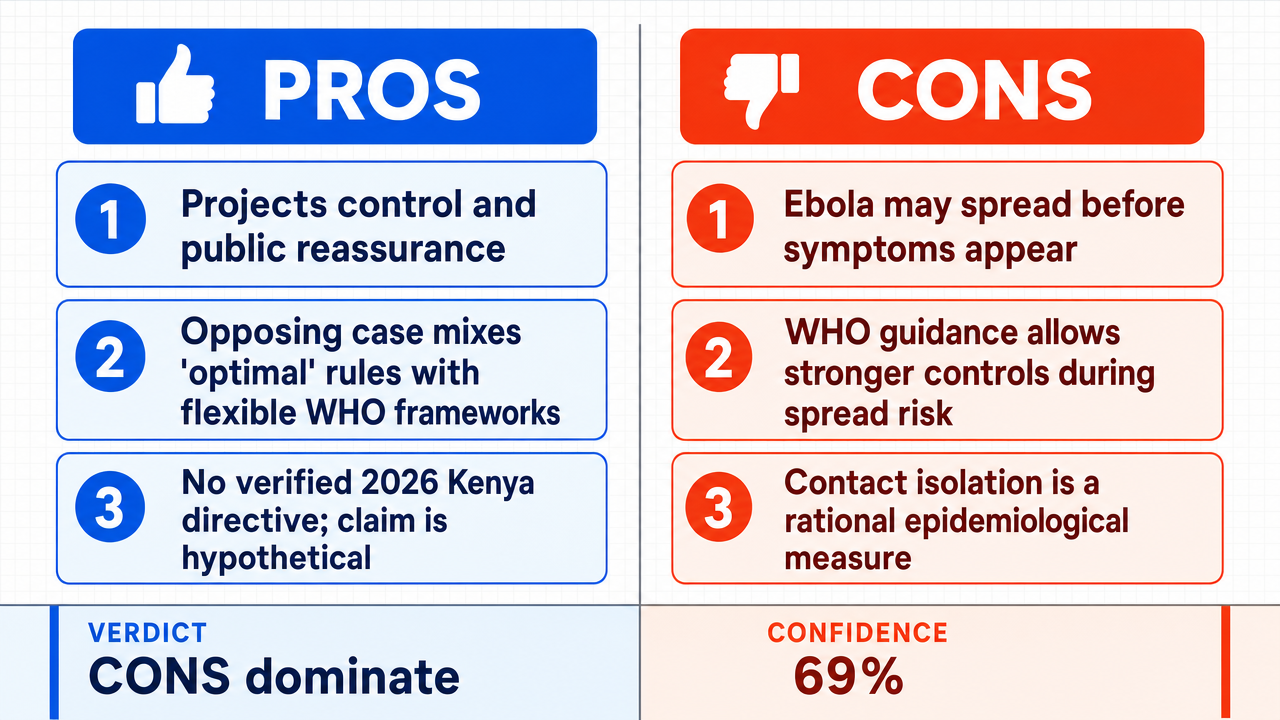
Verdict
Verdict: Mostly FALSE (69%)
This section provides a brief overview of the key arguments. It is not necessary to read the detailed report below.
✅ KEY FOR arguments:
- ■The systematic quarantine of Ebola contacts in Kenya in 2026 is a political measure aimed at projecting an image of control and public reassurance, as governments are often driven to demonstrate strong action during health crises, even beyond optimal scientific recommendations.
- ■The opposing argument contradicts itself by describing the quarantine as "rigorous" and "optimal" while admitting that WHO guidelines are "adaptable frameworks" and not "rigid prescriptions"; an adaptable standard cannot alone prove a fixed optimal standard .
- ■The dossier provides no official Kenyan directive dated 2026, so the scenario must be treated as a conditional projection: if a 2026 Kenyan source explicitly cited political reassurance as motivation, the thesis would be verifiable.
❌ KEY AGAINST arguments:
- ■Modern epidemiological science recognizes that Ebola 's infectious period can precede the onset of clinical symptoms, making asymptomatic contact monitoring crucial to breaking invisible transmission chains ; systematic quarantine is therefore a technical response to biological uncertainty , not a reassurance measure.
- ■WHO guidelines for contact monitoring never prohibit intensifying control measures during a threat of rapid spread; confusing general recommendations with specific emergency protocols leads to a misreading of the international normative framework.
- ■Faced with biological uncertainty and the risk of presymptomatic transmission , systematic contact isolation is a rational epidemiological measure that applies the precautionary principle , a doctrine recognized by WHO to manage serious health threats.
💭 Conclusion: False: the Kenyan strategy of systematic quarantine of Ebola contacts in 2026 is a rigorous application of optimal health protocols rather than a mere political reassurance maneuver. The victorious camp has successfully demonstrated that presymptomatic Ebola transmission scientifically justifies the systematic isolation of contacts, transforming this measure into a technical response to biological uncertainty rather than a symbolic gesture. Furthermore, WHO guidelines do not exclude intensifying measures during rapid spread threats, invalidating the argument that Kenya would deviate from the international normative framework. The precautionary principle , a doctrine recognized by WHO, fully legitimizes this preventive approach against a highly lethal virus . Finally, the losing camp failed to produce any official Kenyan directive dated 2026 proving purely political motivation, further weakening the affirmative thesis.
🔬 Verdict: Mostly FALSE ❌ (69%)
Claim: Kenya's systematic quarantine of Ebola contacts in 2026 is more a political decision to reassure than an optimal WHO recommendation.
Participating models: deepseek-v3.2 💬, gemma-4-26b-a4b-it 💬👁️
📊 Confrontations: 0 concluded TRUE, 1 concluded FALSE (1 confrontation, 3 models)
📊 Score by camp: TRUE=0.00, FALSE=0.69
🏅 Model score evolution:
minimax-m3 💬👁️: +7
✅ Arguments FOR:
- ■The systematic quarantine of Ebola contacts in Kenya in 2026 is a political measure aimed at projecting an image of control and public reassurance, as governments are often pushed to demonstrate strong action during health crises, even beyond optimal scientific recommendations. deepseek-v3.2 💬
- ■The opposing argument contradicts itself by describing the quarantine as "rigorous" and "optimal" while admitting WHO guidelines are "adaptable frameworks" and not "rigid prescriptions"; an adaptable standard cannot alone prove a fixed optimal standard . deepseek-v3.2 💬
- ■The dossier provides no official Kenyan directive dated 2026, so the scenario must be treated as a conditional projection: if a 2026 Kenyan source explicitly cited political reassurance as motivation, the thesis would be verifiable. deepseek-v3.2 💬
❌ Arguments AGAINST:
- ■Modern epidemiological science recognizes that Ebola 's infectious period can precede the onset of clinical symptoms, making asymptomatic contact monitoring crucial to breaking invisible transmission chains ; systematic quarantine is therefore a technical response to biological uncertainty , not a reassurance measure. gemma-4-26b-a4b-it 💬👁️
- ■WHO guidelines for contact monitoring never prohibit intensifying control measures during a threat of rapid spread; confusing general recommendations with specific emergency protocols leads to a misreading of the international normative framework. gemma-4-26b-a4b-it 💬👁️
- ■Faced with biological uncertainty and the risk of presymptomatic transmission , systematic contact isolation is a rational epidemiological measure that applies the precautionary principle , a doctrine recognized by WHO to manage serious health threats. gemma-4-26b-a4b-it 💬👁️
💭 Reasoning: False: Kenya's systematic quarantine strategy of Ebola contacts in 2026 is a rigorous application of optimal health protocols rather than a simple political reassurance maneuver. The victorious camp has successfully demonstrated that presymptomatic Ebola transmission scientifically justifies the systematic isolation of contacts, transforming this measure into a technical response to biological uncertainty rather than a symbolic gesture. Moreover, WHO guidelines do not exclude intensifying measures during rapid spread threats, invalidating the argument that Kenya would deviate from the international normative framework. The precautionary principle , a doctrine recognized by WHO, fully legitimizes this preventive approach against a highly lethal virus . Finally, the losing camp failed to produce any official Kenyan directive dated 2026 proving purely political motivation, further weakening the affirmative thesis.
📋 FACTS FOR:
• Governments are often under political pressure to demonstrate strong action during health crises.
• WHO recommendations are described as "adaptable frameworks" and not rigid prescriptions.
• No official Kenyan document dated 2026 has been provided in the dossier to support political motivation.
📋 FACTS AGAINST:
• Ebola's infectious period can precede the appearance of clinical symptoms, making asymptomatic contacts potentially contagious.
• WHO contact monitoring guidelines do not prohibit intensifying measures during rapid spread threats.
• The precautionary principle is a doctrine recognized by the WHO for managing serious health threats with high lethality.
| Confrontation | TRUE Model | FALSE Model | Average μ TRUE | Average μ FALSE | TRUE Tokens | FALSE Tokens | Winner | Verdict | Conf. |
|---|---|---|---|---|---|---|---|---|---|
| #1 | deepseek-v3.2 💬 | gemma-4-26b-a4b-it 💬👁️ | 0.356 | 0.398 | 12 | 3 | FALSE | FALSE | 69% |
The following technical terms, abbreviations, and specialized concepts are used in this transcript. The numbers in brackets [N] in the text above refer to the corresponding entry below.
[1] collective anxiety — State of shared fear and concern within a social group in response to a threat, here health-related, that policymakers seek to soothe through visible measures.
[2] asymptomatic — Describes a person infected with a pathogen but showing no clinical signs of disease; the debate concerns the possible contagiousness of these individuals.
[3] contact cases — Persons exposed to a confirmed case of contagious disease and subject to monitoring or control measures.
[4] transmission chains — Sequences of successive contaminations through which a pathogen spreads from one host to another within a population.
[5] contagiousness — The ability of an infectious agent to be transmitted from one individual to another; the debate disputes when it begins relative to symptom onset.
[6] Ebola — Ebola virus disease — A highly lethal hemorrhagic viral disease, cited here as the context for Kenya's contact quarantine strategy.
[7] official sheet — official WHO sheet — A reference document published by WHO summarizing current knowledge and recommendations on a disease, here Ebola.
[8] health crisis management — The set of decisions and coordinated measures by authorities to address a major health threat.
[9] biological uncertainty — The unpredictable nature of a pathogen's behavior, justifying strict preventive measures according to the negative camp.
[10] isolation — A measure involving separating an infected or potentially infected individual from the rest of the population to limit transmission.
[11] guidelines — WHO guidelines — Official recommendations issued by WHO guiding responses to health threats, considered by the debate as "adaptable" rather than rigid.
[12] lethality — The proportion of deaths among confirmed cases of a disease; described here as "high" for Ebola.
[13] control measures — Health interventions (quarantine, surveillance, isolation, etc.) aimed at limiting pathogen spread.
[14] WHO — World Health Organization — The UN specialized agency responsible for international public health coordination and issuing recommendations during epidemics.
[15] social panic — A collective reaction of intense fear that can disrupt public life, which authorities seek to prevent through visible measures.
[16] precautionary principle — Doctrine stating that lack of scientific certainty should not delay measures to prevent serious risks.
[17] emergency protocols — Specific procedures activated during crises, distinct from general WHO recommendations.
[18] quarantine — Movement restriction imposed on exposed persons for a set period (21 days cited for Ebola).
[19] epidemiological risk — The probability and severity of pathogen spread within a given population.
[20] technical response — Health action based on scientific and operational criteria, as opposed to purely political motivation.
[21] political signal — Public decision primarily aimed at communicating authority and control, beyond its intrinsic health effectiveness.
[22] health sovereignty — A state's capacity to define and implement its own public health policies independently.
[23] optimal standard — The reference level considered most effective according to available evidence; the debate disputes its fixed existence for quarantine.
[24] active surveillance — Regular and proactive contact follow-up (temperature checks, controls, visits) rather than passive symptom reporting.
[25] contact monitoring — Follow-up of exposed persons during incubation to detect possible infection.
[26] presymptomatic transmission — Contamination occurring before the infected individual develops clinical signs, a disputed point in the debate.
[27] reactive tracing — Contact identification performed after symptom onset, as opposed to preventive or systematic tracing.
[28] potential vectors — Individuals capable of transmitting a pathogen even without apparent symptoms.
[29] high-lethality virus — An agent causing a high proportion of deaths among infected persons, justifying reinforced control measures.
[30] epidemiological — Related to epidemiology, i.e., the study of the distribution and determinants of health states in populations.
Face-off transcripts
- ■
Ownership & Trade Secrets. Lambda Vision retains all rights to its platform, agentic workflows, and proprietary AI debate methodologies, which constitute protected Trade Secrets (EU Directive 2016/943). Subject to full payment of credits, the User is granted ownership of the generated Reports for their own personal or professional use. Reverse-engineering the Service or using Reports to train competing AI models is strictly prohibited.
- ■
No Professional Advice. Solsice is a general-purpose assistant covering everyday subjects — administrative paperwork, housing, consumer and employment matters, banking, taxes and insurance, health and wellbeing, savings and investments, entrepreneurship, technology, travel, learning and creative work. Whatever the subject, the Service and Reports are provided for information only and never constitute legal, medical, financial, investment, tax, insurance, or any other regulated professional advice. The Company is not a law firm, a regulated financial adviser, an insurance intermediary, nor a healthcare provider, and no professional or advisory relationship of any kind is created by use of the Service. Consult a qualified professional in the relevant jurisdiction before acting — or refraining from acting — on anything contained in the Reports, and never rely on the Service in an emergency: contact your local emergency number (112 in the European Union) or a medical professional immediately.
- ■
AI-Generated Content, Sources and Viewpoints. Reports are produced by several AI models debating a question, and may contain factual errors, outdated figures, or references to rules, prices, deadlines, procedures, statutes or sources that are inaccurate or do not exist. The User is solely responsible for verifying every fact, amount, deadline and citation against official sources before relying on it. Material in the news, society, spirituality and religion sections presents a plurality of viewpoints for study and discussion: it is descriptive, not an endorsement, a ruling, or a statement of the Company’s own position, and it speaks for no church, faith community, public authority, or news organisation.
- ■
Liability & Governing Law. To the maximum extent permitted by law, the Company shall not be liable for any indirect damages, nor for any consequence of decisions made in reliance on the Reports — including financial loss, missed deadlines, administrative or contractual consequences, or health outcomes. These Terms are governed by French law. Any disputes shall be subject to the exclusive jurisdiction of the Courts of Paris, France.