
La seule certitude absolue qu'une personne puisse avoir est la conscience de soi dans l'instant présent.
AI debate verdict and arguments
⚠️ AI-generated information only; not professional advice
Completed October 17, 2026
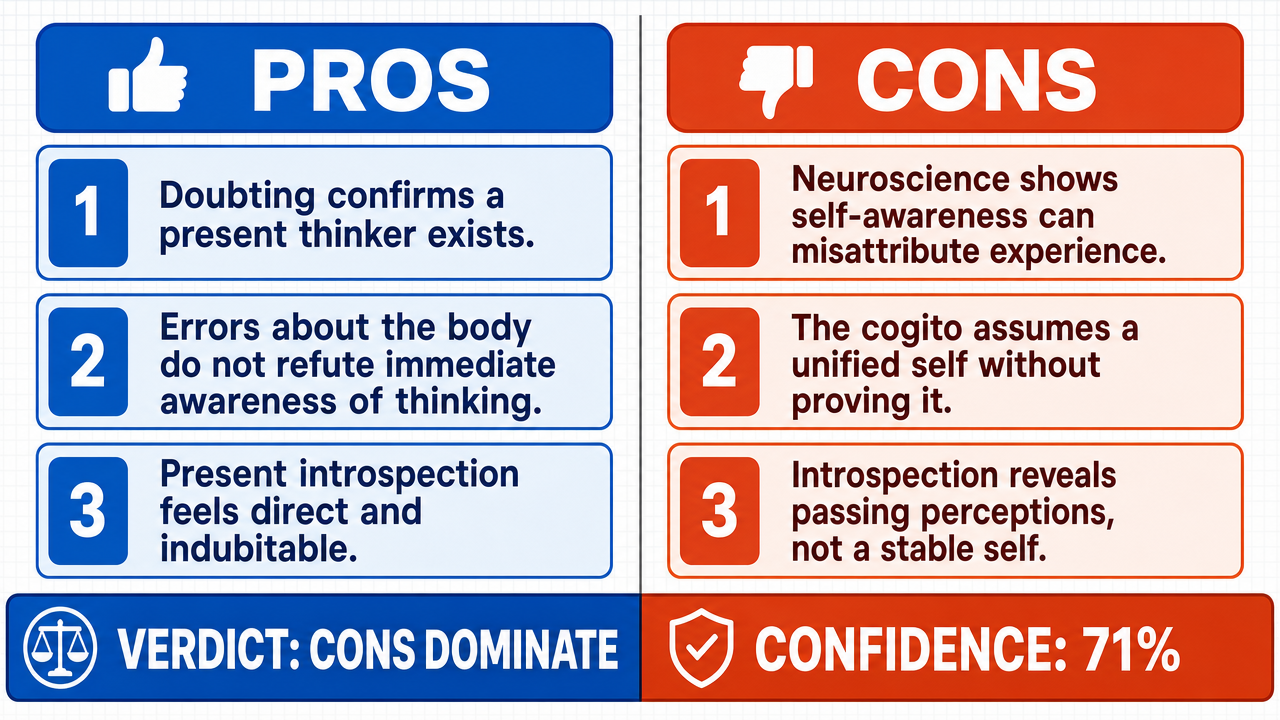
Verdict
Verdict: Mostly FALSE (71%)
Online report: https://solsice.com/public/debates/la-seule-certitude-absolue-qu-une-personne-puisse-avoir-est-208e3a4d1492
This section provides a brief overview of the key arguments. It is not necessary to read the detailed report below.
✅ Key FOR arguments:
- ■The Cartesian argument of the cogito establishes that hyperbolic doubt cannot erode the immediate self-awareness of "I think, therefore I am": the very act of doubting performatively attests to the existence of the thinking subject, which grants immediate self-consciousness an immunity to doubt that no other knowledge possesses (Descartes, Meditations on First Philosophy, 1641).
- ■The objection of anosognosia relies on a categorical confusion: it concerns bodily or representational self-awareness (the cognitive model the brain constructs of the body), not phenomenal self-awareness (the introspective awareness of being a experiencing subject). An anosognosic patient continues to experience a first-person subjective perspective — they see themselves as "I" denying their paralysis.
❌ Key CONTRA arguments:
- ■Cognitive neuroscience shows that immediate self-awareness is subject to massive attribution errors: phenomena of anosognosia , disorders of bodily integration , and depersonalization experiences demonstrate that a subject can have a self-awareness radically disconnected from their biological or psychological reality, undermining any claim to absolute certainty.
- ■The Cartesian argument relies on a petitio principii : it presupposes that the experience of thought necessarily implies the existence of a unified and stable subject, even though radical doubt is supposed to challenge this presupposition. The conclusion therefore cannot justify what it presupposes.
- ■Hume's critique of personal identity demonstrates that introspection never reveals a substantive "self" or a unified self-awareness , but only an incessant flow of changing perceptions (impressions and ideas ): thus, there is no stable subject whose consciousness could constitute an absolute certainty.
💭 Conclusion: False: negation prevails because the opposing arguments have succeeded in undermining the two pillars of the claim. First, Hume's attack on personal identity shows that introspection yields no substantive "self" but a flow of perceptions, contradicting the claim of a unified self-awareness . Second, neuroscientific data on anosognosia and disorders of bodily integration establish that self-awareness is empirically fallible and constructed, not indubitable. Third, refuting the petitio principii of the cogito shows that the Cartesian argument presupposes exactly what it seeks to prove: the existence of a stable subject. Fourth, the distinction proposed by the statement between phenomenal consciousness and representational consciousness does not suffice to save absoluteness, as the former structurally relies on the same cognitive mechanisms as the latter. Finally, the judge's confidence at 71% reflects a clear rejection but not unanimity, leaving reasonable room for the partial persistence of the cogito as quasi-certainty rather than as absolute certainty.
🔬 Verdict: Mostly FALSE ❌ (71%)
Claim: The only absolute certainty a person can have is self-awareness in the present moment.
Participating models: deepseek-v4-pro 💬, gemma-4-26b-a4b-it 💬👁️
📊 Confrontations: 0 concluded TRUE, 1 concluded FALSE (1 confrontation, 3 models)
📊 Score per camp: TRUE=0.00, FALSE=0.71
🏅 Model score evolution:
minimax-m3 💬👁️: +7
✅ FOR arguments:
- ■The Cartesian argument of the cogito establishes that hyperbolic doubt cannot erode the perception of "I think, therefore I am": the very act of doubting performatively attests to the existence of the thinking subject, which grants immediate self-awareness an immunity to doubt that no other knowledge possesses (Descartes, Meditations on First Philosophy, 1641). deepseek-v4-pro 💬
- ■The objection of anosognosia relies on a categorical confusion: it concerns bodily or representational self-awareness (the cognitive model the brain constructs of the body), not phenomenal self-awareness (the introspective awareness of being a experiencing subject). An anosognosic patient continues to experience a first-person subjective perspective — they see themselves as "I" denying their paralysis. deepseek-v4-pro 💬
❌ Arguments AGAINST:
- ■Cognitive neuroscience shows that immediate self-awareness is subject to massive attribution errors: phenomena of anosognosia, disorders of bodily integration , and depersonalization experiences demonstrate that a subject can have a self-awareness radically disconnected from their biological or psychological reality, undermining any claim to absolute certainty. gemma-4-26b-a4b-it 💬👁️
- ■The Cartesian argument relies on a petitio principii : it presupposes that the experience of thought necessarily implies the existence of a unified and stable subject, even though radical doubt is supposed to challenge this presupposition. The conclusion cannot therefore justify what it presupposes. gemma-4-26b-a4b-it 💬👁️
- ■Hume's critique of personal identity demonstrates that introspection never reveals a substantive "self" or a unified self-awareness , but only an incessant flow of changing perceptions (impressions and ideas ): thus, there is no stable subject whose consciousness could constitute an absolute certainty. gemma-4-26b-a4b-it 💬👁️
💭 Reasoning: False: negation wins because the opposing arguments have succeeded in undermining the two pillars of the claim. First, Hume's attack on personal identity demonstrates that introspection yields no substantive "self" but a flow of perceptions, contradicting the claim of a unified self-awareness. Second, neuroscientific data on anosognosia and disorders of bodily integration establish that self-awareness is empirically fallible and constructed, not indubitable. Third, refuting the petitio principii of the cogito shows that the Cartesian argument presupposes exactly what it seeks to prove: the existence of a stable subject. Fourth, the distinction proposed by the statement between phenomenal consciousness and representational consciousness does not suffice to save absoluteness, as the former structurally relies on the same cognitive mechanisms as the latter. Finally, the judge's confidence at 71% reflects a clear rejection but not unanimity, leaving reasonable room for the partial persistence of the cogito as quasi-certainty rather than as absolute certainty.
📋 Facts IN FAVOR:
• Descartes, in the Second Meditation (1641), formulates the cogito as the first indubitable certainty: the act of doubting performatively proves the existence of the doubting subject.
• The cogito possesses a property of performative self-verification: awareness of the act of thinking is contained within the act itself, without external inference.
📋 FACTS AGAINST:
• Cognitive neuroscience documents anosognosia, a disorder where a patient denies paralysis or a bodily deficit despite clinical evidence, demonstrating the fallibility of self-awareness.
• David Hume, in A Treatise of Human Nature (1739), argues that introspection only reveals a bundle of changing perceptions, without a substantive underlying "self."
• The argument of the cogito commits a petitio principii by presupposing a unified and stable subject as a condition for the experience of thought, whereas this subject is precisely what it claims to demonstrate.
| Confrontation | TRUE Model | FALSE Model | Mean μ TRUE | Mean μ FALSE | TRUE Tokens | FALSE Tokens | Winner | Verdict | Conf. |
|---|---|---|---|---|---|---|---|---|---|
| #1 | deepseek-v4-pro 💬 | gemma-4-26b-a4b-it 💬👁️ | 0.662 | 0.569 | 6 | 2 | TRUE | FALSE | 71% |
The following technical terms, abbreviations, and specialized concepts are used in this transcript. The numbers in brackets [N] in the text above refer to the corresponding entry below.
[1] anosognosia — Lack of recognition or denial by a patient of a neurological deficit (e.g., paralysis), traditionally studied following brain lesions.
[2] aperception — Philosophical term referring to reflexive awareness of a perception or the activity by which a subject reports a representation to itself.
[3] awareness — English term used in the text to designate the immediate, direct, and non-inferential consciousness a subject has of a lived state.
[4] self-consciousness — The capacity of a subject to take itself as an object of its own knowledge, i.e., to recognize itself as an experiencing subject.
[5] phenomenal self-consciousness — The qualitative and pre-reflective dimension of being a subject, opposed in the debate to bodily or representational self-consciousness.
[6] hyperbolic doubt — Form of radical doubt introduced by Descartes in the Meditations, extended to the hypothesis of the malicious demon.
[7] transcendental ego — Pure subject of consciousness as conceived by Husserl after the epoché, which constitutes meaning and objects; the debate contests the indubitable scope attributed to it.
[8] errors of self-attribution — Cognitive biases whereby a subject erroneously attributes mental states, intentions, or actions to itself.
[9] personal identity — Classic philosophical problem, notably addressed by Hume, concerning what makes a person remain the same over time.
[10] illusions of consciousness — Cases, discussed by cognitive neuroscience, where the brain produces a self-awareness disconnected from the biological or psychological reality of the subject.
[11] immunity to error through misidentification — Property, debated in philosophy of mind, whereby certain self-attributions would not allow for error regarding the identity of the subject.
[12] impressions and ideas — Humean distinction between impressions, vivid and present perceptions, and ideas, weaker copies of impressions in memory or imagination.
[13] introspection — Examination by a subject of its own thoughts or mental states, often opposed to external observation.
[14] malicious demon — Cartesian hypothesis of a supreme being capable of deceiving us about everything, used to push methodological doubt to its maximum.
[15] cognitive neuroscience — Discipline studying the neural correlates of cognitive functions, cited here to support the idea of illusions of consciousness.
[16] transcendental phenomenology — Husserlian philosophical method aiming to describe the structures of constitutive consciousness from the first-person perspective.
[17] presence to oneself — The intrinsically first-personal character of all conscious experience, indicating that it is lived "for the subject."
[18] petitio principii — Fallacy of assuming in the premises what one seeks to demonstrate in the conclusion.
[19] apodictic residue — In Husserl, what remains after the epoché as content of certainty: the transcendental ego and its cogitations.
[20] body schema — Sensorimotor representation constructed by the brain of the body, underpinning posture and movement.
[21] disorders of bodily integration — Neurological conditions disrupting the integration of the body proper (somatoparaphrenia, hemineglect, etc.), invoked as counterexamples to infallible self-awareness.
[22] epoché — Husserlian suspension of any thesis about the existence of the external world, a step in phenomenological reduction.
Face-off transcripts
- ■
Ownership & Trade Secrets. Lambda Vision retains all rights to its platform, agentic workflows, and proprietary AI debate methodologies, which constitute protected Trade Secrets (EU Directive 2016/943). Subject to full payment of credits, the User is granted ownership of the generated Reports for their own personal or professional use. Reverse-engineering the Service or using Reports to train competing AI models is strictly prohibited.
- ■
No Professional Advice. Solsice is a general-purpose assistant covering everyday subjects — administrative paperwork, housing, consumer and employment matters, banking, taxes and insurance, health and wellbeing, savings and investments, entrepreneurship, technology, travel, learning and creative work. Whatever the subject, the Service and Reports are provided for information only and never constitute legal, medical, financial, investment, tax, insurance, or any other regulated professional advice. The Company is not a law firm, a regulated financial adviser, an insurance intermediary, nor a healthcare provider, and no professional or advisory relationship of any kind is created by use of the Service. Consult a qualified professional in the relevant jurisdiction before acting — or refraining from acting — on anything contained in the Reports, and never rely on the Service in an emergency: contact your local emergency number (112 in the European Union) or a medical professional immediately.
- ■
AI-Generated Content, Sources and Viewpoints. Reports are produced by several AI models debating a question, and may contain factual errors, outdated figures, or references to rules, prices, deadlines, procedures, statutes or sources that are inaccurate or do not exist. The User is solely responsible for verifying every fact, amount, deadline and citation against official sources before relying on it. Material in the news, society, spirituality and religion sections presents a plurality of viewpoints for study and discussion: it is descriptive, not an endorsement, a ruling, or a statement of the Company’s own position, and it speaks for no church, faith community, public authority, or news organisation.
- ■
Liability & Governing Law. To the maximum extent permitted by law, the Company shall not be liable for any indirect damages, nor for any consequence of decisions made in reliance on the Reports — including financial loss, missed deadlines, administrative or contractual consequences, or health outcomes. These Terms are governed by French law. Any disputes shall be subject to the exclusive jurisdiction of the Courts of Paris, France.