
La richesse, telle qu'elle est conçue en 2026, est incompatible avec la préservation de la planète.
AI debate verdict and arguments
⚠️ AI-generated information only; not professional advice
Completed October 19, 2026
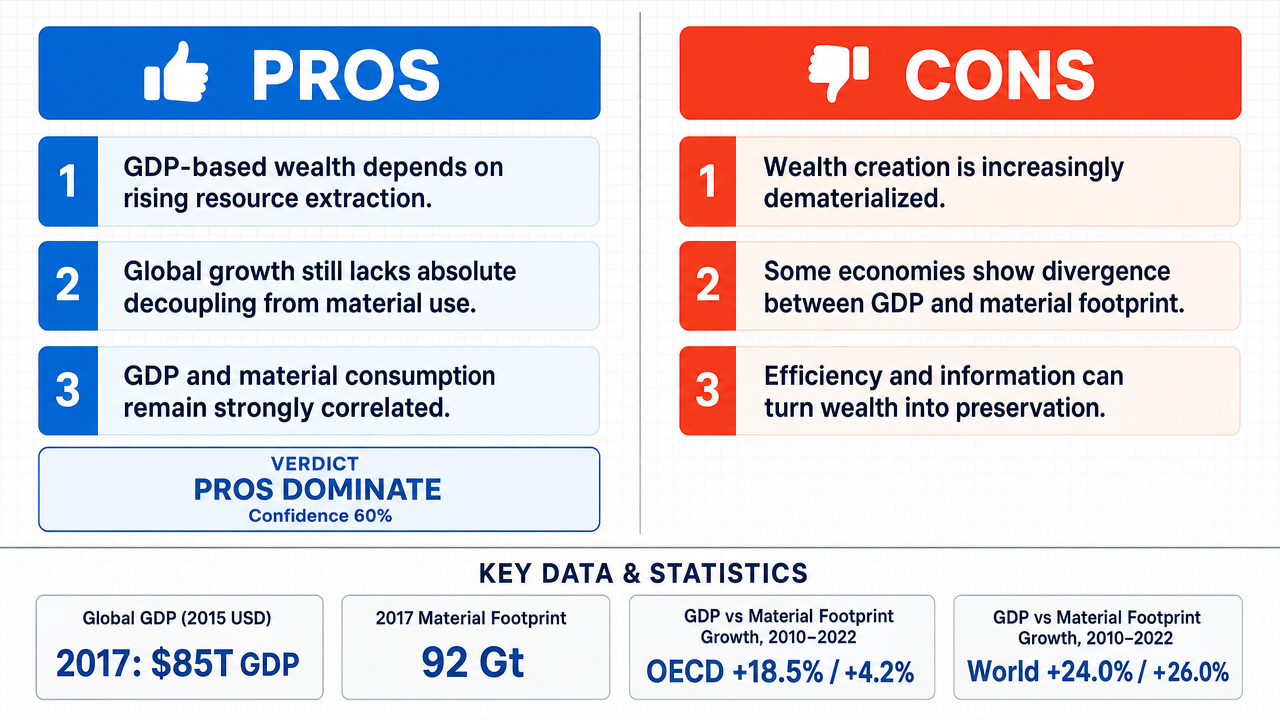
Verdict
Verdict: rather TRUE (60%)
Online report: https://solsice.com/public/debates/la-richesse-telle-qu-elle-est-concue-en-2026-est-incompatibl-69ba66fb7604
This section provides a brief overview of the key arguments. It is not necessary to read the detailed report below.
✅ Key FOR arguments:
- ■The current conception of wealth, measured by GDP growth , is intrinsically linked to an ever-increasing extraction of natural resources. According to the UNEP Global Resources Outlook 2024 report , global material extraction has tripled since 1970, rising from about 30 Gt to 92 Gt in 2017, and is expected to increase by another 60% by 2060 if current trends continue, demonstrating a structural overshoot of planetary boundaries .
- ■The opposing objection that the thesis of structural incompatibility is a petitio principii contradicts itself: if incompatibility were a tautology , it would be true by definition and could not be modified by any contingent fact, so the market's capacity for adaptation could neither confirm nor refute it.
- ■The high correlation (0.9) between GDP and material consumption, as well as the absence of absolute decoupling at the global scale, demonstrate that economic growth continues to be accompanied by increasing material pressure on ecosystems, making planetary preservation incompatible with the current wealth model.
❌ Key AGAINST arguments:
- ■The opposing argument relies on a fundamental confusion between resource extraction and value creation. Modern wealth is gradually dematerializing, and environmental innovation depends precisely on economic growth to finance clean technologies and sustainable solutions.
- ■The claim that no absolute decoupling is observed at the global level rests on an incomplete reading: there is a structural divergence in material intensity per unit of GDP , and the data on relative decoupling , although insufficient, contradict the fatality of the past correlation between GDP and material extraction.
- ■The market's capacity for adaptation, notably through efficiency and information management, allows transforming wealth into a lever for environmental preservation rather than a destructive force, making the incompatibility non-structural but contingent.
💭 Conclusion: True: the verdict of TRUE prevails with a weighted confidence of 60%, as the deepseek-v4-pro model convinced the judge that wealth conceived in 2026, measured by GDP growth , remains structurally incompatible with planetary preservation . The strongest argument from the winning side relies on UNEP data showing a tripling of global material extraction since 1970 and the near parallelism between GDP growth (+73%) and material footprint (+70%) between 2000 and 2017, which indicates a breach of planetary boundaries . The losing side (gemma-4-26b-a4b-it) attempted to distinguish value creation from material extraction, as well as invoke a relative decoupling , but failed to refute the close correlation between economic growth and material pressure. The moderate confidence (60%) reflects that the debate only involved a single confrontation and that the issue remains complex, some aspects of wealth dematerialization not being fully refuted. The conclusion thus relies on the strongest arguments from the affirmative side regarding the structural incompatibility between material accumulation and ecological preservation.
🔬 Verdict: mostly TRUE ✅ (60%)
Claim: Wealth, as conceived in 2026, is incompatible with planetary preservation.
Participating models: deepseek-v4-pro 💬, gemma-4-26b-a4b-it 💬👁️
📊 Confrontations: 1 concluded TRUE, 0 concluded FALSE (1 confrontation, 3 models)
📊 Score by side: TRUE=0.60, FALSE=0.00
🏅 Model score evolution:
minimax-m3 💬👁️: +6
✅ Arguments FOR:
- ■The current conception of wealth, measured by GDP growth , is intrinsically linked to a continually increasing extraction of natural resources. According to the UNEP Global Resources Outlook 2024 report , global material extraction has tripled since 1970, rising from about 30 Gt to 92 Gt in 2017, and is expected to increase by another 60% by 2060 if current trends continue, demonstrating a structural overshoot of planetary boundaries . deepseek-v4-pro 💬
- ■The counter-argument that the thesis of structural incompatibility is a petitio principii contradicts itself: if incompatibility were a tautology , it would be true by definition and could not be altered by any contingent fact, so market adaptability would neither confirm nor refute it. deepseek-v4-pro 💬
- ■The high correlation (0.9) between GDP and material consumption, as well as the absence of absolute decoupling at the global scale, demonstrate that economic growth continues to be accompanied by increasing material pressure on ecosystems, making planetary preservation incompatible with the current wealth model. deepseek-v4-pro 💬
❌ Arguments AGAINST:
- ■The counter-argument relies on a fundamental confusion between resource extraction and value creation. Modern wealth is gradually dematerializing, and environmental innovation depends precisely on economic growth to finance clean technologies and sustainable solutions. gemma-4-26b-a4b-it 💬👁️
- ■The claim that no absolute decoupling is observed at the global level is based on an incomplete reading: there is a structural divergence in material intensity per unit of GDP, and data on relative decoupling , although insufficient, contradicts the fatality of the past correlation between GDP and material extraction. gemma-4-26b-a4b-it 💬👁️
- ■The market's capacity to adapt, notably through efficiency and information management, allows transforming wealth into a lever for environmental preservation rather than a destructive force, making the incompatibility non-structural but contingent. gemma-4-26b-a4b-it 💬👁️
💭 Reasoning: True: the TRUE verdict prevails with a weighted confidence of 60%, with the deepseek-v4-pro model convincing the judge that the wealth conceived in 2026, measured by GDP growth, remains structurally incompatible with planetary preservation. The strongest argument from the winning side is based on UNEP data showing a tripling of global material extraction since 1970 and the near-parallelism between GDP growth (+73%) and material footprint (+70%) between 2000 and 2017, indicating a breach of planetary boundaries. The losing side (gemma-4-26b-a4b-it) attempted to distinguish value creation from material extraction, as well as invoke relative decoupling, but failed to refute the close correlation between economic growth and material pressure. The moderate confidence (60%) reflects that the debate involved only one confrontation and that the question remains complex, with some aspects of wealth dematerialization not fully refuted. The conclusion thus relies on the strongest arguments from the affirmative side regarding the structural incompatibility between material accumulation and ecological preservation.
📋 Facts FOR:
• Global material extraction has tripled since 1970, reaching 92 Gt in 2017, according to the UNEP Global Resources Outlook 2024 report.
• No absolute decoupling between economic growth and resource consumption has been observed at the global level.
📋 Facts AGAINST:
• Modern wealth tends to dematerialize, with material intensity per unit of GDP decreasing in several advanced economies.
• Relative decoupling between added value and resource consumption is documented in some regions, although insufficient at the global scale.
• Economic growth funds environmental innovation and the development of clean technologies.
| Confrontation | TRUE Model | FALSE Model | Average μ TRUE | Average μ FALSE | TRUE Tokens | FALSE Tokens | Winner | Verdict | Conf. |
|---|---|---|---|---|---|---|---|---|---|
| #1 | deepseek-v4-pro 💬 | gemma-4-26b-a4b-it 💬👁️ | 0.572 | 0.281 | 6 | 2 | TRUE | TRUE | 60% |
The following technical terms, abbreviations, and specialized concepts are used in this transcript. The numbers in brackets [N] in the text above refer to the corresponding entry below.
[1] Material accumulation — Process of increasing stocks of physical goods and material resources in an economy, often associated with GDP growth.
[2] Anomaly — In statistics and econometrics, an observation or result that significantly deviates from the expected behavior of a theoretical model.
[3] Cointegration — Econometric concept indicating the existence of a long-term statistical relationship between two non-stationary time series.
[4] Correlation — Statistical measure of the degree of linear association between two variables, expressed by a coefficient between -1 and +1.
[5] Economic growth — Sustained increase in the production of goods and services of an economy, usually measured by real GDP, over a long period.
[6] Decoupling — Separation between economic growth and natural resource consumption or polluting emissions.
[7] Absolute decoupling — Absolute reduction in resource consumption or environmental emissions, despite continued economic growth.
[8] Relative decoupling — Decrease in the ratio of resource consumption to GDP, without necessarily leading to an absolute decrease in resources used.
[9] Dematerialization — Process of reducing the amount of raw materials mobilized per unit of economic value produced, linked to the shift towards a service and information economy.
[10] Material footprint — Total quantity of raw materials extracted (biotic and abiotic) to meet the final consumption of an economy or country.
[11] IPCC — Intergovernmental Panel on Climate Change — International scientific body created in 1988 that assesses knowledge on climate change and publishes periodic assessment reports.
[12] Gt — Gigatonne — Unit of mass equivalent to a billion tonnes, used to quantify global flows of extracted materials or emissions.
[13] Material intensity — Quantity of raw materials consumed per unit of GDP, an indicator of an economy's efficiency in resource use.
[14] Planetary boundaries — Critical thresholds of biogeochemical and ecological processes whose crossing threatens the stability of the Earth system, a concept introduced in scientific literature on sustainability.
[15] OECD — Organisation for Economic Co-operation and Development — International organization comprising countries committed to democracy and market economy, which produces comparative data on advanced economies.
[16] GDP — Gross Domestic Product — Accounting measure of the total monetary value of final goods and services produced in a country over a given period.
[17] UNEP — United Nations Environment Programme — United Nations agency coordinating international environmental actions and publishing reports on the state of global resources.
[18] Intellectual property — Set of legal rights (patents, trademarks, copyrights) protecting creations of the mind and innovations.
[19] Proxy — Substitute variable used to represent a difficult-to-measure concept directly, here used to equate GDP with the physical mass of resources.
[20] Planetary preservation — Maintenance of the integrity of Earth's major ecological and biogeochemical systems at a global scale.
[21] Petition of principle — Circular reasoning in which the conclusion is presupposed in the premises, rendering the argument logically empty.
[22] Tautology — Logical proposition true by definition, whose truth does not depend on any empirical verification.
[23] Interpretive theory — Analytical approach seeking to understand the meaning of phenomena rather than explaining them through general laws and verifiable causal relations.
[24] Value added — Difference between the value of an economic agent's production and the value of intermediate consumptions used to produce it.
The following financial data tables were cited during the debate exchanges:
| Year | GDP (Billion USD 2015) | Material Footprint (Gt) | GDP Growth vs 2000 (%) | Material Growth vs 2000 (%) |
|---|---|---|---|---|
| 2000 | 49,000 | 54 | - | - |
| 2017 | 85,000 | 92 | +73% | +70% |
Legend: Global GDP in constant 2015 dollars (source: World Bank) and global material footprint in gigatons (source: UNEP, International Resource Panel). Percentages indicate the cumulative growth between 2000 and 2017.
| Sector | Carbon Intensity (gCO2/USD) | Material Intensity (kg/USD) | Evolution 2015-2025 |
|---|---|---|---|
| Digital Services | 0.02 | 0.05 | -40% |
| Renewable Energies | 12.0 | 45.0 | -25% |
| Manufacturing Industry | 450.0 | 1200.0 | -15% |
Legend: Carbon and material intensity per unit of wealth produced. The values are indicative estimates to illustrate the dematerialization trend. The evolution represents the reduction in intensity over the decade.
| Region | GDP Growth (2010-2022) | Material Footprint Growth (2010-2022) | Material Intensity (Δ %) |
|---|---|---|---|
| OECD (Average) | +18.5% | +4.2% | -12.8% |
| Emerging Markets | +35.0% | +38.0% | +2.1% |
| World (Global) | +24.0% | +26.0% | +1.5% |
Legend: Comparison between GDP growth and material footprint growth. Material intensity represents the variation in resource consumption per unit of GDP. The data are indicative aggregates based on OECD and World Bank trends.
Face-off transcripts
- ■
Ownership & Trade Secrets. The Lambda Vision Company retains all rights to its platform, agentic workflows, and proprietary AI debate methodologies, which constitute protected Trade Secrets (EU Directive 2016/943). Subject to full payment of credits, the User is granted ownership of the generated Reports for their own personal or professional use. Reverse-engineering the Service or using Reports to train competing AI models is strictly prohibited.
- ■
No Professional Advice. Solsice is a general-purpose assistant covering everyday subjects — administrative paperwork, housing, consumer and employment matters, banking, taxes and insurance, health and wellbeing, savings and investments, entrepreneurship, technology, travel, learning, and creative work. Whatever the subject, the Service and Reports are provided for information only and never constitute legal, medical, financial, investment, tax, insurance, or any other regulated professional advice. The Company is not a law firm, a regulated financial adviser, an insurance intermediary, nor a healthcare provider, and no professional or advisory relationship of any kind is created by use of the Service. Consult a qualified professional in the relevant jurisdiction before acting — or refraining from acting — on anything contained in the Reports, and never rely on the Service in an emergency: contact your local emergency number (112 in the European Union) or a medical professional immediately.
- ■
AI-Generated Content, Sources and Viewpoints. Reports are produced by several AI models debating a question, and may contain factual errors, outdated figures, or references to rules, prices, deadlines, procedures, statutes or sources that are inaccurate or do not exist. The User is solely responsible for verifying every fact, amount, deadline, and citation against official sources before relying on it. Material in the news, society, spirituality, and religion sections presents a plurality of viewpoints for study and discussion: it is descriptive, not an endorsement, a ruling, or a statement of the Company’s own position, and it speaks for no church, faith community, public authority, or news organization.
- ■
Liability & Governing Law. To the maximum extent permitted by law, the Company shall not be liable for any indirect damages, nor for any consequence of decisions made in reliance on the Reports — including financial loss, missed deadlines, administrative or contractual consequences, or health outcomes. These Terms are governed by French law. Any disputes shall be subject to the exclusive jurisdiction of the Courts of Paris, France.