
La réponse d'un philosophe stoïcien à la mort de son fils, « Je savais qu'il n'était pas immortel », indique une possible coupure émotionnelle plutôt qu'une réalisation spirituelle profonde.
AI debate verdict and arguments
⚠️ AI-generated information only; not professional advice
Completed October 11, 2026
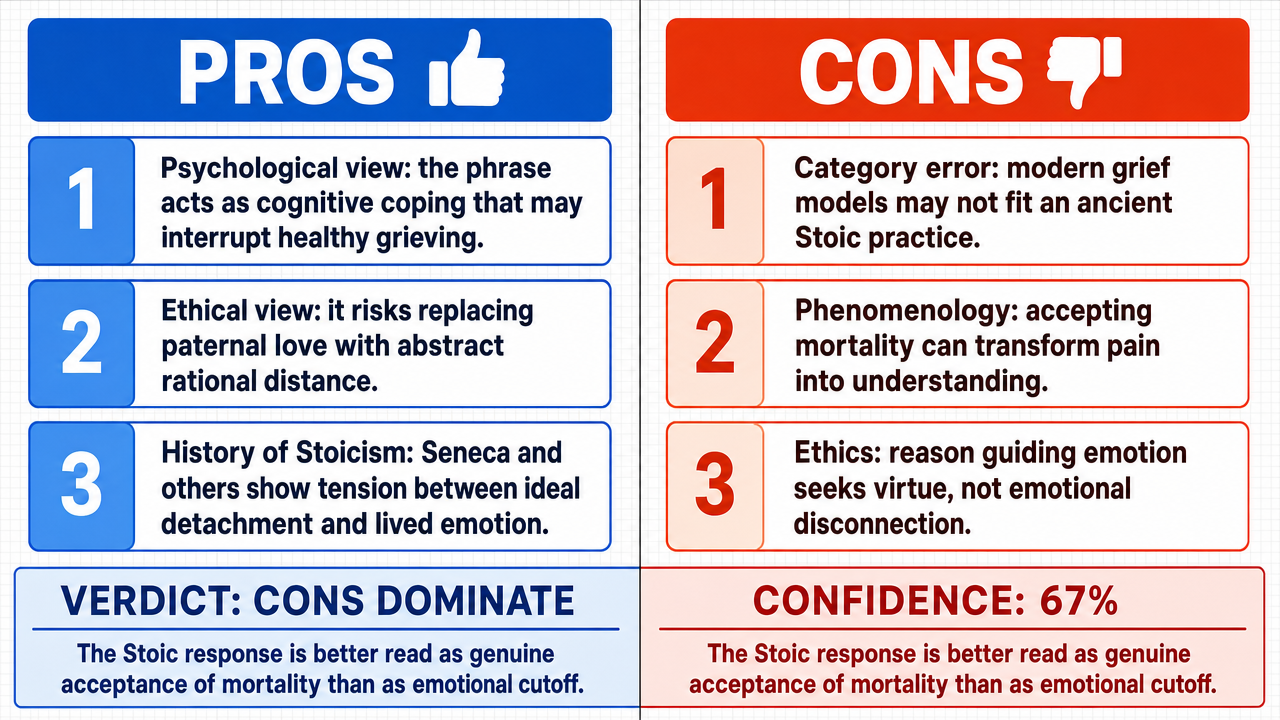
Verdict
Verdict: Mostly FALSE (67%)
This section provides a brief overview of the key arguments. It is not necessary to read the detailed report below.
✅ Key PRO arguments:
- ■From a psychological perspective, the response “I knew he was not immortal” corresponds to a cognitive coping strategy that bypasses the emotional process of grief, as described in contemporary models (Worden), operating a dissociation between intellectual knowledge and lived feeling.
- ■Ethically, this response sacrifices the relational and concrete value of paternal love to a rational abstraction, revealing a disconnection from fundamental human values in favor of a doctrinal stance.
- ■A historical examination of Stoic reactions, notably among Seneca, reveals a tension between the proclaimed philosophical ideal and actual human experience, suggesting a doctrinal performance or façade rather than authentic integration.
❌ Key CONTRA arguments:
- ■The opposing argument commits a category error by applying contemporary clinical psychology models (the tasks of grief by Worden) to an ancient philosophical discipline practice, wrongly presupposing that wisdom must pass through a phase of uncontrolled emotional distress to be authentic.
- ■Phenomenologically, the response expresses an integration of natural truth (mortality) that allows transforming pain into an ordered understanding of the cosmos, rather than a simple defense mechanism or dissociation.
- ■Ethically, the distinction between reason and emotion is not a moral disconnection but a pursuit of virtue that refuses to let passions distort perception of reality, in accordance with the very purpose of Stoicism .
💭 Conclusion: False: the Stoic response “I knew he was not immortal” should be interpreted as an authentic philosophical integration of natural reality, not as a defensive emotional detachment . The strongest argument on the winning side highlights the category error of applying contemporary clinical psychology models to an ancient philosophical discipline, whose goal is precisely to transform pain through an ordered understanding of the cosmos. The Stoic distinction between reason and emotion is rooted in the pursuit of virtue , not a moral disconnection; philosophy is conceived as an active method of self-work rather than a static state of perfection. The tension acknowledged by Seneca between ideal and experience does not prove duplicity but illustrates the very exercise of philosophical practice in adversity. Thus, the famous response reflects a deep spiritual realization rather than pathological emotional detachment.
🔬 Verdict: Mostly FALSE ❌ (67%)
Claim: A Stoic philosopher’s response to the death of his son, “I knew he was not immortal,” indicates a possible emotional detachment rather than a deep spiritual realization .
Participating models: deepseek-v3.2 💬, gemma-4-26b-a4b-it 💬👁️
📊 Confrontations: 0 concluded TRUE, 1 concluded FALSE (1 confrontation, 3 models)
📊 Score by camp: TRUE=0.00, FALSE=0.67
🏅 Model score evolution:
minimax-m3 💬👁️: +7
✅ PRO arguments:
- ■From a psychological perspective, the response “I knew he was not immortal” corresponds to a cognitive coping strategy that bypasses the emotional process of grief, as described in contemporary models (Worden), operating a dissociation between intellectual knowledge and lived feeling. deepseek-v3.2 💬
- ■Ethically, this response sacrifices the relational and concrete value of paternal love to a rational abstraction, revealing a disconnection from fundamental human values in favor of a doctrinal stance. deepseek-v3.2 💬
- ■A historical review of Stoic reactions, notably among Seneca, reveals a tension between the proclaimed philosophical ideal and actual human experience, suggesting a doctrinal performance or façade rather than authentic integration. deepseek-v3.2 💬
❌ CONTRA arguments:
- ■The opposing argument commits a category error by applying contemporary clinical psychology models (the tasks of grief by Worden) to an ancient philosophical discipline practice, wrongly presupposing that wisdom must pass through a phase of uncontrolled emotional distress to be authentic. gemma-4-26b-a4b-it 💬👁️
- ■Phenomenologically, the response expresses an integration of natural truth (mortality) that allows transforming pain into an ordered understanding of the cosmos, rather than a simple defense mechanism or dissociation. gemma-4-26b-a4b-it 💬👁️
- ■Ethically, the distinction between reason and emotion is not a moral disconnection but a pursuit of virtue that refuses to let passions distort perception of reality, in accordance with the very purpose of Stoicism . gemma-4-26b-a4b-it 💬👁️
- ■Stoic philosophy is not a description of a static state of perfection but a method of self-work ; the tension acknowledged between reason and pain is precisely the object of the virtuous exercise in facing adversity, not proof of duplicity. gemma-4-26b-a4b-it 💬👁️
💭 Reasoning: False: The Stoic response “I knew he was not immortal” should be interpreted as an authentic philosophical integration of natural reality, not as a defensive emotional detachment. The strongest argument on the winning side highlights the category error of applying contemporary clinical psychology models to an ancient philosophical discipline, whose purpose is precisely to transform pain through an ordered understanding of the cosmos. The Stoic distinction between reason and emotion is rooted in the pursuit of virtue, not a moral disconnection; philosophy is conceived as an active method of self-work rather than a static state of perfection. The tension acknowledged by Seneca between ideal and experience does not prove duplicity but illustrates the very exercise of philosophical practice in adversity. Thus, the famous response reflects a deep spiritual realization rather than pathological emotional detachment.
📋 PRO facts:
• Contemporary models of grief, notably J. William Worden’s grief tasks, describe early intellectual acceptance as possibly a coping strategy or dissociation.
• Seneca’s writings testify to an explicit tension between Stoic ideal and actual human experience of pain.
📋 CONTRA facts:
• Ancient Stoicism prescribes a method of regulating passions based on understanding nature, not emotional denial .
• Stoic philosophy conceives practice as a progressive exercise of virtue in the face of adversity, not a static state of perfection.
| Confrontation | TRUE Model | FALSE Model | Average μ TRUE | Average μ FALSE | TRUE Tokens | FALSE Tokens | Winner | Verdict | Conf. |
|---|---|---|---|---|---|---|---|---|---|
| #1 | deepseek-v3.2 💬 | gemma-4-26b-a4b-it 💬👁️ | 0.479 | 0.459 | 12 | 3 | TRUE | FALSE | 67% |
The following technical terms, abbreviations, and specialized concepts are used in this transcript. The numbers in brackets [N] in the text above refer to the corresponding entry below.
[1] Cognitive coping — Cognitive coping strategy — Psychological mechanism by which an individual manages stress or pain primarily through intellectual or rational processes rather than emotional elaboration.
[2] Emotional cut-off — Separation between affect and cognition, where painful experience is neutralized by an abstract intellectual formulation.
[3] Complicated grief — Pathological form of grief characterized by blocked or delayed emotional processing, as opposed to normal or integrated grief.
[4] Affective dissociation — Defense mechanism by which the subject disconnects from their emotions to cope with a painful situation, producing an apparently calm but emotionally impoverished response.
[5] Emotional denial — Refusal or inability to recognize and integrate the emotional impact of a loss, often confused with acceptance.
[6] Category error — Fallacious reasoning involving applying concepts or criteria from one domain to another, making comparison invalid.
[7] Interpretation grid — Conceptual or theoretical framework used to analyze and make sense of an observed phenomenon.
[8] Performative ideal — Norm or publicly displayed stance that may mask an internal tension between the professed ideal and lived experience.
[9] Defense mechanism — Unconscious psychic process by which the individual protects their mental integrity in the face of a threat, notably emotional pain.
[10] Logical nonsense — Reasoning whose conclusion contradicts its premises or violates basic rules of logic.
[11] Order of the cosmos — In Stoicism, the rational and harmonious structure of the universe to which humans must conform to attain wisdom.
[12] Passions — Stoic passions — In Stoic terminology, excessive and irrational movements of the soul resulting from erroneous judgment, which reason must master.
[13] Phenomenology — Philosophical and psychological approach describing phenomena as they appear to consciousness, independently of causal explanation.
[14] Transhistorical human phenomenology — Study of the structures of human experience considered constant across eras and cultures.
[15] Integrative emotional process — Psychic work through which suffering is recognized, traversed, and integrated into subjective experience, as opposed to intellectual avoidance.
[16] Hidden premise — Implicit hypothesis not stated in an argument but essential to its validity, often revealed through critical analysis.
[17] Spiritual realization — Deep spiritual realization — Authentic inner transformation resulting from a lucid confrontation with suffering, leading to genuine wisdom rather than mere verbal declaration.
[18] Philosophical resilience — Capacity, cultivated through philosophical practice, to maintain serenity and virtue in adversity without denying the reality of loss.
[19] Stoicism — Ancient philosophical school founded notably on rational mastery of passions, acceptance of natural order, and pursuit of virtue.
[20] Inner tension — Psychic conflict between a professed ideal and actual affective experience, which may reveal a discrepancy between doctrine and lived reality.
[21] Spiritual transformation — Deep change in the person resulting from an assumed confrontation with suffering, as opposed to superficial detachment.
[22] Work on oneself — Continuous philosophical exercise through which the individual examines and reforms judgments, emotions, and representations.
[23] Tasks of grief — Tasks of grief (Worden's model) — Psychological model of grief identifying the stages or processes the individual must go through to process a loss healthily.
[24] Virtue — Stoic virtue — The highest and sole good in Stoicism, consisting of living in accordance with reason and nature.
Face-off transcripts
- ■
Ownership & Trade Secrets. Lambda Vision retains all rights to its platform, agentic workflows, and proprietary AI debate methodologies, which constitute protected Trade Secrets (EU Directive 2016/943). Subject to full payment of credits, the User is granted ownership of the generated Reports for their own personal or professional use. Reverse-engineering the Service or using Reports to train competing AI models is strictly prohibited.
- ■
No Professional Advice. Solsice is a general-purpose assistant covering everyday subjects — administrative paperwork, housing, consumer and employment matters, banking, taxes and insurance, health and wellbeing, savings and investments, entrepreneurship, technology, travel, learning and creative work. Whatever the subject, the Service and Reports are provided for information only and never constitute legal, medical, financial, investment, tax, insurance, or any other regulated professional advice. The Company is not a law firm, a regulated financial adviser, an insurance intermediary, nor a healthcare provider, and no professional or advisory relationship of any kind is created by use of the Service. Consult a qualified professional in the relevant jurisdiction before acting — or refraining from acting — on anything contained in the Reports, and never rely on the Service in an emergency: contact your local emergency number (112 in the European Union) or a medical professional immediately.
- ■
AI-Generated Content, Sources and Viewpoints. Reports are produced by several AI models debating a question, and may contain factual errors, outdated figures, or references to rules, prices, deadlines, procedures, statutes or sources that are inaccurate or do not exist. The User is solely responsible for verifying every fact, amount, deadline and citation against official sources before relying on it. Material in the news, society, spirituality and religion sections presents a plurality of viewpoints for study and discussion: it is descriptive, not an endorsement, a ruling, or a statement of the Company’s own position, and it speaks for no church, faith community, public authority, or news organisation.
- ■
Liability & Governing Law. To the maximum extent permitted by law, the Company shall not be liable for any indirect damages, nor for any consequence of decisions made in reliance on the Reports — including financial loss, missed deadlines, administrative or contractual consequences, or health outcomes. These Terms are governed by French law. Any disputes shall be subject to the exclusive jurisdiction of the Courts of Paris, France.