
La réintroduction des peines de prison courtes en France en 2026 est une solution efficace pour briser les trajectoires de délinquance naissante et améliorer la récidive, contrairement aux aménagements de peine actuels.
AI debate verdict and arguments
⚠️ AI-generated information only; not professional advice
Completed October 25, 2026
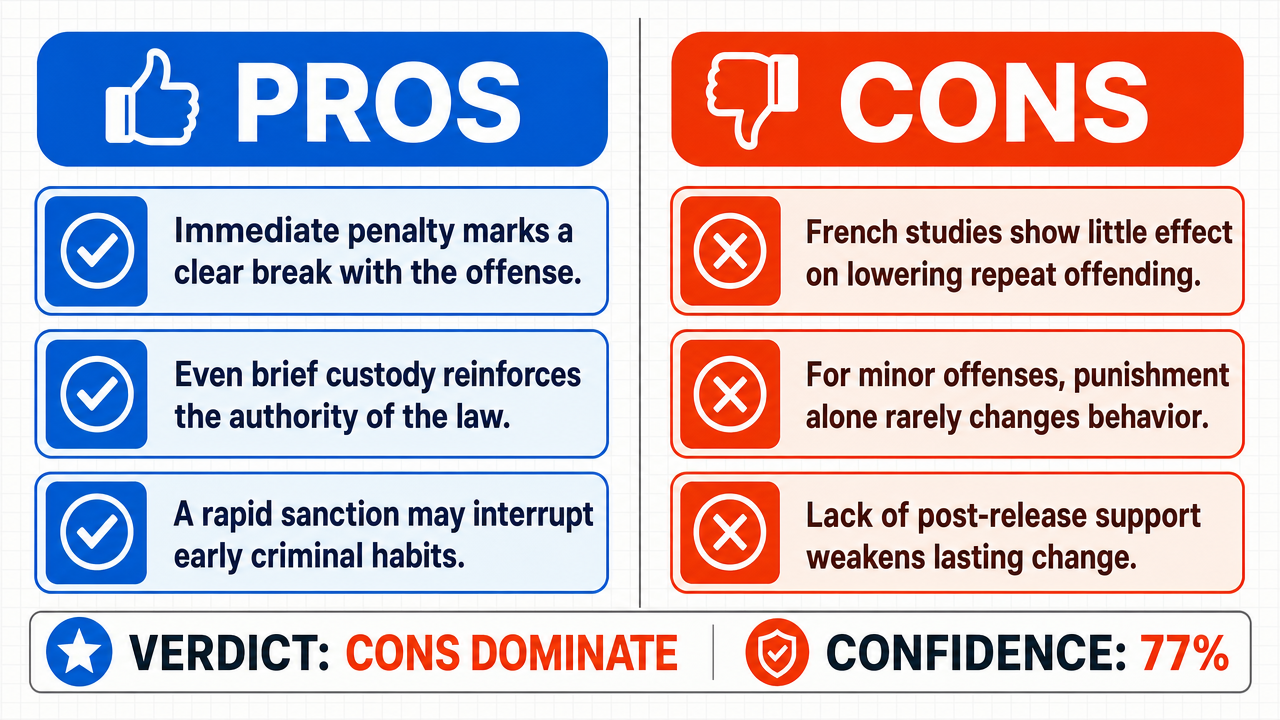
Verdict
Verdict: Mostly FALSE (77%)
Online report: https://solsice.com/public/debates/la-reintroduction-des-peines-de-prison-courtes-en-france-en-57810d9132d4
This section provides a brief overview of the key arguments. It is not necessary to read the detailed report below.
✅ Key PRO arguments:
- ■Short prison sentences establish an immediate and symbolic penal response , essential to mark the break with impulsive acts during initial offenses, where sentence adjustments can be perceived as a lack of sanction.
- ■Deprivation of liberty , even brief, reaffirms the authority of the law and the reality of legal consequences, which sentence adjustments fail to produce among first-time offenders.
- ■This quick response allows for interrupting the normalization process of delinquency before it becomes rooted in a criminal lifestyle, playing a preventive role in emerging trajectories.
❌ Key CON arguments:
- ■French empirical studies show that short prison sentences have limited impact on recidivism reduction, as their duration does not allow for effective reintegration programs .
- ■The National Delinquency and Penal Responses Observatory (ONDRP ) demonstrated that for low-severity offenses , penal sanctions alone are rarely decisive in changing behavior.
- ■Lack of post-incarceration follow-up hampers behavior change, contradicting the idea that short prison terms act as a true rupture signal to break a delinquent trajectory.
💭 Conclusion: False: the FALSE verdict prevails with 77% confidence, because empirical arguments presented by the negative side, notably ONDRP data , demonstrate that short prison sentences do not improve recidivism rates for low-severity offenses . The brevity of incarceration prevents the implementation of effective reintegration programs and exposes first-time offenders to prison contamination , directly contradicting the sub-assertion that these sentences "break emerging delinquency trajectories ." The lack of post-incarceration follow-up is an aggravating factor that properly applied sentence adjustments can help mitigate. Finally, the affirmative side's argument was based on a theoretical reading of symbolic deterrence, without solid empirical support against the French statistical data used by the opposition.
🔬 Verdict: Mostly FALSE ❌ (77%)
Claim: The reintroduction of short prison sentences in France in 2026 is an effective solution to break emerging delinquency trajectories and improve recidivism, contrary to current sentence adjustments .
Participating models: gemma-4-26b-a4b-it 💬👁️, glm-4.7-flash 💬
📊 Confrontations: 0 concluded TRUE, 1 concluded FALSE (1 confrontation, 3 models)
📊 Score per side: TRUE=0.00, FALSE=0.77
🏅 Model score evolution:
minimax-m3 💬👁️: +8
✅ Arguments FOR:
- ■Short prison sentences establish an immediate and symbolic penal response , essential to mark the break with impulsive acts during initial offenses, where sentence adjustments can be perceived as a lack of sanction. gemma-4-26b-a4b-it 💬👁️
- ■Deprivation of liberty , even brief, reaffirms the authority of the law and the reality of legal consequences, which sentence adjustments fail to produce among first-time offenders. gemma-4-26b-a4b-it 💬👁️
- ■This rapid response allows for interrupting the normalization process of delinquency before it becomes rooted in a criminal lifestyle, playing a preventive role in emerging trajectories. gemma-4-26b-a4b-it 💬👁️
- ■The psychological impact of incarceration acts as a dissuasive shock, distinct from long-term reintegration , and is sufficient to produce a behavioral rupture in first-time offenders. gemma-4-26b-a4b-it 💬👁️
- ■Confusing the absence of long-term programs with a lack of recidivism prevention is a reasoning error: immediate rupture and long-term reintegration are two distinct objectives that short prison terms fulfill for the former. gemma-4-26b-a4b-it 💬👁️
❌ Arguments AGAINST:
- ■French empirical studies show that short prison sentences have limited impact on reducing recidivism, as their duration does not allow for effective reintegration programs. glm-4.7-flash 💬
- ■The National Delinquency and Penal Responses Observatory (ONDRP ) demonstrated that for low-severity offenses , penal sanctions alone are rarely decisive in changing behavior. glm-4.7-flash 💬
- ■Lack of post-incarceration follow-up hampers behavior change, contradicting the idea that short prison terms act as a true rupture signal to break a delinquency trajectory. glm-4.7-flash 💬
- ■Short sentences promote recidivism through prison contamination : brief but real contact with the penitentiary environment exposes first-time offenders to criminal networks without enough time for in-depth work. glm-4.7-flash 💬
- ■Current sentence adjustments, when well managed, offer a continuous socio-judicial follow-up framework that proves more suitable for recidivism prevention for low-severity offenses than brief incarceration. glm-4.7-flash 💬
💭 Reasoning: False: the verdict FALSE prevails with 77% confidence, because empirical arguments presented by the negative side, notably ONDRP data, demonstrate that short prison sentences do not improve recidivism rates for low-severity offenses. The brevity of incarceration prevents the implementation of effective reintegration programs and exposes first-time offenders to prison contamination, directly contradicting the sub-assertion that these sentences "break emerging delinquency trajectories." The lack of post-incarceration follow-up is an aggravating factor that properly applied sentence adjustments can help mitigate. Finally, the affirmative side's argument was based on a theoretical reading of symbolic deterrence, without solid empirical support against the French statistical data used by the opposition.
📋 Facts FOR:
• Deprivation of liberty, even brief, produces a psychological deterrent effect on first-time offenders.
• Sentence adjustments can be perceived by offenders as a lack of real sanction.
• A quick penal response can interrupt the normalization process of delinquency.
📋 Facts AGAINST:
• The National Observatory of Delinquency and Penal Responses (ONDRP) has shown that penal sanctions alone are rarely decisive for minor offenses.
• French empirical studies indicate that short prison sentences have limited impact on reducing recidivism.
• The duration of short sentences does not allow for the implementation of effective reintegration programs.
• The lack of post-incarceration follow-up hampers behavior change among former inmates.
• The phenomenon of prison contamination exposes first-time offenders to criminal networks during their brief incarceration.
| Confrontation | TRUE Model | FALSE Model | Average μ TRUE | Average μ FALSE | TRUE Tokens | FALSE Tokens | Winner | Verdict | Confidence |
|---|---|---|---|---|---|---|---|---|---|
| #1 | gemma-4-26b-a4b-it 💬👁️ | glm-4.7-flash 💬 | 0.186 | 0.371 | 4 | 4 | FALSE | FALSE | 77% |
The following technical terms, abbreviations, and specialized concepts are used in this transcript. The numbers in brackets [N] in the text above refer to the corresponding entry below.
[1] penal arrangements — Alternative measures to imprisonment (electronic monitoring, suspended sentences, community service, etc.) allowing execution of a sentence outside or adapted to detention. The debate contrasts these with short prison sentences as a lever against recidivism.
[2] CNCCD — National Council of Criminologists and Prisoners — French body mentioned in the debate as a source of work highlighting that incarceration, regardless of its duration, can accelerate the delinquent trajectory.
[3] sine qua non condition — Latin expression meaning "condition without which nothing can be done," indicating an essential requirement. In the debate, the opponent uses it to argue that reintegration requires long-term programs.
[4] prison contamination — Phenomenon whereby incarceration, including short-term, exposes the inmate to criminogenic influences and learning of delinquency, potentially worsening recidivism.
[5] incipient delinquency — Initial phase of the delinquent path, characterized by first infractions and the gradual normalization of acting out. The debate presents it as the moment when penal intervention could break the criminal trajectory.
[6] minor offenses — Category of less severe criminal infractions, for which the ONDRP, according to the debate, considers that penal sanctions alone are rarely decisive.
[7] ONDRP — National Delinquency and Penal Responses Observatory — French public organization responsible for producing statistics and studies on delinquency and penal responses. Cited in the debate for a study concluding the limited impact of short sentences on recidivism.
[8] acting out — Criminology term referring to the act by which an individual commits an offense, marking the transition from intention to delinquent action.
[9] short prison sentences — prison sentences of less than or equal to one year — Imprisonment sentences with a maximum duration of one year, whose reintroduction in France in 2026 is proposed in the debate as a tool against emerging delinquency.
[10] post-sentencing — Period following the referral to judicial authority. The debate mentions the lack of post-sentencing follow-up as a factor hindering behavior change among primary offenders.
[11] first-time offenders — Persons committing their first offense. The debate distinguishes them as a specific group for whom short incarceration would have a particular deterrent effect.
[12] deprivation of liberty — Penal sanction involving confining a person in a penitentiary facility, considered in the debate as a strong signal of law enforcement authority.
[13] behavioral rupture — Clear interruption of the acting-out process, opposed in the debate to long-term social rehabilitation as a distinct objective of short sentences.
[14] social rehabilitation — Long-term process aimed at reinserting the convicted individual into society. The debate distinguishes it from immediate behavioral rupture sought by short sentences.
[15] reintegration — Social and professional reintegration of a former inmate. The debate emphasizes that the brevity of short sentences would prevent the implementation of effective reintegration programs.
[16] penal response — Systematic reaction of the judicial system to an offense, encompassing all applicable sanctions and measures. The debate values its immediate and symbolic dimension.
[17] penal sanction — Penalty imposed by a repressive jurisdiction in response to an offense. The debate questions its sufficiency for minor infractions.
[18] optimal segmentation — Concept used by the affirmative to describe a strategy differentiating the objectives of the sentence (immediate rupture vs. long-term reintegration) based on the offender's profile.
[19] post-sentencing follow-up — Support and monitoring exercised after judicial referral. Its absence is identified in the debate as a barrier to behavior change.
[20] recidivism rate — Statistical proportion of convicted individuals who commit a new offense within a given period. A key indicator in the debate to evaluate the respective effectiveness of short sentences and penal arrangements.
Face-off transcripts
- ■
Ownership & Trade Secrets. Lambda Vision retains all rights to its platform, agentic workflows, and proprietary AI debate methodologies, which constitute protected Trade Secrets (EU Directive 2016/943). Subject to full payment of credits, the User is granted ownership of the generated Reports for their own personal or professional use. Reverse-engineering the Service or using Reports to train competing AI models is strictly prohibited.
- ■
No Professional Advice. Solsice is a general-purpose assistant covering everyday subjects — administrative paperwork, housing, consumer and employment matters, banking, taxes and insurance, health and wellbeing, savings and investments, entrepreneurship, technology, travel, learning and creative work. Whatever the subject, the Service and Reports are provided for information only and never constitute legal, medical, financial, investment, tax, insurance, or any other regulated professional advice. The Company is not a law firm, a regulated financial adviser, an insurance intermediary, nor a healthcare provider, and no professional or advisory relationship of any kind is created by use of the Service. Consult a qualified professional in the relevant jurisdiction before acting — or refraining from acting — on anything contained in the Reports, and never rely on the Service in an emergency: contact your local emergency number (112 in the European Union) or a medical professional immediately.
- ■
AI-Generated Content, Sources and Viewpoints. Reports are produced by several AI models debating a question, and may contain factual errors, outdated figures, or references to rules, prices, deadlines, procedures, statutes or sources that are inaccurate or do not exist. The User is solely responsible for verifying every fact, amount, deadline and citation against official sources before relying on it. Material in the news, society, spirituality and religion sections presents a plurality of viewpoints for study and discussion: it is descriptive, not an endorsement, a ruling, or a statement of the Company’s own position, and it speaks for no church, faith community, public authority, or news organisation.
- ■
Liability & Governing Law. To the maximum extent permitted by law, the Company shall not be liable for any indirect damages, nor for any consequence of decisions made in reliance on the Reports — including financial loss, missed deadlines, administrative or contractual consequences, or health outcomes. These Terms are governed by French law. Any disputes shall be subject to the exclusive jurisdiction of the Courts of Paris, France.