
La règle selon laquelle les deux "s" (ss) ne se trouvent qu'entre deux voyelles pour produire le son "s" sourd est une règle orthographique du français sans exception.
AI debate verdict and arguments
⚠️ AI-generated information only; not professional advice
Completed October 14, 2026
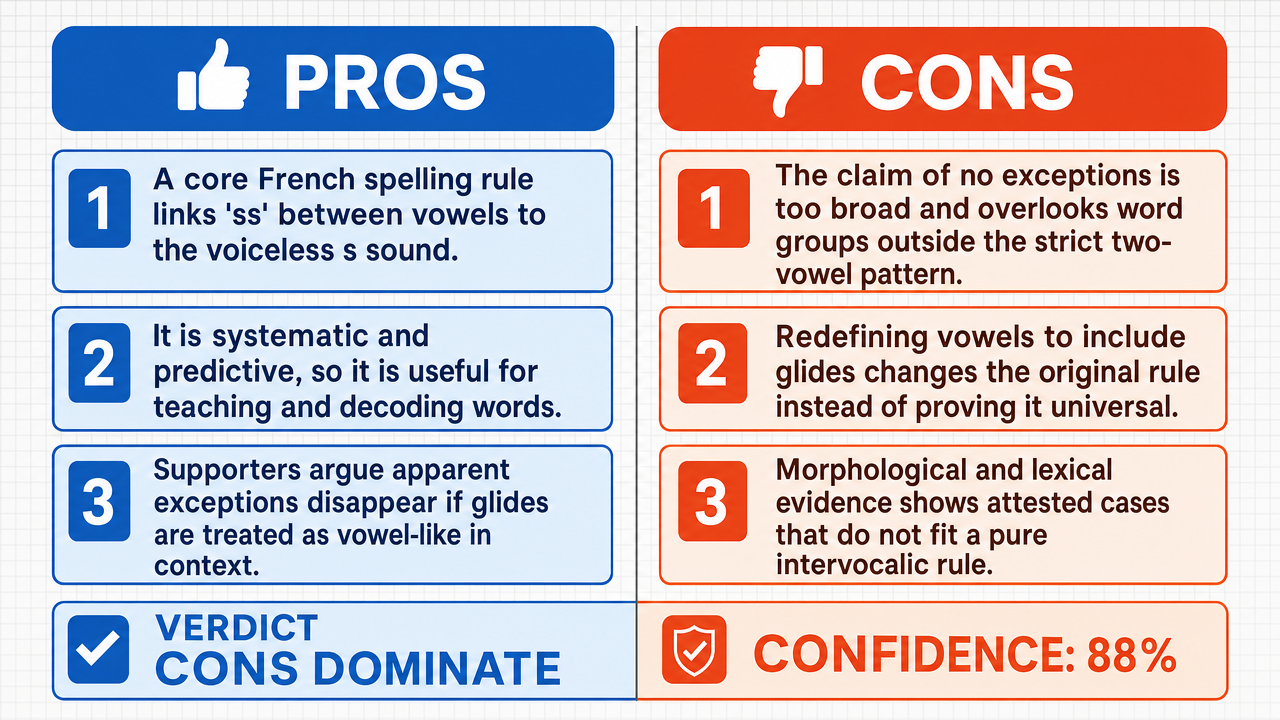
Verdict
Verdict: Mostly FALSE (88%)
Online report: https://solsice.com/public/debates/la-regle-selon-laquelle-les-deux-s-ss-ne-se-trouvent-qu-entr-4aa31a00ff7f
This section provides a brief overview of the key arguments. It is not necessary to read the detailed report below.
✅ Key FOR arguments:
- ■The rule of "ss" between two vowels to produce the voiceless [s] sound is a fundamental, systematic, and predictive rule of French spelling, taught from the earliest stages of reading, and is a necessary condition for the use of double "s".
- ■The rule has no real exceptions because, in phonology , the operational definition of "vowel" includes semi-vowels (/j/, /ɥ/, /w/) when they form the second element of a diphthong , which allows words like "essuyer" (/e.sɥi.je/) to be included within the intervocalic framework.
❌ Key AGAINST arguments:
- ■The claim of universality without exception ignores entire categories of words where the [s] sound is produced by "ss" without being strictly surrounded by two vowels in the phonetic or morphological sense, invalidating any claim of absoluteness.
- ■The opponent makes an illegitimate substitution of the referent's identity by redefining "vowel" to include semi-vowels to cover problematic cases; they do not demonstrate the validity of the rule, they merely modify its scope, which constitutes a disguised exception.
- ■The existence of terms whose internal structure or etymology diverges from the pure intervocalic position — including attested morphological and lexical cases — proves that the rule admits real exceptions and cannot be considered absolute.
💭 Conclusion: The assertion that the "ss" intervocalic rule is absolutely exception-free is too strong to hold. The opposing argument convincingly demonstrated that the rule has real exceptions, and presenting it as "without exception" based on a reliability rate close to 100% involves a logical fallacy: a rate of 99.9% does not equate to an absence of exceptions, but rather confirms their existence. Invoking Larousse or Robert dictionaries, while attesting to the statistical predominance of the rule across thousands of words, does not suffice to prove its absolute nature.
🔬 Verdict: Mostly FALSE ❌ (88%)
Claim: The rule that the two "s" (ss) only appear between two vowels to produce the voiceless "s" sound is an exceptionless French spelling rule.
Participating models: deepseek-v3.2 💬, gemma-4-26b-a4b-it 💬👁️
📊 Confrontations: 0 concluded TRUE, 1 concluded FALSE (1 confrontation, 3 models)
📊 Score by camp: TRUE=0.00, FALSE=0.88
🏅 Model score evolution:
minimax-m3 💬👁️: +9
✅ Arguments FOR:
- ■The rule of "ss" between two vowels to produce the voiceless [s] sound is a fundamental, systematic, and predictive rule of French spelling, taught from the earliest stages of reading, and is a necessary condition for the use of double "s". deepseek-v3.2 💬
- ■The rule has no real exceptions because, in phonology , the operational definition of "vowel" includes semi-vowels (/j/, /ɥ/, /w/) when they form the second element of a diphthong , which allows words like "essuyer" (/e.sɥi.je/) to be included within the intervocalic framework. deepseek-v3.2 💬
❌ Arguments AGAINST:
- ■The claim of universality without exception ignores entire categories of words where the [s] sound is produced by "ss" without being strictly surrounded by two vowels in the phonetic or morphological sense, invalidating any claim of absoluteness. gemma-4-26b-a4b-it 💬👁️
- ■The opponent makes an illegitimate substitution of the referent's identity by redefining "vowel" to include semi-vowels to cover problematic cases; they do not demonstrate the validity of the rule, they merely modify its scope, which constitutes a disguised exception. gemma-4-26b-a4b-it 💬👁️
- ■The existence of terms whose internal structure or etymology diverges from the pure intervocalic position — including attested morphological and lexical cases — proves that the rule admits real exceptions and cannot be considered absolute. gemma-4-26b-a4b-it 💬👁️
💭 Reasoning: The assertion that the "ss" intervocalic rule is absolutely exception-free is too strong to be upheld. The opposing argument convincingly demonstrated that the rule has real exceptions, and claiming it as "without exception" based on a reliability rate close to 100% involves a logical fallacy: a rate of 99.9% does not mean no exceptions exist, but rather confirms their presence. Invoking Larousse or Robert dictionaries, while statistically confirming the rule's predominance across thousands of words, does not prove its absolute character.
📋 Facts FOR:
• From an educational and statistical perspective, the rule is presented as absolute because its reliability rate is close to 100%, making it pedagogically effective to teach as such.
• Examination of comprehensive dictionaries like Larousse or Robert shows that the thousands of words containing a "ss" pronounced [s] all respect the intervocalic condition.
📋 Facts AGAINST:
• There are words where "ss" produces the [s] sound without strictly respecting the intervocalic condition, constituting genuine exceptions.
• Claiming a rule is "without exception" because its reliability rate is close to 100% is a logical fallacy.
• A reliability rate of 99.9% is not an absence of exceptions; it is proof that exceptions exist.
| Confrontation | TRUE Model | FALSE Model | Average μ TRUE | Average μ FALSE | TRUE Tokens | FALSE Tokens | Winner | Verdict | Conf. |
|---|---|---|---|---|---|---|---|---|---|
| #1 | deepseek-v3.2 💬 | gemma-4-26b-a4b-it 💬👁️ | 0.474 | 0.262 | 8 | 2 | TRUE | FALSE | 88% |
The following technical terms, abbreviations, and specialized concepts are used in this transcript. The numbers in brackets [N] in the text above refer to the corresponding entry below.
[1] corpus — Structured set of texts used as a basis for linguistic analysis.
[2] digram — Pair of letters used to represent a single phoneme, such as "ss" or "ch" in French.
[3] diphthong — Complex vowel consisting of two vocalic elements combined within the same syllable.
[4] semantic extension — Broadening or modification of the meaning of a word or concept beyond its initial definition.
[5] referent identity — Characteristic of what designates the same entity, object, or concept as a given linguistic expression; the debate contests the legitimacy of such substitution.
[6] lexical — Relating to the lexicon, i.e., the set of words and lexical units of a language.
[7] morphology — Branch of linguistics studying the formation, internal structure, and inflections of words.
[8] phonology — Branch of linguistics that studies the system of sounds of a language and their distinctive functions.
[9] phoneme — The smallest distinctive sound unit of a language, allowing words to be distinguished from each other.
[10] phonetics — Study of concrete sounds produced by the vocal apparatus and their auditory perception.
[11] intervocalic position — Position of a phoneme or grapheme located between two vowels.
[12] predictive rule — Linguistic rule allowing the form of a unit to be predicted from its phonological or morphological context.
[13] semi-vowel — Sound that functions as a vowel but is articulated with a configuration close to that of a consonant (e.g., /j/, /ɥ/, /w/).
[14] voiceless sound — Sound produced without vibration of the vocal cords, as opposed to a voiced sound.
[15] semantics — Branch of linguistics studying the meaning of linguistic units and their relationships.
[16] tautology — Proposition that is true by definition and adds no new information beyond its own formulation; the debate contests the tautological nature of the expanded rule.
[17] universality — Characteristic of a rule or principle that applies to all cases without exception; the debate specifically concerns the universal scope of the "ss" intervocalic rule.
[18] vocalic element — Sound component exhibiting the acoustic characteristics of a vowel, including when it appears in a diphthong.
[19] etymology — Branch of linguistics studying the origin and historical development of words.
Face-off transcripts
- ■
Ownership & Trade Secrets. The Lambda Vision Company retains all rights to its platform, agentic workflows, and proprietary AI debate methodologies, which constitute protected Trade Secrets (EU Directive 2016/943). Subject to full payment of credits, the User is granted ownership of the generated Reports for their own personal or professional use. Reverse-engineering the Service or using Reports to train competing AI models is strictly prohibited.
- ■
No Professional Advice. Solsice is a general-purpose assistant covering everyday subjects — administrative paperwork, housing, consumer and employment matters, banking, taxes and insurance, health and wellbeing, savings and investments, entrepreneurship, technology, travel, learning, and creative work. Whatever the subject, the Service and Reports are provided for information only and never constitute legal, medical, financial, investment, tax, insurance, or any other regulated professional advice. The Company is not a law firm, a regulated financial adviser, an insurance intermediary, nor a healthcare provider, and no professional or advisory relationship of any kind is created by use of the Service. Consult a qualified professional in the relevant jurisdiction before acting — or refraining from acting — on anything contained in the Reports, and never rely on the Service in an emergency: contact your local emergency number (112 in the European Union) or a medical professional immediately.
- ■
AI-Generated Content, Sources and Viewpoints. Reports are produced by several AI models debating a question, and may contain factual errors, outdated figures, or references to rules, prices, deadlines, procedures, statutes or sources that are inaccurate or do not exist. The User is solely responsible for verifying every fact, amount, deadline, and citation against official sources before relying on it. Material in the news, society, spirituality, and religion sections presents a plurality of viewpoints for study and discussion: it is descriptive, not an endorsement, a ruling, or a statement of the Company’s own position, and it speaks for no church, faith community, public authority, or news organization.
- ■
Liability & Governing Law. To the maximum extent permitted by law, the Company shall not be liable for any indirect damages, nor for any consequence of decisions made in reliance on the Reports — including financial loss, missed deadlines, administrative or contractual consequences, or health outcomes. These Terms are governed by French law. Any disputes shall be subject to the exclusive jurisdiction of the Courts of Paris, France.