
La région Centre-Val de Loire, par son histoire et ses contributions, a façonné l'identité française plus que toute autre région de France.
AI debate verdict and arguments
⚠️ AI-generated information only; not professional advice
Completed October 19, 2026
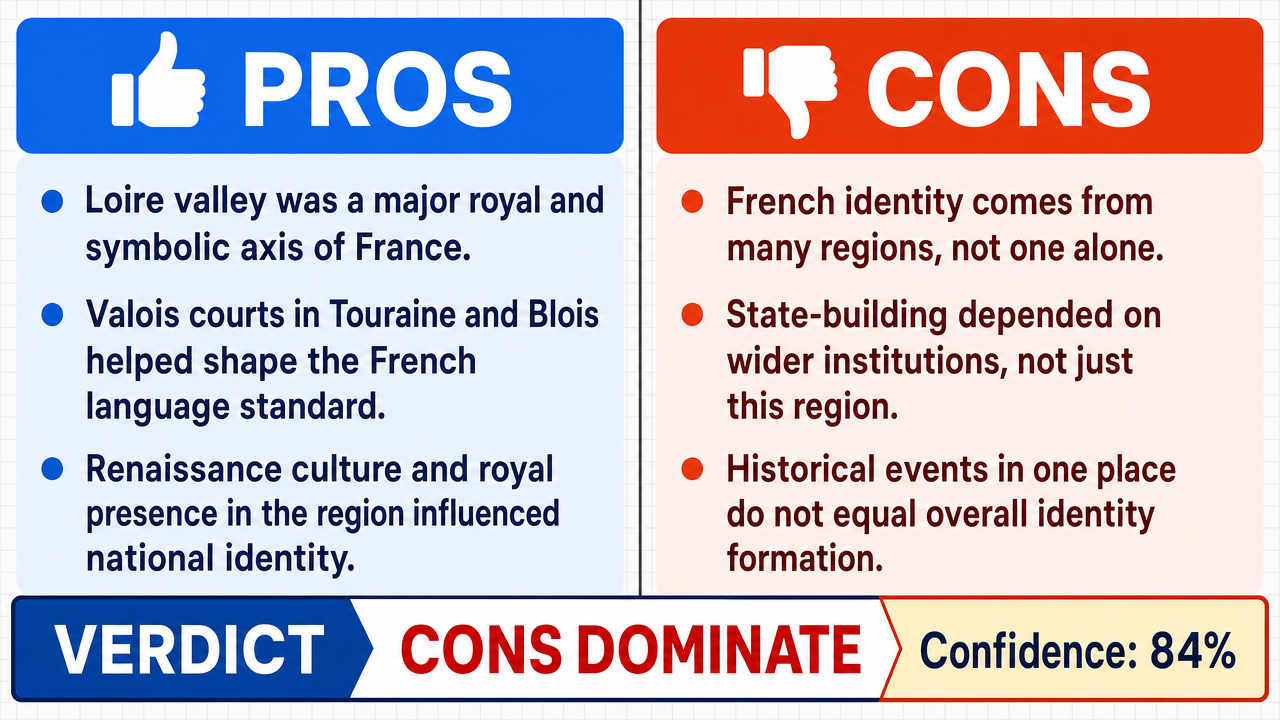
Verdict
Verdict: Mostly FALSE (84%)
Online report: https://solsice.com/public/debates/la-region-centre-val-de-loire-par-son-histoire-et-ses-contri-c8329aee2071
This section provides a brief overview of the key arguments. It is not necessary to read the detailed report below.
✅ Key PRO arguments:
- ■The Centre-Val de Loire region constitutes the fundamental political and symbolic axis of France: the Loire was the vital artery where royal power was established from the 15th century, making Tours, Blois, Amboise, and Chambord the de facto capitals of the kingdom, notably the site of the signing of the Edict of Nantes by Henry IV.
- ■The Valois court , established in Touraine and in Blesois , set the linguistic standard for French: the Ordinance of Villers-Cotterêts (1539) imposed a French language whose norm had been established by this court, surpassing the simple dialect of Île-de-France of the 13th century.
❌ Key CON arguments:
- ■French identity is a multidimensional construct of which the Centre-Val de Loire is only one fragment; the opposing argument commits a referent substitution by measuring the region's influence through the presence of castles or royal decisions without ever establishing the necessary transfer between these monuments and the very structure of national identity .
- ■The institutionalization of the French state — characterized by bureaucracy , centralized taxation , and administrative law — occurred through mechanisms that far exceed the geographical scope of the region; using the presence of royal residences as a proxy for sovereignty is a substitution error confusing the location of court acts with the structural genesis of the state.
💭 Conclusion: False: the Centre-Val de Loire region did not shape French identity more than any other region, because the affirmative argument relies on a fallacious substitution between the geographical presence of historical events and the actual construction of national identity . The negative side successfully demonstrated that French identity is a multidimensional construction involving many regions, and that the concentration of royal residences or political decisions in the Loire Valley does not constitute proof of primacy in identity. The argument that the modern French state mainly results from court activity in Touraine confuses the location of sovereign acts with the structural genesis of bureaucratic, fiscal, and administrative institutions. Furthermore, claiming linguistic primacy of Touraine neglects the role of the francien dialect of Île-de-France and the complexity of linguistic normalization processes. Thus, the Centre-Val de Loire is an important but non-determinant fragment of French identity, alongside many other contributing regions.
🔬 Verdict: mostly FALSE ❌ (84%)
Claim: The Centre-Val de Loire region , through its history and contributions, has shaped French identity more than any other region in France.
Participating models: deepseek-v4-pro 💬, gemma-4-26b-a4b-it 💬👁️
📊 Confrontations: 0 concluded TRUE, 1 concluded FALSE (1 confrontation, 3 models)
📊 Score by camp: TRUE=0.00, FALSE=0.84
🏅 Model score evolution:
minimax-m3 💬👁️: +8
✅ PRO arguments:
- ■The Centre-Val de Loire region forms the fundamental political and symbolic axis of France: the Loire was the vital artery where royal power was established from the 15th century, making Tours, Blois, Amboise, and Chambord the de facto capitals of the kingdom.
- ■The Ordinance of Villers-Cotterêts (1539) established French as the administrative language of the kingdom.
- ■The Edict of Nantes was signed by Henry IV in the Loire Valley region.
❌ CON arguments:
- ■French identity is a multidimensional construct of which the Centre-Val de Loire is only one fragment; the opposing argument commits a referent substitution by measuring the region's influence through the presence of castles or royal decisions without ever establishing the necessary transfer between these monuments and the very structure of national identity .
- ■The institutionalization of the French state — characterized by bureaucracy , centralized taxation , and administrative law — occurred through mechanisms that far exceed the geographical scope of the region; using the presence of royal residences as a proxy for sovereignty is a substitution error confusing the location of court acts with the structural genesis of the state.
💭 Reasoning: False: the Centre-Val de Loire region did not shape French identity more than any other region, because the affirmative argument relies on a fallacious substitution between the geographical presence of historical events and the actual construction of national identity. The negative side successfully demonstrated that French identity is a multidimensional construction involving many regions, and that the concentration of royal residences or political decisions in the Loire Valley does not constitute proof of primacy in identity. The argument that the modern French state mainly results from court activity in Touraine confuses the location of sovereign acts with the structural genesis of bureaucratic, fiscal, and administrative institutions. Moreover, claiming linguistic primacy of Touraine neglects the role of the francien dialect of Île-de-France and the complexity of linguistic normalization processes. Thus, the Centre-Val de Loire is an important but non-determinant fragment of French identity, alongside many other contributing regions.
📋 Facts IN FAVOR:
• The French royal power was established along the Loire from the 15th century, making Tours, Blois, Amboise, and Chambord de facto capitals of the kingdom.
• The Ordinance of Villers-Cotterêts (1539) mandated French as the administrative language of the kingdom.
• The Edict of Nantes was signed by Henry IV in the Loire Valley region.
📋 Facts AGAINST:
• French identity is a multidimensional construct involving multiple regions, not the product of a single region.
• The institutionalization of the French state (bureaucracy, centralized taxation, administrative law) results from mechanisms far beyond the geographical scope of the Centre-Val de Loire.
• Standard French roots in the francien dialect of Île-de-France, not exclusively in the Valois court in Touraine.
| Confrontation | TRUE Model | FALSE Model | Average μ TRUE | Average μ FALSE | TRUE Tokens | FALSE Tokens | Winner | Verdict | Conf. |
|---|---|---|---|---|---|---|---|---|---|
| #1 | deepseek-v4-pro 💬 | gemma-4-26b-a4b-it 💬👁️ | 0.457 | 0.241 | 6 | 2 | TRUE | FALSE | 84% |
The following technical terms, abbreviations, and specialized concepts are used in this transcript. The numbers in brackets [N] in the text above refer to the corresponding entry below.
[1] Blésois — Refers to what relates to the historical region of Blois, in the Val de Loire, often used to locate royal residences and political activity of the Valois.
[2] bureaucracy — Administrative system characterized by a hierarchy of specialized agents and formalized procedures, identified in the debate as one of the markers of the construction of the modern state.
[3] de facto capitals — Expression denoting cities that, without being officially designated as capitals, in practice perform the political and administrative functions of a center of power.
[4] centralization — Political process by which decision-making power is concentrated in a single center, here associated in the debate with Paris's preeminence over the provinces.
[5] Parisian centralization — Specific form of political and administrative centralization around Paris, presented in the debate as having marginalized Loire centers of power from the 17th century onward.
[6] Centre-Val de Loire — French administrative region resulting from the merger of several departments, with Orléans as its capital, and whose territory largely overlaps with the former historic province of Val de Loire.
[7] clerks — In the medieval and Renaissance context, literate persons serving a court or institution, here mentioned as having contributed to fixing the linguistic norm at the Valois court.
[8] Valois court — House and entourage of the king under the Valois dynasty (15th-16th centuries), whose itinerant residence in the Val de Loire is central to the debate's argumentation.
[9] Dauphin — Title borne by the heir to the French throne, mentioned in the debate regarding Charles VII during his meeting with Joan of Arc at Chinon in 1429.
[10] dialect — Regional variant of a language, discussed in the debate through the Francien dialect as a purported source of standard French.
[11] Francien dialect — Linguistic variant spoken in Île-de-France during the Middle Ages, presented in the debate as the basis of standard French, a point contested by the affirmative.
[12] National domain — French legal status designating a set of monuments and historic properties under the responsibility of the State, such as the Domaine national de Chambord cited in the debate.
[13] administrative law — Branch of law governing the organization and functioning of public administration, identified in the debate as one of the pillars of the modern state.
[14] centralized taxation — System of tax collection and management organized around a central authority, presented in the debate as a marker of the modern state.
[15] Grand Est — French administrative region resulting from the merger of Alsace, Lorraine, and Champagne-Ardenne, mentioned in the debate to locate Reims.
[16] Hundred Years' War — Dynastic and territorial conflict between the kingdoms of France and England from 1337 to 1453, with the debate mentioning its reversal by the Chinon meeting in 1429.
[17] national identity — Set of shared representations, values, and references constituting the feeling of belonging to a nation, a central object of the debate.
[18] Loire region — Adjective referring to what relates to the Loire River, used in the debate to qualify the court, castles, and political influence area of the river.
[19] transfer mechanism — Rhetorical expression referring to the process by which a local phenomenon would produce a national effect, whose absence is reproached to the opponent's argument in the debate.
[20] norm — linguistic norm — Reference standard setting the correct usage of a language, discussed in the debate as codified by clerks and poets of the Loire court.
[21] Villers-Cotterêts ordinance — Royal ordinance of 1539 mandating the use of French in official acts, presented in the debate as a normative milestone linked to the Valois court.
[22] Parliaments — Sovereign courts of the Ancien Régime, mentioned in the debate as institutions in tension with royal power in the construction of the state.
[23] proxy — Term borrowed from statistics denoting an indirect indicator used to measure a phenomenon, here reproached for using castles as an indicator of sovereignty.
[24] premises — In logic, initial propositions of an argument from which conclusions derive, mentioned in the debate as "not established" in the opposing argument.
[25] royal coronation ceremonies — Ceremonies of crowning and anointing French kings, mentioned in the debate before the affirmative rectifies their location to Reims.
[26] national sentiment — Collective awareness of belonging to the same nation, presented in the debate as forged by major political events such as the Chinon meeting.
[27] referent substitution — Rhetorical term denoting the act of replacing the object of a demonstration with another close but distinct object, reproached to the opposing argument in the debate.
[28] Touraine — Former French province centered on Tours, mentioned in the debate as the seat of the Valois court and the fixation of the linguistic norm.
[29] Edict of Nantes — Edict signed by Henry IV in 1598, whose preparation and negotiation in the Loire castles, notably Blois, are mentioned in the debate.
[30] Modern state — Historiographical concept referring to the form of political organization that appeared in Europe, characterized in the debate by bureaucracy, centralized taxation, and administrative law.
[31] Estates-General — Representative assembly of the three estates of the kingdom of France, mentioned in the debate as one of the institutions in tension with royal power.
[32] Île-de-France — Historic and administrative region in northern France, mentioned in the debate as the home of the Francien dialect.
Face-off transcripts
- ■
Ownership & Trade Secrets. Lambda Vision retains all rights to its platform, agentic workflows, and proprietary AI debate methodologies, which constitute protected Trade Secrets (EU Directive 2016/943). Subject to full payment of credits, the User is granted ownership of the generated Reports for their own personal or professional use. Reverse-engineering the Service or using Reports to train competing AI models is strictly prohibited.
- ■
No Professional Advice. Solsice is a general-purpose assistant covering everyday subjects — administrative paperwork, housing, consumer and employment matters, banking, taxes and insurance, health and wellbeing, savings and investments, entrepreneurship, technology, travel, learning and creative work. Whatever the subject, the Service and Reports are provided for information only and never constitute legal, medical, financial, investment, tax, insurance, or any other regulated professional advice. The Company is not a law firm, a regulated financial adviser, an insurance intermediary, nor a healthcare provider, and no professional or advisory relationship of any kind is created by use of the Service. Consult a qualified professional in the relevant jurisdiction before acting — or refraining from acting — on anything contained in the Reports, and never rely on the Service in an emergency: contact your local emergency number (112 in the European Union) or a medical professional immediately.
- ■
AI-Generated Content, Sources and Viewpoints. Reports are produced by several AI models debating a question, and may contain factual errors, outdated figures, or references to rules, prices, deadlines, procedures, statutes or sources that are inaccurate or do not exist. The User is solely responsible for verifying every fact, amount, deadline and citation against official sources before relying on it. Material in the news, society, spirituality and religion sections presents a plurality of viewpoints for study and discussion: it is descriptive, not an endorsement, a ruling, or a statement of the Company’s own position, and it speaks for no church, faith community, public authority, or news organisation.
- ■
Liability & Governing Law. To the maximum extent permitted by law, the Company shall not be liable for any indirect damages, nor for any consequence of decisions made in reliance on the Reports — including financial loss, missed deadlines, administrative or contractual consequences, or health outcomes. These Terms are governed by French law. Any disputes shall be subject to the exclusive jurisdiction of the Courts of Paris, France.