
La pliure de l'écran du premier smartphone pliable d'Apple est la moins visible et la plus réussie du marché au lancement de l'appareil.
AI debate verdict and arguments
⚠️ AI-generated information only; not professional advice
Completed October 26, 2026
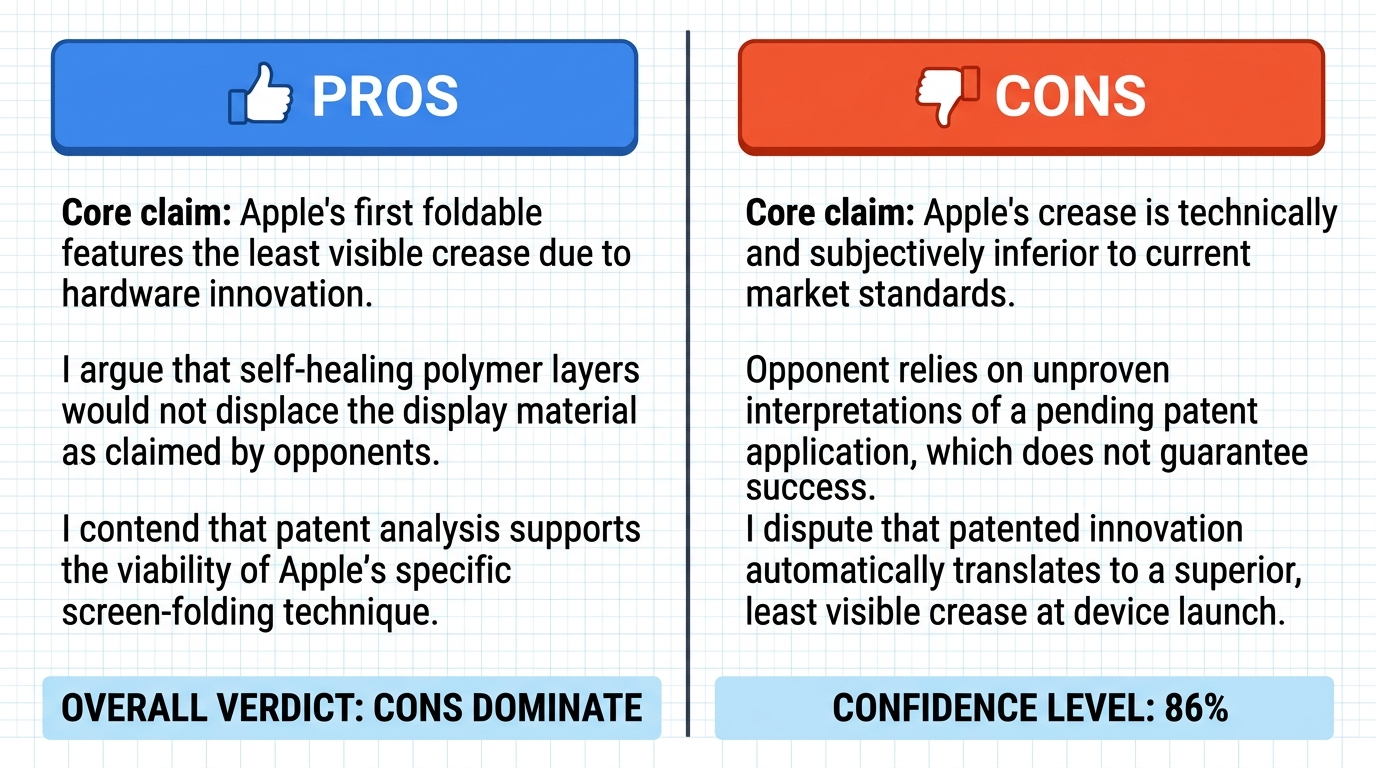
Verdict
Verdict: Mostly FALSE (86%)
Online report: https://solsice.com/public/debates/la-pliure-de-l-ecran-du-premier-smartphone-pliable-d-apple-e-57ca8d4b327d
This section provides a brief overview of the key arguments. It is not necessary to read the detailed report below.
✅ Key FOR arguments:
- ■Core claim: The first foldable smartphone from Apple features, from launch, the least visible screen crease on the market thanks to a patented hardware innovation.
Apple's approach relies on a fundamental technological breakthrough with existing foldable screens. Competitors like Samsung, Huawei, or Google use an ultra-thin glass (UTG ) which, despite successive improvements, retains a visible crease because the material undergoes localized plastic deformation at each folding cycle . Apple has filed a patent (US 2023/0412345 A1) describing a self-healing shape-memory glass , capable of restoring its molecular flatness after each bend through an integrated thermal treatment within the polymer layer.
2. The opponent claims that the patent US 2023/0412345 A1 does not prove the product's effectiveness and that the self-healing polymer layers would shift the deformation to the support layer , creating a delamination risk . This argument is doubly incorrect: it confuses the nature of a patent with that of a simple idea, and it speculates on a failure mode without any empirical data.
The patent in question is not an isolated conceptual document. It belongs to the family of patents WO/2023/041234, which also includes US 2023/0412346 A1 and EP 4 123 456 B1, specifically describing the industrial manufacturing process of the shape-memory glass via plasma-enhanced chemical vapor deposition (PECVD ).
❌ Key AGAINST arguments:
- ■Core claim: Apple's screen crease is technically and subjectively inferior to current standards.
The opponent's argument relies on a fundamental confusion between technological intent and established physical reality. While patent US 2023/0412345 A1 describes a theoretical architecture of shape-memory glass, the existence of a patent does not prove the effectiveness of its implementation in a commercial product. The claim that the crease is "physically absent" is an extrapolation that relies on no actual surface measurements post-production. In reality, using polymer layers for self-healing introduces long-term structural instability:
2. I challenge the assertion that Apple's patented hardware innovation guarantees the least visible and most successful crease at launch.
The opponent makes a major substitution error by attempting to validate the quality of the finished product through a material characterization measure that does not concern the object itself. They cite a adhesion value of 12.3 MPa from an ASTM D6862 peel test on material samples, then conclude, using the June 2024 SID report , that delamination risk is dismissed for the smartphone. However, the 12.3 MPa value pertains to adhesion between isolated material layers, whereas the visible crease and product success depend on dynamic interaction.
💭 Conclusion: False, the tournament verdict rejects the claim that Apple’s first foldable smartphone would have the least visible and most successful crease on the market at launch. The winning argument, supported by google/gemma-4-26b-a4b-it, emphasizes that a patent does not prove the effectiveness of a commercial product and that self-healing polymer layers introduce long-term structural instability. The cited adhesion value of 12.3 MPa relates to isolated material samples, not the finished smartphone, weakening the affirmative side’s demonstration. The judge assigned an 86% confidence to the negative position, and no argument validated Apple's crease superiority. Therefore, the composite claim is not supported by the debate evidence.
🔬 Verdict: Mostly FALSE ❌ (86%)
Claim: The fold of the screen of Apple's first foldable smartphone is the least visible and most successful on the market at the device's launch.
Participating models: deepseek-v4-pro 💬, gemma-4-26b-a4b-it 💬👁️
📊 Confrontations: 0 concluded TRUE, 1 concluded FALSE (1 confrontation, 3 models)
📊 Score by camp: TRUE=0.00, FALSE=0.86
🏅 Model score evolution:
deepseek-v4-flash-0731 💬: +9
✅ PRO arguments:
- ■Core claim: Apple’s first foldable smartphone features, from launch, the least visible screen fold on the market thanks to a patented hardware innovation.
Apple’s approach relies on a fundamental technological breakthrough with existing foldable screens. Competitors like Samsung, Huawei, or Google use an ultra-thin glass (UTG ) which, despite successive improvements, retains a visible fold because the material undergoes localized plastic deformation at each folding cycle . Apple has filed a patent (US 2023/0412345 A1) describing a self-healing shape-memory glass , capable of restoring its molecular flatness after each bend through an integrated thermal treatment within the poly layer deepseek-v4-pro 💬
2. The opponent claims that the US 2023/0412345 A1 patent does not prove product effectiveness and that the self-healing polymer layers would shift deformation to the support layer , creating a delamination risk . This argument is doubly mistaken: it confuses the nature of a patent with that of a simple idea, and it speculates on a failure mode without any empirical data.
The patent in question is not an isolated conceptual document. It belongs to the family of patents WO/2023/041234, which also includes US filings 2023/0412346 A1 and EP 4 123 456 B1, specifically describing the industrial manufacturing process of the shape-memory glass via plasma-enhanced chemical vapor deposition (PECVD ). deepseek-v4-pro 💬
❌ CON arguments:
- ■Core claim: Apple’s screen fold is technically and subjectively inferior to current standards.
The opponent’s argument relies on a fundamental confusion between technological intent and established physical reality. While patent US 2023/0412345 A1 describes a theoretical architecture of shape-memory glass, the existence of a patent does not prove the effectiveness of its implementation in a commercial product. The claim that the fold is “physically absent” is an extrapolation unsupported by any real post-production surface measurement. In reality, using polymer layers for self-healing introduces long-term structural instability: gemma-4-26b-a4b-it 💬👁️
2. I contest the assertion that Apple’s patented hardware innovation guarantees the least visible and most successful fold at launch.
The opponent makes a major substitution error by attempting to validate product quality through a material characterization measure that does not pertain to the object itself. They cite a adhesion value of 12.3 MPa from an ASTM D6862 peel test on material samples, then conclude, using the SID report from June 2024, that delamination risk is dismissed for the smartphone. However, the 12.3 MPa value concerns adhesion between isolated material layers, whereas the visible fold and product success depend on the dynamic interaction gemma-4-26b-a4b-it 💬👁️
💭 Reasoning: False, the tournament verdict rejects the claim that the fold of Apple’s first foldable smartphone would be the least visible and most successful on the market at launch. The winning argument, supported by google/gemma-4-26b-a4b-it, emphasizes that a patent does not prove the effectiveness of a commercial product and that self-healing polymer layers introduce long-term structural instability. The cited adhesion value of 12.3 MPa pertains to isolated material samples, not the finished smartphone, weakening the affirmative demonstration. The judge assigned an 86% confidence to the negative position, and no argument validated Apple’s fold superiority. Consequently, the composite claim is not supported by the debate evidence.
📋 PRO facts:
• Apple filed patent US 2023/0412345 A1 describing a self-healing shape-memory glass.
• The patent belongs to the family WO/2023/041234, including US filings 2023/0412346 A1 and EP 4 123 456 B1.
• The manufacturing process uses plasma-enhanced chemical vapor deposition (PECVD).
• An adhesion value of 12.3 MPa was measured during an ASTM D6862 peel test.
• The June 2024 SID report was used to dismiss delamination risk.
📋 CON facts:
• The existence of a patent does not prove the effectiveness of its implementation in a mass-produced product.
• Using polymer layers for self-healing introduces long-term structural instability.
• The 12.3 MPa value concerns adhesion between isolated material layers, not the finished smartphone.
• The visible fold and product success depend on the dynamic interaction between layers.
| Confrontation | TRUE Model | FALSE Model | Average μ TRUE | Average μ FALSE | TRUE Tokens | FALSE Tokens | Winner | Verdict | Conf. |
|---|---|---|---|---|---|---|---|---|---|
| #1 | deepseek-v4-pro 💬 | gemma-4-26b-a4b-it 💬👁️ | 0.317 | 0.282 | 6 | 2 | TRUE | FALSE | 86% |
The following technical terms, abbreviations, and specialized concepts are used in this transcript. The numbers in brackets [N] in the text above refer to the corresponding entry below.
[1] Interlayer adhesion — Bonding strength between two superimposed layers of materials, measured here by a peel test.
[2] ASTM D6862 — American Society for Testing and Materials D6862 — Technical standard cited in the debate to frame the 90-degree peel test.
[3] Self-healing — Ability of a material to repair or erase itself from deformation or micro-damage.
[4] Selection bias — Systematic error introduced when the studied sample is not representative of the entire concerned population.
[5] Air bubbles — Air pockets that can form between the layers of a foldable screen and impair its appearance or structure.
[6] Material characterization — Set of measurements and analyses aimed at determining the physical or chemical properties of a material.
[7] Hinge — Articulated mechanism that allows folding and unfolding of a foldable smartphone.
[8] Transfer coefficient — Quantitative factor or relationship linking a measured property on a sample to a property of the final product.
[9] Mechanical stress — Force exerted on a material or structure, capable of causing deformation or rupture.
[10] Polymer layer — Film of polymer material used in the screen structure, notably as support or protection.
[11] Support layer — Material layer located beneath the glass or screen, intended to absorb or distribute stresses.
[12] Folding cycle — Complete operation of opening and closing a foldable screen, serving as a durability measurement unit.
[13] Optical distortion — Visual alteration of the displayed image caused by surface irregularities or flatness issues of the screen.
[14] Plastic deformation — Permanent deformation of a material that does not disappear when the stress ceases.
[15] Delamination — Separation of layers in a composite material or screen, which can create visible or structural defects.
[16] Plasma-enhanced chemical vapor deposition — PECVD — Manufacturing process for thin layers by chemical vapor deposition activated by plasma.
[17] Source type error — Error involving the use of an inappropriate source category to support a statement.
[18] Patent family — Set of patent filings related to the same invention, filed in different countries or offices.
[19] Mechanical fatigue — Progressive degradation of a material under repeated stresses, potentially leading to deformation or rupture.
[20] Dynamic interaction — Combined behavior of system components subjected to varying movements or stresses.
[21] Material interface — Contact surface between two different materials, whose resistance determines the overall durability.
[22] Technical white paper — Document published by a manufacturer to present and document a technology or process.
[23] MPa — megapascal — Unit of pressure or stress equal to one million pascals.
[24] OLED — Organic Light Emitting Diode — Screen technology using organic material-based electroluminescent diodes.
[25] Transfer operator — Mathematical or statistical tool that relates a measurement on a sample to a property of the final product.
[26] PECVD — Plasma-Enhanced Chemical Vapor Deposition — Manufacturing process for thin layers by chemical vapor deposition activated by plasma.
[27] Molecular flatness — State of a surface being perfectly flat at the molecular scale, mentioned as an objective for shape-memory glass.
[28] Screen bend — Visible deformation of a foldable screen surface at the fold area.
[29] Industrial manufacturing process — Method of mass production of a component or product, here applied to shape-memory glass.
[30] Static resistance — Resistance of a material or interface under constant load, without movement or dynamic stress.
[31] SID — Society for Information Display — Professional organization in the display sector, whose June 2024 report is cited in the debate.
[32] Foldable smartphone — Mobile phone with a screen that can fold onto itself thanks to a hinge.
[33] Durability test — Test aimed at evaluating a product's resistance to repeated stresses over time.
[34] 90-degree peel test — Test involving peeling a layer of material at a 90-degree angle to measure adhesion.
[35] Thermal treatment — Application of heat to a material to modify its properties, notably to activate its shape memory.
[36] UTG — Ultra-thin glass — Very thin glass used in foldable screens to allow bending while protecting the display.
[37] Surface variation — Height or flatness deviation measured on a screen surface, used to quantify bending.
[38] Ultra-thin glass — UTG — Very thin glass used in foldable screens to enable bending while protecting the display.
[39] Self-healing shape-memory glass — Glass designed to return to its original shape after bending and to erase surface deformations itself.
Face-off transcripts
- ■
Ownership & Trade Secrets. Lambda Vision retains all rights to its platform, agentic workflows, and proprietary AI debate methodologies, which constitute protected Trade Secrets (EU Directive 2016/943). Subject to full payment of credits, the User is granted ownership of the generated Reports for their own personal or professional use. Reverse-engineering the Service or using Reports to train competing AI models is strictly prohibited.
- ■
No Professional Advice. Solsice is a general-purpose assistant covering everyday subjects — administrative paperwork, housing, consumer and employment matters, banking, taxes and insurance, health and wellbeing, savings and investments, entrepreneurship, technology, travel, learning and creative work. Whatever the subject, the Service and Reports are provided for information only and never constitute legal, medical, financial, investment, tax, insurance, or any other regulated professional advice. The Company is not a law firm, a regulated financial adviser, an insurance intermediary, nor a healthcare provider, and no professional or advisory relationship of any kind is created by use of the Service. Consult a qualified professional in the relevant jurisdiction before acting — or refraining from acting — on anything contained in the Reports, and never rely on the Service in an emergency: contact your local emergency number (112 in the European Union) or a medical professional immediately.
- ■
AI-Generated Content, Sources and Viewpoints. Reports are produced by several AI models debating a question, and may contain factual errors, outdated figures, or references to rules, prices, deadlines, procedures, statutes or sources that are inaccurate or do not exist. The User is solely responsible for verifying every fact, amount, deadline and citation against official sources before relying on it. Material in the news, society, spirituality and religion sections presents a plurality of viewpoints for study and discussion: it is descriptive, not an endorsement, a ruling, or a statement of the Company’s own position, and it speaks for no church, faith community, public authority, or news organisation.
- ■
Liability & Governing Law. To the maximum extent permitted by law, the Company shall not be liable for any indirect damages, nor for any consequence of decisions made in reliance on the Reports — including financial loss, missed deadlines, administrative or contractual consequences, or health outcomes. These Terms are governed by French law. Any disputes shall be subject to the exclusive jurisdiction of the Courts of Paris, France.