
La moindre moue ou hésitation de la part d'un proche peut nous pousser à minimiser notre désir, voire à le remettre en question, influençant nos décisions quotidiennes.
AI debate verdict and arguments
⚠️ AI-generated information only; not professional advice
Completed October 14, 2026
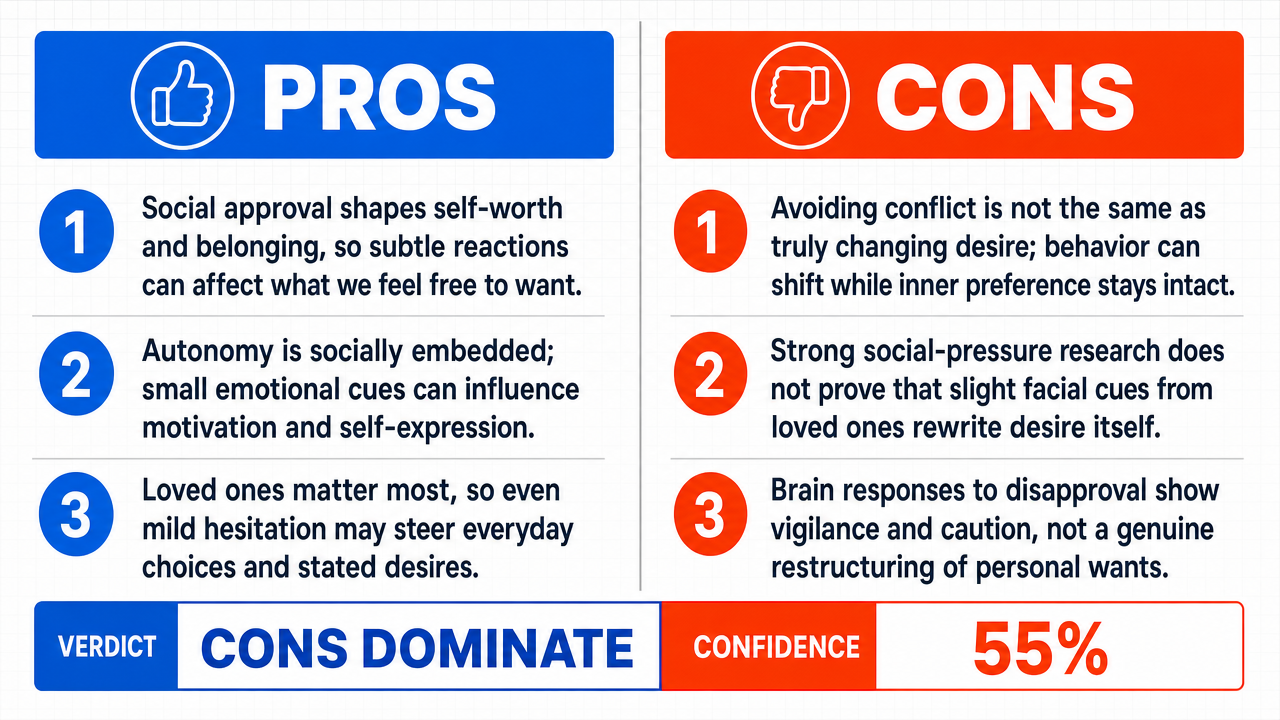
Verdict
Verdict: Mostly FALSE (55%)
Online report: https://solsice.com/public/debates/la-moindre-moue-ou-hesitation-de-la-part-d-un-proche-peut-no-e7956df5c047
This section provides a brief overview of the key arguments. It is not necessary to read the detailed report below.
✅ Key PRO arguments:
- ■Humans are deeply social, and their self-esteem as well as their sense of belonging are regulated by approval from their social environment; studies on stereotype threat and internalization norms show that a simple expression of doubt can trigger a self-censorship process .
- ■Autonomy is not a binary and isolated state: affective neuroscience and social psychology demonstrate that subtle social signals truly penetrate internal deliberation and modulate actual preferences, not just their expression.
❌ Key CON arguments:
- ■There is a crucial distinction between behavioral conformity (not expressing an opinion to avoid conflict) and actual desire modification (changing what one truly wants); the cited research demonstrates the former but does not support the latter.
- ■Social psychology studies on stereotype threat concern massive structural and identity pressures , not the volatility of will in response to a simple micro-expression ; extrapolating these results to an ordinary frown is conjecture.
- ■Neuroscience shows that activation of the amygdala in response to a disapproval signal reflects a vigilance reaction , not an authentic restructuring of deep preferences.
💭 Conclusion: False, with a moderate confidence level (55%), the negative side prevails by making a decisive distinction between behavioral conformity and actual desire modification. The initial claim subtly shifts from influence on preference expression to influence on their very content, which the available empirical data do not confirm for social signals as subtle as a frown or hesitation. The pro side cites well-documented phenomena (stereotype threat , self-censorship ) but these relate to contexts of heavy identity pressure and cannot be extrapolated to everyday micro-interactions without committing a fallacy of extension. Finally, the stability of authentic desires in the face of subtle signals, and the role of the amygdala in vigilance rather than in restructuring preferences, are solid empirical counterarguments that the pro side has not refuted. The verdict remains cautious: the 55% confidence reflects that the debate only involved two models in a single round and that the question admits gray areas, especially for highly socially approval-sensitive individuals.
🔬 Verdict: Mostly FALSE ❌ (55%)
Claim: The slightest frown or hesitation from a close person can lead us to minimize our desire or even question it, influencing our daily decisions.
Participating models: deepseek-v3.2 💬, gemma-4-26b-a4b-it 💬👁️
📊 Confrontations: 0 concluded TRUE, 1 concluded FALSE (1 confrontation, 3 models)
📊 Score per side: TRUE=0.00, FALSE=0.55
🏅 Model score evolution:
minimax-m3 💬👁️: +6
✅ Arguments FOR:
- ■Humans are deeply social, and their self-esteem as well as their sense of belonging are regulated by approval from their social environment; studies on stereotype threat and internalization norms show that a simple expression of doubt can trigger a self-censorship process . deepseek-v3.2 💬
- ■Autonomy is not a binary and isolated state: affective neuroscience and social psychology demonstrate that subtle social signals truly penetrate internal deliberation and modulate actual preferences, not just their expression. deepseek-v3.2 💬
❌ Arguments AGAINST:
- ■There is a crucial distinction between behavioral conformity (not expressing an opinion to avoid conflict) and actual desire modification (changing what one truly wants); the cited research demonstrates the former but does not support the latter. gemma-4-26b-a4b-it 💬👁️
- ■Social psychology studies on stereotype threat concern massive structural and identity pressures , not the volatility of will in response to a simple micro-expression ; extrapolating these results to an ordinary frown is conjecture. gemma-4-26b-a4b-it 💬👁️
- ■Neuroscience shows that activation of the amygdala in response to a negative social signal reflects increased vigilance , not an authentic restructuring of deep preferences. gemma-4-26b-a4b-it 💬👁️
💭 Reasoning: False, with a moderate confidence level (55%), the negative side prevails by making a decisive distinction between behavioral conformity and actual desire modification. The initial statement subtly shifts from influence on preference expression to influence on their very content, which the available empirical data do not confirm for social signals as subtle as a frown or hesitation. The pro side cites well-documented phenomena (stereotype threat, self-censorship) but these relate to contexts of heavy identity pressure and cannot be extrapolated to everyday micro-interactions without committing a fallacy of extension. Finally, the stability of authentic desires in the face of subtle signals, and the role of the amygdala in vigilance rather than in restructuring preferences, are solid empirical counterarguments that the pro side has not refuted. The verdict remains cautious: the 55% confidence reflects that the debate only involved two models in a single round and that the question admits gray areas, especially for highly socially approval-sensitive individuals.
📋 Facts IN FAVOR:
• Studies on stereotype threat demonstrate that a doubt signal from an authority figure can trigger self-censorship in the targeted individual.
• Social psychology documents that self-esteem and the sense of belonging are regulated by approval from the social environment.
📋 Facts AGAINST:
• Social psychology research distinguishes behavioral conformity and actual desire modification; they demonstrate the former but not the latter.
• Studies on stereotype threat concern massive identity and structural pressures, not micro facial expressions.
• Activation of the amygdala in response to a negative social signal indicates increased vigilance, not a restructuring of deep desires.
| Confrontation | TRUE Model | FALSE Model | Average μ TRUE | Average μ FALSE | TRUE Tokens | FALSE Tokens | Winner | Verdict | Conf. |
|---|---|---|---|---|---|---|---|---|---|
| #1 | deepseek-v3.2 💬 | gemma-4-26b-a4b-it 💬👁️ | 0.511 | 0.367 | 8 | 2 | TRUE | FALSE | 55% |
The following technical terms, abbreviations, and specialized concepts are used in this transcript. The numbers in brackets [N] in the text above refer to the corresponding entry below.
[1] Amygdala — Brain structure involved in processing emotions, notably fear and threat. The negative camp mentions it to discuss vigilance response to social signals but disputes that it can alter intrinsic preferences.
[2] Self-censorship — Process by which an individual restrains or moderates the expression of their opinion, desire, or position. The affirmative camp associates it with the effect of non-verbal disapproval signals, while the negative camp distinguishes self-censorship (behavioral conformity) from genuine desire modification.
[3] Autonomy of will — Philosophical and psychological concept referring to an individual's capacity to determine themselves freely, independently of external influences. The negative camp considers it a pillar of their thesis on desire stability, while the affirmative camp describes it as “a continuum constantly negotiated within a social context.”
[4] Perceived autonomy — Subjective feeling of acting according to one's own choices, identified as a key mediator of intrinsic motivation. The affirmative camp argues that subtle disapproval signals can undermine it.
[5] Neural circuits — Interconnected networks of neurons activated during cognitive or emotional processes. The affirmative camp mentions those involved in processing social rejection and disapproval as a threat.
[6] Behavioral conformity — The act of adjusting one's visible speech or actions to align with perceived social norms, without deep internal preference change. The negative camp emphasizes the distinction between this phenomenon and actual desire modification.
[7] Social conformity — Tendency of individuals to align attitudes and behaviors with those of the group. The negative camp criticizes the opponent for using studies on this phenomenon to conclude a modification of the very structure of desire.
[8] Continuum — Notion that autonomy is not a binary state (all or nothing) but a gradient unfolding within a social context, according to the affirmative camp.
[9] Cognitive dissonance — Psychological tension felt when an individual acts in contradiction to their beliefs, attitudes, or desires (concept from Festinger). The negative camp cites it as evidence that desire remains stable despite conformity.
[10] Self-esteem — Subjective evaluation of one's own worth, regulated notably by approval from others according to the affirmative camp.
[11] Authority figure — Person whose judgment exerts particular influence (parent, superior, expert). The affirmative camp notes that expressing doubt from such a person can trigger self-censorship.
[12] Stereotype threat — Concept in social psychology referring to the risk of confirming a negative stereotype associated with a group, which can impair performance or expression of an individual. The negative camp argues that this phenomenon involves massive structural pressures, not micro-expressions from close ones.
[13] Microexpression — Brief and subtle facial expression, often involuntary, that can signal an emotion. The negative camp disputes that such an expression can modify the structure of desire.
[14] Intrinsic motivation — Motivation originating from within the individual, related to autonomy, competence, and sense of belonging. The affirmative camp presents it as vulnerable to social signals of doubt.
[15] Protection mechanism — Adaptive response aimed at protecting the individual from a perceived threat. The negative camp considers that the limbic response to a pout falls into this category and not a rewriting of preferences.
[16] Mediator — In psychology and statistics, a variable that transmits the effect of a cause on an outcome. The affirmative camp identifies perceived autonomy as a key mediator between non-verbal signals and motivation.
[17] Affective neuroscience — Branch of neuroscience studying the neural bases of emotions. The affirmative camp cites it to support the influence of social signals on desire.
[18] Internality norm — Social pressure to attribute responsibility for one's results to internal factors (effort, talent) rather than external ones, whose activation can, according to the affirmative camp, reinforce self-censorship.
[19] Structural and identity pressures — Constraints related to social structure or group identity, which the negative camp distinguishes from interpersonal micro-signals like a close one's pout.
[20] Intrinsic preference — Desire or preference inherent to the individual, independent of external influences. The negative camp argues it is not altered by a simple pout, while the affirmative camp disputes this robustness.
[21] Cognitive psychology — Branch of psychology studying mental processes (perception, memory, reasoning, decision). The negative camp considers it the pillar of preference stability.
[22] Social psychology — Discipline studying how the presence, real or imagined, of others influences thoughts, emotions, and behaviors. Central to the debate, invoked by both camps with opposing conclusions.
[23] Limbic response — Emotional reaction involving the limbic system (including the amygdala), interpreted by the negative camp as a vigilance and protection mechanism, distinct from desire modification.
[24] Sense of belonging — Fundamental need to be integrated into a social group, regulated according to the affirmative camp by approval from others.
[25] Non-verbal signals — Communication without speech (facial expressions, postures, looks, intonations). The debate concerns their actual capacity to modify a interlocutor's desire.
[26] Preference stability — Pillar of cognitive psychology stating that an individual's preferences remain relatively fixed over time. Disputed point: the negative camp sees it as a safeguard against micro-signal influence, while the affirmative camp describes it as a continuum.
[27] Psychological tension — Internal discomfort resulting from a gap between beliefs and actions. The negative camp sees, via cognitive dissonance, proof that desire is not modified.
[28] Self-determination theories — Theoretical framework of motivational psychology proposing three fundamental psychological needs (autonomy, competence, belonging), which the negative camp uses to defend desire stability.
[29] Affective value — Emotional importance that an individual assigns to a close one's judgment. The affirmative camp argues that this value amplifies the effect of disapproval signals.
[30] Vigilance — State of heightened attention to a potentially threatening signal. The negative camp attributes a vigilance function to the amygdala, without desire modification, in response to a pout.
Face-off transcripts
- ■
Ownership & Trade Secrets. Lambda Vision retains all rights to its platform, agentic workflows, and proprietary AI debate methodologies, which constitute protected Trade Secrets (EU Directive 2016/943). Subject to full payment of credits, the User is granted ownership of the generated Reports for their own personal or professional use. Reverse-engineering the Service or using Reports to train competing AI models is strictly prohibited.
- ■
No Professional Advice. Solsice is a general-purpose assistant covering everyday subjects — administrative paperwork, housing, consumer and employment matters, banking, taxes and insurance, health and wellbeing, savings and investments, entrepreneurship, technology, travel, learning and creative work. Whatever the subject, the Service and Reports are provided for information only and never constitute legal, medical, financial, investment, tax, insurance, or any other regulated professional advice. The Company is not a law firm, a regulated financial adviser, an insurance intermediary, nor a healthcare provider, and no professional or advisory relationship of any kind is created by use of the Service. Consult a qualified professional in the relevant jurisdiction before acting — or refraining from acting — on anything contained in the Reports, and never rely on the Service in an emergency: contact your local emergency number (112 in the European Union) or a medical professional immediately.
- ■
AI-Generated Content, Sources and Viewpoints. Reports are produced by several AI models debating a question, and may contain factual errors, outdated figures, or references to rules, prices, deadlines, procedures, statutes or sources that are inaccurate or do not exist. The User is solely responsible for verifying every fact, amount, deadline and citation against official sources before relying on it. Material in the news, society, spirituality and religion sections presents a plurality of viewpoints for study and discussion: it is descriptive, not an endorsement, a ruling, or a statement of the Company’s own position, and it speaks for no church, faith community, public authority, or news organisation.
- ■
Liability & Governing Law. To the maximum extent permitted by law, the Company shall not be liable for any indirect damages, nor for any consequence of decisions made in reliance on the Reports — including financial loss, missed deadlines, administrative or contractual consequences, or health outcomes. These Terms are governed by French law. Any disputes shall be subject to the exclusive jurisdiction of the Courts of Paris, France.