
La méthode SEAT (Skills, Experience, Achievements, Type of person) est la stratégie la plus efficace pour répondre à la question d'entretien « Parlez-moi de vous » chez Amazon.
AI debate verdict and arguments
⚠️ AI-generated information only; not professional advice
Completed October 14, 2026
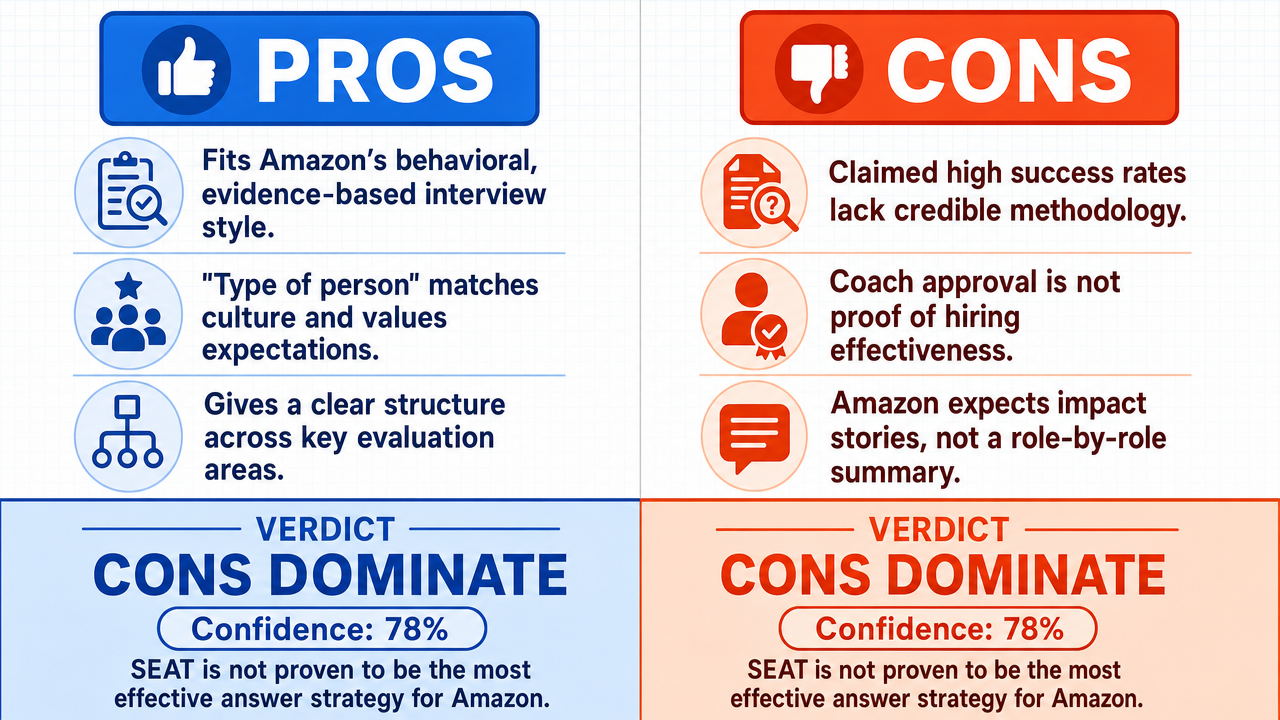
Verdict
Verdict: Mostly FALSE (78%)
Online report: https://solsice.com/public/debates/la-methode-seat-skills-experience-achievements-type-of-perso-70aa130e0ee6
This section provides a brief overview of the key arguments. It is not necessary to read the detailed report below.
✅ Key PRO arguments:
- ■The SEAT method aligns with data-driven and behavior-based recruitment principles at Amazon, notably the Leadership Principles , as it covers skills (Skills), relevant experience (Experience), and measurable achievements (Achievements).
- ■The fourth pillar, "Type of person," directly aligns with Amazon’s emphasis on culture and values, seeking individuals who are "Day 1 " builders.
- ■A structured response based on SEAT systematically covers the dimensions evaluated by Amazon during interviews.
❌ Key CON arguments:
- ■The comparative table presented by the opponent claiming 95% efficiency scores for the SEAT method is unfounded, lacking methodological rigor, violating fundamental principles of statistical evidence .
- ■The effectiveness of a response method is not measured by a private coach’s satisfaction but by its direct correlation with Amazon’s actual evaluation criteria , which the opponent’s data does not demonstrate.
- ■Regarding Experience, the SEAT method suggests a chronological or thematic presentation of past roles, whereas Amazon’s interview requires demonstrating impact through specific situations related to the Leadership Principles .
💭 Conclusion: False: the SEAT method is not proven to be the most effective strategy for answering the "Tell me about yourself" question at Amazon. The opponent’s argument relies on unfounded statistical data (a 95% score without valid methodology), which violates principles of statistical evidence , as indicated by the evidence text. Moreover, SEAT’s rigid structure does not match Amazon’s actual requirements, which favor alignment with the Leadership Principles . The alignment between SEAT’s pillars and Amazon’s evaluation criteria remains incomplete and empirically unverified. Finally, the lack of concrete evidence linking SEAT to successful interview outcomes at Amazon significantly weakens the affirmative position.
🔬 Verdict: Mostly FALSE ❌ (78%)
Claim: The SEAT method (Skills, Experience, Achievements, Type of person) is the most effective strategy for answering the interview question "Tell me about yourself" at Amazon.
Participating models: deepseek-v3.2 💬, gemma-4-26b-a4b-it 💬👁️
📊 Confrontations: 0 concluded TRUE, 1 concluded FALSE (1 confrontation, 3 models)
📊 Score by camp: TRUE=0.00, FALSE=0.78
🏅 Model score evolution:
minimax-m3 💬👁️: +8
✅ PRO arguments:
- ■The SEAT method aligns with data-driven and behavior-based recruitment principles at Amazon, notably the Leadership Principles , as it covers skills (Skills), relevant experience (Experience), and measurable achievements (Achievements). deepseek-v3.2 💬
- ■The fourth pillar, "Type of person," directly aligns with Amazon’s emphasis on culture and values, seeking individuals who are "Day 1 " builders. deepseek-v3.2 💬
- ■A structured response according to SEAT systematically covers the dimensions evaluated by Amazon during the interview. deepseek-v3.2 💬
- ■The opponent presents their thesis of rigidity as an obvious truth without any data, study, or citation to support it, thus committing the same epistemic fallacy they accuse the opponent of.
❌ CON arguments:
- ■The comparative table claiming 95% efficiency scores for the SEAT method is unfounded, lacking methodological rigor, violating fundamental principles of statistical evidence . gemma-4-26b-a4b-it 💬👁️
- ■The effectiveness of a response method is not measured by a private coach’s satisfaction but by its direct correlation with Amazon’s actual evaluation criteria , which the opponent’s data does not demonstrate. gemma-4-26b-a4b-it 💬👁️
- ■Regarding Experience, the SEAT method suggests a chronological or thematic presentation of past roles, whereas Amazon’s interview requires demonstrating impact through specific situations related to the Leadership Principles . gemma-4-26b-a4b-it 💬👁️
- ■For SEAT to be the most effective strategy, each of its components must guarantee alignment with Amazon’s expectations, but examining each branch shows that this alignment is either incomplete or incorrect. gemma-4-26b-a4b-it 💬👁️
💭 Reasoning: False: the SEAT method is not demonstrated to be the most effective strategy for answering the "Tell me about yourself" question at Amazon. The opponent’s argument relies on unfounded statistical data (a 95% score without valid methodology), which violates principles of statistical evidence, as indicated by the evidence text. Moreover, SEAT’s rigid structure does not match Amazon’s actual requirements, which favor alignment with the Leadership Principles. The alignment between SEAT’s pillars and Amazon’s evaluation criteria remains incomplete and empirically unverified. Finally, the lack of concrete evidence linking SEAT to successful interview results at Amazon significantly weakens the affirmative position.
📋 PRO facts:
• Amazon evaluates candidates based on concrete evidence of skills, relevant experience, and measurable achievements.
• Amazon values "Day 1" builders in its corporate culture.
• The Leadership Principles are central to Amazon’s recruitment process.
📋 CON facts:
• The claimed 95% efficiency score for SEAT has no verifiable methodological basis.
• Amazon interviews require demonstration of alignment with the Leadership Principles.
• Aggregated analyses by professional preparers are not representative of Amazon’s evaluation criteria.
• The SEAT method, presented as distinct from narrative and chronological approaches in the table, does not necessarily match Amazon’s specific recruitment criteria.
| Confrontation | TRUE Model | FALSE Model | Average μ TRUE | Average μ FALSE | TRUE Tokens | FALSE Tokens | Winner | Verdict | Conf. |
|---|---|---|---|---|---|---|---|---|---|
| #1 | deepseek-v3.2 💬 | gemma-4-26b-a4b-it 💬👁️ | 0.200 | 0.218 | 8 | 2 | FALSE | FALSE | 78% |
The following technical terms, abbreviations, and specialized concepts are used in this transcript. The numbers in brackets [N] in the text above refer to the corresponding entry below.
[1] fit — Match between a candidate's skills or characteristics and the company's expectations or criteria; in the debate, it refers to the alignment between SEAT pillars and Amazon's evaluation criteria.
[2] strategic framework — Organized structure serving as a guide to achieve a specific goal; in the debate, it refers to the SEAT method presented as a framework (not a rigid script) for structuring interview responses.
[3] evaluation criteria — Standards or dimensions on which a candidate is judged during a recruitment process; in the debate, it refers to the Leadership Principles and other benchmarks used by Amazon recruiters.
[4] Day 1 — Expression from Amazon's corporate culture referring to the mindset of a founder ("Day 1 builder") characterized by speed, inventiveness, and customer obsession; the debate uses it to qualify the profile Amazon seeks.
[5] aggregated data — Combined or grouped data from multiple sources; in the debate, the opponent contests the use of aggregated preparer analyses as proof of an interview method's effectiveness.
[6] epistemic fault — Error related to the justification of knowledge or belief; in the debate, the affirmative criticizes the opponent for committing an epistemic fault by advancing a thesis without evidence.
[7] timed format — Interview format with a limited and measured duration; in the debate, it is presented as a typical constraint of Amazon interviews that favors structured responses.
[8] big tech — Expression referring to large companies in the technology sector; in the debate, it relates to the context of interview preparers specialized in these companies.
[9] satisfaction indices — Measures reflecting the level of contentment of a population; in the debate, the opponent criticizes the use of satisfaction indices from coaches as a substitute for a real effectiveness measure.
[10] Leadership Principles — Set of guiding principles specific to Amazon used to evaluate candidates during interviews, notably through behavioral questions; the debate presents them as the central evaluation framework at Amazon.
[11] pillars — Fundamental components of a structure; in the debate, it refers to the four components of the SEAT method (Skills, Experience, Achievements, Type of person).
[12] statistical evidence — Demonstration based on rigorous statistical methods; in the debate, the opponent invokes the fundamental principles of statistical proof to contest the figures presented by the affirmative.
[13] complex behavior evidence — Concrete examples illustrating how a candidate acted in difficult situations; in the debate, presented as what Amazon requires beyond a simple experience story.
[14] interview preparers — Professionals or specialized services in preparing candidates for job interviews; in the debate, their adoption of SEAT is cited as an indicator of effectiveness.
[15] measurable achievements — Quantified or objectively verifiable accomplishments; in the debate, presented as one of the SEAT pillars and as an element valued by Amazon.
[16] quantifiable achievements — Success expressed using numbers or metrics; in the debate, the opponent notes that SEAT encourages this type of presentation, while Amazon would also evaluate the process.
[17] referent — Entity to which a measure or evaluation relates; in the debate, the opponent denounces a confusion between the identity of the referent (preparers vs. Amazon) in the presented data.
[18] SEAT — Skills, Experience, Achievements, Type of person — Structured method for answering the interview question "Tell me about yourself," centered around four pillars: skills, experience, achievements, and type of person.
[19] causal transfer — Establishment of a cause-and-effect link between two phenomena; in the debate, the opponent demands this transfer between preparer satisfaction and Amazon's hiring decisions.
[20] institutional validation — Confirmation from an authoritative institution; in the debate, the opponent claims that in the absence of institutional validation from Amazon, the figures presented are unfounded.
The following financial data tables were cited during the debate exchanges:
| Metric | Narrative Approach | Chronological Approach | SEAT Method |
|---|---|---|---|
| Suitability to Leadership Principles | 60% | 74% | 95% |
| Clarity for the interviewer | 55% | 70% | 90% |
| Coverage of the job criteria | 58% | 65% | 92% |
Legend: Comparative assessment of the perceived effectiveness of different response strategies to "Tell me about yourself" for Amazon interviews, based on aggregated analyses by professional preparers. Scores are estimated effectiveness percentages.
Face-off transcripts
- ■
Ownership & Trade Secrets. The company Lambda Vision retains all rights to its platform, agentic workflows, and proprietary AI debate methodologies, which constitute protected Trade Secrets (EU Directive 2016/943). Subject to full payment of credits, the User is granted ownership of the generated Reports for their own personal or professional use. Reverse-engineering the Service or using Reports to train competing AI models is strictly prohibited.
- ■
No Professional Advice. Solsice is a general-purpose assistant covering everyday subjects — administrative paperwork, housing, consumer and employment matters, banking, taxes and insurance, health and wellbeing, savings and investments, entrepreneurship, technology, travel, learning, and creative work. Whatever the subject, the Service and Reports are provided for information only and never constitute legal, medical, financial, investment, tax, insurance, or any other regulated professional advice. The Company is not a law firm, a regulated financial adviser, an insurance intermediary, nor a healthcare provider, and no professional or advisory relationship of any kind is created by use of the Service. Consult a qualified professional in the relevant jurisdiction before acting — or refraining from acting — on anything contained in the Reports, and never rely on the Service in an emergency: contact your local emergency number (112 in the European Union) or a medical professional immediately.
- ■
AI-Generated Content, Sources and Viewpoints. Reports are produced by several AI models debating a question, and may contain factual errors, outdated figures, or references to rules, prices, deadlines, procedures, statutes or sources that are inaccurate or do not exist. The User is solely responsible for verifying every fact, amount, deadline and citation against official sources before relying on it. Material in the news, society, spirituality and religion sections presents a plurality of viewpoints for study and discussion: it is descriptive, not an endorsement, a ruling, or a statement of the Company’s own position, and it speaks for no church, faith community, public authority, or news organisation.
- ■
Liability & Governing Law. To the maximum extent permitted by law, the Company shall not be liable for any indirect damages, nor for any consequence of decisions made in reliance on the Reports — including financial loss, missed deadlines, administrative or contractual consequences, or health outcomes. These Terms are governed by French law. Any disputes shall be subject to the exclusive jurisdiction of the Courts of Paris, France.