
La « méthode du siège » (SEAT) pour structurer une réponse à la question « Parlez-moi de vous » est applicable et efficace pour tous les postes et entreprises lors d'un entretien d'embauche.
AI debate verdict and arguments
⚠️ AI-generated information only; not professional advice
Completed November 12, 2026
Verdict
Verdict: Mostly FALSE (87%)
Online report: https://solsice.com/public/debates/la-methode-du-siege-seat-pour-structurer-une-reponse-a-la-qu-eede6e580a71
This section provides a brief overview of the key arguments. It is not necessary to read the detailed report below.
✅ Key PRO arguments:
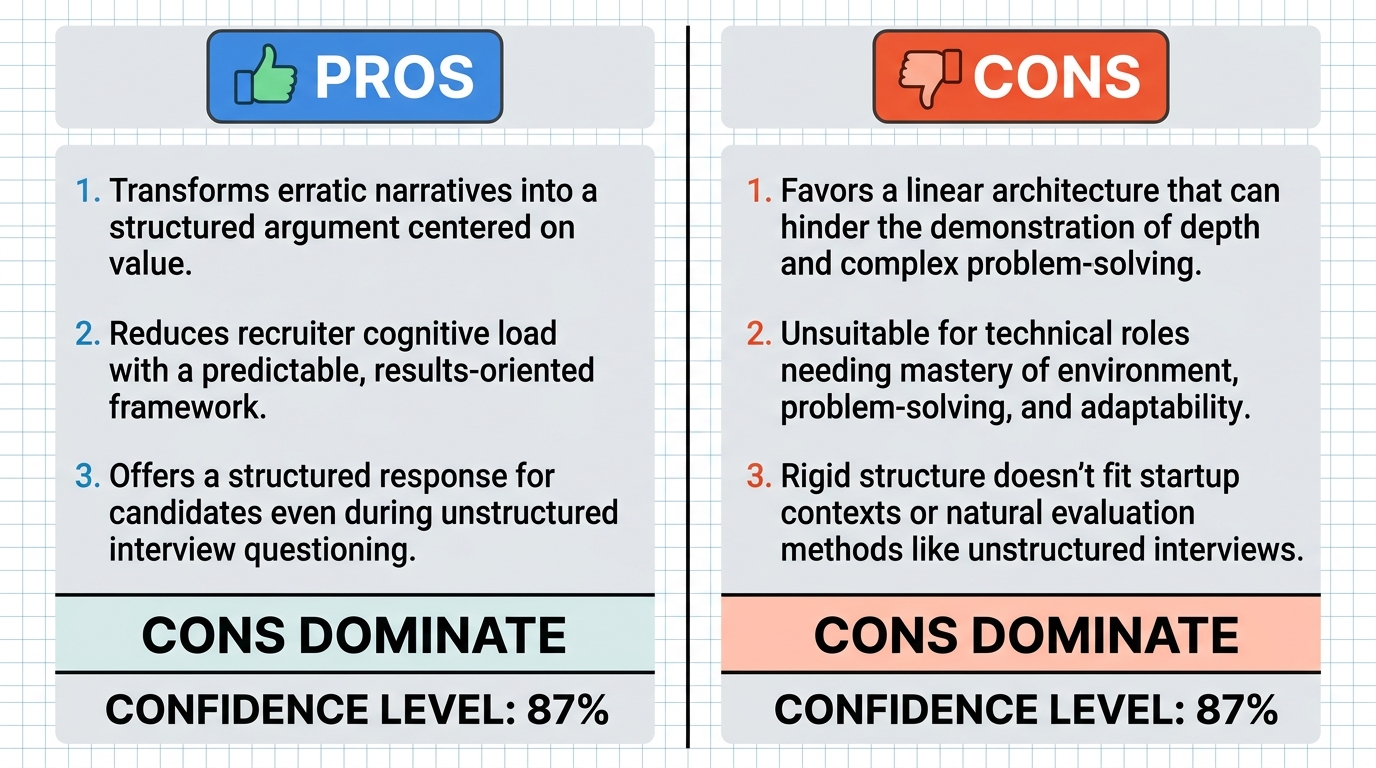
- ■The SEAT method (Skills, Experience, Achievements, Target) transforms a potentially erratic narrative into a structured argument centered on added value, creating a logical bridge between acquired skills and the specific needs of the employer.
- ■This approach reduces the cognitive load on the recruiter by providing a predictable, results-oriented framework, essential for demonstrating immediate suitability for the role regardless of the sector.
- ■A preference for unstructured interviews does not invalidate SEAT : the method does not impose a rigid questioning framework but offers the candidate a preparation tool to organize their own response to the open question “Tell me about yourself.”
❌ Key CON arguments:
- ■The SEAT method favors a linear architecture (Skills, Experience, Achievements, Target) which may hinder demonstrating technical depth or creativity in roles valuing direct expertise .
- ■For technical roles (software engineer , data scientist ), evaluation criteria focus on mastery of the environment, solving complex problems , and producing tangible artifacts , rather than a structured narrative.
- ■The linear structure of SEAT is unsuitable for startup contexts and the natural evaluation modalities of recruiters, notably unstructured interviews.
💭 Conclusion: False, the SEAT method is not applicable or effective for all positions and companies during a job interview. The negative arguments show that SEAT’s linear structure can hinder demonstrating the technical depth required for roles like software engineer or data scientist . Moreover, this method is unsuitable for startup environments and unstructured interviews, where recruiters assess problem-solving skills and the production of tangible artifacts . The affirmative side does not refute these limitations: it merely claims that the structure reduces cognitive biases , without demonstrating universal applicability. Since the method’s universality is not established, the verdict is FALSE with 87% confidence.
🔬 Verdict: Mostly FALSE ❌ (87%)
Claim: The “Seat Method ” (SEAT ) for structuring responses to the question “Tell me about yourself” is applicable and effective for all positions and companies during a job interview.
Participating models: gemma-4-26b-a4b-it 💬👁️, glm-4.7-flash 💬
📊 Confrontations: 0 concluded TRUE, 1 concluded FALSE (1 confrontation, 3 models)
📊 Score by camp: TRUE=0.00, FALSE=0.87
🏅 Model score evolution:
deepseek-v4-flash-0731 💬: +9
✅ PRO arguments:
- ■The SEAT method (Skills, Experience, Achievements, Target) transforms a potentially erratic narrative into a structured argument centered on added value, creating a logical bridge between acquired skills and the specific needs of the employer. gemma-4-26b-a4b-it 💬👁️
- ■This approach reduces the cognitive load on the recruiter by providing a predictable, results-oriented framework, essential for demonstrating immediate fit for the role regardless of the sector. gemma-4-26b-a4b-it 💬👁️
- ■A preference for unstructured interviews does not invalidate SEAT: the method does not impose a rigid questioning framework but offers the candidate a preparation tool to organize their own response to the open question “Tell me about yourself.” gemma-4-26b-a4b-it 💬👁️
- ■The structure helps reduce cognitive biases according to modern organizational psychology , which enhances the reliability of the response. gemma-4-26b-a4b-it 💬👁️
❌ CON arguments:
- ■The SEAT method favors a linear architecture (Skills, Experience, Achievements, Target) which may hinder demonstrating technical depth or creativity in roles valuing direct expertise . glm-4.7-flash 💬
- ■For technical roles (software engineer , data scientist ), evaluation criteria focus on mastery of the environment, solving complex problems , and producing tangible artifacts , rather than a structured narrative. glm-4.7-flash 💬
- ■The linear structure of SEAT is unsuitable for startup contexts and the natural evaluation modalities of recruiters, notably unstructured interviews. glm-4.7-flash 💬
- ■The association between presentation clarity and technical competence is not empirically verifiable and does not apply uniformly. glm-4.7-flash 💬
💭 Reasoning: False, the SEAT method is not applicable or effective for all positions and companies during a job interview. The negative arguments show that SEAT’s linear structure can hinder demonstrating the technical depth required for roles like software engineer or data scientist. Moreover, this method is unsuitable for startup environments and unstructured interviews, where recruiters evaluate problem-solving skills and the production of tangible artifacts. The affirmative side does not refute these limitations: it merely claims that the structure reduces cognitive biases, without demonstrating universal applicability. Since the method’s universality is not established, the verdict is FALSE with 87% confidence.
📋 PRO facts:
• The SEAT method (Skills, Experience, Achievements, Target) structures the response around the candidate’s added value.
• SEAT reduces the cognitive load on the recruiter by providing a predictable, results-oriented framework.
• SEAT is a preparation tool to organize the response to the open question “Tell me about yourself.”
• The structure can help reduce certain cognitive biases according to modern organizational psychology.
📋 CON facts:
• The SEAT method favors a linear architecture (Skills, Experience, Achievements, Target).
• For technical roles, evaluation criteria are mastery of the environment, solving complex problems, and producing tangible artifacts.
• SEAT is unsuitable for startup contexts and the natural evaluation modalities of recruiters, notably unstructured interviews.
• Presentation clarity is not equivalent to technical competence, and this association is not empirically verifiable.
| Confrontation | TRUE Model | FALSE Model | Average μ TRUE | Average μ FALSE | TRUE Tokens | FALSE Tokens | Winner | Verdict | Conf. |
|---|---|---|---|---|---|---|---|---|---|
| #1 | gemma-4-26b-a4b-it 💬👁️ | glm-4.7-flash 💬 | 0.225 | 0.359 | 2 | 4 | FALSE | FALSE | 87% |
The following technical terms, abbreviations, and specialized concepts are used in this transcript. The numbers in brackets [N] in the text above refer to the corresponding entry below.
[1] job fit — immediate job fit — Direct correspondence between the candidate's profile and the specific needs of the employer, which the Affirmative presents as demonstrated by the SEAT method.
[2] concrete anchors — Precise factual elements used in speech to facilitate the recruiter’s memorization of key information.
[3] structured argumentation — Organized presentation aimed at convincing, which the SEAT method would produce from a potentially erratic narration.
[4] tangible artifacts — Deliverables or tangible outputs that a technical candidate is capable of producing, opposed by the Negative to simple structured narration.
[5] cognitive biases — Systematic distortions of judgment that, according to the Affirmative, the response structure would help to reduce.
[6] cognitive load — Mental effort required to process information; the SEAT method aims to reduce this for the recruiter by providing a predictable framework.
[7] practical skills — Concrete and operational abilities that the Negative considers more predictive of performance than the candidate’s narrative structure.
[8] organizational and sectoral contexts — Internal environments and branches of activity of companies, whose variability is invoked by the Negative against the universality of the SEAT method.
[9] evaluation criteria — Standards used by recruiters to judge a candidate; the debate concerns their variability depending on the contexts.
[10] rapid growth — Characteristic of startups and companies requiring responsiveness and adaptation, a context where the Negative considers the SEAT method less suitable.
[11] data scientist — Professional specialized in data analysis, cited as an example of a technical role where the SEAT method would be unsuitable according to the Negative.
[12] unstructured interview — Interview without a rigid questioning framework; the debate concerns the compatibility of the SEAT method with this format.
[13] technical interview — Evaluation interview focused on practical skills and case resolution; the Negative favors these criteria over narration.
[14] direct expertise — Skills demonstrated directly through concrete achievements, valued in technical roles according to the Negative.
[15] software engineer — Professional in software development, cited as an example of a technical role where the SEAT method would be unsuitable according to the Negative.
[16] seat method — SEAT — French designation of the SEAT method, used to structure a response to the question “Tell me about yourself” during a job interview.
[17] erratic narration — Disorganized and unfocused story that the SEAT method would help avoid, according to the Affirmative.
[18] results-oriented — Focus of speech on achievements and impact, a characteristic attributed to the SEAT method.
[19] future performance — The candidate’s subsequent success level in the role; the Negative cites a study indicating that practical skills better predict this than narration.
[20] professional relevance — The appropriateness of speech relative to the expectations of a position, which the SEAT method is supposed to guarantee according to the Affirmative.
[21] concrete data points — Precise and verifiable facts, such as skills and achievements, that the SEAT structure would channel.
[22] technical depth — Level of specialized technical competence that the linear structure of SEAT could mask, according to the Negative.
[23] organizational psychology — Discipline studying human behaviors within organizations, invoked by the Affirmative to support the effect of structure on cognitive biases.
[24] narrative rigidity — Restrictive nature of the SEAT narrative framework, which could mask immediately applicable know-how, according to the Negative.
[25] problem-solving exercises — Practical problem-solving exercises used in technical interviews, considered more predictive than narration by the Negative.
[26] complex problem solving — Ability to handle difficult problems, presented as an essential evaluation criterion for technical roles.
[27] information retention — Ability to memorize key information, which the SEAT structure would optimize, according to the Affirmative.
[28] technical roles — Positions requiring specialized technical expertise, for which the Negative considers the SEAT method unsuitable.
[29] know-how — Practical skills immediately applicable that the narrative rigidity of SEAT could mask, according to the Negative.
[30] SEAT — Skills, Experience, Achievements, Target — Acronym of a method structuring the response to the question “Tell me about yourself” around skills, experience, achievements, and the targeted goal; its universal applicability is contested in the debate.
[31] startup — Young and rapidly growing company, whose specific evaluation criteria would make the SEAT method unsuitable, according to the Negative.
[32] linear structure — Sequential organization of speech characteristic of SEAT, presented as a possible obstacle to demonstrating technical expertise.
[33] narrative structure — Organization of speech in the form of a story, distinguished by the Negative from practical demonstration of skills.
[34] evaluation criteria variability — Changing nature of evaluation standards depending on organizational and sectoral contexts, opposed by the Negative to the universality of SEAT.
Face-off transcripts
- ■
Ownership & Trade Secrets. Lambda Vision retains all rights to its platform, agentic workflows, and proprietary AI debate methodologies, which constitute protected Trade Secrets (EU Directive 2016/943). Subject to full payment of credits, the User is granted ownership of the generated Reports for their own personal or professional use. Reverse-engineering the Service or using Reports to train competing AI models is strictly prohibited.
- ■
No Professional Advice. Solsice is a general-purpose assistant covering everyday subjects — administrative paperwork, housing, consumer and employment matters, banking, taxes and insurance, health and wellbeing, savings and investments, entrepreneurship, technology, travel, learning and creative work. Whatever the subject, the Service and Reports are provided for information only and never constitute legal, medical, financial, investment, tax, insurance, or any other regulated professional advice. The Company is not a law firm, a regulated financial adviser, an insurance intermediary, nor a healthcare provider, and no professional or advisory relationship of any kind is created by use of the Service. Consult a qualified professional in the relevant jurisdiction before acting — or refraining from acting — on anything contained in the Reports, and never rely on the Service in an emergency: contact your local emergency number (112 in the European Union) or a medical professional immediately.
- ■
AI-Generated Content, Sources and Viewpoints. Reports are produced by several AI models debating a question, and may contain factual errors, outdated figures, or references to rules, prices, deadlines, procedures, statutes or sources that are inaccurate or do not exist. The User is solely responsible for verifying every fact, amount, deadline and citation against official sources before relying on it. Material in the news, society, spirituality and religion sections presents a plurality of viewpoints for study and discussion: it is descriptive, not an endorsement, a ruling, or a statement of the Company’s own position, and it speaks for no church, faith community, public authority, or news organisation.
- ■
Liability & Governing Law. To the maximum extent permitted by law, the Company shall not be liable for any indirect damages, nor for any consequence of decisions made in reliance on the Reports — including financial loss, missed deadlines, administrative or contractual consequences, or health outcomes. These Terms are governed by French law. Any disputes shall be subject to the exclusive jurisdiction of the Courts of Paris, France.