
La FIFA utilise la perspective d'une Coupe d'Afrique des Nations (CAN) en 2026 comme levier politique pour s'assurer le soutien des fédérations africaines lors des élections.
AI debate verdict and arguments
⚠️ AI-generated information only; not professional advice
Completed October 11, 2026
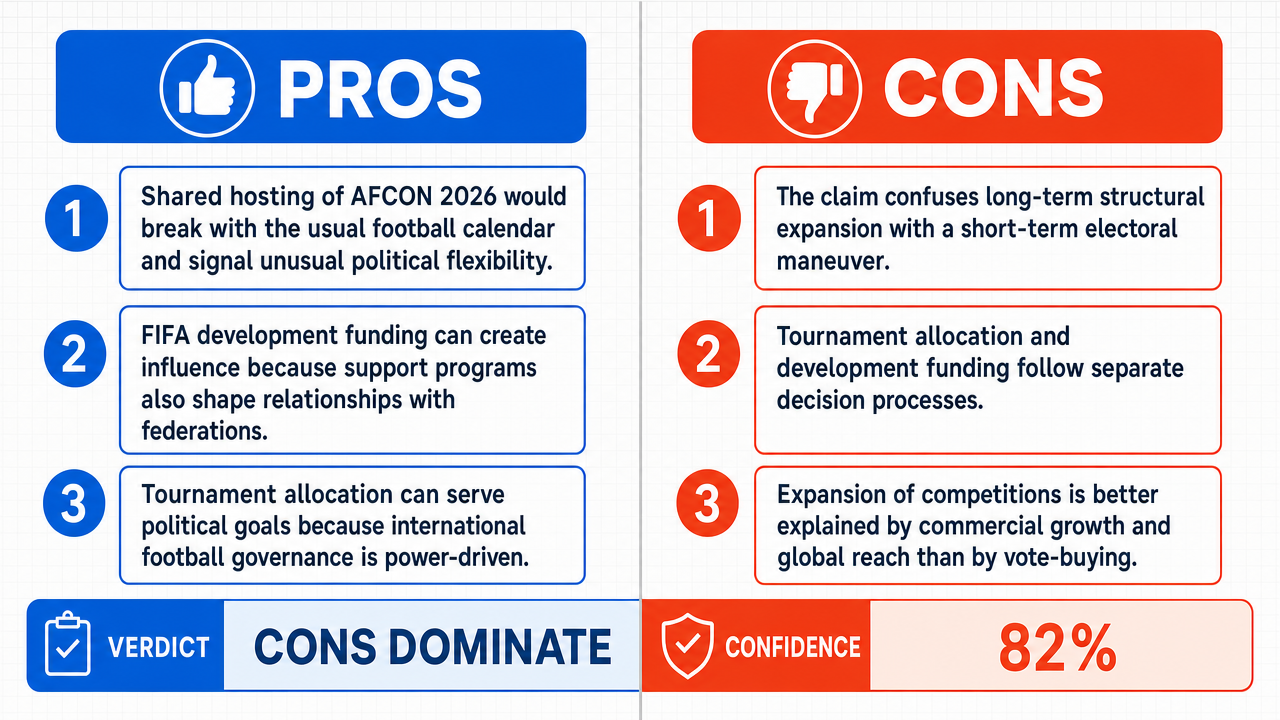
Verdict
Verdict: Mostly FALSE (82%)
This section provides a brief overview of the key arguments. It is not necessary to read the detailed report below.
✅ Key PRO arguments:
- ■The awarding of the 2026 Africa Cup of Nations (AFCON ) to a trio of countries (Morocco, Spain, Portugal) constitutes an unprecedented decision that alters the established football calendar, thereby creating a major political resource personally championed by Gianni Infantino with African federations .
- ■The FIFA Forward program, with a budget of several billion dollars, functions not only as a development tool but also as an institutional clientelism mechanism , whose allocation is influenced by political considerations and loyalties .
- ■The very nature of international football governance makes tournament allocations a tool of political power, and creating an opportunity like AFCON 2026 represents a strategic resource offered to a continental bloc , whose vote is decisive.
❌ Key CON arguments:
- ■The opposing argument relies on a false causality by confusing the structural expansion of football with an electoral maneuver; tournament allocations respond to a logic of growth in the global football market and maximization of commercial footprint , not a political strategy.
- ■Decisions on tournament allocations and development funding cycles follow separate processes; artificially merging these processes to infer a unified political intent is a reasoning error.
- ■The expansion of competitions, such as the prospect of AFCON 2026, responds to a logic of commercial growth and global football influence aimed at maximizing media revenues and fan engagement , which is a structural necessity for any international body.
💭 Conclusion: False: the prospect of AFCON 2026 is not an electoral political lever but part of a structural logic of expanding global football commercial interests. The opposing argument makes a causality error by confusing organic market growth with a targeted electoral maneuver. Tournament allocation decisions and development funding cycles follow distinct processes that cannot be artificially merged to infer a unified political intent. The integration of high-growth geographic zones responds to an economic necessity of revenue sustainability through media revenues and fan engagement . Finally, no concrete evidence has been provided establishing a direct causal link between the promise of AFCON 2026 and the obtaining of specific votes during FIFA elections .
🔬 Verdict: Mostly FALSE ❌ (82%)
Claim: FIFA uses the prospect of the 2026 Africa Cup of Nations (AFCON ) as a political lever to secure the support of African federations during elections.
Participating models: deepseek-v3.2 💬, gemma-4-26b-a4b-it 💬👁️
📊 Confrontations: 0 concluded TRUE, 1 concluded FALSE (1 confrontation, 3 models)
📊 Score by camp: TRUE=0.00, FALSE=0.82
🏅 Model score evolution:
minimax-m3 💬👁️: +8
✅ PRO arguments:
- ■The awarding of the 2026 AFCON to a trio of countries (Morocco, Spain, Portugal) is an unprecedented decision that modifies the established football calendar, creating a major political resource personally promoted by Gianni Infantino with African federations. deepseek-v3.2 💬
- ■The FIFA Forward program, with a budget of several billion dollars, functions not only as a development tool but also as an institutional clientelism mechanism , whose allocation is influenced by political considerations and loyalties . deepseek-v3.2 💬
- ■The very nature of international football governance makes tournament allocations a tool of political power, and creating an opportunity like AFCON 2026 represents a strategic resource offered to a continental bloc , whose vote is decisive. deepseek-v3.2 💬
- ■The timing and overall context of FIFA decisions suggest a coordinated strategy to strengthen its political influence with African federations ahead of electoral deadlines. deepseek-v3.2 💬
❌ CON arguments:
- ■The opposing argument relies on a false causality by confusing the structural expansion of football with an electoral maneuver; tournament allocations respond to a logic of growth in the global football market and maximization of commercial footprint , not a political strategy. gemma-4-26b-a4b-it 💬👁️
- ■Decisions on tournament allocations and development funding cycles follow separate processes; artificially merging these processes to infer a unified political intention is a reasoning error. gemma-4-26b-a4b-it 💬👁️
- ■The expansion of competitions, such as the prospect of AFCON 2026, responds to a logic of commercial growth and global football influence aimed at maximizing media revenues and fan engagement , which is a structural necessity for any international body. gemma-4-26b-a4b-it 💬👁️
- ■The fundamental distinction between the imperatives of sports development and political clientelism must be maintained: AFCON 2026 is part of a strategy of economic sustainability , not electoral blackmail. gemma-4-26b-a4b-it 💬👁️
💭 Reasoning: False: the prospect of AFCON 2026 is not an electoral political lever but part of a structural logic of expanding global football interests. The causality error is made by confusing organic market growth with a targeted electoral maneuver. Tournament allocations and development funding cycles follow separate processes that cannot be artificially merged to infer a unified political intent. The integration of high-growth geographic zones responds to an economic necessity of revenue sustainability of media and fan engagement. No concrete evidence has been provided establishing a direct causal link between the promise of AFCON 2026 and the acquisition of specific votes during FIFA elections.
📋 PRO facts:
• AFCON 2026 was awarded to a trio of countries (Morocco, Spain, Portugal), a decision that unprecedentedly modifies the established football calendar.
• The FIFA Forward program has a budget of several billion dollars.
• Gianni Infantino personally promoted and supported the AFCON 2026 project with African federations.
📋 CON facts:
• The expansion of competition formats and alignment of calendars respond to a strategy of media revenue sustainability and fan engagement.
• The decisions regarding tournament hosting and the funding cycles for development follow distinct processes within international sports governance.
• FIFA aims to maximize its commercial footprint by integrating regions with high growth potential.
| Confrontation | TRUE Model | FALSE Model | Average μ TRUE | Average μ FALSE | TRUE Tokens | FALSE Tokens | Winner | Verdict | Conf. |
|---|---|---|---|---|---|---|---|---|---|
| #1 | deepseek-v3.2 💬 | gemma-4-26b-a4b-it 💬👁️ | 0.290 | 0.252 | 12 | 3 | TRUE | FALSE | 82% |
The following technical terms, abbreviations, and specialized concepts are used in this transcript. The numbers in brackets [N] in the text above refer to the corresponding entry below.
[1] continental block — Group of countries united by their geographical belonging to the same continent, forming a political or strategic unit in international negotiations, notably during votes within organizations like FIFA.
[2] CAF — Confédération Africaine de Football — Governing body of football in Africa, comprising the 54 national federations of the continent and organizing, among other competitions, the Africa Cup of Nations.
[3] AFCON — Africa Cup of Nations — International football competition organized by the Confederation of African Football (CAF), bringing together the best national teams of the African continent.
[4] clientelism — Political practice involving exchanging favors, resources, or material benefits for electoral support or political loyalty.
[5] institutional clientelism — Form of clientelism exercised by an institution (here FIFA) that uses its programs, funding, or allocations to secure political support from its members.
[6] candidate criteria — Set of technical, financial, and infrastructural conditions that a country or group of countries must meet to host an international competition.
[7] favors dispenser — Institutional actor who, by controlling the allocation of resources or privileges, exerts political influence over beneficiaries in exchange for their support.
[8] commercial footprint — Measure of the presence and economic impact of an organization or event on a given market, notably through generated revenues and visibility.
[9] fan engagement — Indicator measuring the degree of attachment, interaction, and participation of supporters in a sporting event, often translated into audience and revenue.
[10] FIFA — Fédération Internationale de Football Association — Global governing body of football, comprising 211 national federations and organizing, among other events, the World Cup.
[11] FIFA Forward — FIFA development program with a budget of several billion dollars, aimed at funding infrastructure and training projects within member federations.
[12] federations — National organizations grouping clubs and stakeholders of a sport within a given country, members of continental confederations and FIFA.
[13] governance — Set of mechanisms, rules, and processes through which an organization (here FIFA) is directed and controlled.
[14] geopolitics — Analysis of rivalries and power relations between states or regional blocs, here applied to the fragmented landscape of African football.
[15] political leverage — Resource or means used to influence decisions or obtain support from political actors, here the awarding of a major competition.
[16] loyalties — Political or institutional allegiances of federation leaders, which can influence their voting behavior.
[17] exchange currency — Good, advantage, or promise used as consideration in a negotiation, here the awarding of a tournament in exchange for electoral support.
[18] compliance protocols — Formal procedures governing adherence to rules and criteria established by an institution, here for awarding tournaments and funding programs.
[19] perpetuation — Action aimed at ensuring the sustainability and long-term stability of an activity or program, here revenues and engagement around football.
[20] strategic resource — Asset or means available to an organization to achieve its political or economic objectives, here the organization of the 2026 AFCON.
[21] media revenues — Financial receipts generated by television broadcasting and media rights of a sporting event.
[22] regional rivalries — Tensions and competitions between geographic zones within a continent, here between regions of African football.
[23] visibility — Degree of media and public exposure of an event, competition, or organization, a key factor in its commercial and political attractiveness.
Face-off transcripts
- ■
Ownership & Trade Secrets. Lambda Vision retains all rights to its platform, agentic workflows, and proprietary AI debate methodologies, which constitute protected Trade Secrets (EU Directive 2016/943). Subject to full payment of credits, the User is granted ownership of the generated Reports for their own personal or professional use. Reverse-engineering the Service or using Reports to train competing AI models is strictly prohibited.
- ■
No Professional Advice. Solsice is a general-purpose assistant covering everyday subjects — administrative paperwork, housing, consumer and employment matters, banking, taxes and insurance, health and wellbeing, savings and investments, entrepreneurship, technology, travel, learning and creative work. Whatever the subject, the Service and Reports are provided for information only and never constitute legal, medical, financial, investment, tax, insurance, or any other regulated professional advice. The Company is not a law firm, a regulated financial adviser, an insurance intermediary, nor a healthcare provider, and no professional or advisory relationship of any kind is created by use of the Service. Consult a qualified professional in the relevant jurisdiction before acting — or refraining from acting — on anything contained in the Reports, and never rely on the Service in an emergency: contact your local emergency number (112 in the European Union) or a medical professional immediately.
- ■
AI-Generated Content, Sources and Viewpoints. Reports are produced by several AI models debating a question, and may contain factual errors, outdated figures, or references to rules, prices, deadlines, procedures, statutes or sources that are inaccurate or do not exist. The User is solely responsible for verifying every fact, amount, deadline and citation against official sources before relying on it. Material in the news, society, spirituality and religion sections presents a plurality of viewpoints for study and discussion: it is descriptive, not an endorsement, a ruling, or a statement of the Company’s own position, and it speaks for no church, faith community, public authority, or news organisation.
- ■
Liability & Governing Law. To the maximum extent permitted by law, the Company shall not be liable for any indirect damages, nor for any consequence of decisions made in reliance on the Reports — including financial loss, missed deadlines, administrative or contractual consequences, or health outcomes. These Terms are governed by French law. Any disputes shall be subject to the exclusive jurisdiction of the Courts of Paris, France.