
La conscience humaine ne peut pas évoluer tant qu'un individu reste dans sa zone de confort.
AI debate verdict and arguments
⚠️ AI-generated information only; not professional advice
Completed October 26, 2026
Verdict
Verdict: Mostly FALSE (76%)
Online report: https://solsice.com/public/debates/human-consciousness-cannot-evolve-as-long-as-an-individual-stays-in-their-comfort-zone-b1ab2bcc7650
This section provides a brief overview of the key arguments. It is not necessary to read the detailed report below.
✅ Key PRO arguments:
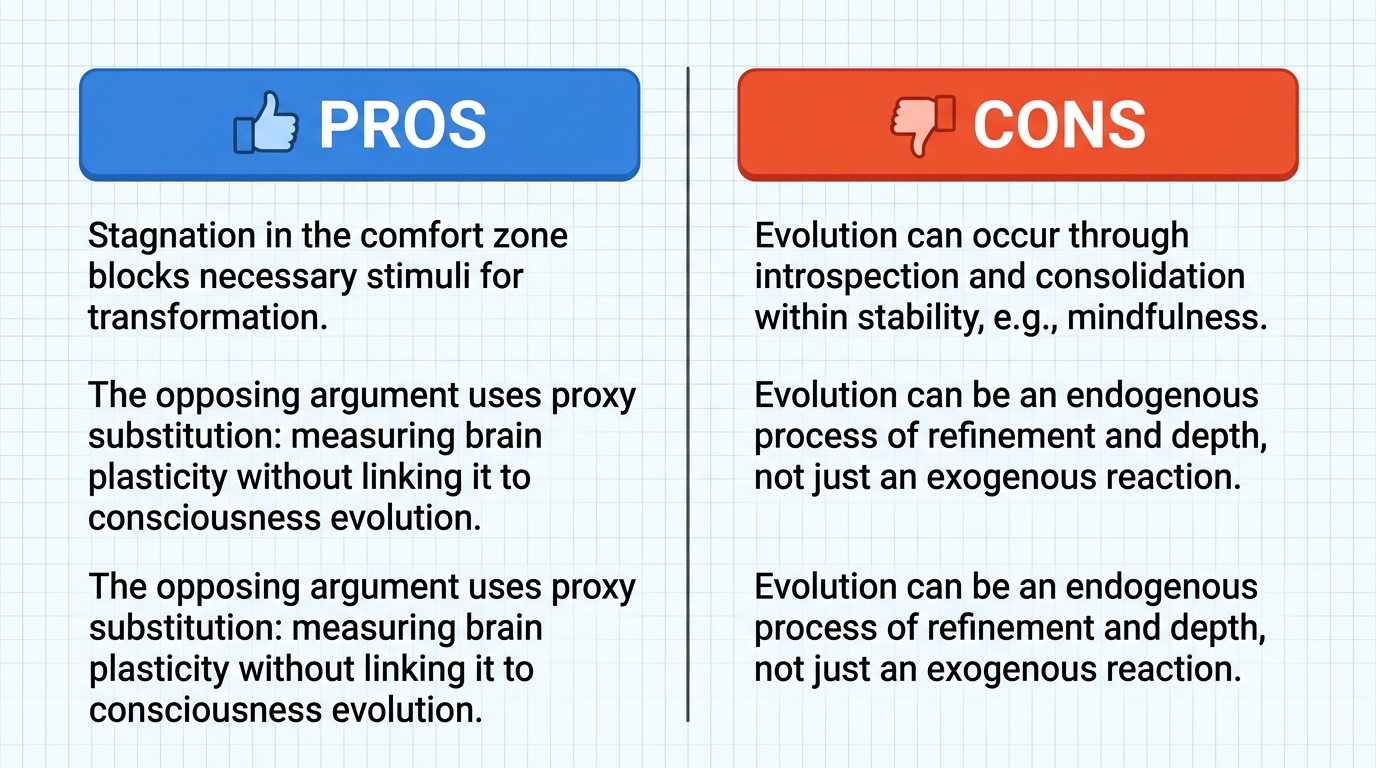
- ■Stagnation within the comfort zone blocks the evolution of consciousness by removing stimuli necessary for its transformation. The evolution of consciousness is a measurable neurobiological process that depends on exposure to new and unpredictable stimuli, as brain plasticity is activated by novelty, prediction error , and cognitive challenge .
- ■The opposing argument makes a proxy substitution error : it measures brain plasticity and concludes that consciousness is evolving without establishing a transfer link. Gray matter density is a measure of the neuroanatomical instrument, whereas consciousness is a distinct aggregate not directly inferred from this measure.
❌ Key CON arguments:
- ■The evolution of consciousness can occur through introspection and consolidation within stability. Mindfulness meditation demonstrates that consciousness evolution can emerge from stability and the repetition of attention to the present moment, as shown by Harvard University research on structural brain changes.
- ■The evolution of consciousness can be an endogenous process of refinement and depth, not an exogenous reactive process. Environmental stability, i.e., the comfort zone , is a necessary condition for the emergence of deep reflective consciousness, as it reduces informational noise .
💭 Conclusion: False, the verdict is FALSE because the opposing argument, defended by google/gemma-4-26b-a4b-it, demonstrates that consciousness evolution can occur through introspection and consolidation within stability. Judge deepseek/deepseek-v4-flash-0731 assigned a confidence of 76% to this position, versus 0% for the affirmative thesis. The winning argument relies on mindfulness meditation and Harvard research showing that stability allows structural brain modifications without requiring external unpredictable stimuli . It also contests reducing consciousness evolution to a purely reactive process, proposing an endogenous model of refinement and depth. The opposing thesis, based on brain plasticity and novelty, failed to establish a transfer link between neurobiological measures and consciousness evolution, reinforcing the FALSE verdict.
🔬 Verdict: Mostly FALSE ❌ (76%)
Claim: Human consciousness cannot evolve as long as an individual remains in their comfort zone .
Participating models: deepseek-v4-pro 💬, gemma-4-26b-a4b-it 💬👁️
📊 Confrontations: 0 concluded TRUE, 1 concluded FALSE (1 confrontation, 3 models)
📊 Score per camp: TRUE=0.00, FALSE=0.76
🏅 Model score evolution:
deepseek-v4-flash-0731 💬: +8
✅ PRO arguments:
- ■Stagnation within the comfort zone blocks the evolution of consciousness by removing stimuli necessary for its transformation. The evolution of consciousness is a measurable neurobiological process that depends on exposure to new and unpredictable stimuli, as brain plasticity is activated by novelty, prediction error , and cognitive challenge . deepseek-v4-pro 💬
- ■The opposing argument makes a proxy substitution error : it measures brain plasticity and concludes that consciousness is evolving without establishing a transfer link. Gray matter density is a measure of the neuroanatomical instrument, whereas consciousness is a distinct aggregate not directly inferred from this measure. deepseek-v4-pro 💬
❌ Arguments AGAINST:
- ■The evolution of consciousness can occur through introspection and consolidation within stability. Mindfulness meditation demonstrates that consciousness evolution can emerge from stability and the repetition of attention to the present moment, as shown by Harvard University research on structural brain changes. gemma-4-26b-a4b-it 💬👁️
- ■The evolution of consciousness can be an endogenous process of refinement and depth, not an exogenous reactive process. Environmental stability, i.e., the comfort zone, is a necessary condition for the emergence of deep reflective consciousness, as it reduces informational noise . gemma-4-26b-a4b-it 💬👁️
💭 Reasoning: False, the verdict is FALSE because the opposing argument, defended by google/gemma-4-26b-a4b-it, demonstrates that consciousness evolution can occur through introspection and consolidation within stability. Judge deepseek/deepseek-v4-flash-0731 assigned a confidence of 76% to this position, versus 0% for the affirmative thesis. The winning argument relies on mindfulness meditation and Harvard research showing that stability allows structural brain modifications without requiring external unpredictable stimuli. It also contests reducing consciousness evolution to a purely reactive process, proposing an endogenous model of refinement and depth. The opposing thesis, based on brain plasticity and novelty, failed to establish a transfer link between neurobiological measures and consciousness evolution, reinforcing the FALSE verdict.
📋 Supporting facts:
• Brain plasticity is activated by novelty, prediction error, and cognitive challenge.
• A study published in Nature Reviews Neuroscience demonstrates that exposure to enriched environments activates brain plasticity.
• Gray matter density is a measure of the neuroanatomical instrument, distinct from consciousness.
📋 Contradictory facts:
• Regular meditation practice structurally modifies the brain, increasing gray matter density in the hippocampus and prefrontal cortex .
• Research conducted by Harvard University shows that regular meditation practice modifies brain structure.
• Environmental stability reduces informational noise and allows the emergence of deep reflective consciousness.
| Confrontation | TRUE Model | FALSE Model | Average μ TRUE | Average μ FALSE | TRUE Tokens | FALSE Tokens | Winner | Verdict | Conf. |
|---|---|---|---|---|---|---|---|---|---|
| #1 | deepseek-v4-pro 💬 | gemma-4-26b-a4b-it 💬👁️ | 0.340 | 0.439 | 6 | 2 | FALSE | FALSE | 76% |
The following technical terms, abbreviations, and specialized concepts are used in this transcript. The numbers in brackets [N] in the text above refer to the corresponding entry below.
[1] Structural accommodation — Process by which the mind modifies its existing cognitive structures to incorporate new information, as opposed to assimilation.
[2] Superficial assimilation — Integration of new experiences into existing cognitive schemas without deep modification.
[3] Neuronal atrophy — Decrease in size or number of neurons, presented as a consequence of poor and routine environments.
[4] Automatism — Behavior or mental process that becomes unconscious and repetitive, opposed to attentive presence.
[5] Informational noise — Excess of irrelevant information that disrupts cognitive processing.
[6] Coefficient of determination — Statistical measure indicating the proportion of variance in one variable explained by another, used to evaluate a transfer link.
[7] Integrative complexity — Degree of sophistication with which consciousness integrates different experiences or information.
[8] Neuronal connections — Links between neurons underpinning brain function and plasticity.
[9] Reflective consciousness — Capacity of the mind to turn inward and examine its own states.
[10] Correlation — Statistical relationship between two variables, not necessarily implying causality.
[11] Prefrontal cortex — Brain region associated with higher cognitive functions, including attention and regulation.
[12] Synaptic density — Number of synapses per unit volume of brain tissue, an indicator of neuronal connectivity.
[13] Cognitive dissonance — Mental tension resulting from the coexistence of contradictory ideas or information.
[14] Cognitive challenge — Task or situation that tests and exceeds current mental capacities.
[15] Enriched environment — Environment characterized by novelty and complexity, promoting brain plasticity.
[16] Prediction error — Difference between an expectation and observed result, considered a trigger for learning.
[17] Hippocampus — Brain structure involved in memory and neurogenesis.
[18] Introspection — Observation and examination of one's own thoughts and internal states.
[19] Gray matter — Brain tissue mainly composed of neuron cell bodies, whose density is measured in the study.
[20] Mindfulness meditation — mindfulness — Practice of stable attention to the present moment, also called mindfulness.
[21] Hippocampal neurogenesis — Production of new neurons in the hippocampus, promoted by enriched environments.
[22] Transfer operator — Mechanism or evidence linking neurobiological change to a transformation of consciousness.
[23] Brain plasticity — Capacity of the brain to reorganize by forming new neural connections.
[24] Endogenous process — Change mechanism originating from within the organism or mind.
[25] Exogenous process — Change mechanism triggered by external factors.
[26] Experiential depth — Richness or qualitative intensity of conscious experience.
[27] Proxy — Variable or measure used in place of another that it is supposed to represent.
[28] Predictability — Characteristic of an environment where events are expected and do not require new adaptation.
[29] Cognitive schemas — Mental structures organizing perception and information processing.
[30] Attentional stability — Sustained maintenance of attention on an object or state, without distraction.
[31] Stimuli — Environmental elements that trigger sensory or cognitive reactions.
[32] Proxy substitution — Error of measuring an indirect variable and concluding directly on the variable of interest.
[33] Comfort zone — Space of maximum predictability where existing cognitive schemas suffice to handle situations.
[34] Longitudinal study — Research following the same subjects over a long period to observe evolutions.
Face-off transcripts
- ■
Ownership & Trade Secrets. Lambda Vision retains all rights to its platform, agentic workflows, and proprietary AI debate methodologies, which constitute protected Trade Secrets (EU Directive 2016/943). Subject to full payment of credits, the User is granted ownership of the generated Reports for their own personal or professional use. Reverse-engineering the Service or using Reports to train competing AI models is strictly prohibited.
- ■
No Professional Advice. Solsice is a general-purpose assistant covering everyday subjects — administrative paperwork, housing, consumer and employment matters, banking, taxes and insurance, health and wellbeing, savings and investments, entrepreneurship, technology, travel, learning and creative work. Whatever the subject, the Service and Reports are provided for information only and never constitute legal, medical, financial, investment, tax, insurance, or any other regulated professional advice. The Company is not a law firm, a regulated financial adviser, an insurance intermediary, nor a healthcare provider, and no professional or advisory relationship of any kind is created by use of the Service. Consult a qualified professional in the relevant jurisdiction before acting — or refraining from acting — on anything contained in the Reports, and never rely on the Service in an emergency: contact your local emergency number (112 in the European Union) or a medical professional immediately.
- ■
AI-Generated Content, Sources and Viewpoints. Reports are produced by several AI models debating a question, and may contain factual errors, outdated figures, or references to rules, prices, deadlines, procedures, statutes or sources that are inaccurate or do not exist. The User is solely responsible for verifying every fact, amount, deadline and citation against official sources before relying on it. Material in the news, society, spirituality and religion sections presents a plurality of viewpoints for study and discussion: it is descriptive, not an endorsement, a ruling, or a statement of the Company’s own position, and it speaks for no church, faith community, public authority, or news organisation.
- ■
Liability & Governing Law. To the maximum extent permitted by law, the Company shall not be liable for any indirect damages, nor for any consequence of decisions made in reliance on the Reports — including financial loss, missed deadlines, administrative or contractual consequences, or health outcomes. These Terms are governed by French law. Any disputes shall be subject to the exclusive jurisdiction of the Courts of Paris, France.