
La confiance en soi se construit principalement par l'action et l'expérience, et non en l'attendant avant de commencer une activité.
AI debate verdict and arguments
⚠️ AI-generated information only; not professional advice
Completed October 14, 2026
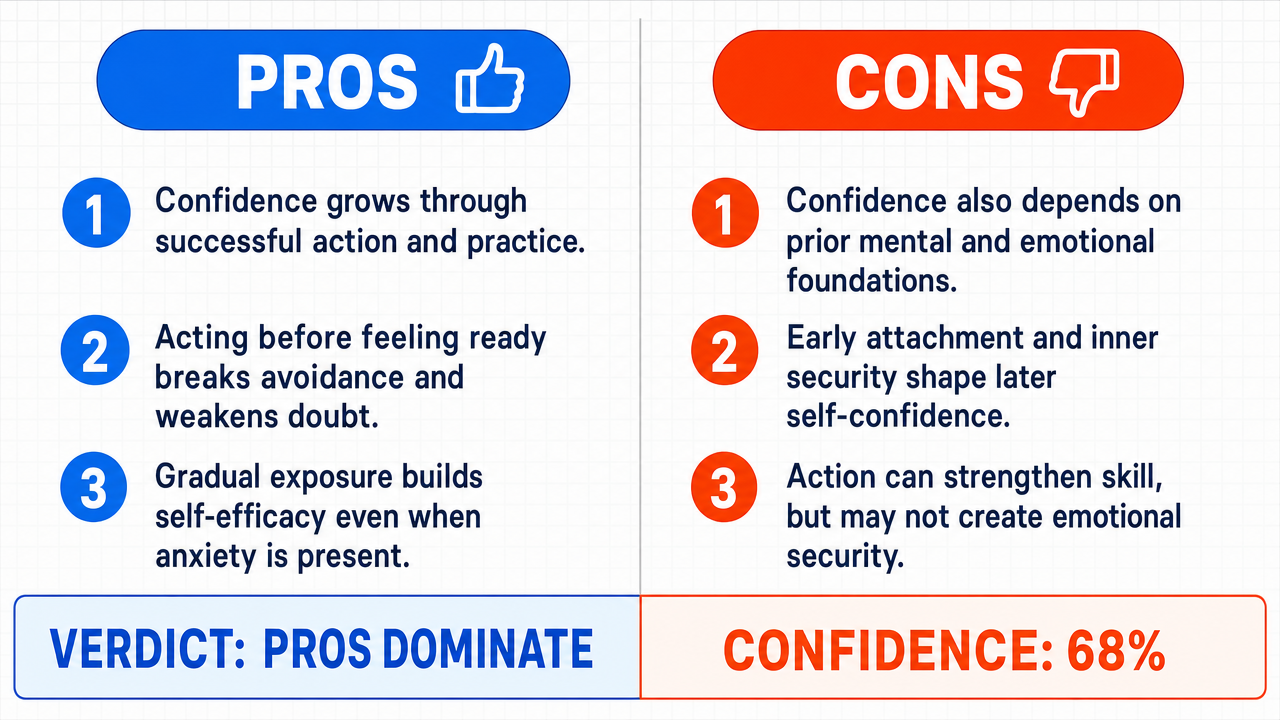
Verdict
Verdict: Mostly TRUE (68%)
Online report: https://solsice.com/public/debates/la-confiance-en-soi-se-construit-principalement-par-l-action-6d5098565924
This section provides a brief overview of the key arguments. It is not necessary to read the detailed report below.
✅ Key PRO arguments:
- ■According to Albert Bandura's self-efficacy theory , self-confidence is primarily built through mastery experiences , i.e., personal success in performing a task, which is the most powerful source of this feeling.
- ■Passively waiting for confidence to arrive before acting creates a vicious circle of avoidance and doubt, whereas action, even modest, provides concrete evidence of competence that reinforces self-perception.
- ■Behavioral therapy supports this principle through gradual exposure , where one acts despite anxiety to gradually build a sense of self-efficacy .
❌ Key CONTRA arguments:
- ■Self-confidence relies on pre-existing cognitive and emotional structures, and action alone cannot build confidence in an individual whose basic cognitive schemas are dysfunctional.
- ■John Bowlby's attachment theory demonstrates that internal security, the foundation of self-confidence, is formed during early childhood through the quality of emotional bonds, long before any adult mastery experience .
- ■While action can strengthen an existing skill , it cannot alone create the emotional and affective foundation from which confidence develops.
💭 Conclusion: True, the statement is successfully defended in this debate. The decisive argument relies on Albert Bandura's self-efficacy theory , which identifies mastery experiences as the most powerful source of self-confidence, thus establishing a clear causal link between action and the building of self-efficacy . The opposing argument based on Bowlby's attachment theory , although relevant for explaining early foundations of internal security, does not invalidate the mechanism by which concrete action consolidates and extends confidence into adulthood. The internal contradiction raised by the negative camp weakens its position by conceding the existence of multiple sources of self-efficacy. However, the judge's moderate confidence (68%) reflects an acknowledgment that secondary sources and early emotional factors play a significant role. Therefore, the TRUE verdict prevails without denying the contribution of pre-existing affective structures to self-confidence.
🔬 Verdict: Mostly TRUE ✅ (68%)
Statement: Self-confidence is mainly built through action and experience, not by waiting for it before starting an activity.
Participating models: deepseek-v3.2 💬, gemma-4-26b-a4b-it 💬👁️
📊 Confrontations: 1 concluded TRUE, 0 concluded FALSE (1 confrontation, 3 models)
📊 Score per camp: TRUE=0.68, FALSE=0.00
🏅 Model score evolution:
minimax-m3 💬👁️: +7
✅ PRO arguments:
- ■According to Albert Bandura's self-efficacy theory , self-confidence is mainly forged through mastery experiences , i.e., personal success in performing a task, which is the most powerful source of this feeling. deepseek-v3.2 💬
- ■Passively waiting for confidence to arrive before acting creates a vicious circle of avoidance and doubt, whereas action, even modest, provides concrete evidence of competence that reinforces self-perception. deepseek-v3.2 💬
- ■Behavioral therapy supports this principle through gradual exposure , where one acts despite anxiety to gradually build a sense of self-efficacy . deepseek-v3.2 💬
- ■Other sources of self-efficacy identified by Bandura — vicarious experience, verbal persuasion , and physiological states — are secondary compared to direct mastery experience. deepseek-v3.2 💬
- ■Successful action is the primary causal antecedent of confidence, not the other way around: proven competence engenders belief in one's abilities. deepseek-v3.2 💬
❌ CONTRA arguments:
- ■Self-confidence relies on pre-existing cognitive and emotional structures, and action alone cannot build confidence in an individual whose basic cognitive schemas are dysfunctional. gemma-4-26b-a4b-it 💬👁️
- ■John Bowlby's attachment theory demonstrates that internal security, the foundation of self-confidence, is formed during early childhood through the quality of emotional bonds, long before any adult mastery experience .
- ■If action can reinforce an existing skill , it cannot alone create the emotional and affective foundation from which confidence unfolds. gemma-4-26b-a4b-it 💬👁️
- ■The opposing argument suffers from an internal contradiction: it recognizes the existence of multiple sources of self-efficacy while treating mastery experience as the only valid path. gemma-4-26b-a4b-it 💬👁️
💭 Reasoning: True, the statement is successfully defended in this debate. The decisive argument relies on Albert Bandura's self-efficacy theory, which identifies mastery experience as the most powerful source of self-confidence, thus establishing a clear causal link between action and the construction of self-efficacy. The opposing argument based on Bowlby's attachment theory, although relevant for explaining early foundations of internal security, does not invalidate the mechanism by which concrete action consolidates and extends confidence into adulthood. The internal contradiction raised by the negative camp weakens its position by conceding the existence of multiple sources of self-efficacy. However, the judge's moderate confidence (68%) reflects an acknowledgment that secondary sources and early emotional factors play a significant role. Therefore, the TRUE verdict is justified without denying the contribution of pre-existing affective structures to self-confidence.
📋 Supporting facts PRO:
• Albert Bandura demonstrated that mastery experience is the most powerful source of self-efficacy.
• Bandura identifies four sources of self-efficacy: mastery experience, vicarious experience, verbal persuasion, and physiological states.
• Behavioral therapy uses gradual exposure as a method to build self-efficacy.
• Passive waiting for confidence before acting creates a vicious circle of avoidance and doubt according to cognitive-behavioral psychology.
📋 Supporting facts CONTRA:
• John Bowlby's attachment theory states that internal security is formed during early childhood through the quality of emotional bonds.
• Dysfunctional pre-existing cognitive schemas can prevent confidence from being built solely through action.
• Action can strengthen an existing skill without necessarily building confidence on solid emotional foundations.
| Confrontation | TRUE Model | FALSE Model | Mean μ TRUE | Mean μ FALSE | TRUE Tokens | FALSE Tokens | Winner | Verdict | Confidence |
|---|---|---|---|---|---|---|---|---|---|
| #1 | deepseek-v3.2 💬 | gemma-4-26b-a4b-it 💬👁️ | 0.479 | 0.469 | 8 | 2 | TRUE | TRUE | 68% |
The following technical terms, abbreviations, and specialized concepts are used in this transcript. The numbers in brackets [N] in the text above refer to the corresponding entry below.
[1] causal antecedent — In psychology and logic, a variable or event that precedes and is considered the cause of another phenomenon. The debate questions whether action is the causal antecedent of confidence (affirmative camp) or if it is instead its consequence (negative camp).
[2] vicarious learning — Process by which an individual acquires skills or beliefs by observing the actions and results obtained by others, without direct experience. Mentioned as a secondary source of self-efficacy in Bandura's theory.
[3] self-efficacy — sense of self-efficacy — An individual's belief in their ability to accomplish a specific task or exert control over life events. A central concept developed by Albert Bandura, whose hierarchy of sources (mastery experience vs. others) is precisely the subject of debate.
[4] vicious circle — vicious avoidance circle — Negative feedback loop in which avoidance of action reinforces fear and doubt, which in turn intensifies avoidance. Used by the affirmative camp to describe passive expectation of confidence.
[5] competence — Actual demonstrated ability in performing a task, distinct from confidence in one's own capacity. The negative camp criticizes the affirmative camp for confusing these two concepts.
[6] gradual exposure — Behavioral therapeutic technique involving gradually facing anxiety-provoking situations rather than avoiding them. Cited by the affirmative camp as a reference treatment for anxiety disorders and lack of confidence.
[7] mastery experience — According to Bandura's theory, direct personal success in accomplishing a task. The debate concerns its status: primary source of self-efficacy (affirmative camp) or one among others, without exclusive causal primacy (negative camp).
[8] feedbacks — Information received about performance of an action, allowing adjustment of behaviors and reinforcement of perceived competence. Mentioned in the context of climbing and public speaking.
[9] meta-analysis — Statistical method combining results from multiple independent studies to draw an overall conclusion. Cited by the affirmative camp (reference from 2017 covering 38 studies) to support the effect of guided practice interventions.
[10] metacognitive — metacognition — The ability of an individual to reflect on their own cognitive processes, beliefs, and mental states. The negative camp criticizes the affirmative camp for ignoring this dimension in its argument.
[11] subjective perception — Personal assessment an individual makes of their own abilities or value, distinct from objective competence. Mentioned as a construct internal to the individual that cannot be reduced solely to action.
[12] verbal persuasion — Encouragements and speeches from others that reinforce an individual's belief in their capacity to succeed. Cited by Bandura as a source of self-efficacy, whose role the affirmative camp downplays relative to mastery experience.
[13] cognitive and behavioral psychology — Branch of psychology studying both mental processes (thoughts, beliefs) and observable behaviors. Cited by the affirmative camp as the theoretical foundation of the concept of self-efficacy.
[14] emotional regulation — Set of processes that allow modulating, expressing, or inhibiting emotions. The negative camp argues that this dimension necessarily precedes action to explain confidence.
[15] cognitive schemas — Organized mental structures that filter and interpret information. According to the negative camp, dysfunctional schemas pre-existing would prevent action from building confidence.
[16] sense of self-efficacy — Synonym of self-efficacy: an individual's belief in their capacity to mobilize the necessary resources to achieve a goal, a concept at the heart of the debate.
[17] psychic structure — The set of internal dispositions (affective, cognitive, relational) constituting personality. According to the negative camp, it preexists action and conditions self-confidence.
[18] effect size — A statistical measure quantifying the magnitude of an observed difference or relationship, regardless of sample size. Mentioned by the affirmative camp to compare practice-based interventions and cognitive restructuring interventions.
[19] attachment theory — Theory developed notably by John Bowlby describing how early emotional bonds during early childhood shape inner security and, by extension, self-confidence in adulthood.
[20] behavioral therapy — Psychotherapeutic approach based on conditioning principles, aiming to modify behaviors and emotions through exposure and learning. Cited by the affirmative camp in support of gradual exposure.
[21] anxiety disorders — Category of psychological disorders characterized by excessive and persistent fear or worry. Gradual exposure is presented as the reference treatment for these disorders and for lack of confidence.
[22] mediating variable — Variable that explains the relationship between a cause and an effect, transmitting the influence from one to the other. The negative camp criticizes the affirmative camp for confusing confidence (considered as a mediator) and competence.
[23] physiological states — Physical and somatic conditions of an individual (muscle tension, heart rate, energy level) which, according to Bandura, constitute one of the sources contributing to the feeling of self-efficacy.
Face-off transcripts
- ■
Ownership & Trade Secrets. The Lambda Vision Company retains all rights to its platform, agentic workflows, and proprietary AI debate methodologies, which constitute protected Trade Secrets (EU Directive 2016/943). Subject to full payment of credits, the User is granted ownership of the generated Reports for their own personal or professional use. Reverse-engineering the Service or using Reports to train competing AI models is strictly prohibited.
- ■
No Professional Advice. Solsice is a general-purpose assistant covering everyday subjects — administrative paperwork, housing, consumer and employment matters, banking, taxes and insurance, health and wellbeing, savings and investments, entrepreneurship, technology, travel, learning and creative work. Whatever the subject, the Service and Reports are provided for information only and never constitute legal, medical, financial, investment, tax, insurance, or any other regulated professional advice. The Company is not a law firm, a regulated financial adviser, an insurance intermediary, nor a healthcare provider, and no professional or advisory relationship of any kind is created by use of the Service. Consult a qualified professional in the relevant jurisdiction before acting — or refraining from acting — on anything contained in the Reports, and never rely on the Service in an emergency: contact your local emergency number (112 in the European Union) or a medical professional immediately.
- ■
AI-Generated Content, Sources and Viewpoints. Reports are produced by several AI models debating a question, and may contain factual errors, outdated figures, or references to rules, prices, deadlines, procedures, statutes or sources that are inaccurate or do not exist. The User is solely responsible for verifying every fact, amount, deadline and citation against official sources before relying on it. Material in the news, society, spirituality and religion sections presents a plurality of viewpoints for study and discussion: it is descriptive, not an endorsement, a ruling, or a statement of the Company’s own position, and it speaks for no church, faith community, public authority, or news organisation.
- ■
Liability & Governing Law. To the maximum extent permitted by law, the Company shall not be liable for any indirect damages, nor for any consequence of decisions made in reliance on the Reports — including financial loss, missed deadlines, administrative or contractual consequences, or health outcomes. These Terms are governed by French law. Any disputes shall be subject to the exclusive jurisdiction of the Courts of Paris, France.