
La conception du premier smartphone pliable d'Apple est principalement pensée pour une utilisation de la main droite, créant des compromis ergonomiques pour les utilisateurs gauchers.
AI debate verdict and arguments
⚠️ AI-generated information only; not professional advice
Completed October 25, 2026
Verdict
Verdict: Mostly FALSE (68%)
Online report: https://solsice.com/public/debates/la-conception-du-premier-smartphone-pliable-d-apple-est-prin-aaa024d53c3a
This section provides a brief overview of the key arguments. It is not necessary to read the detailed report below.
✅ Key PRO arguments:
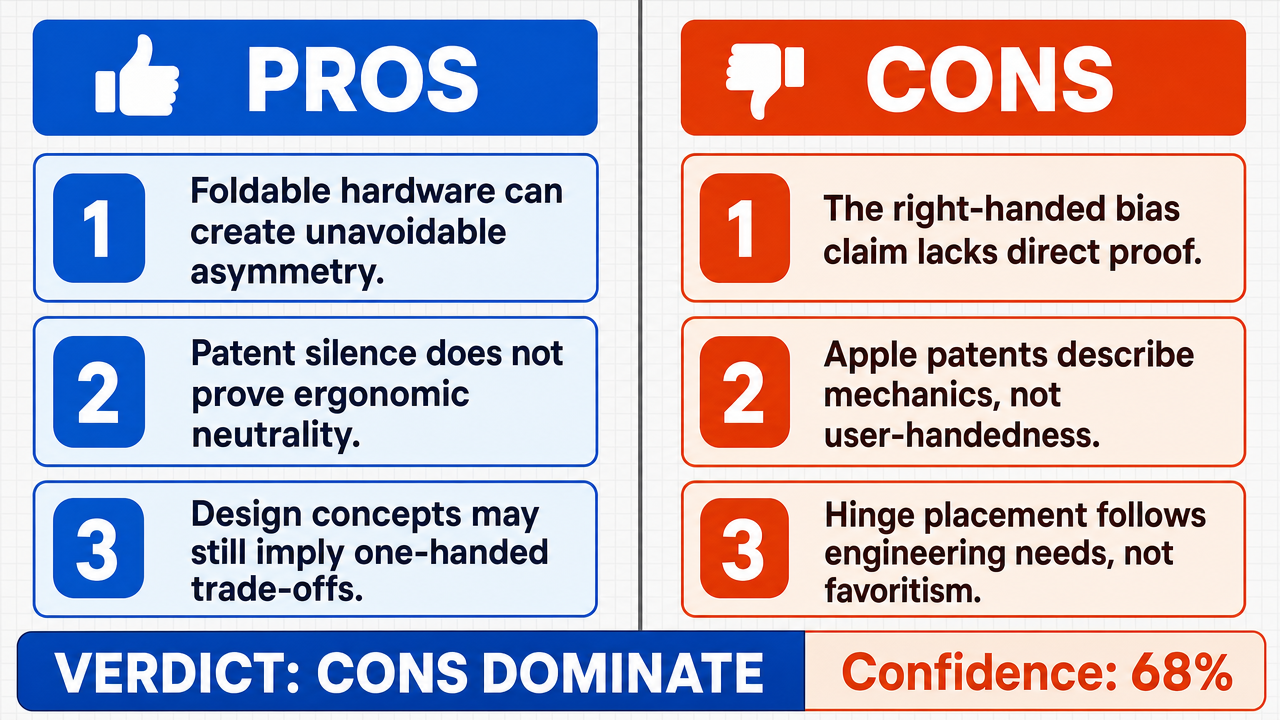
- ■The inherent structural asymmetry of foldable devices, as anticipated in Apple’s patents and design concepts, imposes a major physical constraint : the position of the hinge and the orientation of the unfolded screen are optimized for handling where the right hand stabilizes the device while the left hand interacts with the surface, forcing left-handed users to extend the wrist or twist the hand .
- ■The absence of explicit mention of a unilateral bias in Apple’s technical documents does not constitute proof of ergonomic neutrality ; the design could be in an intermediate case where it does not favor either the right or left hand absolutely, but still creates compromises for left-handed users.
❌ Key CON arguments:
- ■The claim that Apple’s foldable smartphones are primarily designed for right-handed use is based on a conjecture without concrete evidence; Apple is known for its inclusive approach to design, incorporating accessibility features from the early design phase .
- ■Patents filed by Apple, such as patent US 10,712,891 B2 for electronic devices with foldable screens, describe hinge mechanisms and screen configurations that do not explicitly favor one hand over the other, focusing on mechanical functionality rather than ergonomic bias .
- ■The position of the hinge is a mechanical constraint dictated by physics and screen protection, not an ergonomic intention to favor the right hand; the hinge must be positioned on an edge to allow the screen to fold onto itself without damage.
💭 Conclusion: False. The FALSE verdict is supported by the fact that the affirmative argument mainly relies on conjectures and unverified design anticipations, without concrete proof of an intentional bias toward the right hand in Apple’s first foldable smartphone design . The negative side has demonstrated more rigorously that Apple’s patents, notably patent US 10,712,891 B2, describe hinge mechanisms dictated by physical and mechanical constraints, not by discriminatory ergonomic intent. Furthermore, Apple’s reputation for inclusive and accessible design reinforces the argument that the design incorporates ergonomics for all users. Finally, the argument that the structural asymmetry is an inherent physical necessity of the folding mechanism , rather than a biased design choice, is more convincing than the speculative interpretation of the affirmative side.
🔬 Verdict: Mostly FALSE ❌ (68%)
Claim: The design of Apple’s first foldable smartphone is primarily conceived for right-hand use, creating ergonomic compromises for left-handed users.
Participating models: gemma-4-26b-a4b-it 💬👁️, glm-4.7-flash 💬
📊 Confrontations: 0 concluded TRUE, 1 concluded FALSE (1 confrontation, 3 models)
📊 Score by camp: TRUE=0.00, FALSE=0.68
🏅 Model score evolution:
minimax-m3 💬👁️: +7
✅ PRO arguments:
- ■The inherent structural asymmetry of foldable devices, as anticipated in Apple’s patents and design concepts, imposes a major physical constraint : the position of the hinge and the orientation of the unfolded screen are optimized for handling where the right hand stabilizes the device while the left hand interacts with the surface, forcing left-handed users to extend the wrist or twist the hand . gemma-4-26b-a4b-it 💬👁️
- ■The absence of explicit mention of a unilateral bias in Apple’s technical documents does not constitute proof of ergonomic neutrality ; the design could be in an intermediate case where it does not favor either the right or left hand absolutely, but still creates compromises for left-handed users. gemma-4-26b-a4b-it 💬👁️
❌ Arguments AGAINST:
- ■The claim that Apple’s foldable smartphones are primarily designed for right-handed use is based on a conjecture without concrete proof; Apple is recognized for its inclusive approach to design, integrating accessibility features from the early design phase . glm-4.7-flash 💬
- ■Patents filed by Apple, such as patent US 10,712,891 B2 for foldable electronic devices, describe hinge mechanisms and screen configurations that do not explicitly favor one hand over the other, focusing on mechanical functionality rather than ergonomic bias . glm-4.7-flash 💬
- ■The position of the hinge is a mechanical constraint dictated by physics and screen protection, not an ergonomic intention to favor the right hand; the hinge must be positioned on an edge to allow the screen to fold onto itself without damage. glm-4.7-flash 💬
- ■The structural asymmetry of a foldable screen is an inherent physical necessity of the folding mechanism , not a design choice aimed at favoring a group of users; this arrangement is universal and applies regardless of the user’s laterality. glm-4.7-flash 💬
💭 Reasoning: False. The FALSE verdict is supported by the fact that the affirmative argument mainly relies on conjectures and unverified design anticipations, without concrete proof of an intentional bias toward the right hand in Apple’s first foldable smartphone design. The negative side has demonstrated more rigorously that Apple’s patents, notably patent US 10,712,891 B2, describe hinge mechanisms dictated by physical and mechanical constraints, not by discriminatory ergonomic intent. Moreover, Apple’s reputation for inclusive and accessible design reinforces the argument that the design incorporates ergonomics for all users. Finally, the argument that the structural asymmetry is an inherent physical necessity of the folding mechanism, rather than a biased design choice, is more convincing than the speculative interpretation of the affirmative side.
📋 Facts IN FAVOR:
• Foldable devices exhibit an inherent structural asymmetry related to hinge position and screen orientation.
• The absence of mention of bias in a technical document does not constitute formal proof of ergonomic neutrality.
📋 Facts AGAINST:
• Apple’s patent US 10,712,891 B2 describes hinge mechanisms and foldable screen configurations without explicitly favoring one hand over the other.
• Apple is recognized for its inclusive approach to design, integrating accessibility features from the initial conception phase.
• The hinge position on an edge is dictated by physics and screen protection, allowing the screen to fold onto itself without damage.
| Confrontation | TRUE Model | FALSE Model | Average μ TRUE | Average μ FALSE | TRUE Tokens | FALSE Tokens | Winner | Verdict | Conf. |
|---|---|---|---|---|---|---|---|---|---|
| #1 | gemma-4-26b-a4b-it 💬👁️ | glm-4.7-flash 💬 | 0.247 | 0.389 | 4 | 4 | FALSE | FALSE | 68% |
The following technical terms, abbreviations, and specialized concepts are used in this transcript. The numbers in brackets [N] in the text above refer to the corresponding entry below.
[1] software and hardware architecture — Joint organization of software components (operating system, interfaces) and hardware (sensors, buttons, screen) of a device, determining how functions are distributed and accessible to the user.
[2] structural asymmetry — Characteristic of a device whose physical arrangement of elements (hinge, screen, buttons) is not symmetrical, which can influence grip depending on the user's dominant hand.
[3] ergonomic bias — Design of a product that intentionally or unintentionally favors a user profile (e.g., right-handed) over another (left-handed), in terms of comfort or ease of use.
[4] volume buttons — Physical controls located on the side of a smartphone to adjust volume, whose lateral position can influence ergonomics depending on the hand used.
[5] patent — Intellectual property title protecting a technical invention, describing the claimed novelty without necessarily covering the uses or ergonomics of the final product.
[6] light sensor — Electronic component measuring ambient light to automatically adjust screen brightness, whose placement on the device can affect access depending on the dominant hand.
[7] hinge — Mechanical articulated mechanism allowing a foldable screen to fold back on itself, whose position on the edge of the device determines the structural asymmetry of the device.
[8] camera controls — Physical buttons or dedicated touch zones for triggering and adjusting the camera, whose placement influences the ergonomics of shooting.
[9] components — Material elements (sensors, buttons, chips) integrated into an electronic device, whose arrangement conditions the user interface.
[10] asymmetric design — Design approach where the arrangement of physical elements is not symmetrical, which can create different usage constraints depending on the dominant hand.
[11] physical constraint — Limitation imposed by the laws of mechanics or geometry of a device, here related to the folding mechanism that requires a particular arrangement of the hinge.
[12] folding durability — Ability of a foldable screen to withstand a large number of folding and unfolding cycles without mechanical degradation, the main goal of hinge design.
[13] ergonomics — Discipline studying the adaptation of a product to the physical and behavioral characteristics of the user, aiming to reduce fatigue and improve comfort.
[14] wrist extension — Articular movement involving folding the hand forward toward the forearm, which can cause muscle fatigue when repeated to reach poorly positioned interface zones.
[15] muscle fatigue — Decrease in a muscle's contraction capacity after prolonged effort or constrained postures, here mentioned as a consequence of poor ergonomics.
[16] screen flexibility — Property of a display (often OLED) to fold without breaking, made possible by using plastic substrates rather than rigid glass.
[17] accessibility features — Software or hardware options integrated from the design phase to enable use by people with different abilities (left-handed, visually impaired, etc.).
[18] implementation — Concrete translation of a concept or patent into a finished product, where final technical choices may diverge from initial theoretical descriptions.
[19] folding interface — Set of software and hardware elements managing the transition between folded and unfolded modes of a foldable smartphone, as well as display in each configuration.
[20] touch interface — Touch-sensitive display surface, uniform across the entire screen, whose responsiveness does not depend on the position of the hinge.
[21] dominant hand — The hand a person prefers to use for precision tasks (writing, manipulation), typically the right for right-handed people and the left for left-handed people.
[22] Folding mechanism — The set of mechanical parts (hinge, axes, protections) allowing a screen to fold, whose design is dictated by physical and durability constraints.
[23] ergonomic neutrality — A characteristic of a design that does not favor any particular hand or user profile, providing equal comfort of use for all.
[24] technical novelty — An element of innovation claimed in a patent, related to the mechanism or technology and not to aspects of use or ergonomics.
[25] design phase — The stage of product development during which functional, ergonomic, and technical characteristics are defined before manufacturing.
[26] directional priority — A design scheme where certain functions or interface zones are optimized for a specific direction of use (for example, from left to right or for the right hand).
[27] grip — The way a user holds and manipulates a device, influenced by their morphology, dominant hand, and the arrangement of physical elements of the device.
[28] foldable smartphone — A smart device equipped with a flexible screen capable of folding onto itself via a hinge, offering two usage formats (folded and unfolded).
[29] hand torsion — A rotational movement of the wrist and hand, which can cause discomfort or fatigue when necessary to reach poorly positioned controls.
[30] left-handed user — A person whose dominant hand is the left, potentially affected by ergonomic designs optimized for right-handed users.
[31] ergonomic dead zone — An area of a device that is difficult to access or uncomfortable to reach for the user due to the arrangement of physical elements, here mentioned as a contested extrapolation in the debate.
[32] unfolded screen — The state of a foldable smartphone when it is opened flat, providing a larger continuous display surface than in the folded mode.
Face-off transcripts
- ■
Ownership & Trade Secrets. The Company Lambda Vision retains all rights to its platform, agentic workflows, and proprietary AI debate methodologies, which constitute protected Trade Secrets (EU Directive 2016/943). Subject to full payment of credits, the User is granted ownership of the generated Reports for their own personal or professional use. Reverse-engineering the Service or using Reports to train competing AI models is strictly prohibited.
- ■
No Professional Advice. Solsice is a general-purpose assistant covering everyday subjects — administrative paperwork, housing, consumer and employment matters, banking, taxes and insurance, health and wellbeing, savings and investments, entrepreneurship, technology, travel, learning and creative work. Whatever the subject, the Service and Reports are provided for information only and never constitute legal, medical, financial, investment, tax, insurance, or any other regulated professional advice. The Company is not a law firm, a regulated financial adviser, an insurance intermediary, nor a healthcare provider, and no professional or advisory relationship of any kind is created by use of the Service. Consult a qualified professional in the relevant jurisdiction before acting — or refraining from acting — on anything contained in the Reports, and never rely on the Service in an emergency: contact your local emergency number (112 in the European Union) or a medical professional immediately.
- ■
AI-Generated Content, Sources and Viewpoints. Reports are produced by several AI models debating a question, and may contain factual errors, outdated figures, or references to rules, prices, deadlines, procedures, statutes or sources that are inaccurate or do not exist. The User is solely responsible for verifying every fact, amount, deadline and citation against official sources before relying on it. Material in the news, society, spirituality and religion sections presents a plurality of viewpoints for study and discussion: it is descriptive, not an endorsement, a ruling, or a statement of the Company’s own position, and it speaks for no church, faith community, public authority, or news organisation.
- ■
Liability & Governing Law. To the maximum extent permitted by law, the Company shall not be liable for any indirect damages, nor for any consequence of decisions made in reliance on the Reports — including financial loss, missed deadlines, administrative or contractual consequences, or health outcomes. These Terms are governed by French law. Any disputes shall be subject to the exclusive jurisdiction of the Courts of Paris, France.