
La composition des rédactions journalistiques françaises, caractérisée par un excès de personnes blanches et de milieux aisés, empêche une représentation fidèle de la diversité des réalités sociales et ethniques du pays.
AI debate verdict and arguments
⚠️ AI-generated information only; not professional advice
Completed October 23, 2026
Verdict
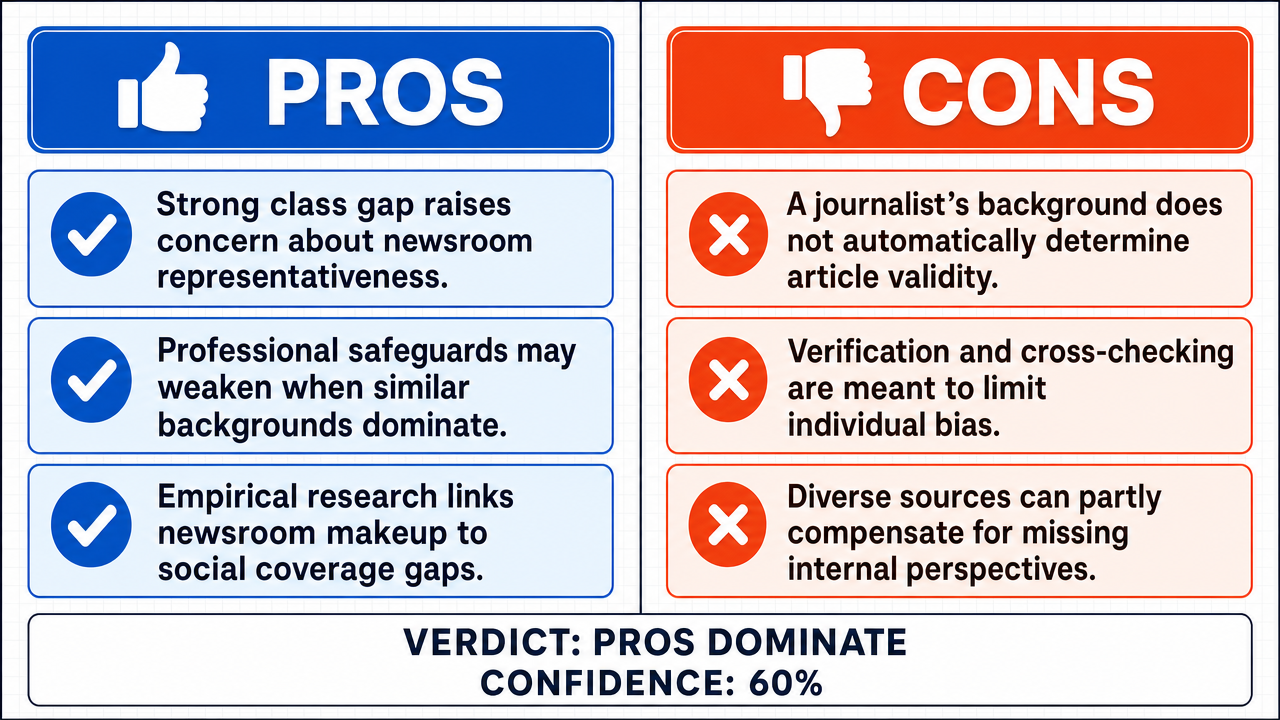
Verdict: rather TRUE (60%)
Online report: https://solsice.com/public/debates/la-composition-des-redactions-journalistiques-francaises-car-d1dbbf9c9206
This section provides a brief overview of the key arguments. It is not necessary to read the detailed report below.
✅ Key FOR arguments:
- ■The affirmative model argued that the gap between 72% of journalists from executive or higher intellectual professions families and 9% of the active population reveals a strong socio-economic homogeneity , which could disconnect journalistic angles from the realities experienced by modest households.
- ■It contested that source diversity and verification methods automatically neutralize this gap: these safeguards would be weakened if the recurring choices of topics, interviewees, and analytical frameworks mainly reflected affluent backgrounds.
- ■It cited the work of Julie Sedel, The Media and the Suburbs, published by PUF in 2019, as empirical evidence showing that newsroom functioning can generate representation biases regarding popular realities.
❌ Key AGAINST arguments:
- ■The negative model argued that the sociological identity of journalists does not determine the validity of their articles and that a direct causal link between their social origin and framing bias cannot be deduced from a simple correlation .
- ■According to it, verification, cross-checking sources, and confronting facts are professional mechanisms designed to reduce individual biases and can enable faithful representation despite homogeneous newsrooms.
- ■It also argued that the diversity of interviewees and organizations can balance perspectives, so that newsroom composition does not constitute a mechanical obstacle to faithful representation.
💭 Conclusion: True: the tournament verdict recognizes that socio-economic homogeneity of newsrooms can compromise the fidelity of social reality representation. The strongest affirmative argument relies on a major quantitative gap: 72% of journalists come from executive or higher intellectual professions families, compared to 9% of the active population. The affirmative model deduces that recurring choices of topics, interviewees, and angles can disconnect journalistic production from the experiences of underrepresented groups. This structural asymmetry explains why source diversity and professional verification alone do not guarantee fully faithful representation, even though they can limit individual biases . Confidence is set at 60%, as the debate alone does not provide specific data on the overrepresentation of white people and mainly argues for a risk of structural mismatch rather than an absolute barrier to faithful representation.
🔬 Verdict: rather TRUE ✅ (60%)
Statement: The composition of French journalistic newsrooms, characterized by an excess of white people and affluent backgrounds, prevents a faithful representation of the country’s social and ethnic diversity.
Participating models: deepseek-v4-pro 💬, gemma-4-26b-a4b-it 💬👁️
📊 Confrontations: 1 concluded TRUE, 0 concluded FALSE (1 confrontation, 3 models)
📊 Score per camp: TRUE=0.63, FALSE=0.00
🏅 Model score evolution:
minimax-m3 💬👁️: +6
✅ Arguments FOR:
- ■The affirmative model argued that the gap between 72% of journalists from executive or higher intellectual professions families and 9% of the active population reveals a strong socio-economic homogeneity , which could disconnect journalistic angles from the realities experienced by modest households. deepseek-v4-pro 💬
- ■It contested that source diversity and verification methods automatically neutralize this gap: these safeguards would be weakened if the recurring choices of topics, interviewees, and analytical frameworks mainly reflected affluent backgrounds. deepseek-v4-pro 💬
- ■It cited Julie Sedel’s work, The Media and the Suburbs, published by PUF in 2019, as empirical evidence showing that newsroom functioning can generate representation biases regarding popular realities. deepseek-v4-pro 💬
- ■It also referenced a joint study by ATD Quart Monde and Mediapart, published in 2020 and dedicated to poverty and media, to support the idea of journalistic treatment influenced by newsroom social composition. deepseek-v4-pro 💬
❌ Arguments AGAINST:
- ■The negative model argued that the sociological identity of journalists does not determine the validity of their articles and that a direct causal link between their social origin and framing bias cannot be deduced from a simple correlation . gemma-4-26b-a4b-it 💬👁️
- ■According to it, verification, cross-checking sources, and confronting facts are professional mechanisms designed to reduce individual biases and can enable faithful representation despite homogeneous newsrooms. gemma-4-26b-a4b-it 💬👁️
- ■It also argued that the diversity of interviewees and organizations can balance perspectives, so that newsroom composition does not constitute a mechanical obstacle to faithful representation. gemma-4-26b-a4b-it 💬👁️
- ■It finally recalled that journalism is not a simple projection of the writer’s identity, but an activity governed by methods and professional rules, which qualifies sociological obstacles without making them insurmountable barriers. gemma-4-26b-a4b-it 💬👁️
💭 Reasoning: True: the tournament verdict recognizes that socio-economic homogeneity of newsrooms can compromise the fidelity of social reality representation. The strongest affirmative argument relies on a major quantitative gap: 72% of journalists come from executive or higher intellectual professions families, compared to 9% of the active population. The affirmative model deduces that recurring choices of topics, interviewees, and angles can disconnect journalistic production from the experiences of underrepresented groups. This structural asymmetry explains why source diversity and professional verification alone do not guarantee fully faithful representation, even though they can limit individual biases. Confidence is set at 60%, as the debate alone does not provide specific data on the overrepresentation of white people and mainly argues for a risk of structural mismatch rather than an absolute barrier to faithful representation.
📋 Facts FOR:
• According to the Inequalities Observatory and its 2021 study, Diversity in French Media, 72% of journalists come from families of executives or higher intellectual professions, compared to 9% of the active population.
• The debate cites Julie Sedel’s survey, The Media and the Suburbs, published by PUF in 2019, on the relationship between the media and the realities of the suburbs.
• The debate mentions a joint study by ATD Quart Monde and Mediapart published in 2020 on poverty and the media.
• The only debate in the tournament was decided in favor of the assertion with a confidence level of 63%.
📋 FACTS AGAINST:
• The negative camp highlighted verification, cross-referencing sources, and confronting facts as mechanisms to reduce individual biases.
• The negative camp argued that the diversity of sources can allow for faithful representation regardless of the sociological composition of the newsroom.
• The dossier provides no direct measure demonstrating that the composition of newsrooms eliminates all possibility of faithful representation.
• The negative camp characterized the causal direct link between journalists’ social origin and the inadequacy of representation as excessive.
| Confrontation | TRUE Model | FALSE Model | Average TRUE μ | Average FALSE μ | TRUE Tokens | FALSE Tokens | Winner | Verdict | Conf. |
|---|---|---|---|---|---|---|---|---|---|
| #1 | deepseek-v4-pro 💬 | gemma-4-26b-a4b-it 💬👁️ | 0.494 | 0.172 | 6 | 2 | TRUE | TRUE | 63% |
The following technical terms, abbreviations, and specialized concepts are used in this transcript. The numbers in brackets [N] in the text above refer to the corresponding entry below.
[1] media angles — Ways of addressing and framing a subject in the media. The assertion links them to the social origin of journalists, while the negative contests this link.
[2] framing bias — Presumed tendency to present topics, sources, and editorial orientation from a particular perspective. Its origin in journalists' social background and its causal role are contested in the debate.
[3] class bias — Bias associated with the social origin of journalists, which would influence the selection of topics, sources, and framing. The existence and direct effect of this bias are disputed.
[4] individual biases — Distortions specific to each reporter that journalistic control methods are supposed to correct. Their capacity to neutralize class biases remains debated.
[5] causality — Causal relationship whereby one phenomenon produces another. The debate opposes the assertion of a link between newsroom composition and fidelity of representation and the contestation of a direct causality.
[6] media field — Social and professional space where media, journalists, and subjects are distributed. The negative presents thematic specialization as a guarantee of coverage.
[7] editorial choices — Selection of topics, identification of sources, and orientation of treatment angles. The assertion links them to the class habitus of journalists, which the negative contests.
[8] popular classes — In the debate, a term referring to social groups associated with modest backgrounds and their social realities. Their underrepresentation is presented as a factor of discrepancy in media coverage.
[9] sociological composition of newsrooms — Distribution of journalists according to their social origin and family background. Its actual influence on the fidelity of representation is the central issue of the assertion.
[10] local correspondents — Journalists assigned to a local area and presented as a means of compensating for individual perspective limitations. Their presence is invoked to support the compatibility between newsroom diversity and faithful representation.
[11] correlation — Observed association between two phenomena, without proof that a causal relationship is established. The negative accuses the assertion of treating a supposed correlation as an absolute causality.
[12] cross-checking sources — Confrontation of information or testimonies from multiple sources. This method is presented as a way to overcome individual biases, without its effectiveness against class biases being accepted.
[13] diversity of newsrooms — Variety of social, family, and professional profiles present in newsrooms. The negative considers it compatible with faithful representation, while the assertion denies that it suffices to eliminate class biases.
[14] diversity of sources — Variety of sources consulted to build information. The negative presents it as a means to guarantee fidelity, which the assertion contests considering journalists' habitus.
[15] structural gap — Disparity between the sociological composition of newsrooms and the realities of the popular classes. The assertion presents it as a source of distortion of inequality representation.
[16] in-group — Operation among people sharing similar social backgrounds. It is associated in the debate with class ethnocentrism and the invisibilization of other social realities.
[17] class ethnocentrism — Treatment from the perspective of one's own class as central or neutral, risking excluding other perspectives. The debate attributes to it the invisibilization of popular realities, while contesting its causal effect on fidelity.
[18] class habitus — Sociological concept used to explain the orientation of editorial choices by the journalists' class origin. The causal role attributed to it by the assertion is contested.
[19] socio-economic homogeneity — Concentration of journalists in privileged social backgrounds. It is presented as limiting understanding of the realities experienced by modest households.
[20] legitimate source identification — Selection, by the editorial staff, of sources deemed appropriate to address a topic. The assertion presents this editorial choice as potentially influenced by the class habitus.
Face-off transcripts
- ■
Ownership & Trade Secrets. Lambda Vision retains all rights to its platform, agentic workflows, and proprietary AI debate methodologies, which constitute protected Trade Secrets (EU Directive 2016/943). Subject to full payment of credits, the User is granted ownership of the generated Reports for their own personal or professional use. Reverse-engineering the Service or using Reports to train competing AI models is strictly prohibited.
- ■
No Professional Advice. Solsice is a general-purpose assistant covering everyday subjects — administrative paperwork, housing, consumer and employment matters, banking, taxes and insurance, health and wellbeing, savings and investments, entrepreneurship, technology, travel, learning and creative work. Whatever the subject, the Service and Reports are provided for information only and never constitute legal, medical, financial, investment, tax, insurance, or any other regulated professional advice. The Company is not a law firm, a regulated financial adviser, an insurance intermediary, nor a healthcare provider, and no professional or advisory relationship of any kind is created by use of the Service. Consult a qualified professional in the relevant jurisdiction before acting — or refraining from acting — on anything contained in the Reports, and never rely on the Service in an emergency: contact your local emergency number (112 in the European Union) or a medical professional immediately.
- ■
AI-Generated Content, Sources and Viewpoints. Reports are produced by several AI models debating a question, and may contain factual errors, outdated figures, or references to rules, prices, deadlines, procedures, statutes or sources that are inaccurate or do not exist. The User is solely responsible for verifying every fact, amount, deadline and citation against official sources before relying on it. Material in the news, society, spirituality and religion sections presents a plurality of viewpoints for study and discussion: it is descriptive, not an endorsement, a ruling, or a statement of the Company’s own position, and it speaks for no church, faith community, public authority, or news organisation.
- ■
Liability & Governing Law. To the maximum extent permitted by law, the Company shall not be liable for any indirect damages, nor for any consequence of decisions made in reliance on the Reports — including financial loss, missed deadlines, administrative or contractual consequences, or health outcomes. These Terms are governed by French law. Any disputes shall be subject to the exclusive jurisdiction of the Courts of Paris, France.