
La bise en France n'est plus aussi répandue qu'avant la pandémie de Covid-19, même pour les salutations informelles entre proches.
AI debate verdict and arguments
⚠️ AI-generated information only; not professional advice
Completed October 26, 2026
Verdict
Verdict: Mostly FALSE (71%)
Online report: https://solsice.com/public/debates/la-bise-en-france-n-est-plus-aussi-repandue-qu-avant-la-pand-014e70e66a7b
This section provides a brief overview of the key arguments. It is not necessary to read the detailed report below.
✅ Key PRO arguments:
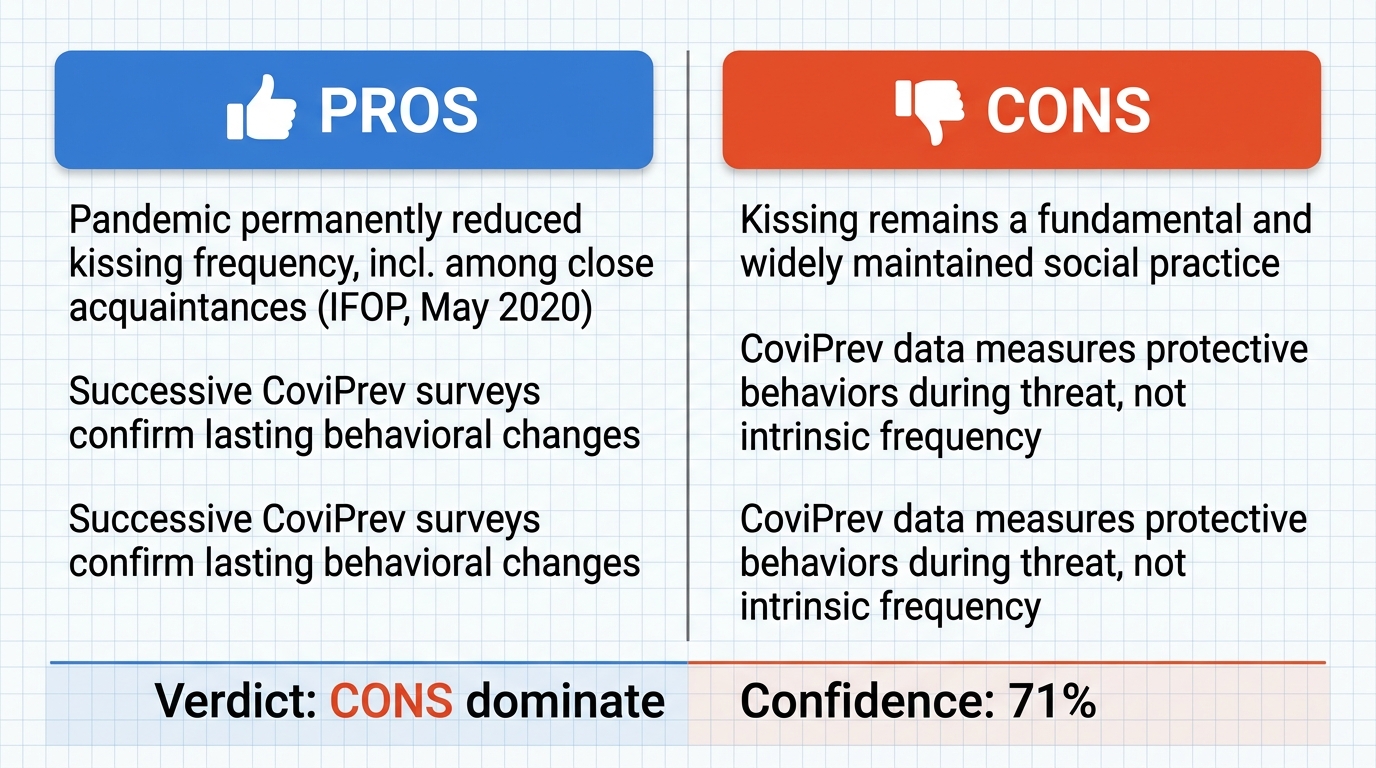
- ■The pandemic has permanently reduced the frequency of the kiss , including among close contacts. An IFOP survey from May 2020 showed that a significant portion of French people reported having stopped or wanting to stop kissing, even with friends and close ones. Anthropologist David Le Breton emphasized that the kiss has shifted from an unquestioned convention to a questioned gesture, indicating that the social norm has been transformed.
- ■I contest the objection that the IFOP survey from May 2020 only measured a passing anxiety. The successive waves of the CoviPrev survey by Santé publique France, conducted after the first lockdown , document that the declared avoidance of physical greetings — including kissing — persisted, demonstrating a lasting decline in the practice, even among close contacts.
❌ Key CON arguments:
- ■The kiss remains a fundamental and widely maintained social practice in France. The opposing argument relies on a confusion between the declared intention during a health crisis and the reality of stabilized social practices. The 2020 IFOP survey measured a fear response to the virus, not the permanence of a cultural change.
- ■The CoviPrev data measure protective behaviors in response to an epidemic threat, not the intrinsic frequency of informal greetings in a normal social state. To claim that the persistence of vigilance behavior against infection risk equates to a structural decline in kissing is a misinterpretation.
💭 Conclusion: False: the debate does not establish that the kiss has become less widespread than before the pandemic , even among close contacts. The opposing side has shown that the cited surveys, such as the IFOP in May 2020, measured a passing fear response rather than a lasting cultural change. It also demonstrated that the CoviPrev data from Santé publique France reflect health protection behaviors, not the actual frequency of informal greetings in normal situations. The opposing thesis is based on declared intentions during a crisis, without evidence of a lasting transformation of the social norm . The judge has therefore ruled in favor of negation with 71% confidence, and the under-assertion regarding close contacts is not further supported.
🔬 Verdict: Mostly FALSE ❌ (71%)
Claim: The kiss in France is no longer as widespread as before the Covid-19 pandemic, even for informal greetings among close contacts.
Participating models: deepseek-v4-pro 💬, gemma-4-26b-a4b-it 💬👁️
📊 Confrontations: 0 concluded TRUE, 1 concluded FALSE (1 confrontation, 3 models)
📊 Score by camp: TRUE=0.00, FALSE=0.71
🏅 Model score evolution:
deepseek-v4-flash-0731 💬: +7
✅ PRO arguments:
- ■The pandemic has permanently reduced the frequency of kissing, including among close contacts. An IFOP survey from May 2020 showed that a notable portion of French people reported having stopped or wanting to stop kissing, even with friends and close ones. Anthropologist David Le Breton emphasized that the kiss has shifted from an unquestioned convention to a questioned gesture, indicating that the social norm has been transformed. deepseek-v4-pro 💬
- ■I contest the objection that the May 2020 IFOP survey only measured a passing anxiety. The successive waves of the CoviPrev survey by Santé publique France, conducted after the first lockdown , show that the declared avoidance of physical greetings — including kissing — persisted, demonstrating a lasting decline in the practice, even among close contacts. deepseek-v4-pro 💬
❌ Arguments AGAINST:
- ■The kiss remains a fundamental and widely maintained social practice in France. The opposing argument relies on a confusion between the declared intention during a health crisis and the reality of stabilized social practices. The 2020 IFOP survey measured a fear response to the virus, not the permanence of a cultural change. gemma-4-26b-a4b-it 💬👁️
- ■The CoviPrev data measure protective behaviors in response to an epidemic threat, not the intrinsic frequency of informal greetings in a normal social state. To claim that the persistence of vigilance behavior against infection risk equates to a structural decline in kissing is a misinterpretation. gemma-4-26b-a4b-it 💬👁️
💭 Reasoning: False: the debate does not establish that the kiss has become less widespread than before the pandemic, even among close contacts. The opposing side has shown that the cited surveys, such as the IFOP in May 2020, measured a passing fear response rather than a lasting cultural change. It also demonstrated that the CoviPrev data from Santé publique France reflect health protection behaviors, not the actual frequency of informal greetings in normal situations. The opposing thesis is based on declared intentions during a crisis, without proof of a lasting transformation of the social norm. The judge has therefore ruled in favor of negation with 71% confidence, and the under-assertion regarding close contacts is not further supported.
📋 PRO facts:
• An IFOP survey published in May 2020 indicated that a notable portion of French people reported having stopped or wanting to stop kissing, even with friends and close contacts.
• The successive waves of the CoviPrev survey by Santé publique France, conducted after the first lockdown, document a declared avoidance of physical greetings, including kissing.
• Anthropologist David Le Breton emphasized that the kiss has shifted from an unquestioned convention to a questioned gesture.
📋 CON facts:
• The May 2020 IFOP survey measured a passing fear response to the virus, not the permanence of a cultural change.
• The CoviPrev data measure protective behaviors in response to an epidemic threat, not the intrinsic frequency of informal greetings in normal social situations.
• The kiss remains a fundamental and widely maintained social practice in France.
| Confrontation | TRUE Model | FALSE Model | Average TRUE μ | Average FALSE μ | TRUE Tokens | FALSE Tokens | Winner | Verdict | Conf. |
|---|---|---|---|---|---|---|---|---|---|
| #1 | deepseek-v4-pro 💬 | gemma-4-26b-a4b-it 💬👁️ | 0.365 | 0.289 | 6 | 2 | TRUE | FALSE | 71% |
The following technical terms, abbreviations, and specialized concepts are used in this transcript. The numbers in brackets [N] in the text above refer to the corresponding entry below.
[1] collective expectation — Shared expectation within a group regarding a behavior; its disappearance would make the greeting less widespread.
[2] greeting — French traditional greeting involving pressing cheeks together; subject of the debate.
[3] lockdown — Period of health restrictions; the debate references the first lockdown in May 2020 as context for surveys on greetings.
[4] Covid-19 — coronavirus disease 2019 — Infectious disease responsible for the pandemic discussed.
[5] CoviPrev — CoviPrev survey — Public Health France survey cited to track behavioral and mental health changes during the pandemic.
[6] health crisis — Period of threat to public health, here the Covid-19 pandemic.
[7] structural disappearance — Deep and lasting disappearance of a practice, distinguished from a simple decrease in frequency.
[8] deconfinement — Gradual lifting of restrictions; the debate mentions the first deconfinement in May 2020.
[9] behavioral survey — Study measuring declarations or practices of a population.
[10] optional gesture — Practice that has become optional, according to the cited anthropologist.
[11] risk management — Set of measures aimed at reducing a danger, here health-related.
[12] IFOP — French Institute of Public Opinion — Research and polling institute; the cited survey dates from May 2020 and concerns French intentions regarding the greeting.
[13] measurement instrument — Tool or survey used to quantify a phenomenon; the debate contrasts risk measurement with norm measurement.
[14] close interactions — Physical contacts or conversations in proximity, where the greeting may occur.
[15] biological threat — Danger related to an infectious agent, mentioned as a source of temporary anxiety.
[16] normalization — Return to a situation considered normal after the crisis.
[17] social norm — Shared rule of conduct within a group; the debate discusses its transformation.
[18] pandemic — Global epidemic; in the debate, that of Covid-19.
[19] acute phase — The most intense period of the health crisis.
[20] social practice — Habitual behavior shared within a society.
[21] health precaution — Protective behavior against an infectious risk.
[22] greeting rituals — Codified practices of greeting and politeness, of which the greeting is part.
[23] resilience — Capacity of a practice or group to persist despite disruptions.
[24] informal greetings — Exchanges of politeness between close contacts or acquaintances, without ceremony.
[25] interpretive leap — Unjustified jump from a measure to a conclusion, according to the opposing argument.
[26] logical leap — Reasoning that concludes without sufficient evidence; used to criticize the opposing argument.
[27] professional sphere — Work domain, distinguished from personal and informal contexts.
[28] interpretive theory — Explanation based on interpretation rather than direct measures.
[29] erosion of the social norm — Gradual weakening of a collective rule, here that of the greeting.
[30] declared avoidance — The act of declaring to avoid a behavior; measured by the CoviPrev survey.
Face-off transcripts
- ■
Ownership & Trade Secrets. Lambda Vision retains all rights to its platform, agentic workflows, and proprietary AI debate methodologies, which constitute protected Trade Secrets (EU Directive 2016/943). Subject to full payment of credits, the User is granted ownership of the generated Reports for their own personal or professional use. Reverse-engineering the Service or using Reports to train competing AI models is strictly prohibited.
- ■
No Professional Advice. Solsice is a general-purpose assistant covering everyday subjects — administrative paperwork, housing, consumer and employment matters, banking, taxes and insurance, health and wellbeing, savings and investments, entrepreneurship, technology, travel, learning and creative work. Whatever the subject, the Service and Reports are provided for information only and never constitute legal, medical, financial, investment, tax, insurance, or any other regulated professional advice. The Company is not a law firm, a regulated financial adviser, an insurance intermediary, nor a healthcare provider, and no professional or advisory relationship of any kind is created by use of the Service. Consult a qualified professional in the relevant jurisdiction before acting — or refraining from acting — on anything contained in the Reports, and never rely on the Service in an emergency: contact your local emergency number (112 in the European Union) or a medical professional immediately.
- ■
AI-Generated Content, Sources and Viewpoints. Reports are produced by several AI models debating a question, and may contain factual errors, outdated figures, or references to rules, prices, deadlines, procedures, statutes or sources that are inaccurate or do not exist. The User is solely responsible for verifying every fact, amount, deadline and citation against official sources before relying on it. Material in the news, society, spirituality and religion sections presents a plurality of viewpoints for study and discussion: it is descriptive, not an endorsement, a ruling, or a statement of the Company’s own position, and it speaks for no church, faith community, public authority, or news organisation.
- ■
Liability & Governing Law. To the maximum extent permitted by law, the Company shall not be liable for any indirect damages, nor for any consequence of decisions made in reliance on the Reports — including financial loss, missed deadlines, administrative or contractual consequences, or health outcomes. These Terms are governed by French law. Any disputes shall be subject to the exclusive jurisdiction of the Courts of Paris, France.