
L'utilisation de polices fantaisistes, de couleurs ou de graphiques dans un CV nuit systématiquement à la candidature car les systèmes de suivi des candidatures (ATS) ne peuvent pas les lire correctement.
AI debate verdict and arguments
⚠️ AI-generated information only; not professional advice
Completed October 20, 2026
Verdict
Verdict: Mostly FALSE (76%)
Online report: https://solsice.com/public/debates/l-utilisation-de-polices-fantaisistes-de-couleurs-ou-de-grap-e4ecefd00028
This section provides a brief overview of the key arguments. It is not necessary to read the detailed report below.
✅ KEY FOR arguments:
- ■ATS rely on syntax analyzers designed to extract plain text from standardized formats; decorative fonts, multiple columns, tables, or images produce characters that the parser cannot resolve into standard Unicode , creating a documented structural obstacle.
- ■For a CV to reach the human recruiter stage, it must first pass through the algorithmic filter , and it is precisely at this stage that visual elements have their most devastating effect by preventing correct information extraction by the ATS .
- ■A Jobscan study analyzing over 10 million CVs found that CVs containing complex visual elements are systematically ranked lower by recruiters because data fields remain empty after automated analysis.
❌ KEY COUNTER arguments:
- ■Next-generation ATS , including those used by Fortune 500 companies , now incorporate OCR engines and deep learning -based document analyzers that treat PDF files as layers of structured information rather than simple streams of raw text .
- ■The argument that graphics are opaque binary objects is logically contradictory: if the object were truly indecipherable, the ATS would not produce a 'blank field' result, which is an interpretable structural data, demonstrating that the system can indeed analyze these elements.
- ■The view of a systematic incompatibility relies on an outdated understanding of parsing technology, whereas modern tools can distinguish background text from decorative elements and extract relevant information despite graphics.
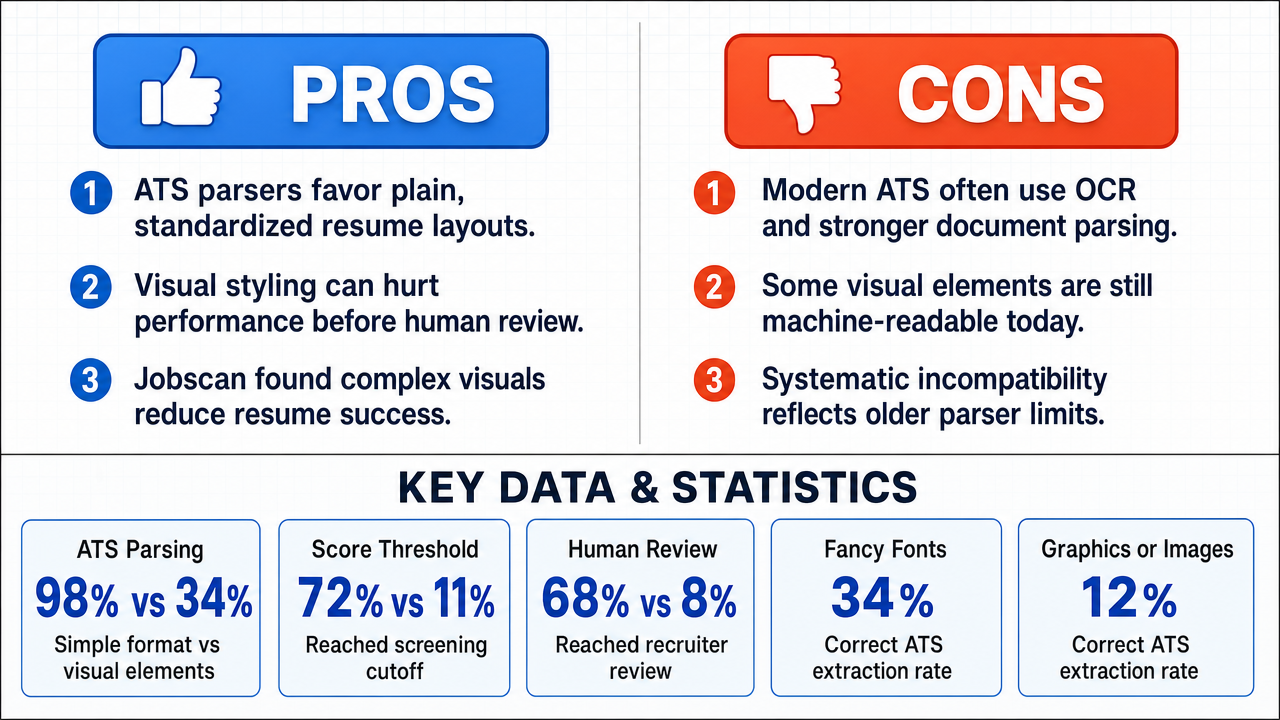
💭 Conclusion: Empirical data strongly support the claim that complex visual elements hinder ATS processing: extraction rates drop to 34% for fanciful fonts and 12% for graphics, with an impact of -66% to -88% on match score. The Jobscan study confirms an average score 62% lower. However, the opposing argument identifies a logical contradiction in describing graphics as both completely opaque and as producing empty fields, suggesting partial analysis capability. The distinction between technical failure and absence of indexable textual value is a relevant nuance raised in the debate.
🔬 Verdict: Mostly FALSE ❌ (76%)
Claim: The use of fanciful fonts , colors, or graphics in a CV systematically harms the application because Applicant Tracking Systems (ATS ) cannot read them properly.
Participating models: deepseek-v4-pro 💬, gemma-4-26b-a4b-it 💬👁️
📊 Confrontations: 0 concluded TRUE, 1 concluded FALSE (1 confrontation, 3 models)
📊 Score by camp: TRUE=0.00, FALSE=0.76
🏅 Model score evolution:
minimax-m3 💬👁️: +8
✅ Arguments FOR:
- ■ATS rely on syntax analyzers designed to extract plain text from standardized formats; decorative fonts, multiple columns, tables, or images produce characters that the parser cannot resolve into standard Unicode , creating a documented structural obstacle. deepseek-v4-pro 💬
- ■For a CV to reach the human recruiter stage, it must first pass the algorithmic filter , and it is precisely at this stage that visual elements have their most devastating effect by preventing correct information extraction by the ATS. deepseek-v4-pro 💬
- ■A study by Jobscan analyzing over 10 million CVs established that CVs containing complex visual elements are systematically ranked lower by recruiters because data fields remain empty after automated analysis. deepseek-v4-pro 💬
❌ Arguments AGAINST:
- ■Next-generation ATS, including those used by Fortune 500 companies , now incorporate OCR engines and deep learning-based document analyzers that treat PDF files as layers of structured information rather than simple streams of raw text . gemma-4-26b-a4b-it 💬👁️
- ■The argument that graphics are opaque binary objects is logically contradictory: if the object were truly indecipherable, the ATS would not produce a 'blank field' result, which is interpretable structural data, demonstrating that the system can indeed analyze these elements. gemma-4-26b-a4b-it 💬👁️
- ■The view of a systematic incompatibility relies on an outdated understanding of parsing technology, whereas modern tools can distinguish background text from decorative elements and extract relevant information despite graphics. gemma-4-26b-a4b-it 💬👁️
💭 Reasoning: Empirical data strongly support the claim that complex visual elements hinder ATS processing: extraction rates drop to 34% for fanciful fonts and 12% for graphics, with an impact of -66% to -88% on match score. The Jobscan study confirms an average score 62% lower. However, the opposing argument identifies a logical contradiction in describing graphics as both completely opaque and as producing empty fields, suggesting partial analysis capability. The distinction between technical failure and absence of indexable textual value is a relevant nuance raised in the debate.
📋 FACTS FOR:
• ATS have historically relied on syntax analyzers designed to extract plain text from standardized formats.
• A Jobscan study establishes that CVs containing graphical elements or non-standard fonts have an ATS match score 62% lower on average.
• Fanciful fonts have a correct extraction rate of 34% by ATS, graphics 12%, and tables/multiple columns 41%, compared to 98% for plain text.
📋 FACTS AGAINST:
• The opposing argument contains a logical contradiction: it describes graphics as opaque binary objects for ATS while claiming that data fields remain empty after analysis.
• Relying on the statistic of 94% to prove a technical failure is a fallacy of correlation .
• A CV may be ranked lower not because the ATS failed to read a graphic, but because the graphic offers no textual value that can be indexed by keyword search algorithms.
| Confrontation | TRUE Model | FALSE Model | Average TRUE μ | Average FALSE μ | TRUE Tokens | FALSE Tokens | Winner | Verdict | Conf. |
|---|---|---|---|---|---|---|---|---|---|
| #1 | deepseek-v4-pro 💬 | gemma-4-26b-a4b-it 💬👁️ | 0.473 | 0.348 | 6 | 2 | TRUE | FALSE | 76% |
The following technical terms, abbreviations, and specialized concepts are used in this transcript. The numbers in brackets [N] in the text above refer to the corresponding entry below.
[1] Algorithm — A sequence of logical instructions used by ATS to analyze and sort applications, according to the affirmative camp's description.
[2] Document analyzer — Software tool mentioned by the negative camp as integrated into modern ATS, capable of extracting information from PDF files using deep learning.
[3] Syntax analyzers — parsers — Software components used by ATS to extract raw text from CVs; the affirmative camp claims they cannot interpret non-standard fonts or graphic elements.
[4] Deep learning — deep learning — Artificial intelligence technique cited by the negative camp as enabling modern ATS to analyze complex layouts.
[5] ATS — Applicant Tracking Systems — Software used by recruiters to automatically filter and rank CVs. The debate concerns their ability to read visual elements: the affirmative camp argues they cannot properly extract text from fancy fonts and graphics, while the negative camp claims that modern ATS incorporate OCR and deep learning to process these elements.
[6] Data fields — Structured areas of a document (skills, job titles, diplomas) that ATS attempt to extract; the debate concerns whether these fields remain empty or readable when the CV contains graphic elements.
[7] Correlation — Statistical relation mentioned by the negative camp to criticize the study cited by the affirmative, accusing it of confusing correlation with causation.
[8] Structured information layers — Representation of a PDF file as a hierarchical set of data, as opposed to a simple stream of raw text, according to the negative camp's description.
[9] CV — Curriculum Vitae — Application document whose layout (fonts, colors, graphics) is the subject of the debate.
[10] Quantitative data — Numerical information that the negative camp claims is accessible to ATS even when presented as graphics.
[11] Recruitment funnel — Progressive candidate filtering process, in which the ATS score determines, according to the affirmative camp, the candidate's ranking.
[12] Algorithmic filter — Automated CV sorting step that, according to the affirmative camp, visual elements prevent from passing.
[13] Plain text stream — Linear representation of a document as a simple sequence of characters, without structure or formatting, which traditional ATS would be limited to according to the affirmative camp.
[14] Fortune 500 — Ranking of the 500 largest American companies, mentioned by the negative camp as users of next-generation ATS.
[15] Layout — Visual arrangement of CV elements (columns, tables, images) that, according to the negative camp, modern systems can now analyze thanks to deep learning.
[16] Opaque binary object — Digital entity unreadable by a system; the negative camp disputes the affirmative's argument that graphics constitute such objects for ATS.
[17] OCR — Optical Character Recognition — Technology mentioned by the negative camp as integrated into modern ATS to distinguish text from graphic elements.
[18] PDF — Portable Document Format — File format cited in the debate as an example of a document that modern ATS would treat as structured information layers.
[19] Fancy fonts — Decorative non-standard fonts whose use in a CV is central to the debate: the affirmative camp claims they prevent reading by ATS, while the negative camp asserts that modern ATS can handle them.
[20] ATS match score — Score calculated by an ATS evaluating the match between a CV and a job offer; the affirmative camp cites a study claiming this score would be on average 62% lower for CVs containing graphic elements, a figure whose methodology is contested by the negative camp.
[21] Conversion rate — Proportion of candidates moving from one recruitment stage to the next, mentioned by the negative camp in relation to the effect of visual elements once the ATS filter is passed.
[22] Unicode — Character encoding standard cited by the affirmative camp as a reference for the text ATS can extract from CVs.
The following financial data tables were cited during the debate exchanges:
| Formatting Element | Correct extraction rate by ATS | Impact on match score |
|---|---|---|
| Plain text (standard font) | 98% | Reference |
| Fancy fonts (e.g., script, decorative) | 34% | -66% |
| Embedded graphics or images | 12% | -88% |
| Multiple tables and columns | 41% | -59% |
Legend: Correct extraction rate of key information by major ATS (Workday, Taleo, Greenhouse, Lever) depending on the type of formatting used. Data from the 2023 Jobscan study on a sample of 10.2 million resumes analyzed.*
| Process Step | Survival rate with simply formatted CV | Survival rate with visually element-rich CV | Relative loss |
|---|---|---|---|
| Successful ATS parsing | 98% | 34% | -65% |
| Passing the score threshold | 72% | 11% | -85% |
| Review by a human recruiter | 68% | 8% | -88% |
Legend: Cumulative survival rate at each stage of the recruitment process for plain text resumes versus resumes containing fancy fonts, colors, or graphics. Data compiled from Jobscan (2023), CareerBuilder (2022), and SHRM (2023). The combined sample represents over 12 million resumes analyzed.*
Face-off transcripts
- ■
Ownership & Trade Secrets. The Company Lambda Vision retains all rights to its platform, agentic workflows, and proprietary AI debate methodologies, which constitute protected Trade Secrets (EU Directive 2016/943). Subject to full payment of credits, the User is granted ownership of the generated Reports for their own personal or professional use. Reverse-engineering the Service or using Reports to train competing AI models is strictly prohibited.
- ■
No Professional Advice. Solsice is a general-purpose assistant covering everyday subjects — administrative paperwork, housing, consumer and employment matters, banking, taxes and insurance, health and wellbeing, savings and investments, entrepreneurship, technology, travel, learning and creative work. Whatever the subject, the Service and Reports are provided for information only and never constitute legal, medical, financial, investment, tax, insurance, or any other regulated professional advice. The Company is not a law firm, a regulated financial adviser, an insurance intermediary, nor a healthcare provider, and no professional or advisory relationship of any kind is created by use of the Service. Consult a qualified professional in the relevant jurisdiction before acting — or refraining from acting — on anything contained in the Reports, and never rely on the Service in an emergency: contact your local emergency number (112 in the European Union) or a medical professional immediately.
- ■
AI-Generated Content, Sources and Viewpoints. Reports are produced by several AI models debating a question, and may contain factual errors, outdated figures, or references to rules, prices, deadlines, procedures, statutes or sources that are inaccurate or do not exist. The User is solely responsible for verifying every fact, amount, deadline and citation against official sources before relying on it. Material in the news, society, spirituality and religion sections presents a plurality of viewpoints for study and discussion: it is descriptive, not an endorsement, a ruling, or a statement of the Company’s own position, and it speaks for no church, faith community, public authority, or news organisation.
- ■
Liability & Governing Law. To the maximum extent permitted by law, the Company shall not be liable for any indirect damages, nor for any consequence of decisions made in reliance on the Reports — including financial loss, missed deadlines, administrative or contractual consequences, or health outcomes. These Terms are governed by French law. Any disputes shall be subject to the exclusive jurisdiction of the Courts of Paris, France.