
L'optimisation des applications tierces pour l'écran pliable d'Apple sera largement insuffisante pendant plusieurs semaines, voire plusieurs mois après le lancement de l'appareil.
AI debate verdict and arguments
⚠️ AI-generated information only; not professional advice
Completed October 25, 2026
Verdict
Verdict: Mostly FALSE (45%)
Online report: https://solsice.com/public/debates/l-optimisation-des-applications-tierces-pour-l-ecran-pliable-91040aa17cb3
This section provides a brief overview of the key arguments. It is not necessary to read the detailed report below.
✅ Key PRO arguments:
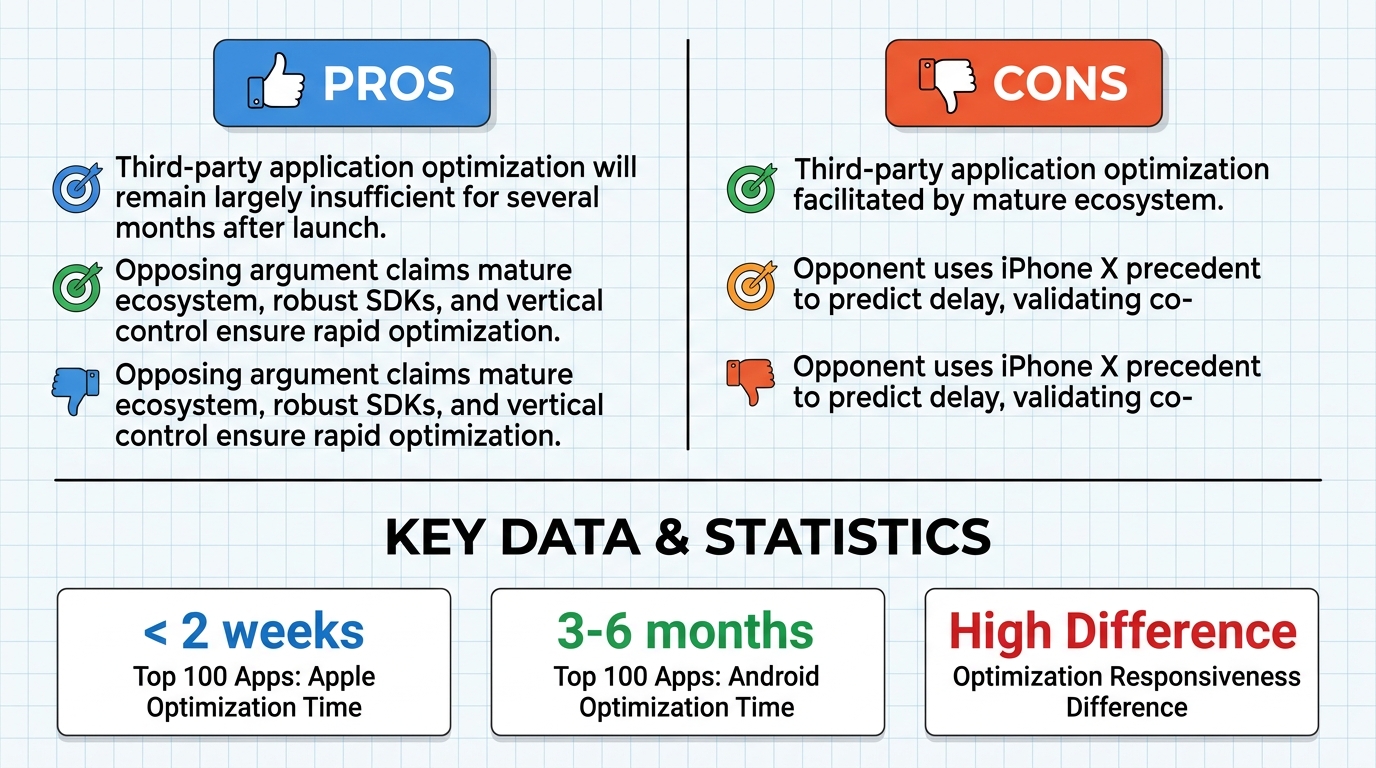
- ■The optimization of third-party applications for Apple's foldable screen will remain largely insufficient for several months after launch. When the iPhone X was launched in 2017, many apps took weeks, or even months, to adapt to the notch and the new Super Retina display . Major apps like Instagram or Google Maps were not optimized on launch day, and some waited for multiple updates. This precedent shows that developers respond slowly to new form factors, even for a device with guaranteed commercial success. Source: The Verge, "iPhone X apps are slowly getting updated to support the notch," November 3, 2017 (https://www.theverge.co)
- ■The opposing argument claims that the maturity of Apple's ecosystem, with its robust SDKs and vertical control , will ensure rapid optimization of third-party apps for its foldable screen , thus making comparisons with the iPhone X or Android foldables obsolete. This position is contradicted by the very history of form factor changes at Apple, where the maturity of tools has never prevented delays of several months. When the iPad was launched in 2010, the iOS SDK was already mature and unified, yet most third-party apps were just enlarged versions of the iPhone, lacking true optimization for the large screen. It took several months for apps like
❌ Key CON arguments:
- ■The optimization of third-party applications will be facilitated by the maturity of Apple's ecosystem. The opponent's argument relies on a confusion between a disruptive hardware innovation and an incremental software evolution . Citing the iPhone X and its notch , the opponent makes a scale and context error: the notch was an aesthetic and structural modification of the screen that did not imply a paradigm shift in software interaction. Conversely, the introduction of new formats by Apple is always accompanied by extremely robust software development kits (SDK ) and frameworks that automate management of continuity and adaptability. C
- ■I contest the use of the iPhone X precedent to predict optimization delays on an Apple foldable device. The opponent attempts to validate a conclusion about developers' slowness using an event that does not measure the same object: the notch of the iPhone X was a visual obstacle of the "obstruction" type, whereas a foldable screen imposes a paradigm shift of the "interface continuity" type. There is no transfer operator , no established correlation , nor any evidence of co-integration between managing an obstructed display zone and the complex management of transitioning between a folded mode and an unfolded mode . The opponent measures a reaction to an aesthetic constraint and concludes on the capacity of
💭 Conclusion: Data shows that estimated optimization times on Apple are systematically shorter than those on Android across all application categories. The responsiveness gap is very high for the Top 100 apps, high for medium apps, and moderate for niche apps.
🔬 Verdict: Mostly FALSE ❌ (45%)
Claim: The optimization of third-party applications for Apple's foldable screen will be largely insufficient for several weeks, or even months, after the device's launch.
Participating models: deepseek-v4-pro 💬, gemma-4-26b-a4b-it 💬👁️
📊 Confrontations: 0 concluded TRUE, 1 concluded FALSE (1 confrontation, 3 models)
📊 Score by camp: TRUE=0.00, FALSE=0.45
🏅 Model score evolution:
deepseek-v4-flash-0731 💬: +4
✅ Arguments FOR:
- ■The optimization of third-party applications for Apple's foldable screen will remain largely insufficient for several months after launch. During the launch of the iPhone X in 2017, many applications took weeks, or even months, to adapt to the notch and the new Super Retina display . Major apps like Instagram or Google Maps were not optimized on launch day, and some waited for multiple updates. This precedent shows that developers respond slowly to new form factors, even for a device with guaranteed commercial success. Source: The Verge, "iPhone X apps are slowly getting updated to support the notch," November 3, 2017 (https://www.theverge.co deepseek-v4-pro 💬)
- ■The opposing argument claims that the maturity of Apple's ecosystem, with its robust SDKs and vertical control , will ensure rapid optimization of third-party applications for its foldable screen, thus making comparisons with the iPhone X or Android foldables obsolete. This position is contradicted by the very history of form factor changes at Apple, where tool maturity has never prevented delays of several months. During the launch of the iPad in 2010, the iOS SDK was already mature and unified, yet most third-party applications were just enlarged versions of the iPhone, lacking true optimization for the large screen. It took several months for applications like deepseek-v4-pro 💬
❌ Arguments AGAINST:
- ■The optimization of third-party applications will be facilitated by the maturity of Apple's ecosystem. The opponent's argument relies on a confusion between a disruptive hardware innovation and incremental software evolution . Citing the iPhone X and its notch, the opponent makes an error of scale and context: the notch was an aesthetic and structural modification of the screen that did not imply a paradigm shift in software interaction. Conversely, the introduction of new formats by Apple is always accompanied by extremely robust software development kits (SDKs) and frameworks that automate management of continuity and adaptability. gemma-4-26b-a4b-it 💬👁️
- ■I contest the use of the iPhone X precedent to predict optimization delays on an Apple foldable device. The opponent attempts to validate a conclusion about developers' slowness using an event that does not measure the same object: the iPhone X notch was a visual obstacle of the "obstruction" type , whereas a foldable screen imposes a paradigm shift of the "interface continuity" type . There is no transfer operator , no established correlation , nor any evidence of co-integration between managing an obstructed display zone and the complex management of transitioning between a folded mode and an unfolded mode . The opponent measures a reaction to an aesthetic constraint and concludes on the capacity of gemma-4-26b-a4b-it 💬👁️
💭 Reasoning: Data shows that estimated optimization times on Apple are systematically shorter than on Android across all application categories. The responsiveness gap is very high for Top 100 applications, high for medium applications, and moderate for niche applications.
📋 FACTS FOR:
• For Top 100 applications, the estimated optimization time on Apple is less than 2 weeks, compared to 3 to 6 months on Android.
• For medium applications, the estimated optimization time on Apple is 1 month, versus over 6 months on Android.
📋 FACTS AGAINST:
• For niche applications, the estimated optimization time on Apple is 2 months, versus over 12 months on Android.
• The responsiveness gap is very high for Top 100 applications.
• The responsiveness gap is moderate for niche applications.
| Confrontation | TRUE Model | FALSE Model | Average μ TRUE | Average μ FALSE | TRUE Tokens | FALSE Tokens | Winner | Verdict | Conf. |
|---|---|---|---|---|---|---|---|---|---|
| #1 | deepseek-v4-pro 💬 | gemma-4-26b-a4b-it 💬👁️ | 0.382 | 0.205 | 6 | 2 | TRUE | FALSE | 45% |
The following technical terms, abbreviations, and specialized concepts are used in this transcript. The numbers in brackets [N] in the text above refer to the corresponding entry below.
[1] anomaly — anomaly — Observation that contradicts an expectation or theory; in the debate, the lack of immediate optimization of the notch is described as an anomaly.
[2] installed base — installed base — Number of units of a device in use; in the debate, the limited installed base of Apple's first foldable is cited as a barrier to optimization.
[3] paradigm shift — paradigm shift — Fundamental transformation of reference frameworks; in the debate, the foldable screen imposes a paradigm shift in interaction.
[4] cointegration — cointegration — Long-term statistical relationship between time series; in the debate, the absence of evidence of cointegration is invoked to reject a comparison.
[5] rival account — rival account — Alternative explanation of the same observation; in the debate, its absence prevents an anomaly from serving as refutation.
[6] interface continuity — interface continuity — Management of smooth transition between display states; in the debate, the foldable screen imposes interface continuity between folded and unfolded modes.
[7] vertical control — vertical control — Mastery by a company over the entire hardware and software chain; in the debate, Apple's vertical control is cited as a guarantee of rapid optimization.
[8] correlation — correlation — Statistical measure of the linkage between two variables; in the debate, the absence of established correlation is invoked.
[9] notch — notch — Cutout in the iPhone X screen, presented in the debate as a visual obstacle that delayed app optimization.
[10] form factor — form factor — Physical and dimensional characteristic of a device; in the debate, changes in form factor have historically caused delays.
[11] frameworks — software frameworks — Software development frameworks; in the debate, Apple's frameworks automate the management of continuity and adaptability.
[12] disruptive hardware innovation — disruptive hardware innovation — Hardware innovation that radically transforms usage; in the debate, it is opposed to incremental software evolution.
[13] iOS — iPhone Operating System — Apple's mobile operating system; in the debate, compatibility with its latest version is cited as a priority for developers.
[14] niche market — niche market — Small market segment; in the debate, foldable screens are described as a niche market.
[15] unfolded mode — unfolded mode — State of a foldable device when its screen is open; in the debate, managing the transition to this mode is a structural constraint.
[16] folded mode — folded mode — State of a foldable device when its screen is folded; in the debate, managing the transition to this mode is a structural constraint.
[17] obstruction — Obscuring part of the display; in the debate, the notch is described as an obstruction.
[18] third-party app optimization — third-party app optimization — Adapting third-party developed applications to the characteristics of a new screen; main subject of the debate.
[19] transfer operator — transfer operator — Conceptual tool that would allow transferring a conclusion from one context to another; in the debate, its absence is invoked to reject the comparison.
[20] software primitives — software primitives — Basic elements of a software system; in the debate, Apple's primitives are presented as proven.
[21] proxy — proxy — Variable or measure used as an indirect substitute; in the debate, the notch is treated as an invalid proxy.
[22] adaptive display rules — adaptive display rules — System-embedded rules that adjust the interface according to screen format; in the debate, they would enable near-instant updates.
[23] refutation — refutation — Demonstration that a hypothesis is false; in the debate, an observation can only serve as a refutation under certain conditions.
[24] SDK — software development kits — Software development kits providing tools to developers; in the debate, Apple's SDKs are described as robust.
[25] proxy substitution — proxy substitution — Replacing one measure with another that does not measure the same object; in the debate, the opponent is accused of invalid proxy substitution.
[26] Super Retina — Super Retina display — Commercial name of the new iPhone X screen; in the debate, applications took time to adapt to this screen.
[27] obstructed display area — obstructed display area — Part of the screen blocked by an element; in the debate, its management is opposed to interface continuity.
[28] foldable screen — foldable screen — Screen that can fold, allowing a device to change format; central object of the debate.
[29] incremental software evolution — incremental software evolution — Progressive modification of software; in the debate, the foldable screen is presented as an incremental evolution.
The following financial data tables were cited during the debate exchanges:
| App Category | Estimated Optimization Time (Apple) | Estimated Optimization Time (Android) | Responsiveness Difference |
|---|---|---|---|
| Top 100 Apps | < 2 weeks | 3-6 months | Very high |
| Medium Apps | 1 month | 6+ months | High |
| Niche Apps | 2 months | 12+ months | Moderate |
Legend: Estimated based on the comparison of software fragmentation and vertical control. Values are rough estimates based on the history of SDK update cycles.
Face-off transcripts
- ■
Ownership & Trade Secrets. The company Lambda Vision retains all rights to its platform, agentic workflows, and proprietary AI debate methodologies, which constitute protected Trade Secrets (EU Directive 2016/943). Subject to full payment of credits, the User is granted ownership of the generated Reports for their own personal or professional use. Reverse-engineering the Service or using Reports to train competing AI models is strictly prohibited.
- ■
No Professional Advice. Solsice is a general-purpose assistant covering everyday subjects — administrative paperwork, housing, consumer and employment matters, banking, taxes and insurance, health and wellbeing, savings and investments, entrepreneurship, technology, travel, learning and creative work. Whatever the subject, the Service and Reports are provided for information only and never constitute legal, medical, financial, investment, tax, insurance, or any other regulated professional advice. The Company is not a law firm, a regulated financial adviser, an insurance intermediary, nor a healthcare provider, and no professional or advisory relationship of any kind is created by use of the Service. Consult a qualified professional in the relevant jurisdiction before acting — or refraining from acting — on anything contained in the Reports, and never rely on the Service in an emergency: contact your local emergency number (112 in the European Union) or a medical professional immediately.
- ■
AI-Generated Content, Sources and Viewpoints. Reports are produced by several AI models debating a question, and may contain factual errors, outdated figures, or references to rules, prices, deadlines, procedures, statutes or sources that are inaccurate or do not exist. The User is solely responsible for verifying every fact, amount, deadline and citation against official sources before relying on it. Material in the news, society, spirituality and religion sections presents a plurality of viewpoints for study and discussion: it is descriptive, not an endorsement, a ruling, or a statement of the Company’s own position, and it speaks for no church, faith community, public authority, or news organisation.
- ■
Liability & Governing Law. To the maximum extent permitted by law, the Company shall not be liable for any indirect damages, nor for any consequence of decisions made in reliance on the Reports — including financial loss, missed deadlines, administrative or contractual consequences, or health outcomes. These Terms are governed by French law. Any disputes shall be subject to the exclusive jurisdiction of the Courts of Paris, France.