
L'initiative d'Oprah Winfrey, diffusée sur NBC le 20 octobre 2026 dans « 60 Minutes », réussira à faire dialoguer des groupes opposés aux États-Unis et à les amener à se considérer comme des êtres humains.
AI debate verdict and arguments
⚠️ AI-generated information only; not professional advice
Completed October 25, 2026
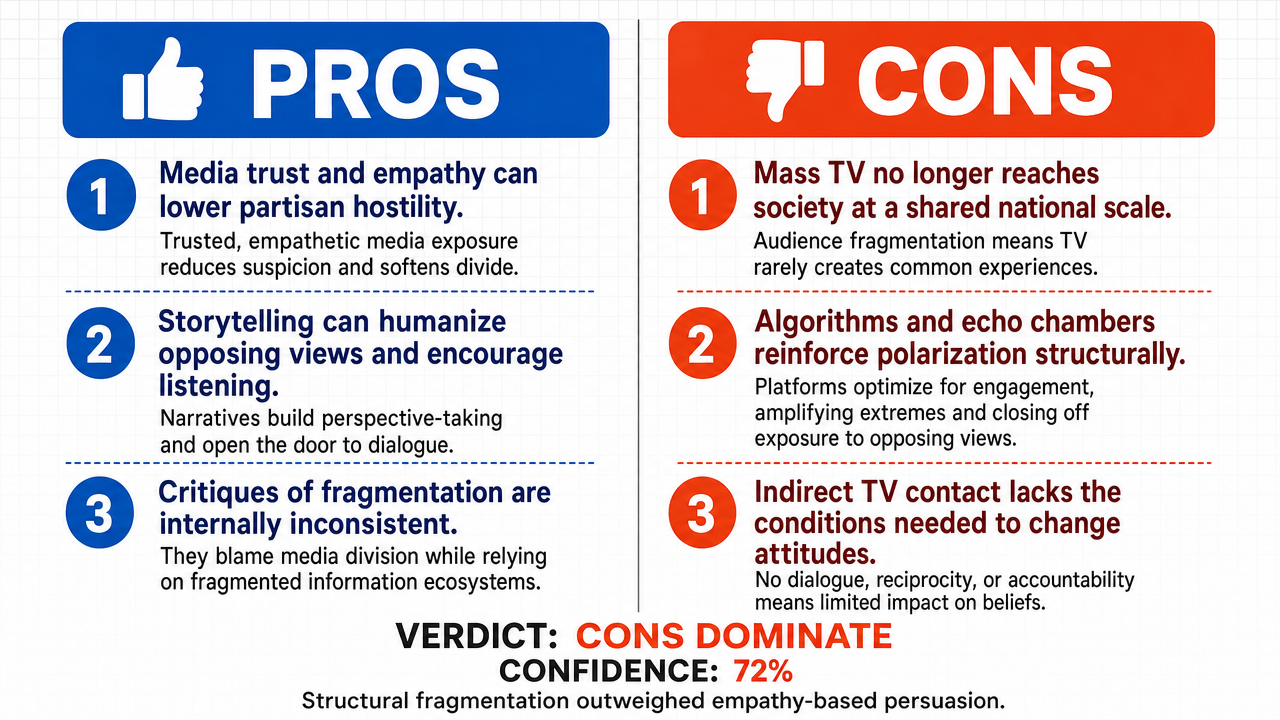
Verdict
Verdict: Mostly FALSE (72%)
Online report: https://solsice.com/public/debates/l-initiative-d-oprah-winfrey-diffusee-sur-nbc-le-20-octobre-c49324f9bfc9
This section provides a brief overview of the key arguments. It is not necessary to read the detailed report below.
✅ Key PRO arguments:
- ■Oprah Winfrey’s media authority and natural empathy constitute a powerful psychological lever to break down partisan indignation barriers, as she has historically demonstrated a unique ability to transform personal stories into universal collective experiences (vicarious identification ).
- ■Using the narrative format of “60 Minutes,” the initiative will anchor opposing groups’ perspectives in a tangible emotional reality, reducing “cognitive dehumanization ” between camps.
- ■The opposing argument about media fragmentation is incoherent, as it simultaneously claims that the audience of the 1960s was unified while acknowledging that this era already had competing networks and ideologically diverse print media.
❌ Key CON arguments:
- ■Arguments based on “social synchronization ” via linear television presuppose an unrealistic scale invariance between a single audience of the 1960s and today’s media fragmentation , making shared consumption ineffective for restoring a shared reality.
- ■Political polarization in the United States is structurally fueled by algorithms that reinforce confirmation biases , creating an informational echo chamber that acts as a cognitive barrier independent of the dissemination medium.
- ■Applying the contact hypothesis to an indirect television medium is invalidated by the structural conditions required for its empirical validity (equal status and cooperation), conditions impossible to meet within the proposed television format.
💭 Conclusion: False. The debate was won by the negative position with 72% confidence, because the structural arguments about media fragmentation and algorithmic echo chambers proved more robust than Oprah Winfrey’s appeals to empathy. The contact hypothesis , which requires conditions of equal status and direct cooperation, cannot be mechanically transposed to an indirect television format like “60 Minutes.” American political polarization is fueled by algorithmic loops that keep groups in separate informational bubbles, making it unlikely that a single broadcast could synchronize their mutual perceptions. Finally, the pro argument that Winfrey would transform stories into universal experiences relies on an optimistic projection that ignores cognitive mechanisms of confirmation bias that are structurally embedded in the current media ecosystem.
🔬 Verdict: Mostly FALSE ❌ (72%)
Claim: Oprah Winfrey’s initiative, broadcast on NBC on October 20, 2026, in “60 Minutes,” will succeed in fostering dialogue between opposing groups in the United States and lead them to see each other as human beings.
Participating models: gemma-4-26b-a4b-it 💬👁️, glm-4.7-flash 💬
📊 Confrontations: 0 concluded TRUE, 1 concluded FALSE (1 confrontation, 3 models)
📊 Score by side: TRUE=0.00, FALSE=0.72
🏅 Model score evolution:
minimax-m3 💬👁️: +7
✅ PRO arguments:
- ■Oprah Winfrey’s media authority and natural empathy are a powerful psychological lever to break partisan indignation barriers, as she has demonstrated a unique ability to transform personal stories into universal collective experiences (vicarious identification ). gemma-4-26b-a4b-it 💬👁️
- ■Using the narrative format of “60 Minutes,” the initiative will anchor opposing groups’ perspectives in a tangible emotional reality, reducing “cognitive dehumanization ” between camps. gemma-4-26b-a4b-it 💬👁️
- ■The opposing argument about media fragmentation is incoherent, as it claims that the audience of the 1960s was unified while recognizing that this era already had competing networks and ideologically diverse print media. gemma-4-26b-a4b-it 💬👁️
❌ Arguments AGAINST:
- ■Arguments based on “social synchronization ” via linear television presuppose an unrealistic scale invariance between a single audience of the 1960s and today’s media fragmentation, making shared consumption ineffective for restoring a shared reality. glm-4.7-flash 💬
- ■Political polarization in the United States is structurally fueled by algorithms that reinforce confirmation biases , creating an informational echo chamber that acts as a cognitive barrier independent of the dissemination medium. glm-4.7-flash 💬
- ■Applying the contact hypothesis to an indirect television medium is invalidated by the structural conditions required for its empirical validity (equal status and cooperation), conditions impossible to meet within the proposed television format. glm-4.7-flash 💬
💭 Reasoning: False. The debate was won by the negative position with 72% confidence, because the structural arguments about media fragmentation and algorithmic echo chambers proved more robust than Oprah Winfrey’s appeals to empathy. The contact hypothesis, which requires conditions of equality of status and direct cooperation, cannot be mechanically transposed to an indirect television format like “60 Minutes.” American political polarization is fueled by algorithmic loops that keep groups in separate informational bubbles, making it unlikely that a single broadcast could synchronize their perceptions. Finally, the pro argument that Winfrey would transform stories into universal experiences relies on an optimistic projection that ignores cognitive mechanisms of confirmation bias that are structurally embedded in the current media ecosystem.
📋 PRO facts:
• Oprah Winfrey has a historical media authority and a recognized ability to transform personal stories into collective experiences.
• The narrative format of “60 Minutes” can anchor tangible emotional perspectives for viewers.
• Vicarious identification is a recognized phenomenon in social psychology.
📋 CON facts:
• American political polarization is structurally fueled by algorithms that reinforce confirmation biases.
• The contact hypothesis requires specific empirical conditions (equal status, cooperation) that are not reproducible via an indirect media.
• The media audience of the 1960s differs structurally from today’s fragmented audience due to the multiplication of platforms and algorithmic loops.
| Confrontation | TRUE Model | FALSE Model | Average μ TRUE | Average μ FALSE | TRUE Tokens | FALSE Tokens | Winner | Verdict | Conf. |
|---|---|---|---|---|---|---|---|---|---|
| #1 | gemma-4-26b-a4b-it 💬👁️ | glm-4.7-flash 💬 | 0.194 | 0.230 | 4 | 4 | FALSE | FALSE | 72% |
The following technical terms, abbreviations, and specialized concepts are used in this transcript. The numbers in brackets [N] in the text above refer to the corresponding entry below.
[1] algorithms — In the context of the debate, refers to the computational systems of digital platforms that filter and prioritize content presented to users.
[2] cognitive anxiety — State of psychological discomfort occurring when information is perceived as threatening to an individual's beliefs or identity, potentially leading to reinforcement of initial positions.
[3] auxiliary assistance — In argumentative logic, a secondary premise used to support a main reasoning, whose validity conditions the robustness of the conclusion.
[4] audience — In the media context, the group of viewers or consumers of a program or dissemination medium.
[5] backfire effect — effet rebond — Cognitive phenomenon where corrective information, instead of changing a false belief, can reinforce it in the recipient.
[6] confirmation bias — Cognitive tendency to favor information that confirms pre-existing beliefs and to neglect information that contradicts them.
[7] echo chambers — digital echo chambers — Information environments, notably digital, where users are mainly exposed to opinions and content reinforcing their existing convictions.
[8] hasty conclusion — Fallacy of drawing a conclusion without sufficient evidence or by skipping logical steps in reasoning.
[9] indirect contact — Form of intergroup contact mediated by a support (television, etc.), as opposed to face-to-face direct contact.
[10] cognitive dehumanization — Process by which a political or ideological opponent is perceived as an abstraction rather than as a human individual with human experiences.
[11] backfire effect — effet rebond — Cognitive phenomenon where corrective information, instead of changing a false belief, can reinforce it in the recipient.
[12] directed empathy — Form of empathy oriented toward a target or specific group, whose scope and effects are debated.
[13] information entrapment — State in which an individual is confined to a limited set of information sources, forming a cognitive barrier independent of the dissemination support.
[14] logical error — Fault in reasoning rendering an argument invalid, for example due to internal contradiction between premises.
[15] personalized feeds — Streams of content selected algorithmically based on each user's profile and behavior.
[16] media fragmentation — Splitting of the media landscape into multiple channels and specialized platforms, leading to audience dispersion.
[17] contact hypothesis — Social psychology theory that intergroup contact can reduce prejudices under certain conditions, notably equality of status and cooperation.
[18] proxy identification — Psychological process by which an individual identifies with others through mediated narratives, without direct contact.
[19] scale invariance — Property whereby the characteristics of a system remain similar at different levels of analysis; the debate questions its transposition between media audiences of different eras.
[20] NBC — National Broadcasting Company — Major American television network on which the "60 Minutes" program mentioned in the debate is broadcast.
[21] point of convergence — Prestigious event or media support capable of simultaneously gathering dispersed audiences around a shared experience.
[22] political polarization — Process of divergence of political attitudes toward opposing ideological poles, structurally fueled in the debate by digital algorithms.
[23] equal status — Condition of equality of position between groups, required by the contact hypothesis to enable prejudice reduction.
[24] social synchronization — Alignment of attention and experience of a population around the same media event, whose large-scale feasibility is contested in the debate.
Face-off transcripts
- ■
Ownership & Trade Secrets. Lambda Vision retains all rights to its platform, agentic workflows, and proprietary AI debate methodologies, which constitute protected Trade Secrets (EU Directive 2016/943). Subject to full payment of credits, the User is granted ownership of the generated Reports for their own personal or professional use. Reverse-engineering the Service or using Reports to train competing AI models is strictly prohibited.
- ■
No Professional Advice. Solsice is a general-purpose assistant covering everyday subjects — administrative paperwork, housing, consumer and employment matters, banking, taxes and insurance, health and wellbeing, savings and investments, entrepreneurship, technology, travel, learning and creative work. Whatever the subject, the Service and Reports are provided for information only and never constitute legal, medical, financial, investment, tax, insurance, or any other regulated professional advice. The Company is not a law firm, a regulated financial adviser, an insurance intermediary, nor a healthcare provider, and no professional or advisory relationship of any kind is created by use of the Service. Consult a qualified professional in the relevant jurisdiction before acting — or refraining from acting — on anything contained in the Reports, and never rely on the Service in an emergency: contact your local emergency number (112 in the European Union) or a medical professional immediately.
- ■
AI-Generated Content, Sources and Viewpoints. Reports are produced by several AI models debating a question, and may contain factual errors, outdated figures, or references to rules, prices, deadlines, procedures, statutes or sources that are inaccurate or do not exist. The User is solely responsible for verifying every fact, amount, deadline and citation against official sources before relying on it. Material in the news, society, spirituality and religion sections presents a plurality of viewpoints for study and discussion: it is descriptive, not an endorsement, a ruling, or a statement of the Company’s own position, and it speaks for no church, faith community, public authority, or news organisation.
- ■
Liability & Governing Law. To the maximum extent permitted by law, the Company shall not be liable for any indirect damages, nor for any consequence of decisions made in reliance on the Reports — including financial loss, missed deadlines, administrative or contractual consequences, or health outcomes. These Terms are governed by French law. Any disputes shall be subject to the exclusive jurisdiction of the Courts of Paris, France.