
L'IA permet aux escrocs de gérer des centaines de conversations simultanées tout en personnalisant les interactions en temps réel avec les victimes.
AI debate verdict and arguments
⚠️ AI-generated information only; not professional advice
Completed October 11, 2026
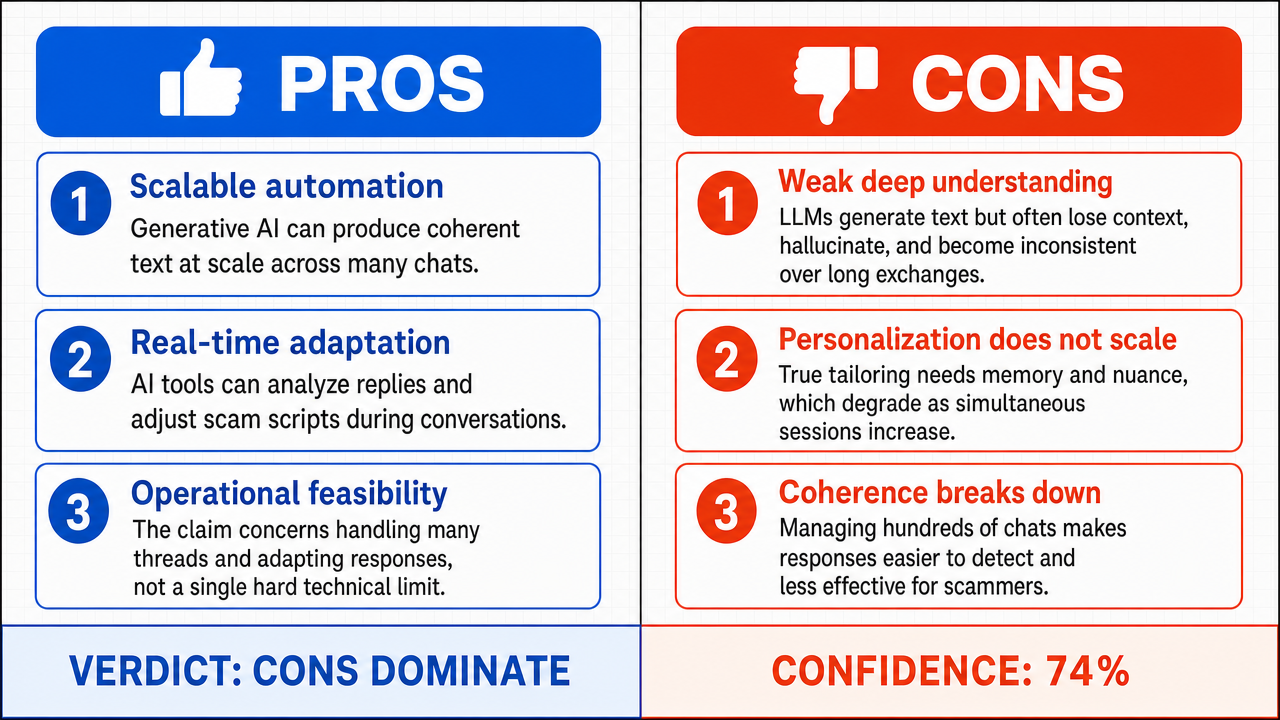
Verdict
Verdict: Mostly FALSE (74%)
This section provides a brief overview of the key arguments. It is not necessary to read the detailed report below.
✅ Key PRO arguments:
- ■Large language models and cloud-based generative AI services offer scalable automation capabilities , enabling the generation of coherent and contextually appropriate texts, with an architecture capable of isolating hundreds of independent sessions .
- ■AI-based tools can analyze victims' responses in real time and dynamically adapt the scam script, making interactions more convincing and harder to detect.
- ■The claim concerns operational feasibility — managing multiple conversation threads and tailoring each response to the victim's signals — and not perfect human understanding, unlimited conversational memory , or total invisibility.
❌ Key CON arguments:
- ■The assertion relies on a confusion between text generation and deep contextual understanding : LLMs suffer from hallucinations and an inability to maintain logical coherence over long and complex exchanges.
- ■Genuine personalization requires managing contextual memory and understanding nuances that diminish as soon as one attempts to multiply sessions automatically, due to the limited context windows of language models .
- ■Managing hundreds of conversations leads to erosion of contextual coherence, making interactions detectable by victims and ineffective against modern cybersecurity measures .
💭 Conclusion: False: the claim that AI enables scammers to manage hundreds of simultaneous conversations while personalizing interactions in real time is deemed false. The negative side has demonstrated that LLMs , despite their text-generation capabilities, suffer from hallucinations and a loss of contextual coherence over long exchanges, which structurally degrades the quality of large-scale interactions. Authentic personalization requires extended conversational memory and understanding of emotional nuances , which current models' limited context windows cannot sustain across hundreds of sessions. Moreover, modern cybersecurity measures and increasing victim vigilance make these automated interactions detectable, undermining operational effectiveness. Finally, the composite nature of the claim — combining massive simultaneity AND real-time personalization — further weakens the thesis, as the least-supported sub-claim (authentic personalization) is not robustly demonstrated.
🔬 Verdict: Mostly FALSE ❌ (74%)
Claim: AI allows scammers to manage hundreds of simultaneous conversations while personalizing interactions in real time with victims.
Participating models: deepseek-v3.2 💬, gemma-4-26b-a4b-it 💬👁️
📊 Confrontations: 0 concluded TRUE, 1 concluded FALSE (1 confrontation, 3 models)
📊 Score per camp: TRUE=0.00, FALSE=0.74
🏅 Model score evolution:
minimax-m3 💬👁️: +7
✅ PRO arguments:
- ■Large language models and cloud-based generative AI services offer scalable automation capabilities , enabling the generation of coherent and contextually appropriate texts, with an architecture capable of isolating hundreds of independent sessions . deepseek-v3.2 💬
- ■AI-based tools can analyze victims' responses in real time and dynamically adapt the scam script, making interactions more convincing and harder to detect. deepseek-v3.2 💬
- ■The claim concerns operational feasibility — managing multiple conversation threads and tailoring each response to the victim's signals — and not perfect human understanding, unlimited conversational memory , or total invisibility. deepseek-v3.2 💬
❌ CON arguments:
- ■The assertion relies on a confusion between text generation and deep contextual understanding : LLMs suffer from hallucinations and an inability to maintain logical coherence over long and complex exchanges. gemma-4-26b-a4b-it 💬👁️
- ■Genuine personalization requires managing contextual memory and understanding nuances that diminish as soon as one attempts to multiply sessions automatically, due to the limited context windows of language models . gemma-4-26b-a4b-it 💬👁️
- ■Managing hundreds of conversations leads to erosion of contextual coherence, making interactions detectable by victims and ineffective against modern cybersecurity measures . gemma-4-26b-a4b-it 💬👁️
- ■For an interaction to be truly personalized and not just a repetition of probabilistic scripts , the agent must incorporate non-textual data and emotional nuances that current AI only superficially processes. gemma-4-26b-a4b-it 💬👁️
💭 Reasoning: False: the claim that AI enables scammers to manage hundreds of simultaneous conversations while personalizing interactions in real time is deemed false. The negative side has shown that, despite their text-generation capacity, LLMs suffer from hallucinations and a loss of contextual coherence over long exchanges, which structurally degrades the quality of large-scale interactions. Authentic personalization requires extended conversational memory and understanding of emotional nuances that current models' limited context windows cannot maintain across hundreds of sessions. Additionally, modern cybersecurity measures and increasing victim vigilance make these automated interactions detectable, undermining operational effectiveness. Finally, the combined nature of the claim — massive simultaneity AND real-time personalization — further weakens the thesis, as the least-supported sub-claim (authentic personalization) is not robustly demonstrated.
📋 PRO facts:
• LLMs can generate coherent and contextually relevant texts at scale.
• Cloud-based generative AI services offer architecture capable of isolating independent sessions.
• AI tools can analyze victims' responses and dynamically adapt scam scripts.
📋 CON facts:
• LLMs suffer from hallucinations and inability to maintain logical coherence over long exchanges.
• Language models' context windows are limited, eroding conversational memory during multiple sessions.
• Authentic personalization requires integrating non-textual data and emotional nuances that current AI only superficially processes.
• Modern cybersecurity measures can detect AI-generated interactions at scale.
| Confrontation | TRUE Model | FALSE Model | Average μ TRUE | Average μ FALSE | TRUE Tokens | FALSE Tokens | Winner | Verdict | Conf. |
|---|---|---|---|---|---|---|---|---|---|
| #1 | deepseek-v3.2 💬 | gemma-4-26b-a4b-it 💬👁️ | 0.347 | 0.280 | 12 | 3 | TRUE | FALSE | 74% |
The following technical terms, abbreviations, and specialized concepts are used in this transcript. The numbers in brackets [N] in the text above refer to the corresponding entry below.
[1] agents — agents (AI) — Autonomous systems capable of perceiving their environment and acting to achieve objectives; in the debate, refers to AI systems that interact with victims.
[2] threat analyses — Process of identifying, assessing, and prioritizing risks and malicious activities in cybersecurity.
[3] architecture — architecture (of AI models) — Technical and organizational structure of an AI system, including the underlying design of language models and their ability to isolate sessions.
[4] scaling automation — Ability to increase the volume of automated processes without a proportional increase in required resources.
[5] phishing campaigns — Coordinated efforts to send fraudulent messages to multiple victims to extract information or money.
[6] contextual understanding — System's ability to interpret the meaning of information considering its surrounding context.
[7] context window — context window — Maximum amount of text a language model can process at once, constituting a structural limit to the memory of exchanges.
[8] cybersecurity — Set of practices and technologies aimed at protecting systems, networks, and data against digital attacks.
[9] non-textual data — Information that is not in textual form, such as images, audio, or video, and which current AI would only superficially process for nuances.
[10] structural degradation — Fundamental decline in quality or performance resulting from inherent system limitations, not from temporary anomalies.
[11] semantic drift — Progressive loss of coherence or meaning in generated text, occurring as the complexity or length of the exchange increases.
[12] detection — detection (in security) — Identification of fraudulent or malicious activities by automated systems or vigilant users.
[13] fake profiles — Fabricated online identities used for deception, often generated or enriched by AI.
[14] text generation — Process of automatically producing text by an AI model, based on statistical probabilities.
[15] hallucinations — hallucinations (AI) — Phenomenon where an AI model produces false, invented, or incoherent information presented as factual.
[16] hyper-personalized — hyper-personalized phishing — Form of phishing using detailed and specific information about the victim to make the attack more credible and harder to detect.
[17] AI — Artificial Intelligence — Set of techniques and computer systems designed to simulate human intelligence processes, such as reasoning and language generation.
[18] generative AI — Generative Artificial Intelligence — Category of AI systems capable of creating new content (text, images, audio) from learned models, often accessible via cloud services.
[19] logical inconsistencies — Contradictions or reasoning errors that compromise the coherence of an exchange or generated text.
[20] LLM — large language models — AI models trained on very large text corpora to understand and generate human language coherently and contextually.
[21] language models — AI models trained to predict and generate natural language text from large volumes of textual data.
[22] contextual memory — System's ability to retain and utilize information from previous exchanges within the same interaction.
[23] conversational memory — Ability of a conversational agent to remember previous exchanges and reuse them later in the dialogue.
[24] emotional nuances — Subtleties and emotional cues present in communication, necessary for authentic personalization.
[25] operations — operations (scams) — Coordinated fraudulent activities carried out on a large scale by scammers.
[26] mass personalization — Ability to individually tailor interactions for a very large number of users simultaneously, whose actual feasibility is contested in the debate.
[27] phishing — Fraud technique involving impersonation of legitimate entities to obtain sensitive information or trap victims.
[28] platforms — Online services or systems where interactions take place and detection mechanisms can be deployed.
[29] generation probability — In a language model, the statistical likelihood associated with producing a given word or sequence.
[30] security reports — Analytical documents describing threats, incidents, and observed trends in cybersecurity.
[31] probabilistic scripts — Pre-written conversational scenarios where responses are selected according to probability distributions, not actual understanding.
[32] independent sessions — Isolated conversation threads, which, according to the affirmative position, could be managed in hundreds of interactions without interference.
[33] human supervision — Control exercised by human operators over automated systems, presented as necessary to correct AI limitations.
[34] security systems — Technological solutions designed to detect and prevent fraudulent or malicious activities.
Face-off transcripts
- ■
Ownership & Trade Secrets. Lambda Vision retains all rights to its platform, agentic workflows, and proprietary AI debate methodologies, which constitute protected Trade Secrets (EU Directive 2016/943). Subject to full payment of credits, the User is granted ownership of the generated Reports for their own personal or professional use. Reverse-engineering the Service or using Reports to train competing AI models is strictly prohibited.
- ■
No Professional Advice. Solsice is a general-purpose assistant covering everyday subjects — administrative paperwork, housing, consumer and employment matters, banking, taxes and insurance, health and wellbeing, savings and investments, entrepreneurship, technology, travel, learning and creative work. Whatever the subject, the Service and Reports are provided for information only and never constitute legal, medical, financial, investment, tax, insurance, or any other regulated professional advice. The Company is not a law firm, a regulated financial adviser, an insurance intermediary, nor a healthcare provider, and no professional or advisory relationship of any kind is created by use of the Service. Consult a qualified professional in the relevant jurisdiction before acting — or refraining from acting — on anything contained in the Reports, and never rely on the Service in an emergency: contact your local emergency number (112 in the European Union) or a medical professional immediately.
- ■
AI-Generated Content, Sources and Viewpoints. Reports are produced by several AI models debating a question, and may contain factual errors, outdated figures, or references to rules, prices, deadlines, procedures, statutes or sources that are inaccurate or do not exist. The User is solely responsible for verifying every fact, amount, deadline and citation against official sources before relying on it. Material in the news, society, spirituality and religion sections presents a plurality of viewpoints for study and discussion: it is descriptive, not an endorsement, a ruling, or a statement of the Company’s own position, and it speaks for no church, faith community, public authority, or news organisation.
- ■
Liability & Governing Law. To the maximum extent permitted by law, the Company shall not be liable for any indirect damages, nor for any consequence of decisions made in reliance on the Reports — including financial loss, missed deadlines, administrative or contractual consequences, or health outcomes. These Terms are governed by French law. Any disputes shall be subject to the exclusive jurisdiction of the Courts of Paris, France.