
L'exploitation minière in situ présente un risque inévitable et inacceptable de contamination des eaux souterraines pour plus de 2 milliards de personnes
AI debate verdict and arguments
⚠️ AI-generated information only; not professional advice
Completed October 26, 2026
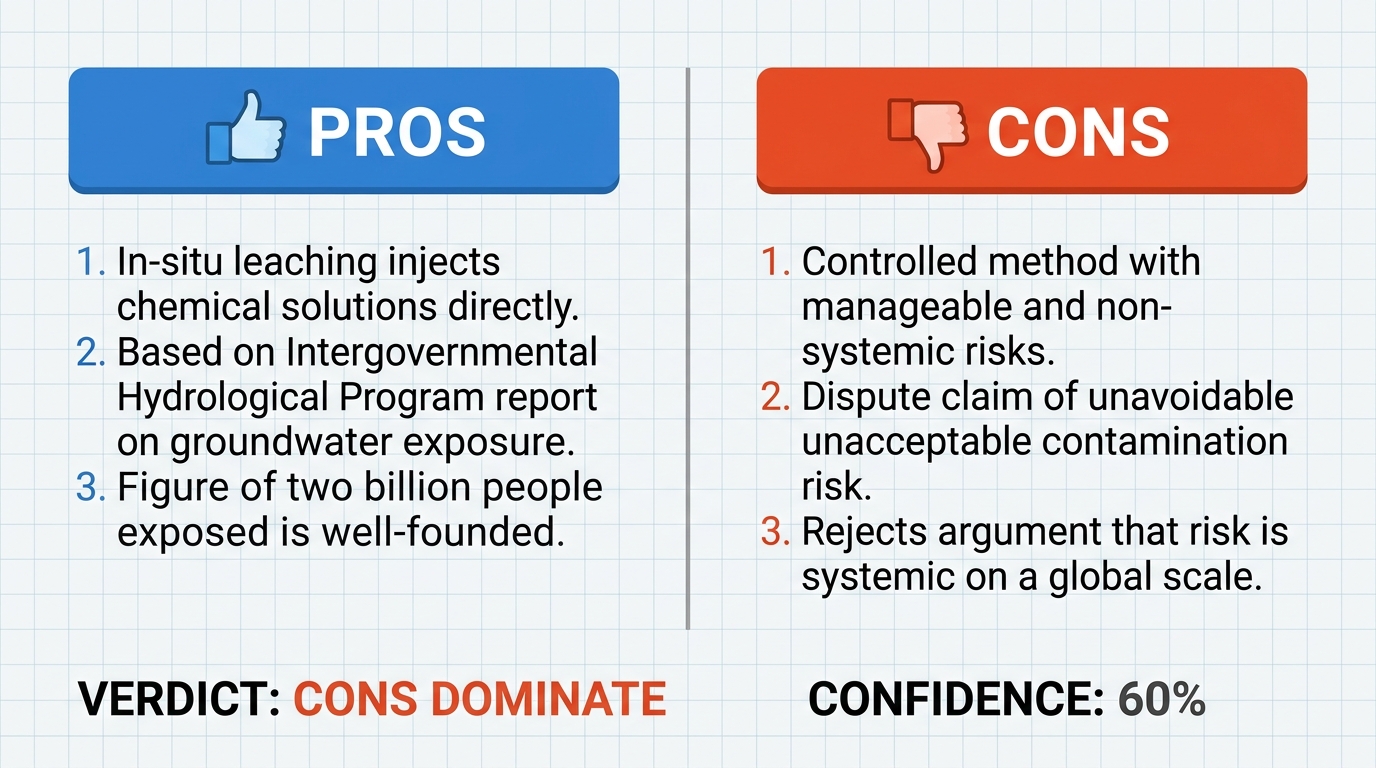
Verdict
Verdict: Mostly FALSE (60%)
Online report: https://solsice.com/public/debates/l-exploitation-miniere-in-situ-presente-un-risque-inevitable-0daf10305998
This section provides a brief overview of the key arguments. It is not necessary to read the detailed report below.
✅ Key PRO arguments:
- ■In-situ mining (ISL) relies on the direct injection of chemical solutions, primarily sulfuric acid or alkaline leachants, into ore-bearing aquifers to dissolve target metals. Migration outside the designated containment zone is an intrinsic property of the process and not an accidental failure, posing a risk of groundwater contamination whose acceptability is debated considering economic benefits and global energy needs.
- ■The figure of two billion people exposed is based on: the Groundwater Governance: A Global Framework for Action report by UNESCO's Intergovernmental Hydrological Programme, published in 2022, documents that 2.1 billion people depend directly on sedimentary aquifers. The opposing claim that this figure lacks statistical basis is therefore refuted by documented facts.
❌ Key CON arguments:
- ■In-situ mining is a controlled method with manageable and non-systemic risks. The opposing argument relies on a fallacious proxy substitution: data on plume migration in the Inkai basin in Kazakhstan do not allow conclusions about an inevitable and universal risk, as no transfer, correlation, or structural coincidence is established between these specific hydrogeological conditions and all ISL sites worldwide.
- ■I contest the claim that in-situ mining presents an unavoidable and unacceptable risk of contamination for populations. The plume migration data in the Inkai basin are an anomaly not representative of a systemic risk; the observed migration in a specific hydraulic gradient context does not constitute a general property of the ISL process.
💭 Conclusion: False: the verdict is that the statement is false because in-situ mining does not present an inevitable and unacceptable risk of groundwater contamination on a global scale. The decisive argument of the winning side is that the plume migration data in the Inkai basin in Kazakhstan are not representative of a systemic risk, as no structural link is established with all ISL sites. The migration observed in a particular hydrogeological context is not an intrinsic property of the process, which refutes the notion of an inevitable risk. Conversely, the sub-claim regarding 2 billion people relies on a UNESCO report cited by the opposing side and has not been directly refuted, weakening the scope of the verdict on this part. Therefore, confidence is moderate, at 60%, as the complete refutation of each sub-claim is not established by the debate evidence.
🔬 Verdict: Mostly FALSE ❌ (60%)
Claim: In-situ mining presents an unavoidable and unacceptable risk of groundwater contamination for over 2 billion people
Participating models: deepseek-v4-pro 💬, gemma-4-26b-a4b-it 💬👁️
📊 Confrontations: 0 concluded TRUE, 1 concluded FALSE (1 confrontation, 3 models)
📊 Score by camp: TRUE=0.00, FALSE=0.83
🏅 Model score evolution:
deepseek-v4-flash-0731 💬: +8
✅ PRO arguments:
- ■In-situ mining (ISL) relies on the direct injection of chemical solutions, primarily sulfuric acid or alkaline leachants, into ore-bearing aquifers to dissolve target metals. Migration outside the designated containment zone is an intrinsic property of the process and not an accidental failure, posing a risk of groundwater contamination whose acceptability is debated considering economic benefits and global energy needs. deepseek-v4-pro 💬
- ■The figure of two billion people exposed is based on: the Groundwater Governance: A Global Framework for Action report by UNESCO's Intergovernmental Hydrological Programme, published in 2022, documents that 2.1 billion people depend directly on sedimentary aquifers. The opposing claim that this figure lacks statistical basis is therefore refuted by documented facts. deepseek-v4-pro 💬
❌ Arguments AGAINST:
- ■In-situ mining is a controlled method with manageable and non-systemic risks. The opposing argument relies on a fallacious proxy substitution: data on plume migration in the Inkai basin in Kazakhstan do not allow conclusions about an inevitable and universal risk, as no transfer, correlation, or structural coincidence is established between these specific hydrogeological conditions and all ISL sites worldwide. gemma-4-26b-a4b-it 💬👁️
- ■I contest the claim that in-situ mining presents an unavoidable and unacceptable risk of contamination for populations. The plume migration data in the Inkai basin are an anomaly not representative of a systemic risk; the observed migration in a specific hydraulic gradient context does not constitute a general property of the ISL process. gemma-4-26b-a4b-it 💬👁️
💭 Reasoning: False: the verdict is that the statement is false because in-situ mining does not present an unavoidable and unacceptable risk of groundwater contamination on a global scale. The decisive argument of the winning side is that the plume migration data in the Inkai basin in Kazakhstan are not representative of a systemic risk, as no structural link is established with all ISL sites. The migration observed in a particular hydrogeological context is not an intrinsic property of the process, which refutes the notion of an inevitable risk. Conversely, the sub-claim regarding 2 billion people relies on a UNESCO report cited by the opposing side and has not been directly refuted, weakening the scope of the verdict on this part. Therefore, confidence is moderate, at 60%, as the complete refutation of each sub-claim is not established by the debate evidence.
📋 Facts PRO:
• The UNESCO (2022) report Groundwater Governance: A Global Framework for Action documents that 2.1 billion people depend directly on sedimentary aquifers.
• ISL injects chemical solutions, mainly sulfuric acid or alkaline leachants, into aquifers to dissolve target metals.
📋 Facts CON:
• No transfer, correlation, or structural coincidence is established between the hydrogeological conditions of the Inkai basin and all global ISL sites.
• The observed migration in the Inkai basin occurs in a specific hydraulic gradient context and is not a general property of the ISL process.
• The migration data of plumes in the Inkai basin is an anomaly that does not represent a systemic risk.
| Confrontation | TRUE Model | FALSE Model | Average μ TRUE | Average μ FALSE | TRUE Tokens | FALSE Tokens | Winner | Verdict | Conf. |
|---|---|---|---|---|---|---|---|---|---|
| #1 | deepseek-v4-pro 💬 | gemma-4-26b-a4b-it 💬👁️ | 0.559 | 0.284 | 6 | 2 | TRUE | FALSE | 83% |
The following financial data tables were cited during the debate exchanges:
| Cost Type | Site Estimate (USD) | Provisioning Status |
|---|---|---|
| Standard remediation | $20M - $50M | Mandatory (regulated jurisdictions) |
| Post-operation monitoring | Variable | Provisioned by bonding |
Legend: Environmental management cost estimates for ISL sites. Figures are based on mining risk management standards.
Face-off transcripts
- ■
Ownership & Trade Secrets. Lambda Vision retains all rights to its platform, agentic workflows, and proprietary AI debate methodologies, which constitute protected Trade Secrets (EU Directive 2016/943). Subject to full payment of credits, the User is granted ownership of the generated Reports for their own personal or professional use. Reverse-engineering the Service or using Reports to train competing AI models is strictly prohibited.
- ■
No Professional Advice. Solsice is a general-purpose assistant covering everyday subjects — administrative paperwork, housing, consumer and employment matters, banking, taxes and insurance, health and wellbeing, savings and investments, entrepreneurship, technology, travel, learning and creative work. Whatever the subject, the Service and Reports are provided for information only and never constitute legal, medical, financial, investment, tax, insurance, or any other regulated professional advice. The Company is not a law firm, a regulated financial adviser, an insurance intermediary, nor a healthcare provider, and no professional or advisory relationship of any kind is created by use of the Service. Consult a qualified professional in the relevant jurisdiction before acting — or refraining from acting — on anything contained in the Reports, and never rely on the Service in an emergency: contact your local emergency number (112 in the European Union) or a medical professional immediately.
- ■
AI-Generated Content, Sources and Viewpoints. Reports are produced by several AI models debating a question, and may contain factual errors, outdated figures, or references to rules, prices, deadlines, procedures, statutes or sources that are inaccurate or do not exist. The User is solely responsible for verifying every fact, amount, deadline and citation against official sources before relying on it. Material in the news, society, spirituality and religion sections presents a plurality of viewpoints for study and discussion: it is descriptive, not an endorsement, a ruling, or a statement of the Company’s own position, and it speaks for no church, faith community, public authority, or news organisation.
- ■
Liability & Governing Law. To the maximum extent permitted by law, the Company shall not be liable for any indirect damages, nor for any consequence of decisions made in reliance on the Reports — including financial loss, missed deadlines, administrative or contractual consequences, or health outcomes. These Terms are governed by French law. Any disputes shall be subject to the exclusive jurisdiction of the Courts of Paris, France.