
L'existence d'une entité nécessaire, non contingente et source de toute existence, est logiquement déductible de l'observation du monde contingent.
AI debate verdict and arguments
⚠️ AI-generated information only; not professional advice
Completed October 11, 2026
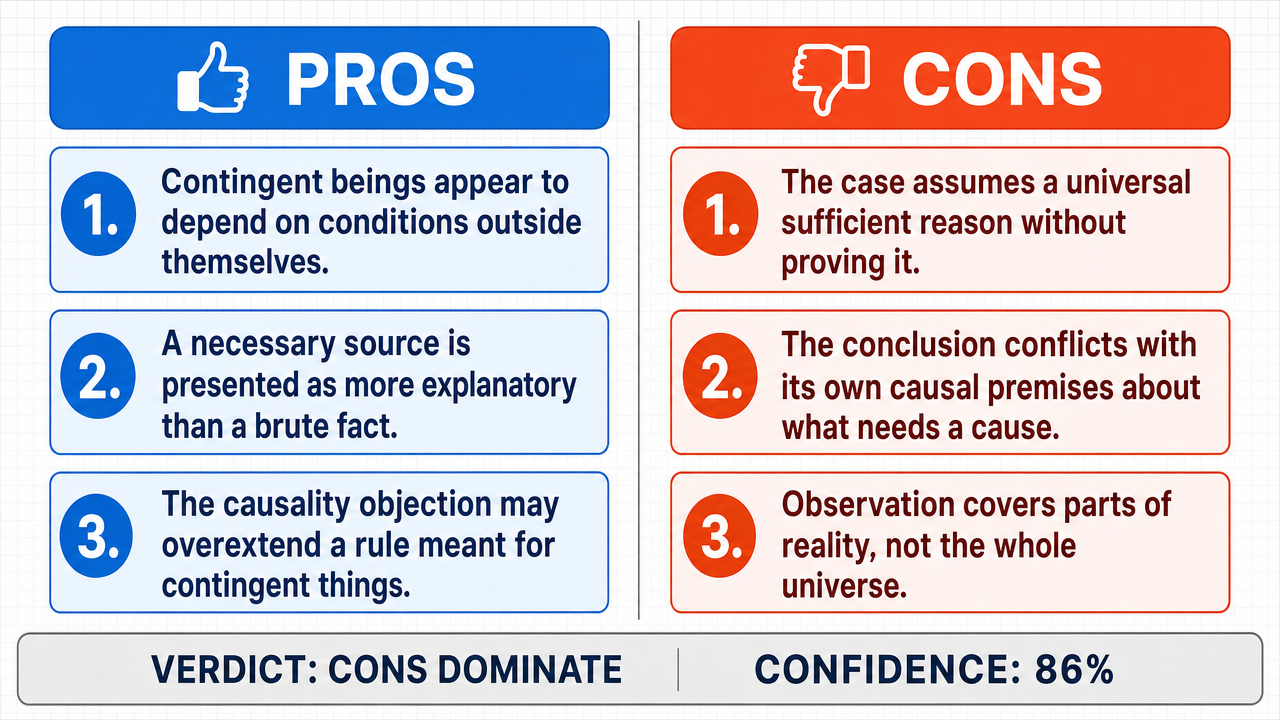
Verdict
Verdict: Mostly FALSE (86%)
This section provides a brief overview of the key arguments. It is not necessary to read the detailed report below.
✅ KEY PRO arguments:
- ■On the causal axis, observing a contingent world shows that beings can not be and receive other conditions for their existence; an indefinite succession of contingent causes explains one link by the previous, but does not account for the fact that the series exists as a series. Assuming the principle of sufficient reason , the chain of dependencies must end in a cause that does not borrow its existence, hence necessary.
- ■The hypothesis of brute fact constitutes the true non-deductive conjecture. If observation shows that contingent beings receive their existence from a prior cause, the series formed by these beings shares this same contingency. Claiming that this series could be a brute fact without explanation is an undue projection.
- ■The opposing objection that the principle of causality is a universal law requiring a cause for the necessary entity relies on a doctrinal reading: it transforms "every contingent being has a cause" into "every being has a cause," which is an undue generalization that the affirmative refuses to accept.
❌ KEY CON arguments:
- ■The causal argument relies on a petitio principii by postulating the principle of sufficient reason as a universal law applied to all of reality. The claim that a chain of contingent causes requires a non-contingent cause to "account for the series" is an overreaching conjecture that projects a human logical structure onto the brute ontology of the world.
- ■The affirmative argument is structurally incoherent because it relies on an internal contradiction between its premises and conclusion: it claims that "classical principles require each contingent being to have a cause or explanation," while deducing the existence of a "necessary entity " which, by definition, is an entity whose existence requires no cause or external explanation.
- ■Direct observation only concerns parts of the world, not the whole. The universe itself could be a brute fact without any observation of contingent parts allowing deduction about the necessity of a foundation. Deduction requires a logical bridge that the affirmative does not provide.
💭 Conclusion: False. The FALSE verdict is firmly established by highlighting a structural incoherence in the affirmative argument: it postulates a universal causal principle to justify the necessity of an ultimate term, while defining this term as an entity whose existence precisely does not need a cause. Applying the principle of sufficient reason to all of reality is a petitio principii , projecting a human logical requirement onto ontology without independent proof. Observation of contingent beings in the world only concerns parts and cannot, by simple generalization, lead to conclusions about the nature of the whole. The opposing hypothesis of a "brute fact " is no more conjectural than the affirmative hypothesis of a necessary entity , and the lack of decisive evidence favors the negative position. Finally, the distinction between logical and physical modalities , as well as the improper use of the essence /existence distinction, reinforce the idea that the claimed deduction is not logically valid.
🔬 Verdict: Mostly FALSE ❌ (86%)
Claim: The existence of a necessary entity , non-contingent and the source of all existence, is logically deducible from the observation of the contingent world .
Participating models: deepseek-v3.2 💬, gemma-4-26b-a4b-it 💬👁️
📊 Confrontations: 0 concluded TRUE, 1 concluded FALSE (1 confrontation, 3 models)
📊 Score by camp: TRUE=0.00, FALSE=0.86
🏅 Model score evolution:
minimax-m3 💬👁️: +9
✅ Arguments FOR:
- ■On the causal axis, observing a contingent world shows that beings can not be and receive other conditions for their existence; an indefinite succession of contingent causes explains one link by the previous, but does not account for the fact that the series exists as a series. Assuming the principle of sufficient reason , the chain of dependencies must end in a cause that does not borrow its existence, hence necessary. deepseek-v3.2 💬
- ■The hypothesis of brute fact constitutes the true non-deductive conjecture. If observation shows that contingent beings receive their existence from a prior cause, the series formed by these beings shares this same contingency. Claiming that this series could be a brute fact without explanation is an undue projection. deepseek-v3.2 💬
- ■The opposing objection that the principle of causality is a universal law requiring a cause for the necessary entity relies on a doctrinal reading: it transforms "every contingent being has a cause" into "every being has a cause," which is an undue generalization that the affirmative refuses to accept. deepseek-v3.2 💬
❌ Arguments AGAINST:
- ■The causal argument relies on a petitio principii by postulating the principle of sufficient reason as a universal law applied to all of reality. The claim that a chain of contingent causes requires a non-contingent cause to "account for the series" is an overreaching conjecture that projects a human logical structure onto the brute ontology of the world. gemma-4-26b-a4b-it 💬👁️
- ■The affirmative argument is structurally incoherent because it relies on an internal contradiction between its premises and conclusion: it claims that "classical principles require each contingent being to have a cause or explanation," while deducing the existence of a "necessary entity " which, by definition, is an entity whose existence requires no cause or external explanation. gemma-4-26b-a4b-it 💬👁️
- ■Direct observation only concerns parts of the world, not the whole. The universe itself could be a brute fact without any observation of contingent parts allowing deduction about the necessity of a foundation. Deduction requires a logical bridge that the affirmative does not provide. gemma-4-26b-a4b-it 💬👁️
💭 Reasoning: False. The verdict FALSE is firmly established by highlighting a structural incoherence in the affirmative argument: it postulates a universal causal principle to justify the necessity of an ultimate term, while defining this term as an entity whose existence precisely does not need a cause. The application of the principle of sufficient reason to all of reality constitutes a petitio principii, projecting a human logical requirement onto ontology without independent proof. Observation of contingent beings in the world only concerns parts and cannot, by simple generalization, lead to conclusions about the nature of the whole. The opposing hypothesis of a "brute fact " is no more conjectural than the affirmative hypothesis of a necessary entity , and the absence of decisive evidence favors the negative position. Finally, the distinction between logical and physical modalities , as well as the improper use of the essence /existence distinction, reinforce the idea that the claimed deduction is not logically valid.
📋 Facts FOR:
• Contingent beings observed depend on prior conditions for their existence.
• A series of contingent causes explains each link by the previous one but does not explain why the series exists as a series.
• The principle of sufficient reason, if accepted, requires a foundation not borrowed from anything else.
📋 Facts AGAINST:
• The universal application of the principle of causality to all of reality constitutes a begging the question.
• Deducting a necessary entity from a universal causal principle is logically contradictory with the very definition of necessity.
• Direct observation only concerns parts of the world, not the whole.
• The hypothesis of a universe as a "raw fact" is no more conjectural than the hypothesis of a necessary entity.
• No independent empirical or logical proof allows us to move from observed contingency to deduced necessity.
| Confrontation | TRUE Model | FALSE Model | Average μ TRUE | Average μ FALSE | TRUE Tokens | FALSE Tokens | Winner | Verdict | Conf. |
|---|---|---|---|---|---|---|---|---|---|
| #1 | deepseek-v3.2 💬 | gemma-4-26b-a4b-it 💬👁️ | 0.562 | 0.512 | 12 | 3 | TRUE | FALSE | 86% |
The following technical terms, abbreviations, and specialized concepts are used in this transcript. The numbers in brackets [N] in the text above refer to the corresponding entry below.
[1] Cosmological argument — Family of metaphysical arguments that, starting from the existence or contingency of the world, attempt to deduce the existence of a foundational reality (first cause, necessary being).
[2] Non-contingent cause — Cause whose existence is not borrowed from another reality and which does not depend on an external condition to exist; it opposes the contingent cause.
[3] Explanatory closure — Philosophical requirement that a complete explanation cannot be indefinitely deferred and must, ultimately, close on an ultimate term.
[4] Contingent — contingent being — In metaphysics, refers to a being whose existence is not necessary: it may or may not exist, and its existence depends on a cause or external conditions.
[5] Logical deduction — Type of inference where the conclusion necessarily follows from the premises, such that negating the conclusion makes the entire set of premises incoherent.
[6] Necessary entity — Being whose existence cannot not be, which does not receive its existence from an external cause, and whose non-existence is logically impossible.
[7] Essence — essence (vs existence) — In classical metaphysics, what a thing is by its definition or nature, distinguished from its existence, i.e., the fact that it is; the essence/existence distinction is used to articulate the status of contingent and necessary beings.
[8] Brute fact — Fact whose existence is posited without explanation or prior cause, and which constitutes a terminus in the chain of reasons.
[9] Inference — Logical operation by which a conclusion is drawn from one or more propositions taken as premises.
[10] Universal law — Principle claimed to apply without exception to the entire domain considered (e.g., every contingent being has a cause).
[11] Logical and physical modalities — Distinction between necessity/possibility in the logical sense (related to non-contradiction) and in the physical sense (related to the laws of nature and the actual course of the world).
[12] Metaphysics — metaphysical leap — Related to metaphysics, the discipline that deals with the ultimate principles of being; a metaphysical leap refers to an argumentative step that exceeds what is strictly justified by the premises.
[13] Ontology — Branch of metaphysics that studies being as being, its structure, and its fundamental categories.
[14] Principle of sufficient reason — Principle that states that everything that exists or occurs must have a reason, cause, or sufficient explanation.
[15] Premise — Initial proposition of an argument from which a conclusion is drawn.
[16] Petition of principle — Fallacy of assuming in the premises what one seeks to demonstrate in the conclusion, making the argument circular.
[17] Rigor of deduction — Property of a deductive argument where each step is justified and the conclusion necessarily follows from the premises without external addition.
[18] Univocal universality — univocal universality of causality — Application of the same concept (e.g., causality) in a single sense, without exception, to all realities to which it is attributed.
[19] Epistemological — epistemological preference — Related to epistemology, the study of the conditions of validity of knowledge; an epistemological preference indicates a methodological choice rather than a logically forced conclusion.
Face-off transcripts
- ■
Ownership & Trade Secrets. Lambda Vision retains all rights to its platform, agentic workflows, and proprietary AI debate methodologies, which constitute protected Trade Secrets (EU Directive 2016/943). Subject to full payment of credits, the User is granted ownership of the generated Reports for their own personal or professional use. Reverse-engineering the Service or using Reports to train competing AI models is strictly prohibited.
- ■
No Professional Advice. Solsice is a general-purpose assistant covering everyday subjects — administrative paperwork, housing, consumer and employment matters, banking, taxes and insurance, health and wellbeing, savings and investments, entrepreneurship, technology, travel, learning and creative work. Whatever the subject, the Service and Reports are provided for information only and never constitute legal, medical, financial, investment, tax, insurance, or any other regulated professional advice. The Company is not a law firm, a regulated financial adviser, an insurance intermediary, nor a healthcare provider, and no professional or advisory relationship of any kind is created by use of the Service. Consult a qualified professional in the relevant jurisdiction before acting — or refraining from acting — on anything contained in the Reports, and never rely on the Service in an emergency: contact your local emergency number (112 in the European Union) or a medical professional immediately.
- ■
AI-Generated Content, Sources and Viewpoints. Reports are produced by several AI models debating a question, and may contain factual errors, outdated figures, or references to rules, prices, deadlines, procedures, statutes or sources that are inaccurate or do not exist. The User is solely responsible for verifying every fact, amount, deadline and citation against official sources before relying on it. Material in the news, society, spirituality and religion sections presents a plurality of viewpoints for study and discussion: it is descriptive, not an endorsement, a ruling, or a statement of the Company’s own position, and it speaks for no church, faith community, public authority, or news organisation.
- ■
Liability & Governing Law. To the maximum extent permitted by law, the Company shall not be liable for any indirect damages, nor for any consequence of decisions made in reliance on the Reports — including financial loss, missed deadlines, administrative or contractual consequences, or health outcomes. These Terms are governed by French law. Any disputes shall be subject to the exclusive jurisdiction of the Courts of Paris, France.