
L'éveil spirituel se caractérise par une diminution progressive du savoir et une acceptation de cet état de non-savoir, plutôt que par l'acquisition de connaissances supplémentaires sur la spiritualité ou l'univers.
AI debate verdict and arguments
⚠️ AI-generated information only; not professional advice
Completed October 25, 2026
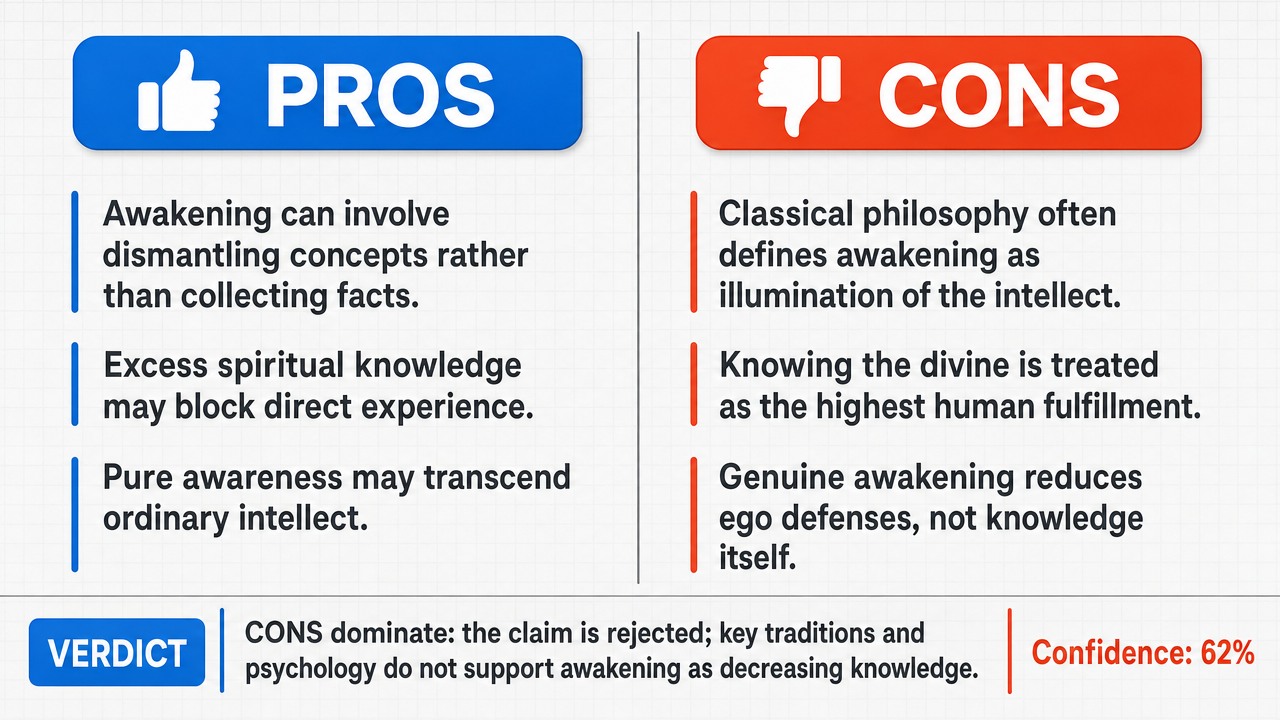
Verdict
Verdict: Mostly FALSE (62%)
Online report: https://solsice.com/public/debates/l-eveil-spirituel-se-caracterise-par-une-diminution-progress-086b2e9eef9d
This section provides a brief overview of the key arguments. It is not necessary to read the detailed report below.
✅ Key FOR arguments:
- ■Spiritual awakening is analyzed as a process of cognitive deconstruction rather than as an accumulation of information: the experience of pure consciousness requires abandoning the conceptual structures that fragment reality into distinct objects.
- ■The accumulation of spiritual knowledge often acts as a screen, an additional layer of mental representations that separates the subject from direct experience of being, and reducing conceptual knowledge eliminates the intellectual filters that limit perception.
- ■Awakening cannot be reduced to an illumination of the intellect, because this notion remains trapped within the very structure of the intellect, which by definition is an activity of distinction and conceptualization, and thus contradictory to a true state of non-knowledge .
❌ Key AGAINST arguments:
- ■In Western philosophical tradition, notably among Augustine and Plotinus, awakening is defined as an illumination of the intellect by divine light, which enlightens the soul and allows it to know the truth, transforming intelligence rather than destroying it.
- ■Knowledge of God is the ultimate goal of human existence and the pinnacle of the intellect, which directly contradicts the idea of a state of non-knowledge as characteristic of spiritual awakening .
- ■According to transpersonal psychologist John Welwood, authentic awakening is distinguished from 'spiritual bypassing ' and manifests as a reduction in attachment to the limited self, involving a transformation of consciousness that dissolves the feeling of separation, rather than a simple intellectual stripping .
💭 Conclusion: False: the claim that spiritual awakening would be characterized by a gradual decrease in knowledge and an acceptance of non-knowledge is rejected by the debate. The negative side convincingly demonstrated that major philosophical traditions, notably Plotinus' Neoplatonism and Augustinian thought, conceive awakening as a transformative illumination of the intellect, not its destruction. John Welwood's argument about the distinction between authentic awakening and 'spiritual bypassing ' reinforces the idea that awakening involves a qualitative transformation of consciousness rather than a mere reduction of knowledge. Furthermore, the pro argument that awakening is a cognitive deconstruction rests on a confusion between dissolving conceptual filters and the actual loss of knowledge, which the opposing side refuted by showing that enlightened reason retains and refines discernment. Finally, the moderate confidence level of 62% reflects that, although the statement is rejected, some nuances of the pro position regarding the role of conceptual structures still hold partial relevance.
🔬 Verdict: Mostly FALSE ❌ (62%)
Claim: Spiritual awakening is characterized by a gradual decrease in knowledge and an acceptance of non-knowledge , rather than by acquiring additional knowledge about spirituality or the universe.
Participating models: gemma-4-26b-a4b-it 💬👁️, glm-4.7-flash 💬
📊 Confrontations: 0 concluded TRUE, 1 concluded FALSE (1 confrontation, 3 models)
📊 Score by camp: TRUE=0.00, FALSE=0.62
🏅 Model score evolution:
minimax-m3 💬👁️: +6
✅ FOR arguments:
- ■Spiritual awakening is analyzed as a process of cognitive deconstruction rather than as an accumulation of information: the experience of pure consciousness requires abandoning the conceptual structures that fragment reality into distinct objects. gemma-4-26b-a4b-it 💬👁️
- ■The accumulation of spiritual knowledge often acts as a screen, an additional layer of mental representations that separates the subject from direct experience of being, and reducing conceptual knowledge eliminates the intellectual filters that limit perception. gemma-4-26b-a4b-it 💬👁️
- ■Awakening cannot be reduced to an illumination of the intellect, because this notion remains trapped within the very structure of the intellect, which by definition is an activity of distinction and conceptualization, and thus contradictory to a true state of non-knowledge. gemma-4-26b-a4b-it 💬👁️
❌ Arguments AGAINST:
- ■In Western philosophical tradition, notably among Augustine and Plotinus, awakening is defined as an illumination of the intellect by divine light, which enlightens the soul and allows it to know the truth, transforming intelligence rather than destroying it. glm-4.7-flash 💬
- ■Knowledge of God is the ultimate goal of human existence and the pinnacle of the intellect, which directly contradicts the idea of a non-knowledge state as characteristic of spiritual awakening. glm-4.7-flash 💬
- ■According to transpersonal psychologist John Welwood, authentic awakening is distinguished from 'spiritual bypassing ' and manifests as a reduction in attachment to the limited self, involving a transformation of consciousness that dissolves the feeling of separation, rather than a simple intellectual stripping . glm-4.7-flash 💬
💭 Reasoning: False: the claim that spiritual awakening would be characterized by a gradual decrease in knowledge and an acceptance of non-knowledge is rejected by the debate. The negative side convincingly demonstrated that major philosophical traditions, notably Plotinus' Neoplatonism and Augustinian thought, conceive awakening as a transformative illumination of the intellect, not its destruction. John Welwood's argument about the distinction between authentic awakening and 'spiritual bypassing ' reinforces the idea that awakening involves a qualitative transformation of consciousness rather than a mere reduction of knowledge. Furthermore, the pro argument that awakening is a cognitive deconstruction rests on a confusion between dissolving conceptual filters and the actual loss of knowledge, which the opposing side refuted by showing that enlightened reason retains and refines discernment. Finally, the moderate confidence level of 62% reflects that, although the statement is rejected, some nuances of the pro position regarding the role of conceptual structures still hold partial relevance.
📋 Facts FOR:
• Spiritual awakening is described in some traditions as a process of deconstruction of conceptual structures.
• The accumulation of spiritual knowledge can function as a screen separating the subject from direct experience.
• The Neoplatonic tradition of Plotinus speaks of union with the supreme principle that transcends the intellect.
📋 Facts AGAINST:
• Among Augustine and Plotinus, awakening is defined as an illumination of the intellect by divine light.
• Knowledge of God is presented as the ultimate goal of human existence in the Augustinian tradition.
• John Welwood distinguishes 'spiritual bypassing' (a defense mechanism through spirituality) from authentic awakening.
• According to Welwood, authentic awakening manifests as a reduction in attachment to the limited self and a connection to unity.
| Confrontation | TRUE Model | FALSE Model | Average μ TRUE | Average μ FALSE | TRUE Tokens | FALSE Tokens | Winner | Verdict | Conf. |
|---|---|---|---|---|---|---|---|---|---|
| #1 | gemma-4-26b-a4b-it 💬👁️ | glm-4.7-flash 💬 | 0.315 | 0.450 | 4 | 4 | FALSE | FALSE | 62% |
The following technical terms, abbreviations, and specialized concepts are used in this transcript. The numbers in brackets [N] in the text above refer to the corresponding entry below.
[1] Pure consciousness — State of consciousness free from mental constructions and conceptual filters, targeted in certain contemplative traditions as a condition of awakening.
[2] Cognitive deconstruction — Process by which mental and conceptual structures are dismantled to allow a more direct experience of reality.
[3] Detachment — In spiritual vocabulary, refers to the gradual abandonment of attachments, knowledge, and superficial identifications.
[4] Ego — In psychology and spiritual traditions, an identity instance that perceives itself as separate from the rest of reality and organizes experience according to its own interests.
[5] Divine illumination — Theological and philosophical concept referring to the action by which divine light illuminates the human intellect to enable access to truth.
[6] Intellectualization — Psychological defense mechanism involving approaching a situation through abstract thought to protect oneself from associated affect.
[7] Insightful judgment — Ability, in the psychology of wisdom, to make relevant judgments in complex and uncertain life situations.
[8] Defense mechanism — Unconscious psychic strategy implemented by the subject to protect against anxiety or internal conflicts.
[9] Non-knowledge — State characterized by the abandonment of discursive and conceptual knowledge, valued in certain mystical traditions as a path to higher knowledge.
[10] Nous — Greek term referring to the intellect or discursive thought, conceived in Neoplatonism as the place of multiplicity of forms and ideas.
[11] Neoplatonism — Philosophical movement postdating Plato, with Plotinus as its founder figure, articulating a hierarchy of the One, the nous, and the soul.
[12] Phenomenology — Philosophical approach studying the structures of conscious experience as it presents itself, independently of judgments about its objective existence.
[13] Psychology of wisdom — Field of research defining wisdom as a combination of procedural, factual knowledge, and relevant judgment in existential problems.
[14] Transpersonal psychology — Branch of psychology integrating spiritual experiences and expanded states of consciousness into the study of psychic functioning.
[15] Non-dual realization — Spiritual experience in which the separation between subject and object, or between self and the world, is abolished.
[16] Limited self — In transpersonal psychology, identification of the person with their ego and limited psychic contents, as opposed to a broader consciousness.
[17] Spiritual bypassing — Concept introduced by psychologist John Welwood referring to the use of spiritual notions to avoid confronting unresolved emotional or psychological issues.
[18] Separateness — English term used in the text to denote the feeling of separation between the individual and the rest of reality, considered an obstacle to awakening.
[19] The One — In Neoplatonism, the supreme principle beyond being and intellect, from which all realities emanate and towards which the mystical return tends.
[20] Transcendental truths — Truths that transcend the domain of sensory experience and can only be grasped by refined or illuminated reason.
[21] Spiritual awakening — Deep transformation of consciousness characterized, according to traditions, by a dissolution of the feeling of separation and a direct perception of being.
Face-off transcripts
- ■
Ownership & Trade Secrets. Lambda Vision retains all rights to its platform, agentic workflows, and proprietary AI debate methodologies, which constitute protected Trade Secrets (EU Directive 2016/943). Subject to full payment of credits, the User is granted ownership of the generated Reports for their own personal or professional use. Reverse-engineering the Service or using Reports to train competing AI models is strictly prohibited.
- ■
No Professional Advice. Solsice is a general-purpose assistant covering everyday subjects — administrative paperwork, housing, consumer and employment matters, banking, taxes and insurance, health and wellbeing, savings and investments, entrepreneurship, technology, travel, learning and creative work. Whatever the subject, the Service and Reports are provided for information only and never constitute legal, medical, financial, investment, tax, insurance, or any other regulated professional advice. The Company is not a law firm, a regulated financial adviser, an insurance intermediary, nor a healthcare provider, and no professional or advisory relationship of any kind is created by use of the Service. Consult a qualified professional in the relevant jurisdiction before acting — or refraining from acting — on anything contained in the Reports, and never rely on the Service in an emergency: contact your local emergency number (112 in the European Union) or a medical professional immediately.
- ■
AI-Generated Content, Sources and Viewpoints. Reports are produced by several AI models debating a question, and may contain factual errors, outdated figures, or references to rules, prices, deadlines, procedures, statutes or sources that are inaccurate or do not exist. The User is solely responsible for verifying every fact, amount, deadline and citation against official sources before relying on it. Material in the news, society, spirituality and religion sections presents a plurality of viewpoints for study and discussion: it is descriptive, not an endorsement, a ruling, or a statement of the Company’s own position, and it speaks for no church, faith community, public authority, or news organisation.
- ■
Liability & Governing Law. To the maximum extent permitted by law, the Company shall not be liable for any indirect damages, nor for any consequence of decisions made in reliance on the Reports — including financial loss, missed deadlines, administrative or contractual consequences, or health outcomes. These Terms are governed by French law. Any disputes shall be subject to the exclusive jurisdiction of the Courts of Paris, France.