
L'énergie géothermique ne peut pas être la solution unique à tous les problèmes énergétiques mondiaux, mais elle jouera un rôle clé dans une stratégie énergétique globale.
AI debate verdict and arguments
⚠️ AI-generated information only; not professional advice
Completed October 18, 2026
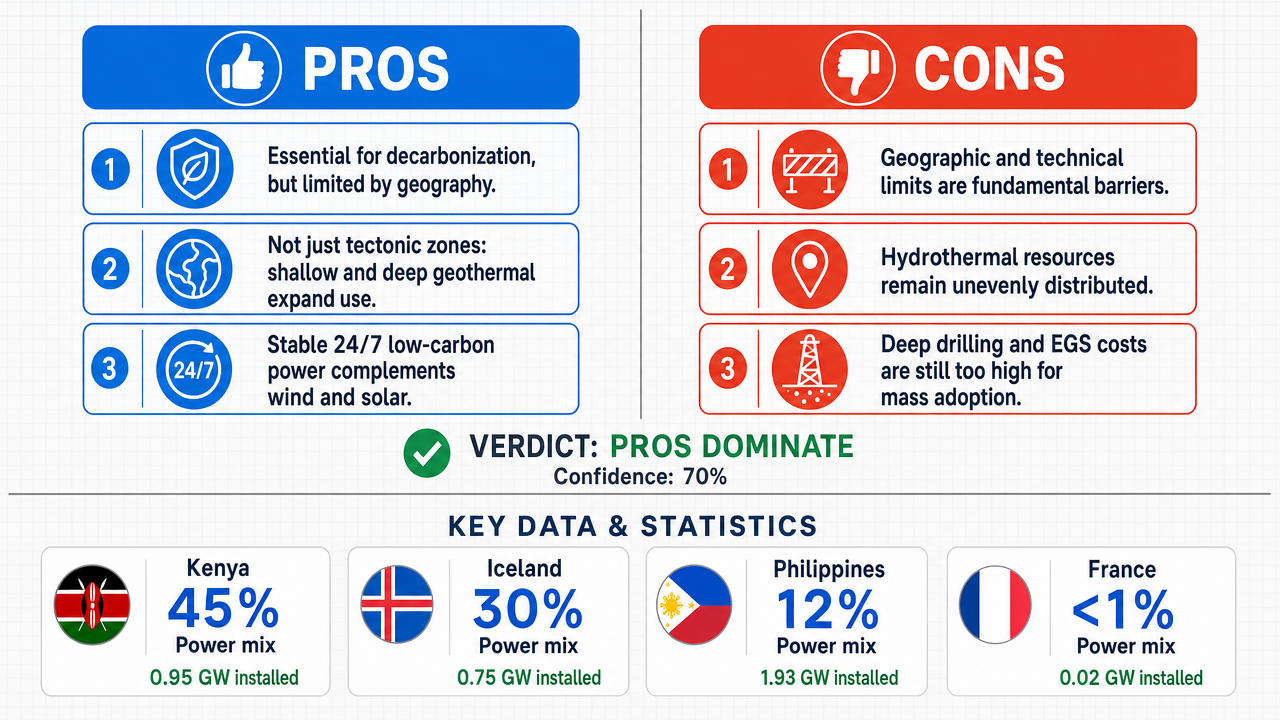
Verdict
Verdict: rather TRUE (70%)
Online report: https://solsice.com/public/debates/l-energie-geothermique-ne-peut-pas-etre-la-solution-unique-a-c893a72162f5
This section provides a brief overview of the key arguments. It is not necessary to read the detailed report below.
✅ Key PRO arguments:
- ■Geothermal energy is an essential pillar of any decarbonized energy strategy , but it cannot be the sole solution due to the physical geography of the resource: high-enthalpy hydrothermal reservoirs , most profitable for electricity generation, are concentrated along tectonic plate boundaries (Iceland, Kenya, Philippines), while most nations on stable continental crusts have a standard geothermal gradient of 25 to 30 °C, insufficient for competitive electrical exploitation without advanced technologies.
- ■The argument that geothermal energy is a niche energy confined to active tectonic zones makes a double error: it confuses deep high-enthalpy geothermal with the entire geothermal spectrum , and ignores the emergence of stimulated geothermal systems (EGS ) that dissociate the resource from its tectonic context, thus opening the possibility of exploitation in stable continental areas.
- ■Geothermal energy , as a stable low-carbon source available 24/7 (unlike intermittent solar and wind), provides an essential complementary value in a diversified energy mix, justifying its key role without claiming exclusivity.
❌ Key CON arguments:
- ■The geographic and technical constraints of geothermal energy are not mere obstacles to be overcome by technological development, but structural barriers that exclude this energy from strategic relevance for most industrial and urban areas worldwide, making the idea of a "key role" exaggerated.
- ■The claim that the geographic distribution of hydrothermal reservoirs limits geothermal energy to a niche resource relies on a scope error : the fundamental resource is the Earth's thermal flux, which is omnipresent even beneath stable zones, thus relativizing the argument of tectonic concentration.
- ■The costs of deep drilling and the technical uncertainties related to EGS systems remain economically prohibitive at large scale, preventing geothermal energy from playing a key role in a short- and medium-term global energy strategy.
💭 Conclusion: True: the TRUE verdict is retained because the statement is nuanced and coherently defended by the affirmative camp. The first sub-argument — that geothermal energy cannot be the sole solution due to the geographic concentration of high-enthalpy reservoirs — is well supported by concrete examples (Iceland, Kenya, Philippines) and a geothermal gradient exceeding 30 °C/km in stable zones. The second sub-argument — that of a key role in a global strategy — is supported by the emergence of EGS systems and the complementary value of geothermal as a stable low-carbon source facing the intermittency of solar and wind. However, confidence is limited to 70% because the debate did not definitively resolve the question of the economic competitiveness of EGS technologies at large scale, nor quantify precisely the share geothermal could represent in a global energy mix. The negative camp raised relevant objections regarding structural barriers and costs but did not refute the logic of complementarity in a diversified mix. The confidence thus reflects the least well-supported sub-argument, namely the exact extent of the "key role" geothermal can play globally.
🔬 Verdict: Mostly TRUE ✅ (70%)
Statement: Geothermal energy cannot be the sole solution to all global energy problems, but it will play a key role in a comprehensive energy strategy.
Participating models: deepseek-v4-pro 💬, gemma-4-26b-a4b-it 💬👁️
📊 Confrontations: 1 concluded TRUE, 0 concluded FALSE (1 confrontation, 3 models)
📊 Score by camp: TRUE=0.70, FALSE=0.00
🏅 Model score evolution:
minimax-m3 💬👁️: +7
✅ Arguments FOR:
- ■Geothermal energy is an essential pillar of any decarbonized energy strategy , but it cannot be the only solution due to the physical geography of the resource: high-enthalpy hydrothermal reservoirs , most profitable for electricity production, are concentrated along tectonic plate boundaries (Iceland, Kenya, Philippines), while most nations on stable continental crusts have a standard geothermal gradient of 25 to 30 °C, insufficient for competitive electricity exploitation without advanced technologies. deepseek-v4-pro 💬
- ■The argument that geothermal energy is a niche confined to active tectonic zones makes a double error: it confuses deep high-enthalpy geothermal with the entire geothermal spectrum , and ignores the emergence of stimulated geothermal systems (EGS ) that dissociate the resource from its tectonic context, thus opening the possibility of exploitation in stable continental zones. deepseek-v4-pro 💬
- ■Geothermal energy, as a stable low-carbon source available 24/7 (unlike intermittent solar and wind), provides an essential complementary value in a diversified energy mix, justifying its key role without claiming exclusivity. deepseek-v4-pro 💬
❌ Arguments AGAINST:
- ■The geographical and technical constraints of geothermal energy are not mere obstacles to overcome through technological development but structural barriers that exclude this energy from strategic relevance for most industrial and urban areas worldwide, making the idea of a "key role" exaggerated. gemma-4-26b-a4b-it 💬👁️
- ■The claim that the geographical distribution of hydrothermal reservoirs would limit geothermal to a niche resource relies on a scope error : the fundamental resource is the Earth's thermal flux, which is omnipresent even beneath stable zones, thus relativizing the argument of tectonic concentration. gemma-4-26b-a4b-it 💬👁️
- ■The costs of deep drilling and the technical uncertainties associated with EGS systems remain economically prohibitive at large scale, preventing geothermal from playing a key role in a comprehensive energy strategy in the short and medium term. gemma-4-26b-a4b-it 💬👁️
💭 Reasoning: True: the TRUE verdict is retained because the statement is nuanced and coherently defended by the affirmative camp. The first sub-argument — that geothermal cannot be the sole solution due to the geographic concentration of high-enthalpy reservoirs — is well supported by concrete examples (Iceland, Kenya, Philippines) and a geothermal gradient exceeding 30 °C/km in stable zones. The second sub-argument — that of a key role in a global strategy — is supported by the emergence of EGS systems and the complementary value of geothermal as a stable low-carbon source facing the intermittency of solar and wind. However, confidence is limited to 70% because the debate did not definitively resolve the economic competitiveness of EGS technologies at large scale, nor quantify precisely the share geothermal could represent in a global energy mix. The negative camp raised relevant objections about structural barriers and costs but did not refute the logic of complementarity within a diversified mix. The confidence thus reflects the least well-supported sub-argument, namely the exact extent of the "key role" geothermal can play worldwide.
📋 Facts FOR:
• High-enthalpy hydrothermal reservoirs are concentrated along tectonic plate boundaries.
• The geothermal gradient in stable continental crusts exceeds 30 °C/km.
• Countries like Iceland, Kenya, and the Philippines meet a large part of their electricity demand through geothermal.
• Stimulated geothermal systems (EGS) allow dissociation of the resource from its tectonic context.
• Geothermal energy is a low-carbon source available 24/7, unlike solar and wind.
📋 Facts AGAINST:
• Geographical and technical constraints are structural barriers, not mere temporary obstacles.
• The Earth's thermal flux is omnipresent, even beneath stable continental zones.
• The costs of deep drilling and the technical uncertainties of EGS systems remain economically prohibitive at large scale.
| Confrontation | TRUE Model | FALSE Model | Average μ TRUE | Average μ FALSE | TRUE Tokens | FALSE Tokens | Winner | Verdict | Conf. |
|---|---|---|---|---|---|---|---|---|---|
| #1 | deepseek-v4-pro 💬 | gemma-4-26b-a4b-it 💬👁️ | 0.630 | 0.267 | 6 | 2 | TRUE | TRUE | 70% |
The following technical terms, abbreviations, and specialized concepts are used in this transcript. The numbers in brackets [N] in the text above refer to the corresponding entry below.
[1] Continent shields — Ancient and stable regions of the continental crust, characterized by low tectonic activity and limited geothermal gradient, making them less favorable for conventional geothermal exploitation.
[2] Excess content conjecture — Fallacious reasoning involving attributing properties or implications to a concept that go beyond what can be demonstrated from available evidence.
[3] Stable continental crusts — Areas of the continental lithosphere far from tectonic plate boundaries, characterized by low geological activity and modest geothermal gradients.
[4] EGS — Enhanced Geothermal Systems — Technologies that create artificial reservoirs in hot, dry rock through hydraulic fracturing, enabling the exploitation of Earth's heat even in the absence of natural hydrothermal reservoirs.
[5] Perimeter error — Fallacious reasoning that inappropriately restricts the definition of a concept to a subset of its cases, leading to erroneous conclusions about its overall scope.
[6] Earth heat flux — The amount of heat transferred from Earth's interior to the surface, measured in mW/m², considered an omnipresent geothermal resource even in stable zones.
[7] Deep drilling — Technique of drilling wells to great depths (often several kilometers) to access geothermal or oil resources inaccessible by conventional methods.
[8] FORGE — Frontier Observatory for Research in Geothermal Energy — U.S. demonstration project dedicated to research and development of stimulated geothermal systems (EGS) in deep crystalline rocks.
[9] Geothermal gradient — Rate of increase of temperature with depth in Earth's crust, typically 25 to 30 °C per kilometer in stable continental zones.
[10] Thermal gradient — Variation of temperature per unit distance, here applied to the increase of temperature with depth in the subsurface.
[11] Geothermal energy — Exploitation of stored heat in Earth's subsurface for electricity or heat production, via different types of reservoirs and technologies.
[12] Conventional hydrothermal geothermal — Classic form of geothermal energy exploiting natural steam or hot water reservoirs, usually located near plate boundaries.
[13] High enthalpy — Characteristic of a geothermal reservoir with sufficiently high temperature (often >150 °C) to allow profitable electricity generation.
[14] Tectonic plates — Rigid fragments of Earth's lithosphere whose movements and interactions (boundaries) determine the location of high-enthalpy geothermal resources.
[15] Dry rock — Hot but naturally low-permeability and fluidless rock, which must be artificially fractured (via EGS) to become an exploitable geothermal reservoir.
[16] Hydrothermal reservoirs — Subsurface geological formations containing naturally heated water or steam, exploitable for geothermal production.
[17] Geothermal spectrum — The range of different forms of exploiting Earth's heat, from low enthalpy to high enthalpy geothermal, including stimulated systems.
[18] Decarbonized energy strategy — Overall plan aimed at reducing carbon emissions from the energy sector by combining various low-carbon energy sources.
[19] Proxy substitution — Logical fallacy involving using a partial indicator (proxy) as if it represented the entire phenomenon measured, leading to biased conclusions.
[20] Steam turbine — Machine converting thermal energy of steam into mechanical energy, used in geothermal power plants to generate electricity.
[21] Niche energy — Energy source whose exploitation is limited to specific geographic or technical contexts, without capacity for large-scale deployment worldwide.
The following financial data tables were cited during the debate exchanges:
| Country | Installed Capacity (GW) | Share in the National Electricity Mix (%) | Average Capacity Factor (%) |
|---|---|---|---|
| Iceland | 0.75 | 30 | 95 |
| Kenya | 0.95 | 45 | 92 |
| Philippines | 1.93 | 12 | 90 |
| France | 0.02 | <1 | 85 |
Legend: Installed geothermal capacity for electricity production and performance indicators for selected countries in 2023. The share in the electricity mix illustrates dependence on the local resource. Source: International Renewable Energy Agency (IRENA), Renewable Capacity Statistics 2024.*
| Region | Electric Geothermal Potential (Relative Scale) | Average Drilling Cost (USD/m) | Economic Viability (Index 1-10) |
|---|---|---|---|
| Pacific Ring of Fire | Very High | $5,000 - $8,000 | 8 |
| Central Europe | Low | $12,000 - $25,000 | 3 |
| Continental Shields (e.g., Canada) | Very Low | $30,000+ | 1 |
Legend: Comparison of geothermal viability based on regional geology. The viability index combines temperature potential and access cost. Source: Synthesis of drilling cost data and structural geology.*
| Technology | Required Geological Context | Estimated Global Potential (TWe) | Actualized Energy Cost (USD/MWh) |
|---|---|---|---|
| Conventional Hydrothermal | Plate boundaries, hot spots | 0.2 | 60 - 100 |
| Stimulated Geothermal Systems (EGS) | Stable continental crust (gradient >30°C/km) | 5.0+ | 80 - 150 |
| Geothermal Heat Pumps | Any context (subsurface <200m) | Unlimited (thermal) | 20 - 50 (electric equivalent) |
Legend: Comparison of geothermal technologies, their required geological context, and their potential for global deployment. The EGS potential is a recoverable technical potential according to MIT and DOE estimates. Source: MIT Energy Initiative, "The Future of Geothermal Energy", 2006, updated by DOE Geothermal Technologies Office reports, 2023.*
| Resource Type | Tectonic Dependence | Deployment Potential | Exploration Risk |
|---|---|---|---|
| Conventional Hydrothermal | Very high | Localized (Niche) | High |
| Stimulated Systems (EGS) | Low | Global (Strategic) | Moderate (Technological) |
| Surface Geothermal | None | Universal (Thermal) | Very low |
Legend: Comparison of the degree of dependence on specific geology and the potential for global deployment. Transition from tectonic dependence to technological mastery marks the shift towards a strategic resource.*
Face-off transcripts
- ■
Ownership & Trade Secrets. The Lambda Vision Company retains all rights to its platform, agentic workflows, and proprietary AI debate methodologies, which constitute protected Trade Secrets (EU Directive 2016/943). Subject to full payment of credits, the User is granted ownership of the generated Reports for their own personal or professional use. Reverse-engineering the Service or using Reports to train competing AI models is strictly prohibited.
- ■
No Professional Advice. Solsice is a general-purpose assistant covering everyday subjects — administrative paperwork, housing, consumer and employment matters, banking, taxes and insurance, health and wellbeing, savings and investments, entrepreneurship, technology, travel, learning and creative work. Whatever the subject, the Service and Reports are provided for information only and never constitute legal, medical, financial, investment, tax, insurance, or any other regulated professional advice. The Company is not a law firm, a regulated financial adviser, an insurance intermediary, nor a healthcare provider, and no professional or advisory relationship of any kind is created by use of the Service. Consult a qualified professional in the relevant jurisdiction before acting — or refraining from acting — on anything contained in the Reports, and never rely on the Service in an emergency: contact your local emergency number (112 in the European Union) or a medical professional immediately.
- ■
AI-Generated Content, Sources and Viewpoints. Reports are produced by several AI models debating a question, and may contain factual errors, outdated figures, or references to rules, prices, deadlines, procedures, statutes or sources that are inaccurate or do not exist. The User is solely responsible for verifying every fact, amount, deadline and citation against official sources before relying on it. Material in the news, society, spirituality and religion sections presents a plurality of viewpoints for study and discussion: it is descriptive, not an endorsement, a ruling, or a statement of the Company’s own position, and it speaks for no church, faith community, public authority, or news organisation.
- ■
Liability & Governing Law. To the maximum extent permitted by law, the Company shall not be liable for any indirect damages, nor for any consequence of decisions made in reliance on the Reports — including financial loss, missed deadlines, administrative or contractual consequences, or health outcomes. These Terms are governed by French law. Any disputes shall be subject to the exclusive jurisdiction of the Courts of Paris, France.