
L'ego est un sens de soi qui se manifeste lorsque l'esprit est inobservé et se caractérise par une insatisfaction constante et le sentiment d'un manque essentiel.
AI debate verdict and arguments
⚠️ AI-generated information only; not professional advice
Completed October 11, 2026
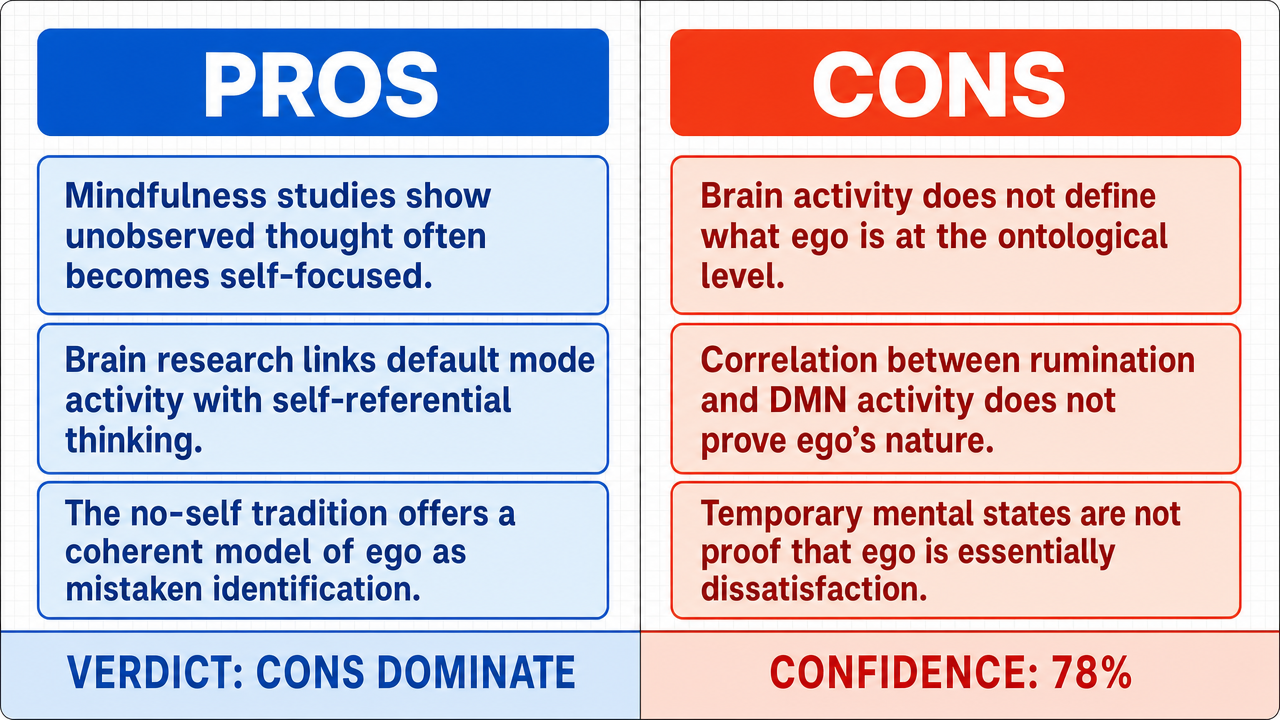
Verdict
Verdict: Mostly FALSE (78%)
This section provides a brief overview of the key arguments. It is not necessary to read the detailed report below.
✅ KEY PRO arguments:
- ■Mindfulness meditation empirically demonstrates that when the mind is not observed, it shifts toward self-referential thought patterns (default mode network ) systematically associated with rumination and negative mood, and sustained observation attenuates these patterns as well as the subjective experience of dissatisfaction that accompanies them.
- ■Neuroscientific research incorporates subjective measures: Brewer et al.'s study (2011) shows that DMN activity is not only correlated with self-referential thought , but also specifically with the subjective experience of mental wandering (mind-wandering ), which is systematically associated with dissatisfaction.
- ■The Buddhist doctrine of anātman provides a coherent framework: the ego (atta ) is the mistaken identification with impermanent aggregates , a mental construct maintained by ignorance , i.e., an unobserved mind, and manifests precisely as a feeling of essential lack.
❌ CONTRA KEY arguments:
- ■The opposing argument makes an error of substitution by attempting to link the activity of the default mode network (DMN) to an ontological definition of the ego : the existence of neural activity correlated with self-referential thought does not mean that the ego is intrinsically defined by dissatisfaction or lack.
- ■The opposing side measures a statistical correlation between two variables (DMN activity and rumination score ) and unjustifiably concludes that the very nature of the ego is dissatisfaction, thus confusing phenomenological correlation with ontological definition .
- ■The observed brain activity is a measure of a transient mental state (rumination ) and not proof of the very nature of the ego ; the ego can be conceived as an adaptive and structural function, not merely a product of dissatisfaction.
💭 Conclusion: False: the claim that the ego is intrinsically defined as a feeling of dissatisfaction arising from an unobserved mind is not supported by the evidence presented. The opposing side has successfully demonstrated that neuroscientific correlations between default mode network activity and rumination are measures of transient mental states, not an ontological proof of the nature of the ego. The distinction between phenomenological correlation and ontological definition weakens the scope of the affirmative argument considerably. Moreover, the ego can be viewed as an adaptive and structural function, making the characterization by constant dissatisfaction overly reductive. Finally, although mindfulness meditation effectively attenuates certain self-referential thought patterns, this does not prove that the ego is defined by an essential lack, but simply that some mental modes are modifiable through contemplative practice.
🔬 Verdict: Mostly FALSE ❌ (78%)
Claim: The ego is a sense of self that manifests when the mind is unobserved and is characterized by constant dissatisfaction and a feeling of an essential lack.
Participating models: deepseek-v3.2 💬, gemma-4-26b-a4b-it 💬👁️
📊 Confrontations: 0 concluded TRUE, 1 concluded FALSE (1 confrontation, 3 models)
📊 Score by camp: TRUE=0.00, FALSE=0.78
🏅 Model score evolution:
minimax-m3 💬👁️: +8
✅ Arguments FOR:
- ■Mindfulness meditation empirically demonstrates that when the mind is not observed, it shifts toward self-referential thought patterns (default mode network ) systematically associated with rumination and negative mood, and sustained observation attenuates these patterns as well as the subjective experience of dissatisfaction that accompanies them. deepseek-v3.2 💬
- ■Neuroscientific research incorporates subjective measures: Brewer et al.'s study (2011) shows that DMN activity is not only correlated with self-referential thought , but also specifically with the subjective experience of mental wandering (mind-wandering ), which is systematically associated with dissatisfaction. deepseek-v3.2 💬
- ■The Buddhist doctrine of anātman provides a coherent framework: the ego (atta ) is the mistaken identification with impermanent aggregates , a mental construct maintained by ignorance , i.e., an unobserved mind, and manifests precisely as a feeling of essential lack. deepseek-v3.2 💬
- ■The absence of mind observation generates a feeling of a separate and vulnerable “self ,” characterized by agitation and constant dissatisfaction, which directly corresponds to the phenomenological definition of the ego proposed in the statement. deepseek-v3.2 💬
❌ Arguments AGAINST:
- ■The opposing argument makes an error of substitution by attempting to link the activity of the default mode network (DMN) to an ontological definition of the ego: the existence of neural activity correlated with self-referential thought does not mean that the ego is intrinsically defined by dissatisfaction or lack. gemma-4-26b-a4b-it 💬👁️
- ■The opposing side measures a statistical correlation between two variables (DMN activity and rumination score) and unjustifiably concludes that the very nature of the ego is dissatisfaction, thus confusing phenomenological correlation with ontological definition. gemma-4-26b-a4b-it 💬👁️
- ■The observed brain activity is a measure of a transient mental state (rumination) and not proof of the very nature of the ego; the ego can be conceived as an adaptive and structural function, not merely a product of dissatisfaction. gemma-4-26b-a4b-it 💬👁️
- ■The statement relies on semantic slippages and logical errors: claiming that attenuation of the DMN through meditation proves that the ego is a defect of observation constitutes an unwarranted generalization from limited empirical data. gemma-4-26b-a4b-it 💬👁️
💭 Reasoning: False: the claim that the ego is intrinsically defined as a feeling of dissatisfaction arising from an unobserved mind is not validated by the evidence presented. The opposing side has successfully demonstrated that neuroscientific correlations between default mode network activity and rumination are measures of transient mental states, not an ontological proof of the nature of the ego. The distinction between phenomenological correlation and ontological definition significantly weakens the scope of the affirmative argument. Moreover, the ego can be viewed as an adaptive and structural function, making the characterization by constant dissatisfaction overly reductive. Finally, although mindfulness meditation effectively attenuates certain self-referential thought patterns, this does not prove that the ego is defined by an essential lack, but simply that some mental modes are modifiable through contemplative practice.
📋 FACTS FOR:
• Brewer et al.'s (2011) study demonstrates a correlation between DMN activity and the subjective experience of mental wandering.
• Mindfulness meditation reduces activity in the default mode network (DMN) according to cited neuroscientific data.
• The Buddhist doctrine of anātman defines the ego (atta) as a mistaken identification with impermanent aggregates.
📋 FACTS AGAINST:
• The default mode network (DMN) is correlated with self-referential thinking, but this correlation does not constitute an ontological definition of the ego.
• The brain activity observed in the cited studies measures transient mental states (such as rumination) and not the essential nature of the ego.
• The ego can be conceptualized as an adaptive and structural function independent of dissatisfaction.
| Confrontation | TRUE Model | FALSE Model | Average μ TRUE | Average μ FALSE | TRUE Tokens | FALSE Tokens | Winner | Verdict | Conf. |
|---|---|---|---|---|---|---|---|---|---|
| #1 | deepseek-v3.2 💬 | gemma-4-26b-a4b-it 💬👁️ | 0.557 | 0.465 | 12 | 3 | TRUE | FALSE | 78% |
The following technical terms, abbreviations, and specialized concepts are used in this transcript. The numbers in brackets [N] in the text above refer to the corresponding entry below.
[1] aggregates — In the Buddhist context cited in the debate, refers to the impermanent aggregates (skandhas) to which the ego would erroneously identify according to the doctrine of anātman.
[2] anātman — Buddhist doctrine of non-self, cited in the debate as a doctrinal framework in which the ego (atta) is an erroneous identification with impermanent aggregates maintained by ignorance.
[3] atta — Pali term meaning "self" or "ego" in Buddhist doctrine, presented in the debate as a mental construct characterized by suffering (dukkha) and a sense of lack.
[4] self-awareness — Ability to observe one's own mental states, presented in the debate as the vector for adjusting between the ideal and the real, allowing for a reduction in dissatisfaction associated with the ego.
[5] correlation — Statistical relationship between two variables; the debate repeatedly emphasizes that the correlation between DMN activity and rumination does not establish an ontological identity with the ego.
[6] covariation — Joint variation of two data sets, invoked by the affirmative side to support that the reduction of the DMN and the decrease in negative rumination are empirically linked.
[7] Default Mode Network — DMN — Brain network associated with self-referential thought and mental rumination, whose activity is attenuated by mindfulness meditation according to cited neuroscientific data.
[8] dukkha — Pali term meaning suffering or fundamental dissatisfaction, presented in the debate as characteristic of the ego according to Buddhist doctrine.
[9] psychological distress — State of mental suffering whose self-reported scores decrease, according to the debate, in parallel with the attenuation of DMN activity through meditation.
[10] ego — Sense of self whose nature is disputed in the debate: the affirmative side defines it as a dissatisfied feeling of self emerging from an unobserved mind, while the negative side considers it as an adaptive and structural function.
[11] substitution error — Logical slip criticized by the negative side of the opponent, consisting of substituting a measure of brain activity or rumination for an ontological definition of the ego.
[12] semantic shifts — Changes in meaning identified by the negative side in the opposing argument, where statistical correlations are presented as essential definitions.
[13] ignorance — In the cited Buddhist framework, refers to avidya that sustains the ego by maintaining the unobserved mind and identification with aggregates.
[14] mind-wandering — "Mental daydreaming" or wandering of the mind, cited in the debate (study Brewer et al., 2011) as a subjective experience correlated with DMN activity and less positive mood states.
[15] self — Psychic instance that contemporary psychology, according to the debate, describes as structured around a gap between the ideal and the real, generating dissatisfaction.
[16] mindfulness meditation — Meditative practice of present-moment observation (breathing, bodily sensations) which the debate highlights as attenuating DMN activity and reducing self-referential rumination.
[17] neuroscience — Discipline whose data on the DMN are mobilized in the debate, with a contestation on the ontological scope of these correlations.
[18] focused observation — Form of sustained meditative attention which, according to the debate, reduces DMN activity and the emergence of narrative thoughts centered on the "self."
[19] ontological — Related to the nature or essence of an entity; the debate opposes an ontological definition of the ego (affirmative) to a functional and structural reading (negative).
[20] self-referential thought — Mental activity centered on the "self" (desires, fears, judgments), correlated in the debate with DMN activity and rumination.
[21] narrative thinking — Mode of thought involving constructing a story centered on oneself, presented in the debate as characteristic of the mind left without observation.
[22] phenomenological — Related to reported subjective experience; the debate distinguishes phenomenological correlations (reported) from ontological definitions of the ego.
[23] circular reasoning — Argumentative structure in which the conclusion serves as a premise, criticized by the negative side of the Buddhist doctrinal argumentation of the opponent.
[24] rumination — Repetitive and negative thinking centered on oneself, discussed in the debate for its correlation with DMN activity and dissatisfaction, without constituting a definition of the ego.
[25] default mode network — DMN — Neural network whose activation, in the absence of focused observation, is associated in the debate with self-referential rumination and the feeling of narrative self.
[26] egocentric patterns — Thought patterns centered on the "self," presented in the debate as attenuated by regular meditative practice.
[27] self-report scores — Subjective measures (e.g., of rumination or psychological distress) collected via self-assessment, whose debate emphasizes their covariation with DMN activity.
Face-off transcripts
- ■
Ownership & Trade Secrets. Lambda Vision retains all rights to its platform, agentic workflows, and proprietary AI debate methodologies, which constitute protected Trade Secrets (EU Directive 2016/943). Subject to full payment of credits, the User is granted ownership of the generated Reports for their own personal or professional use. Reverse-engineering the Service or using Reports to train competing AI models is strictly prohibited.
- ■
No Professional Advice. Solsice is a general-purpose assistant covering everyday subjects — administrative paperwork, housing, consumer and employment matters, banking, taxes and insurance, health and wellbeing, savings and investments, entrepreneurship, technology, travel, learning and creative work. Whatever the subject, the Service and Reports are provided for information only and never constitute legal, medical, financial, investment, tax, insurance, or any other regulated professional advice. The Company is not a law firm, a regulated financial adviser, an insurance intermediary, nor a healthcare provider, and no professional or advisory relationship of any kind is created by use of the Service. Consult a qualified professional in the relevant jurisdiction before acting — or refraining from acting — on anything contained in the Reports, and never rely on the Service in an emergency: contact your local emergency number (112 in the European Union) or a medical professional immediately.
- ■
AI-Generated Content, Sources and Viewpoints. Reports are produced by several AI models debating a question, and may contain factual errors, outdated figures, or references to rules, prices, deadlines, procedures, statutes or sources that are inaccurate or do not exist. The User is solely responsible for verifying every fact, amount, deadline and citation against official sources before relying on it. Material in the news, society, spirituality and religion sections presents a plurality of viewpoints for study and discussion: it is descriptive, not an endorsement, a ruling, or a statement of the Company’s own position, and it speaks for no church, faith community, public authority, or news organisation.
- ■
Liability & Governing Law. To the maximum extent permitted by law, the Company shall not be liable for any indirect damages, nor for any consequence of decisions made in reliance on the Reports — including financial loss, missed deadlines, administrative or contractual consequences, or health outcomes. These Terms are governed by French law. Any disputes shall be subject to the exclusive jurisdiction of the Courts of Paris, France.