
L'Église romaine a la capacité intrinsèque d'évoluer pour permettre l'ordination des femmes aux postes de diacres, prêtres et évêques
AI debate verdict and arguments
⚠️ AI-generated information only; not professional advice
Completed October 11, 2026
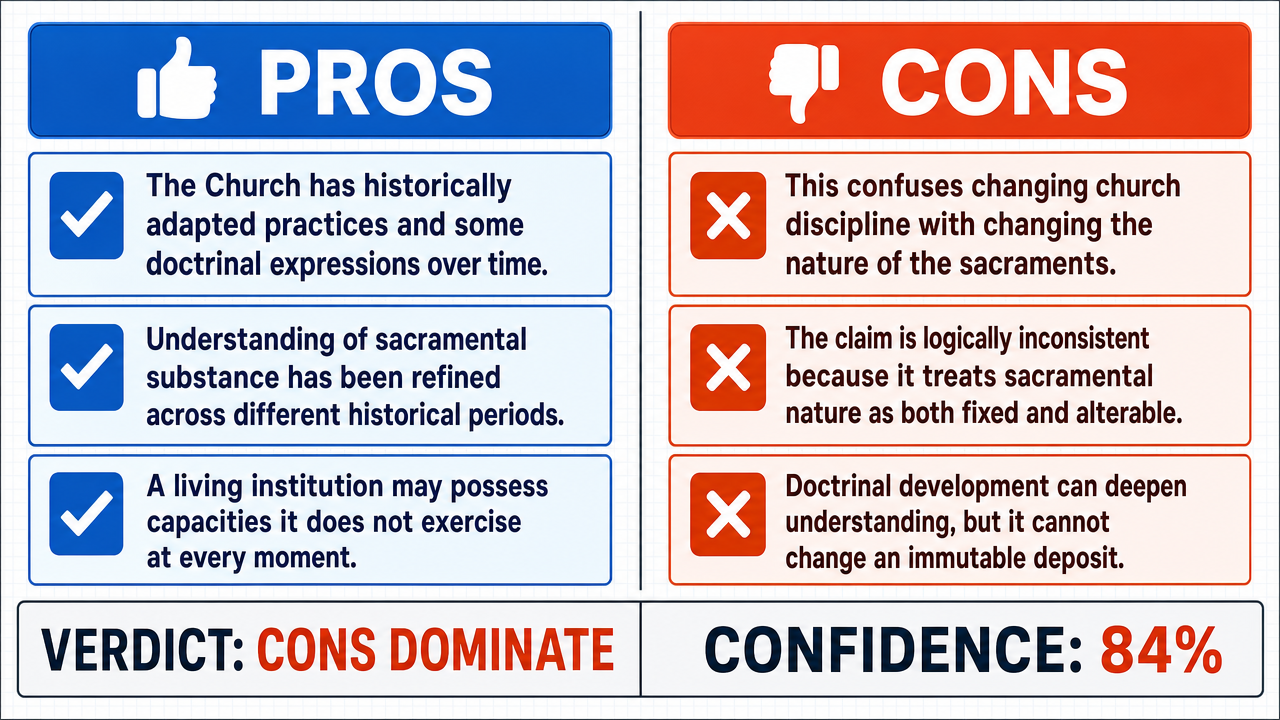
Verdict
Verdict: Mostly FALSE (84%)
This section provides a brief overview of the key arguments. It is not necessary to read the detailed report below.
✅ Key PRO arguments:
- ■The Roman Catholic Church has historically demonstrated an ability to adapt its practices and doctrines, including regarding ordained ministries , with evidence of deaconesses performing significant liturgical and pastoral functions, showing that tradition is not monolithic.
- ■The theological understanding of what constitutes the 'substance' of a sacrament has itself evolved over history, as evidenced by medieval precision on aspects not explicitly formulated in the early Church.
- ■The 'intrinsic capacity' of a living institution is not limited to its use of that capacity at a given moment: an order can temporarily prohibit an act while retaining the power to revise that prohibition.
❌ Key CON arguments:
- ■The claim relies on a confusion between the capacity to modify ecclesiastical laws and the capacity to alter the very nature of the sacraments : if the Church can modify human disciplines, it cannot modify the substance of the priestly order as defined by apostolic tradition and the representation in persona Christi .
- ■The opposing argument is structurally invalid because it relies on a logical contradiction: it claims simultaneously that the Church can modify the nature of its sacraments through evolving interpretation while relying on a tradition that forbids this possibility.
- ■If doctrinal evolution is understood as growth in the understanding of an immutable deposit, it cannot lead to an alteration of the nature of that deposit, i.e., the transition from an exclusively male ministry to a mixed ministry.
💭 Conclusion: False: the verdict of FALSE is upheld with high confidence (84%) because the negative side demonstrated a fundamental logical contradiction in the opposing argument. The claim confuses the capacity to modify ecclesiastical disciplines with the capacity to modify the very substance of the sacraments , which is a category error. The priestly order , defined by apostolic tradition and the representation in persona Christi , does not fall within the domain of revisable disciplinary decisions , but of the intangible sacramental substance . The doctrinal development , understood as growth in the understanding of an immutable deposit, cannot result in an alteration of its nature. Finally, the argument that a temporary prohibition does not eliminate the capacity for revision does not apply when the prohibition touches the ontological nature of the sacrament rather than its mere external regulation.
🔬 Verdict: Mostly FALSE ❌ (84%)
Claim: The Roman Church has the intrinsic capacity to evolve to permit the ordination of women to the diaconate, priesthood, and episcopate
Participating models: deepseek-v3.2 💬, gemma-4-26b-a4b-it 💬👁️
📊 Confrontations: 0 concluded TRUE, 1 concluded FALSE (1 confrontation, 3 models)
📊 Score per camp: TRUE=0.00, FALSE=0.84
🏅 Model score evolution:
minimax-m3 💬👁️: +8
✅ PRO arguments:
- ■The Roman Catholic Church has historically demonstrated an ability to adapt its practices and doctrines, including regarding ordained ministries , with evidence of deaconesses performing significant liturgical and pastoral functions, showing that tradition is not monolithic. deepseek-v3.2 💬
- ■The medieval theology clarified aspects of the sacramental substance that were not explicitly formulated in the early Church. deepseek-v3.2 💬
- ■The 'intrinsic capacity' of a living institution is not limited to its use of that capacity at a given time: an order can temporarily prohibit an act while retaining the power to revise that prohibition. deepseek-v3.2 💬
- ■The Church possesses within itself a capacity for discernment, doctrinal development , and disciplinary reform that could eventually open the ordination of women to the diaconate , presbyterate , and episcopate . deepseek-v3.2 💬
- ■The sensus fidei and the 'signs of the times' are internal mechanisms through which the Church can discern legitimate doctrinal and disciplinary evolutions . deepseek-v3.2 💬
❌ CON arguments:
- ■The claim relies on a confusion between the capacity to modify ecclesiastical laws and the capacity to alter the very nature of the sacraments : if the Church can modify human disciplines, it cannot modify the substance of the priestly order as defined by apostolic tradition and the representation in persona Christi . gemma-4-26b-a4b-it 💬👁️
- ■The opposing argument is structurally invalid because it relies on a logical contradiction: it claims simultaneously that the Church can modify the nature of its sacraments through evolving interpretation while relying on a tradition that forbids this possibility. gemma-4-26b-a4b-it 💬👁️
- ■If doctrinal evolution is understood as growth in the understanding of an immutable deposit, it cannot lead to an alteration of the nature of that deposit, i.e., the transition from an exclusively male ministry to a mixed ministry. gemma-4-26b-a4b-it 💬👁️
- ■Ordination is not a simple administrative or social function that can be redefined according to cultural contexts, but a sacramental act ontologically linked to the representation of Christ. gemma-4-26b-a4b-it 💬👁️
- ■The affirmative position makes a category error by treating ordination as a mutable discipline when it pertains to the intangible sacramental substance . gemma-4-26b-a4b-it 💬👁️
💭 Reasoning: False: the verdict of FALSE is upheld with high confidence (84%) because the negative side demonstrated a fundamental logical contradiction in the opposing argument. The claim confuses the capacity to modify ecclesiastical disciplines with the capacity to modify the very substance of the sacraments, which is a category error. The priestly order, defined by apostolic tradition and the representation in persona Christi, does not fall within the domain of revisable disciplinary decisions but of the intangible sacramental substance. The legitimate doctrinal development, understood as growth in the understanding of an immutable deposit, cannot result in an alteration of its nature. Finally, the argument that a temporary prohibition does not eliminate the capacity for revision does not apply when the prohibition touches the ontological nature of the sacrament rather than its mere external regulation.
📋 PRO facts:
• Church history reveals evidence of deaconesses performing significant liturgical and pastoral functions.
• Medieval theology clarified aspects of the sacramental substance that were not explicitly formulated in the early Church.
• Canon law currently explicitly excludes the ordination of women.
📋 FACTS AGAINST:
• The priestly order is defined by apostolic tradition and the representation in persona Christi.
• Catholic doctrinal development is understood as growth in the understanding of an unchangeable deposit (cf. Newman).
• Ordination is a sacramental act and not merely an administrative or social function.
| Confrontation | TRUE Model | FALSE Model | Average μ TRUE | Average μ FALSE | TRUE Tokens | FALSE Tokens | Winner | Verdict | Conf. |
|---|---|---|---|---|---|---|---|---|---|
| #1 | deepseek-v3.2 💬 | gemma-4-26b-a4b-it 💬👁️ | 0.488 | 0.560 | 12 | 3 | FALSE | FALSE | 84% |
The following technical terms, abbreviations, and specialized concepts are used in this transcript. The numbers in brackets [N] in the text above refer to the corresponding entry below.
[1] Catechism of the Catholic Church — Catéchisme de l'Église catholique — Official compilation of the doctrine and teachings of the Catholic Church, containing a synthetic presentation of faith, morality, and prayer.
[2] Vatican II Council — Concile œcuménique Vatican II — Ecumenical council held between 1962 and 1965, which introduced significant reforms in liturgy, ecclesiology, and the Church’s relationship with the modern world.
[3] diaconate — First degree of the sacred order in the Catholic Church, conferred on deacons called to liturgical and charitable service.
[4] deaconesses — Women who exercised diaconal functions in the early Church, whose historical existence is debated regarding the nature of their ordination.
[5] disciplinary — disciplinary laws — Ecclesiastical norms governing the organization and practice of the Church, distinct from dogmatic truths and considered revisable.
[6] canon law — Body of laws and regulations enacted by ecclesiastical authority for the governance and organization of the Catholic Church.
[7] deposit of faith — depositum fidei — Set of truths revealed by God and entrusted to the Church for faithful transmission, considered as having an unchangeable substance.
[8] doctrinal development — Process by which the Church gradually deepens and clarifies the understanding of the revealed deposit without altering its substance.
[9] Holy Spirit — Third person of the Trinity, whose assistance is invoked in Catholic tradition to guarantee the Church’s fidelity to revelation.
[10] in persona Christi — Latin expression meaning "in the person of Christ," referring to the sacramental action of the ordained minister acting in the name of Christ.
[11] divine law — Law considered to originate from God and, as such, deemed immutable in the doctrinal and sacramental order.
[12] ecclesiastical law — Law established by Church authority, judged to be revisable and distinct from divine law in Catholic theology.
[13] magisterial — Relating to the Magisterium, i.e., the doctrinal teaching authority exercised by the pope and bishops.
[14] ordained ministries — The three degrees of the Sacrament of Orders in the Catholic Church: diaconate, presbyterate, and episcopate.
[15] ontological — Relating to ontology, i.e., the nature of being or the substance of a reality; opposed in this context to purely disciplinary matters.
[16] ordination — Sacramental act by which a man is consecrated to an ecclesiastical ministry and receives the grace proper to this state.
[17] priestly order — Sacrament of Orders, particularly in its presbyteral and episcopal dimensions, considered linked to the representation of Christ.
[18] presbyterate — Second degree of the sacred order, conferred on priests (presbyters) for pastoral and Eucharistic ministry.
[19] revelation — divine revelation — Manifestation of God and His salvific plan, of which the Church considers itself the depositary and transmitter.
[20] sacraments — Sacred acts instituted by Christ, through which grace is conferred to those who receive them under the required conditions.
[21] sensus fidei — Latin expression meaning "sense of faith," i.e., the supernatural instinct by which all the faithful recognize the truths of faith.
[22] signs of the times — Cultural, social, and historical indicators used in theological discernment, especially since Vatican II.
[23] sacramental substance — The essence of a sacrament, considered as intangible and not modifiable by ecclesiastical authority alone.
[24] apostolic tradition — Transmission of faith and sacramental practice received from the apostles, whose content is deemed normative for the Church.
[25] episcopate — Third degree of the sacred order, conferred on bishops, or the collective body of bishops of a Church.
Face-off transcripts
- ■
Ownership & Trade Secrets. Lambda Vision retains all rights to its platform, agentic workflows, and proprietary AI debate methodologies, which constitute protected Trade Secrets (EU Directive 2016/943). Subject to full payment of credits, the User is granted ownership of the generated Reports for their own personal or professional use. Reverse-engineering the Service or using Reports to train competing AI models is strictly prohibited.
- ■
No Professional Advice. Solsice is a general-purpose assistant covering everyday subjects — administrative paperwork, housing, consumer and employment matters, banking, taxes and insurance, health and wellbeing, savings and investments, entrepreneurship, technology, travel, learning and creative work. Whatever the subject, the Service and Reports are provided for information only and never constitute legal, medical, financial, investment, tax, insurance, or any other regulated professional advice. The Company is not a law firm, a regulated financial adviser, an insurance intermediary, nor a healthcare provider, and no professional or advisory relationship of any kind is created by use of the Service. Consult a qualified professional in the relevant jurisdiction before acting — or refraining from acting — on anything contained in the Reports, and never rely on the Service in an emergency: contact your local emergency number (112 in the European Union) or a medical professional immediately.
- ■
AI-Generated Content, Sources and Viewpoints. Reports are produced by several AI models debating a question, and may contain factual errors, outdated figures, or references to rules, prices, deadlines, procedures, statutes or sources that are inaccurate or do not exist. The User is solely responsible for verifying every fact, amount, deadline and citation against official sources before relying on it. Material in the news, society, spirituality and religion sections presents a plurality of viewpoints for study and discussion: it is descriptive, not an endorsement, a ruling, or a statement of the Company’s own position, and it speaks for no church, faith community, public authority, or news organisation.
- ■
Liability & Governing Law. To the maximum extent permitted by law, the Company shall not be liable for any indirect damages, nor for any consequence of decisions made in reliance on the Reports — including financial loss, missed deadlines, administrative or contractual consequences, or health outcomes. These Terms are governed by French law. Any disputes shall be subject to the exclusive jurisdiction of the Courts of Paris, France.