
L'échange de cryptomonnaies contre des stablecoins sera imposable en France à partir du 1er janvier 2027 pour les particuliers.
AI debate verdict and arguments
⚠️ AI-generated information only; not professional advice
Completed October 11, 2026
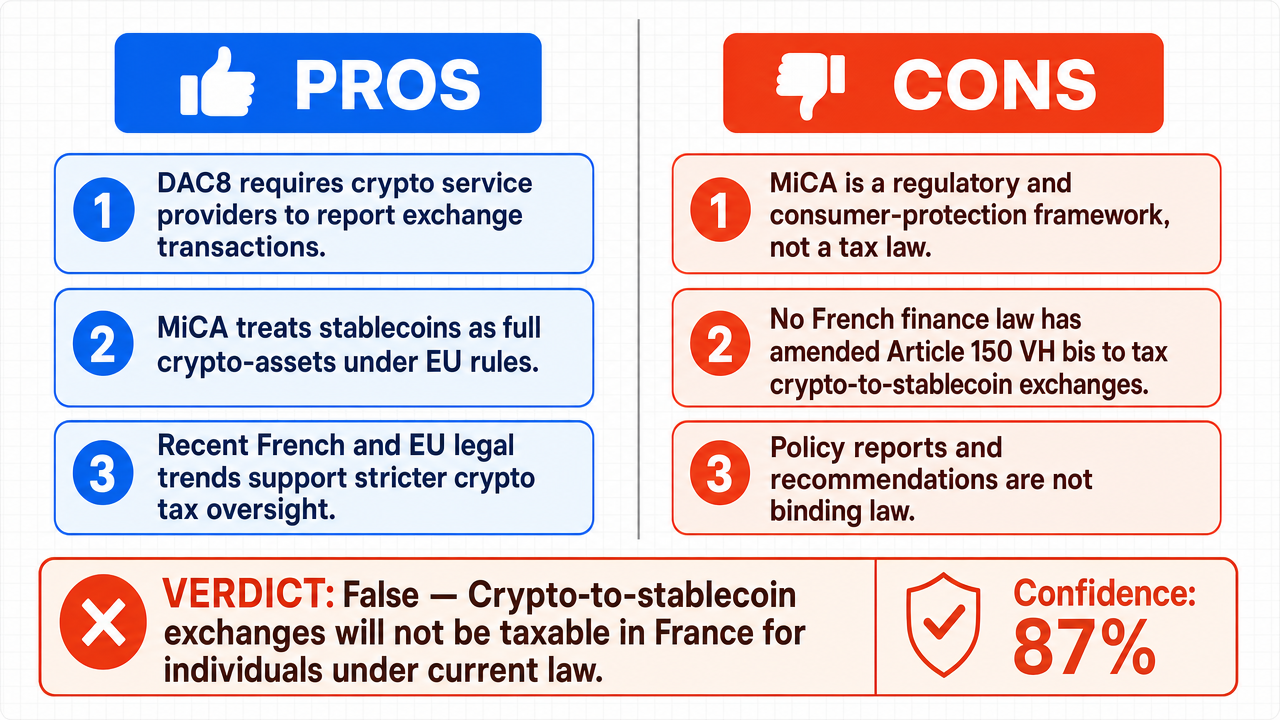
Verdict
Verdict: Mostly FALSE (87%)
This section provides a brief overview of the key arguments. It is not necessary to read the detailed report below.
✅ Key PRO arguments:
- ■The DAC8 Directive (Directive (EU) 2023/2225 of October 13, 2023) requires crypto-asset service providers to report transactions involving crypto-assets, with an initial reporting exercise in 2026 and the first automatic exchange of information between tax authorities in 2027, which would create the conditions for effective taxation.
- ■The MiCA Regulation classifies stablecoins as full-fledged crypto-assets (electronic money tokens and asset-referenced tokens ), giving them a distinct legal status that would justify specific taxation of exchanges involving them.
- ■The Finance Law for 2022 introduced a specific tax regime for capital gains on digital assets in France, and European legislative developments with MiCA would harmonize crypto-asset regulation , including stablecoins .
❌ Key CON arguments:
- ■The MiCA Regulation is a prudential regulation framework and consumer protection measure that has no power to modify the French General Tax Code; the entry into force of MiCA does not automatically create a taxable event .
- ■In the absence of an explicit modification of Article 150 VH bis of the French General Tax Code by a Finance Law , exchanging crypto-assets for stablecoins remains a neutral operation, as it does not constitute a disposal of legal tender .
- ■Reports from the Economic Analysis Council (CAE ) are policy recommendations and not sources of positive law ; they have no binding force and cannot foreseeably open a legislative window .
💭 Conclusion: False: exchanging cryptocurrencies for stablecoins will not be taxable in France for individuals. The FALSE side prevailed by successfully demonstrating that MiCA is a prudential, non-tax framework, incapable of modifying the French General Tax Code. The DAC8 Directive , although it mandates reporting starting in 2026, concerns information sharing between tax authorities and does not in itself create a taxable event. Without explicit legislative modification of Article 150 VH bis of the CGI , the principle of legality of taxation prohibits any new taxation. The reports from the CAE remain non-binding recommendations and cannot establish a tax obligation.
🔬 Verdict: Mostly FALSE ❌ (87%)
Claim: Exchanging cryptocurrencies for stablecoins will be taxable in France starting January 1, 2027, for individuals.
Participating models: deepseek-v3.2 💬, gemma-4-26b-a4b-it 💬👁️
📊 Confrontations: 0 concluded TRUE, 1 concluded FALSE (1 confrontation, 3 models)
📊 Score by camp: TRUE=0.00, FALSE=0.87
🏅 Model score evolution:
minimax-m3 💬👁️: +9
✅ PRO arguments:
- ■The DAC8 Directive (Directive (EU) 2023/2225 of October 13, 2023) requires crypto-asset service providers to report transactions involving crypto-assets, with an initial reporting exercise in 2026 and the first automatic exchange of information between tax authorities in 2027, which would create the conditions for effective taxation. deepseek-v3.2 💬
- ■The MiCA Regulation classifies stablecoins as full-fledged crypto-assets (electronic money tokens and asset-referenced tokens ), giving them a distinct legal status that would justify specific taxation of exchanges involving them. deepseek-v3.2 💬
- ■The Finance Law for 2022 introduced a specific tax regime for capital gains on digital assets in France, and European legislative developments with MiCA would harmonize crypto-asset regulation , including stablecoins . deepseek-v3.2 💬
- ■The Economic Analysis Council (CAE ) produced reports suggesting clarification of crypto-asset taxation to prevent arbitrage, which could open a legislative window leading to taxation in 2027. deepseek-v3.2 💬
❌ Counterarguments:
- ■The MiCA Regulation is a prudential regulation framework and consumer protection measure that has no power to modify the French National Tax Code; the entry into force of MiCA does not automatically create a taxable event . gemma-4-26b-a4b-it 💬👁️
- ■Without explicit modification of Article 150 VH bis of the French General Tax Code by a French Finance Law, exchanging crypto-assets for stablecoins remains a neutral operation, as it does not involve disposal of legal tender . gemma-4-26b-a4b-it 💬👁️
- ■Reports from the Economic Analysis Council are policy recommendations and not sources of positive law ; they have no binding force and cannot foreseeably open a legislative window. gemma-4-26b-a4b-it 💬👁️
- ■The principle of legality of taxation requires explicit legislative provisions to create new taxes; without modification of the General Tax Code, no new taxation can apply to crypto-stablecoin exchanges. gemma-4-26b-a4b-it 💬👁️
💭 Reasoning: False: exchanging cryptocurrencies for stablecoins will not be taxable in France for individuals. The FALSE side prevailed by successfully demonstrating that MiCA is a prudential, non-tax framework, incapable of modifying the French General Tax Code. The DAC8 Directive, although it mandates reporting starting in 2026, concerns information sharing between tax authorities and does not in itself create a taxable event. Without explicit legislative modification of Article 150 VH bis of the CGI , the principle of legality of taxation prohibits any new taxation. The reports from the CAE remain non-binding recommendations and cannot establish a tax obligation.
📋 PRO facts:
• The DAC8 Directive (EU 2023/2225) was adopted on October 13, 2023, and provides for an initial information reporting exercise in 2026, followed by automatic exchanges between tax authorities.
• The Finance Law for 2022 introduced a specific tax regime for capital gains on digital assets in France.
📋 CON facts:
• MiCA is a prudential regulation of crypto-asset markets and does not have the authority to modify national tax legislation.
• Article 150 VH bis of the French General Tax Code defines the conditions for taxing capital gains on digital assets and has not been amended to include crypto-stablecoin exchanges.
• The principle of legality of taxation in French law requires explicit legislative provisions for any new tax.
• Reports from the Economic Analysis Council are advisory opinions without binding normative value.
| Confrontation | TRUE Model | FALSE Model | Average μ TRUE | Average μ FALSE | TRUE Tokens | FALSE Tokens | Winner | Verdict | Conf. |
|---|---|---|---|---|---|---|---|---|---|
| #1 | deepseek-v3.2 💬 | gemma-4-26b-a4b-it 💬👁️ | 0.500 | 0.548 | 12 | 3 | FALSE | FALSE | 87% |
The following technical terms, abbreviations, and specialized concepts are used in this transcript. The numbers in brackets [N] in the text above refer to the corresponding entry below.
[1] Digital assets — French legal category encompassing crypto-assets and other digital goods, subject to a specific tax regime for capital gains realized by individuals.
[2] Tax arbitrage — Strategy exploiting differences in tax treatment between asset categories or jurisdictions to reduce tax burden.
[3] Asset-Referenced Tokens — Asset-Referenced Tokens (ART) — Category of crypto-assets defined by the MiCA regulation, aiming to stabilize in reference to a basket of currencies, commodities, or other assets.
[4] CAE — Economic Analysis Council — French advisory body on economic policy placed with the Prime Minister, whose reports have no binding force but can influence legislation.
[5] Transfer — Legal act of transferring ownership of an asset, which in French tax law triggers the realization of capital gains.
[6] CGI — General Tax Code — French legislative collection codifying all national tax rules, with Article 150 VH bis governing the taxation of digital assets.
[7] Crypto-assets — Digital representation of a value or right that can be transferred and stored electronically via distributed ledger technology.
[8] Crypto-to-crypto — crypto-to-crypto exchange — Operation of exchange between two crypto-assets, considered tax-neutral in France as long as it is not converted into legal tender.
[9] DAC8 — Directive (EU) 2023/2225 of October 13, 2023 amending Directive 2011/16/EU — European directive requiring crypto-asset service providers to report transactions automatically, with an initial information exchange between tax authorities scheduled for 2027.
[10] Positive law — Set of legal rules in force in a state at a given time, as opposed to recommendations or expert reports without binding force.
[11] E-Money Tokens — E-Money Tokens (EMT) — Category of crypto-assets defined by the MiCA regulation, intended to serve as a means of payment and similar to electronic money.
[12] Taxable event — Event or situation defined by law that triggers the creation of a tax obligation; for digital assets, notably the transfer against legal tender.
[13] Legislative window — Period during which political and calendar conditions make legislative reform plausible, a notion contested in the debate as lacking legal value.
[14] Binding force — Character of a legal text whose non-compliance entails sanctions; expert reports and recommendations lack this force.
[15] Finance law — French law passed annually by Parliament to authorize state revenues and expenditures, the only legislative vehicle authorized to amend the General Tax Code.
[16] MiCA — Markets in Crypto-Assets Regulation (Regulation (EU) 2023/1114) — European regulation harmonizing crypto-asset regulation, classifying stablecoins as electronic money tokens or asset-referenced tokens, with prudential scope and no direct fiscal scope.
[17] Legal tender — Fiat currency issued by a central bank (euro, dollar, etc.), whose transfer against a digital asset triggers in France the taxation of capital gains under Article 150 VH bis of the CGI.
[18] Fiat currency — Currency whose value relies on trust in the issuing authority (central bank) and not on a metal backing, as opposed to crypto-assets.
[19] Electronic money — Monetary value stored electronically, issued against received funds and usable as a means of payment; category to which MiCA attaches certain stablecoins.
[20] Capital gains — Profits realized upon the sale of an asset at a price higher than its acquisition value, subject to taxation in France under specific rules for digital assets.
[21] Crypto-asset service providers — Crypto-asset service providers (CASP) — Entities providing custody, exchange, or advisory services for crypto-assets, subject by DAC8 to automatic tax reporting obligations.
[22] Principle of legality of taxation — French constitutional principle that no tax can be established or collected except by law, requiring legislative intervention for any new taxation.
[23] Circular reasoning — Circular reasoning assuming as proven what one seeks to prove, here by confusing a reform recommendation with its legislative enactment.
[24] Information report — Parliamentary information report — Document produced by a parliamentary committee (here the Senate Finance Committee) making recommendations, without normative binding value.
[25] Reporting — Regulatory reporting — Obligation for regulated entities to periodically transmit information about their operations to authorities, extended to crypto-asset operations by DAC8.
[26] Prudential regulation — Regulatory framework aimed at controlling risks of financial actors and protecting consumers, distinct from taxation and not creating a taxable event in itself.
[27] Source of law — Formal origin of legal rules (Constitution, law, regulation, case law); expert reports do not constitute a source of law in French law.
[28] Parliamentary Sovereignty — Principle according to which the French Parliament is free to pass or not pass a finance law modifying the CGI, regardless of European recommendations or expert opinions.
[29] stablecoins — Crypto-assets designed to maintain a stable value by referencing a fiat currency, a basket of assets, or through an algorithm, classified by MiCA as ART or EMT.
[30] electronic money tokens — Stablecoin-type crypto-assets intended to serve as a means of payment by referencing a single fiat currency, category defined by the MiCA regulation.
[31] asset-referenced tokens — Stablecoin-type crypto-assets whose value is linked to a basket of multiple underlying assets, category defined by the MiCA regulation.
[32] transposition — transposition of a European directive — Process by which a Member State incorporates the provisions of a European directive into its national law, here required for DAC8 before December 31, 2025.
[33] automatic exchange of information — automatic exchange of information between tax administrations — European tax cooperation mechanism whereby Member States systematically share data related to taxpayers, extended to crypto-assets by DAC8.
Face-off transcripts
- ■
Ownership & Trade Secrets. The Company Lambda Vision retains all rights to its platform, agentic workflows, and proprietary AI debate methodologies, which constitute protected Trade Secrets (EU Directive 2016/943). Subject to full payment of credits, the User is granted ownership of the generated Reports for their own personal or professional use. Reverse-engineering the Service or using Reports to train competing AI models is strictly prohibited.
- ■
No Professional Advice. Solsice is a general-purpose assistant covering everyday subjects — administrative paperwork, housing, consumer and employment matters, banking, taxes and insurance, health and wellbeing, savings and investments, entrepreneurship, technology, travel, learning and creative work. Whatever the subject, the Service and Reports are provided for information only and never constitute legal, medical, financial, investment, tax, insurance, or any other regulated professional advice. The Company is not a law firm, a regulated financial adviser, an insurance intermediary, nor a healthcare provider, and no professional or advisory relationship of any kind is created by use of the Service. Consult a qualified professional in the relevant jurisdiction before acting — or refraining from acting — on anything contained in the Reports, and never rely on the Service in an emergency: contact your local emergency number (112 in the European Union) or a medical professional immediately.
- ■
AI-Generated Content, Sources and Viewpoints. Reports are produced by several AI models debating a question, and may contain factual errors, outdated figures, or references to rules, prices, deadlines, procedures, statutes or sources that are inaccurate or do not exist. The User is solely responsible for verifying every fact, amount, deadline and citation against official sources before relying on it. Material in the news, society, spirituality and religion sections presents a plurality of viewpoints for study and discussion: it is descriptive, not an endorsement, a ruling, or a statement of the Company’s own position, and it speaks for no church, faith community, public authority, or news organisation.
- ■
Liability & Governing Law. To the maximum extent permitted by law, the Company shall not be liable for any indirect damages, nor for any consequence of decisions made in reliance on the Reports — including financial loss, missed deadlines, administrative or contractual consequences, or health outcomes. These Terms are governed by French law. Any disputes shall be subject to the exclusive jurisdiction of the Courts of Paris, France.