
L'attitude d'un candidat, incluant son énergie et son enthousiasme, peut compenser des réponses de fond moins solides lors d'un entretien d'embauche.
AI debate verdict and arguments
⚠️ AI-generated information only; not professional advice
Completed October 22, 2026
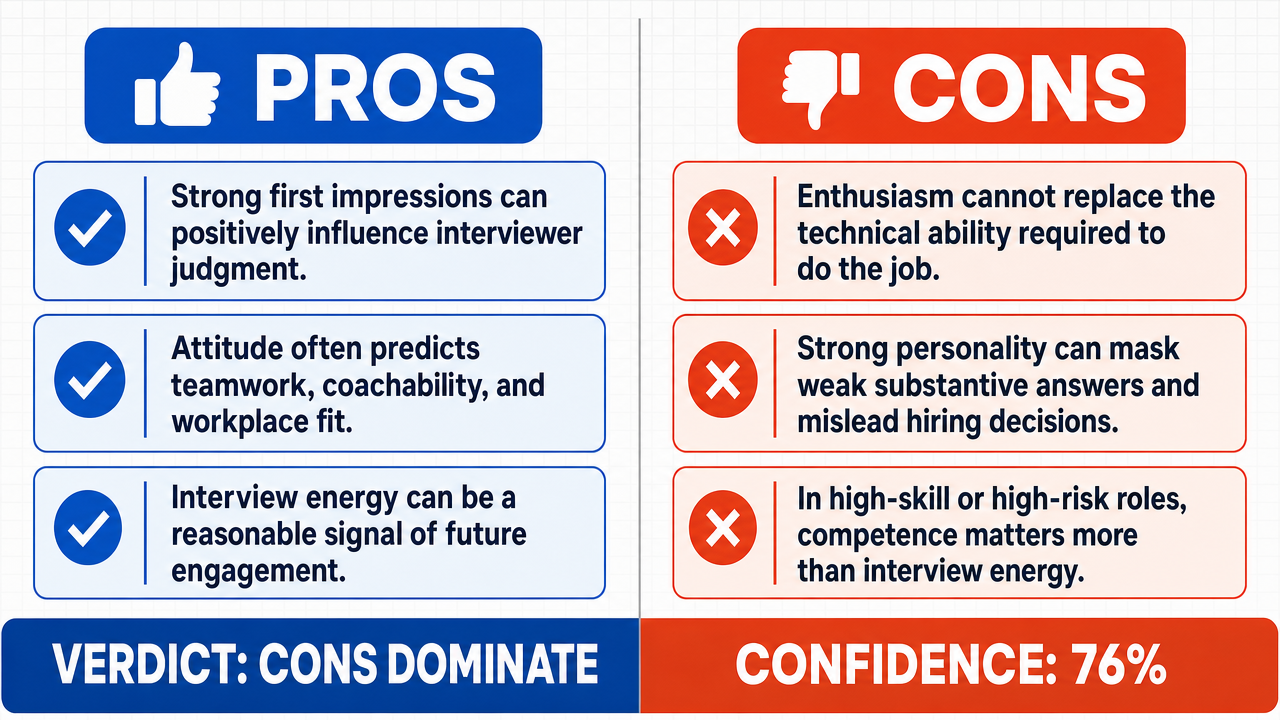
Verdict
Verdict: Mostly FALSE (76%)
Online report: https://solsice.com/public/debates/l-attitude-d-un-candidat-incluant-son-energie-et-son-enthous-38ca23093e13
This section provides a brief overview of the key arguments. It is not necessary to read the detailed report below.
✅ Key PRO arguments:
- ■The halo effect and first impressions, formed in a fraction of a second (Princeton study, Willis & Todorov, 2006), favorably bias the subsequent evaluation of the candidate, so that an energetic attitude positively colors the interpretation of subsequent responses.
- ■The Leadership IQ study (2005) indicates that 89% of failures within the first 18 months after hiring are attributable to attitude issues, compared to only 11% due to technical skill deficits, justifying a recruiter tolerating less solid substantive responses in favor of energy and enthusiasm.
- ■Since the purpose of the interview is to predict future performance , valuing the observed attitude during the interview is a rational choice aligned with empirical data on long-term success.
❌ Key CON arguments:
- ■The opposing argument confuses category between form (personality, attitude) and substance (technical execution ability): in highly technical fields such as engineering, medicine, or quantitative finance , enthusiasm cannot substitute for a miscalculation or lack of knowledge of safety protocols .
- ■The Leadership IQ study suffers from an internal logical contradiction : it claims to exhaust all causes of failure into two categories (attitude vs technical skills) while making attitude the predominant factor, whereas failure depends on multiple contextual factors (management, tools, corporate culture).
- ■A charismatic but technically deficient candidate exposes the organization to direct operational risks (errors, accidents, non-compliance) that neither energy nor enthusiasm can neutralize once in position.
💭 Conclusion: False: the negative side wins because it has demonstrated that enthusiasm and energy do not constitute a functional substitute for technical competence in real operational contexts. The central argument of the victorious side relies on the categorical distinction between form (attitude) and substance (execution capacity), a distinction that the affirmative side failed to refute despite invoking the halo effect. The methodological critique of the Leadership IQ study, judged to be logically contradictory and reductionist, weakened the main empirical argument of the pro side. Finally, the concrete operational risk (technical errors, non-compliance, safety) associated with hiring a candidate solely based on charisma was considered by the judge as more convincing than cognitive biases of first impressions. The confidence score reflects that the sub-claim regarding the total "compensation" of substantive responses is not entirely invalidated in all contexts, especially for low-technicality positions.
🔬 Verdict: Mostly FALSE ❌ (76%)
Claim: A candidate's attitude, including their energy and enthusiasm, can compensate for weaker substantive responses during a job interview.
Participating models: deepseek-v4-pro 💬, gemma-4-26b-a4b-it 💬👁️
📊 Confrontations: 0 concluded TRUE, 1 concluded FALSE (1 confrontation, 3 models)
📊 Score by camp: TRUE=0.00, FALSE=0.76
🏅 Model score evolution:
minimax-m3 💬👁️: +8
✅ Arguments FOR:
- ■The halo effect and first impressions, formed in a fraction of a second (Princeton study, Willis & Todorov, 2006), favorably bias the subsequent evaluation of the candidate, so that an energetic attitude positively colors the interpretation of subsequent responses. deepseek-v4-pro 💬
- ■The Leadership IQ study (2005) indicates that 89% of failures within the first 18 months after hiring are attributable to attitude issues, compared to only 11% due to technical skill deficits, justifying a recruiter tolerating less solid substantive responses in favor of energy and enthusiasm. deepseek-v4-pro 💬
- ■Since the purpose of the interview is to predict future performance , valuing the observed attitude during the interview is a rational choice aligned with empirical data on long-term success. deepseek-v4-pro 💬
❌ Arguments AGAINST:
- ■The opposing argument confuses category between form (personality, attitude) and substance (technical execution ability): in highly technical fields such as engineering, medicine, or quantitative finance , enthusiasm cannot substitute for a miscalculation or lack of knowledge of safety protocols . gemma-4-26b-a4b-it 💬👁️
- ■The Leadership IQ study suffers from an internal logical contradiction : it claims to exhaust all causes of failure into two categories (attitude vs technical skills) while making attitude the predominant factor, whereas failure depends on multiple contextual factors (management, tools, corporate culture). gemma-4-26b-a4b-it 💬👁️
- ■A charismatic but technically deficient candidate exposes the organization to direct operational risks (errors, accidents, non-compliance) that neither energy nor enthusiasm can neutralize once in position. gemma-4-26b-a4b-it 💬👁️
💭 Reasoning: False: the negative camp wins because it has demonstrated that enthusiasm and energy do not constitute a functional substitute for technical competence in real operational contexts. The central argument of the victorious side relies on the categorical distinction between form (attitude) and substance (execution capacity), a distinction that the affirmative side failed to refute despite invoking the halo effect. The methodological critique of the Leadership IQ study, judged to be logically contradictory and reductionist, weakened the main empirical argument of the pro side. Finally, the concrete operational risk (technical errors, non-compliance, safety) linked to hiring a candidate solely based on charisma was considered by the judge as more convincing than the cognitive biases of first impressions. The confidence score reflects that the sub-claim regarding the total "compensation" of substantive responses is not entirely invalidated in all contexts, especially for low-technicality positions.
📋 Facts IN FAVOR:
• Leadership IQ study (2005): 89% of failures within the first 18 months post-hire are attributable to attitude issues, versus 11% to technical skill deficits.
📋 Facts AGAINST:
• In high-technicality sectors (engineering, medicine, quantitative finance), a miscalculation or lack of knowledge of safety protocols cannot be compensated by the candidate's enthusiasm.
• Post-hire professional failure is a dependent variable influenced by multiple factors (context, management, tools, corporate culture), making any causal attribution of 89% to attitude methodologically questionable.
| Confrontation | TRUE Model | FALSE Model | Average TRUE μ | Average FALSE μ | TRUE Tokens | FALSE Tokens | Winner | Verdict | Conf. |
|---|---|---|---|---|---|---|---|---|---|
| #1 | deepseek-v4-pro 💬 | gemma-4-26b-a4b-it 💬👁️ | 0.513 | 0.432 | 6 | 2 | TRUE | FALSE | 76% |
The following technical terms, abbreviations, and specialized concepts are used in this transcript. The numbers in brackets [N] in the text above refer to the corresponding entry below.
[1] bias — In psychology and statistics, a systematic distortion in information processing or evaluation, leading to judgments that deviate from objectivity.
[2] halo effect — A cognitive bias whereby the overall positive (or negative) impression of a person influences the evaluation of their specific traits, such as competence or reliability.
[3] assessment framework — The cognitive and structural context in which an evaluator (e.g., a recruiter) makes a judgment, influenced by expectations and prior impressions.
[4] post-hire failure causes — Factors identified as responsible for an employee's failure after recruitment, generally studied over a given period (e.g., the first 18 months).
[5] technical competence — Mastery of knowledge and skills specific to a professional field, distinct from behavioral or relational skills.
[6] internal logical contradiction — A flaw in an argument that contains premises or conclusions that are mutually incompatible, rendering the reasoning invalid.
[7] criterion — In evaluation, a dimension or variable used to make a judgment (e.g., attitude, technical skill, experience).
[8] category error — A logical fallacy involving assigning properties to a thing that belong to another category, or confusing different levels of abstraction (e.g., form vs. substance).
[9] classification error of causes — An error involving incorrect grouping or hierarchy of explanatory factors of a phenomenon, such as omitting certain cause categories.
[10] visual exposure — The duration during which a face or image is presented to an observer, used in experimental psychology to measure first impression formation.
[11] quantitative finance — A branch of finance applying mathematical, statistical, and computational models to market analysis and financial decision-making.
[12] high technicality — Characteristic of a job or function requiring a high level of specialized knowledge and precise technical skills.
[13] communication modality — The channel or form through which a message is transmitted (verbal, non-verbal, tone, attitude), distinct from the informational content itself.
[14] technical object — A subject or content related to a specialized field, whose mastery requires verifiable technical skills.
[15] performance — In human resource management, the level of achievement of expected objectives by an employee in performing their duties.
[16] future performance — The anticipated result of a candidate after hiring, which the interview aims to predict.
[17] greater weight — In an evaluation process, a higher relative importance given to a criterion compared to others.
[18] safety protocols — Formalized procedures defining rules to prevent accidents and ensure safety in technical or medical environments.
[19] proxy — An indirect variable or measure used to approximate a phenomenon that is difficult to observe directly, often used in empirical research.
[20] hidden premise — An implicit, unstated proposition on which an argument relies and that must be made explicit to assess its validity.
[21] social psychology — The discipline studying how individuals' thoughts, emotions, and behaviors are influenced by the actual or imagined presence of others.
[22] petitio principii — A logical fallacy involving assuming as a premise what one seeks to prove, resulting in circular reasoning.
[23] systemic risk — The risk that a local failure (e.g., a technical error by an employee) propagates and jeopardizes the overall functioning of an organization or system.
[24] residue of unspecified causes — The portion of explanatory factors of a phenomenon that is not captured by any of the explicitly identified cause categories in an analysis.
[25] logically invalid structure — An argument form where true premises do not necessarily lead to a true conclusion, making the reasoning non-conclusive.
[26] fallacious proxy substitution — Using an indirect measure (proxy) in place of another under the false assumption that they are interchangeable, despite measuring different phenomena.
[27] skill transfer — The process by which an ability acquired in one domain is applied to another; in the debate, the idea that enthusiasm could substitute for technical skill.
[28] predictive validity — The ability of an assessment tool (test, interview, criterion) to accurately predict a future outcome, such as job performance.
[29] dependent variable — In statistics, a variable whose variations are to be explained by other variables (independent variables); in the debate, post-hire failure is treated as a dependent variable.
The following financial data tables were cited during the debate exchanges:
| Cause of failure | Percentage |
|---|---|
| Attitude problems | 89% |
| Lack of technical skills | 11% |
Legend: Distribution of the causes of failure among new recruits within the first 18 months, based on the Leadership IQ study (2005) covering 20,000 cases. Source:
| Recruiters' opinion | Percentage |
|---|---|
| Soft skills as important or more important than technical skills | 92% |
Legend: Results of the LinkedIn Global Talent Trends 2019 survey on the importance of soft skills. Source: https://business.linkedin.com/talent-solutions/blog/trends-and-research/2019/global-talent-trends-2019.*
Face-off transcripts
- ■
Ownership & Trade Secrets. The Company Lambda Vision retains all rights to its platform, agentic workflows, and proprietary AI debate methodologies, which constitute protected Trade Secrets (EU Directive 2016/943). Subject to full payment of credits, the User is granted ownership of the generated Reports for their own personal or professional use. Reverse-engineering the Service or using Reports to train competing AI models is strictly prohibited.
- ■
No Professional Advice. Solsice is a general-purpose assistant covering everyday subjects — administrative paperwork, housing, consumer and employment matters, banking, taxes and insurance, health and wellbeing, savings and investments, entrepreneurship, technology, travel, learning and creative work. Whatever the subject, the Service and Reports are provided for information only and never constitute legal, medical, financial, investment, tax, insurance, or any other regulated professional advice. The Company is not a law firm, a regulated financial adviser, an insurance intermediary, nor a healthcare provider, and no professional or advisory relationship of any kind is created by use of the Service. Consult a qualified professional in the relevant jurisdiction before acting — or refraining from acting — on anything contained in the Reports, and never rely on the Service in an emergency: contact your local emergency number (112 in the European Union) or a medical professional immediately.
- ■
AI-Generated Content, Sources and Viewpoints. Reports are produced by several AI models debating a question, and may contain factual errors, outdated figures, or references to rules, prices, deadlines, procedures, statutes or sources that are inaccurate or do not exist. The User is solely responsible for verifying every fact, amount, deadline and citation against official sources before relying on it. Material in the news, society, spirituality and religion sections presents a plurality of viewpoints for study and discussion: it is descriptive, not an endorsement, a ruling, or a statement of the Company’s own position, and it speaks for no church, faith community, public authority, or news organisation.
- ■
Liability & Governing Law. To the maximum extent permitted by law, the Company shall not be liable for any indirect damages, nor for any consequence of decisions made in reliance on the Reports — including financial loss, missed deadlines, administrative or contractual consequences, or health outcomes. These Terms are governed by French law. Any disputes shall be subject to the exclusive jurisdiction of the Courts of Paris, France.