
L'attachement excessif à un objectif, comme la célébrité musicale, nuit à la qualité de l'action présente et constitue une fuite d'énergie.
AI debate verdict and arguments
⚠️ AI-generated information only; not professional advice
Completed October 18, 2026
Verdict
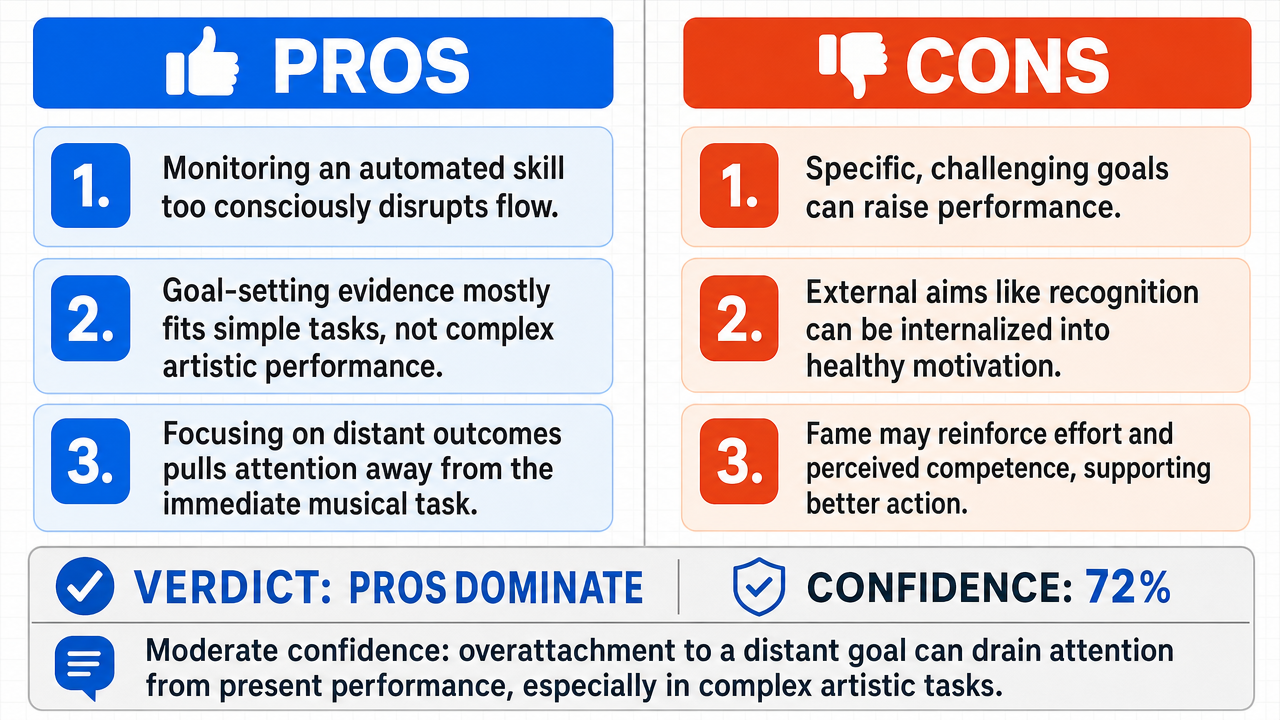
Verdict: Mostly TRUE (72%)
Online report: https://solsice.com/public/debates/l-attachement-excessif-a-un-objectif-comme-la-celebrite-musi-afab79043976
This section provides a brief overview of the key arguments. It is not necessary to read the detailed report below.
✅ Key PRO arguments:
- ■Experimental psychology of performance shows that explicit monitoring of components of an already automated skill degrades gesture fluidity. Excessive attachment to musical fame places the musician in a state of constant self-evaluation, which conflicts with the demands of the current task, increases cognitive load , and leads to errors.
- ■Goal Setting Theory has been primarily validated on simple tasks with measurable criteria , with assigned goals , and immediate feedback ; none of these conditions apply to the pursuit of musical fame. The opponent substitutes a referent without providing a transfer operator linking laboratory goals to excessive attachment to fame.
- ■Focusing on a distant outcome diverts attention from the immediate requirements of the musical task, fragmenting cognitive energy instead of channeling it, which constitutes a real drain of productive energy.
❌ Key CON arguments:
- ■Goal Setting Theory demonstrates that specific and challenging goals increase performance compared to vague goals or no goals. Ambition provides the necessary framework to prioritize efforts and channel cognitive resources toward standards of excellence .
- ■Contemporary research highlights the concept of "integrated motivation ": an extrinsic goal such as social recognition can be fully integrated into an individual's identity and values, which does not harm autonomy but strengthens engagement .
- ■Fame can be perceived as validation of competence and effort, acting as positive reinforcement that stimulates the quality of current action rather than degrading it.
💭 Conclusion: True, the statement is considered valid with moderate confidence. Experimental psychology of performance demonstrates that explicit monitoring of already automated skills degrades gesture fluidity, directly supporting the first sub-affirmation that excessive attachment to a goal harms the quality of current action. The opposing team's argument that Goal Setting Theory validates high ambitions relies on an abusive generalization, as this theory has been validated under very specific conditions (simple tasks, measurable criteria , immediate feedback ) that do not apply to the pursuit of musical fame. The concept of "integrated motivation " raised by the defense does not invalidate the central thesis, as it describes a harmonious integration of the goal, not an excessive attachment that, by definition, escapes this balanced integration. The 72% confidence reflects that the second sub-affirmation (energy drain) is less empirically supported than the first, although both are coherent. The VERDICT TRUE is thus based on the most rigorous arguments from the affirmative side.
🔬 Verdict: Mostly TRUE ✅ (72%)
Claim: Excessive attachment to a goal, such as musical fame, harms the quality of current action and constitutes an energy drain.
Participating models: deepseek-v4-pro 💬, gemma-4-26b-a4b-it 💬👁️
📊 Confrontations: 1 concluded TRUE, 0 concluded FALSE (1 confrontation, 3 models)
📊 Score per camp: TRUE=0.72, FALSE=0.00
🏅 Model score evolution:
minimax-m3 💬👁️: +7
✅ Arguments FOR:
- ■Experimental psychology of performance shows that explicit monitoring of components of an already automated skill degrades gesture fluidity. Excessive attachment to musical fame places the musician in a state of constant self-evaluation, which conflicts with the demands of the current task, increases cognitive load , and leads to errors. deepseek-v4-pro 💬
- ■Goal Setting Theory has been mainly validated on simple tasks with measurable criteria , with assigned goals , and immediate feedback ; none of these conditions apply to the pursuit of musical fame. The opponent substitutes a referent without providing a transfer operator linking laboratory goals to excessive attachment to fame. deepseek-v4-pro 💬
- ■Focusing on a distant result diverts attention from the immediate requirements of the musical task, fragmenting cognitive energy instead of channeling it, which constitutes a true drain of productive energy. deepseek-v4-pro 💬
❌ Arguments AGAINST:
- ■Goal Setting Theory demonstrates that specific and challenging goals increase performance compared to vague goals or no goals. Ambition provides the necessary framework to prioritize efforts and channel cognitive resources toward standards of excellence . gemma-4-26b-a4b-it 💬👁️
- ■Contemporary research highlights the concept of "integrated motivation ": an extrinsic goal such as social recognition can be fully integrated into an individual's identity and values, which does not harm autonomy but reinforces engagement . gemma-4-26b-a4b-it 💬👁️
- ■Fame can be perceived as validation of competence and effort, thus acting as positive reinforcement that stimulates the quality of current action rather than degrading it. gemma-4-26b-a4b-it 💬👁️
💭 Reasoning: True, the statement is judged to be valid with moderate confidence. Experimental psychology of performance shows that explicit monitoring of already automated skills degrades gesture fluidity, directly supporting the first sub-affirmation that excessive attachment to a goal harms the quality of current action. The opposing team's argument that Goal Setting Theory validates high ambitions relies on an abusive generalization, as this theory has been validated under very specific conditions (simple tasks, measurable criteria, immediate feedback) that do not apply to the pursuit of musical fame. The concept of "integrated motivation" raised by the defense does not invalidate the central thesis, as it describes a harmonious integration of the goal, not an excessive attachment that, by definition, escapes this balanced integration. The 72% confidence reflects that the second sub-affirmation (energy drain) is less empirically supported than the first, although both are coherent. The VERDICT TRUE is thus based on the most rigorous arguments from the affirmative camp.
📋 Facts FOR:
• Experimental psychology of performance shows that explicit monitoring of automated skills degrades gesture fluidity.
• The Goal Setting Theory has been primarily validated on simple tasks with measurable criteria, assigned objectives, and immediate feedback.
• Continuous self-evaluation linked to excessive attachment to fame increases cognitive load and produces errors.
📋 Facts AGAINST:
• The Goal Setting Theory demonstrates that specific and difficult goals increase performance compared to vague objectives.
• Contemporary research highlights the concept of "integrated motivation," where an extrinsic goal can be fully integrated into an individual's identity.
• Fame can act as positive reinforcement validating competence and effort.
| Confrontation | TRUE Model | FALSE Model | Mean μ TRUE | Mean μ FALSE | TRUE Tokens | FALSE Tokens | Winner | Verdict | Conf. |
|---|---|---|---|---|---|---|---|---|---|
| #1 | deepseek-v4-pro 💬 | gemma-4-26b-a4b-it 💬👁️ | 0.563 | 0.414 | 6 | 2 | TRUE | TRUE | 72% |
The following technical terms, abbreviations, and specialized concepts are used in this transcript. The numbers in brackets [N] in the text above refer to the corresponding entries below.
[1] self-assessment — Process by which an individual judges their own performance or behavior, here described as permanent in the musician obsessed with fame.
[2] extrinsic goal — Objective oriented toward an external consequence of the activity itself (reward, recognition, status), as opposed to an intrinsic goal related to the pleasure of the task.
[3] cognitive load — Amount of mental resources mobilized to process a task; its increase, according to the debate, results from focusing on a distant goal.
[4] regression coefficient — Statistical measure quantifying the relationship between two variables; cited as an example of missing transfer operator between laboratory results and applied conclusion.
[5] task complexity — Characteristic of an activity based on its difficulty level; goal-setting theory distinguishes simple tasks from complex ones, the latter requiring specific conditions.
[6] correlation — Statistical measure of the degree of association between two variables; mentioned as a possible but insufficient link between experimental results and application to fame.
[7] measurable criteria — Objective indicators used to evaluate goal achievement; their presence is presented as a condition for the validity of goal-setting theory.
[8] intrusive desire — Aspiration that excessively occupies an individual's attentional and emotional field, here applied to the pursuit of musical notoriety.
[9] engagement — Sustained investment of an individual in an activity or goal; the debate opposes its impoverishment by extrinsic motivation to its reinforcement through integrated motivation.
[10] feedback — Information about performance; identified as a necessary condition for the effectiveness of goal-setting, absent in the pursuit of fame.
[11] goal setting — Approach involving defining specific goals to guide action; see also "Goal Setting Theory" and "theory of goal setting."
[12] Goal Setting Theory — Psychological theory (Locke & Latham) stating that specific and challenging goals improve performance under certain restrictive conditions.
[13] automated habilitation — Comptechnique performed without conscious control, whose fluidity degrades when its components are explicitly monitored.
[14] prioritizing efforts — Action of organizing one's resources by priority; presented as a structuring function of an ambitious goal.
[15] goal integration — Process by which an extrinsic goal is assimilated into the individual's values and identity, making it compatible with autonomy.
[16] mastery — Level of skill achieved in a domain; the debate distinguishes technical mastery from validation by social status.
[17] extrinsic motivation — Motivation directed toward a reward or external recognition of the activity practiced.
[18] intrinsic motivation — Motivation derived from pleasure and interest in the activity itself, without external reward.
[19] integrated motivation — Form of motivation where an extrinsic goal is fully assimilated into personal identity and values, surpassing the binary opposition with intrinsic motivation.
[20] causal mechanism — Explanatory process linking a cause to an effect; its absence is emphasized to justify the transfer between laboratory results and application to fame.
[21] assigned goals — Goals set by an external authority; their specificity is presented as a condition for the validity of Goal Setting Theory.
[22] binary opposition — Confrontation between two categories presented as mutually exclusive; criticized in the classical interpretation of Self-Determination Theory.
[23] performance — Level of task achievement; a central dependent variable in studies on goal setting.
[24] perseverance — Maintenance of effort over time; presented as reinforced by social recognition in the negative argument.
[25] social recognition — Validation by others of an individual's status or competence; cited as an example of extrinsic motivation that can be integrated.
[26] positive reinforcement — Procedure by which a pleasant consequence increases the likelihood of behavior repetition; applied to fame as validation of competence.
[27] cognitive resources — Mental capacities available for information processing; their channeling toward standards of excellence is described as an effect of an ambitious goal.
[28] technical rigor — Requirement for precision and discipline in execution; presented as a driver of aspiration for recognition.
[29] motivation regulation — Psychological function guiding and maintaining effort toward a goal; attributed to a clear and demanding goal in the negative argument.
[30] spontaneity — Character of an action performed without conscious control; its loss is associated with permanent self-assessment induced by attachment to fame.
[31] standards of excellence — High levels of quality serving as a reference; cited as a framework toward which an ambitious goal channels cognitive resources.
[32] referent substitution — Argumentative procedure replacing the original object of a conclusion with another without justification; criticized in the transfer between laboratory results and fame case.
[33] Self-Determination Theory — Theory (Deci & Ryan) distinguishing intrinsic and extrinsic motivations, and incorporating the notion of integrated motivation.
[34] goal setting theory — French translation of Goal Setting Theory; see this entry.
[35] vitality — Psychological energy available for action; its exhaustion by extrinsic motivation is contested in the debate.
Face-off transcripts
- ■
Ownership & Trade Secrets. Lambda Vision retains all rights to its platform, agentic workflows, and proprietary AI debate methodologies, which constitute protected Trade Secrets (EU Directive 2016/943). Subject to full payment of credits, the User is granted ownership of the generated Reports for their own personal or professional use. Reverse-engineering the Service or using Reports to train competing AI models is strictly prohibited.
- ■
No Professional Advice. Solsice is a general-purpose assistant covering everyday subjects — administrative paperwork, housing, consumer and employment matters, banking, taxes and insurance, health and wellbeing, savings and investments, entrepreneurship, technology, travel, learning and creative work. Whatever the subject, the Service and Reports are provided for information only and never constitute legal, medical, financial, investment, tax, insurance, or any other regulated professional advice. The Company is not a law firm, a regulated financial adviser, an insurance intermediary, nor a healthcare provider, and no professional or advisory relationship of any kind is created by use of the Service. Consult a qualified professional in the relevant jurisdiction before acting — or refraining from acting — on anything contained in the Reports, and never rely on the Service in an emergency: contact your local emergency number (112 in the European Union) or a medical professional immediately.
- ■
AI-Generated Content, Sources and Viewpoints. Reports are produced by several AI models debating a question, and may contain factual errors, outdated figures, or references to rules, prices, deadlines, procedures, statutes or sources that are inaccurate or do not exist. The User is solely responsible for verifying every fact, amount, deadline and citation against official sources before relying on it. Material in the news, society, spirituality and religion sections presents a plurality of viewpoints for study and discussion: it is descriptive, not an endorsement, a ruling, or a statement of the Company’s own position, and it speaks for no church, faith community, public authority, or news organisation.
- ■
Liability & Governing Law. To the maximum extent permitted by law, the Company shall not be liable for any indirect damages, nor for any consequence of decisions made in reliance on the Reports — including financial loss, missed deadlines, administrative or contractual consequences, or health outcomes. These Terms are governed by French law. Any disputes shall be subject to the exclusive jurisdiction of the Courts of Paris, France.