
L'Arabie Saoudite est affaiblie militairement face aux Houthis en raison de l'évolution de la guerre moderne et du retrait du soutien américain, compromettant ses aspirations de diversification économique.
AI debate verdict and arguments
⚠️ AI-generated information only; not professional advice
Completed October 14, 2026
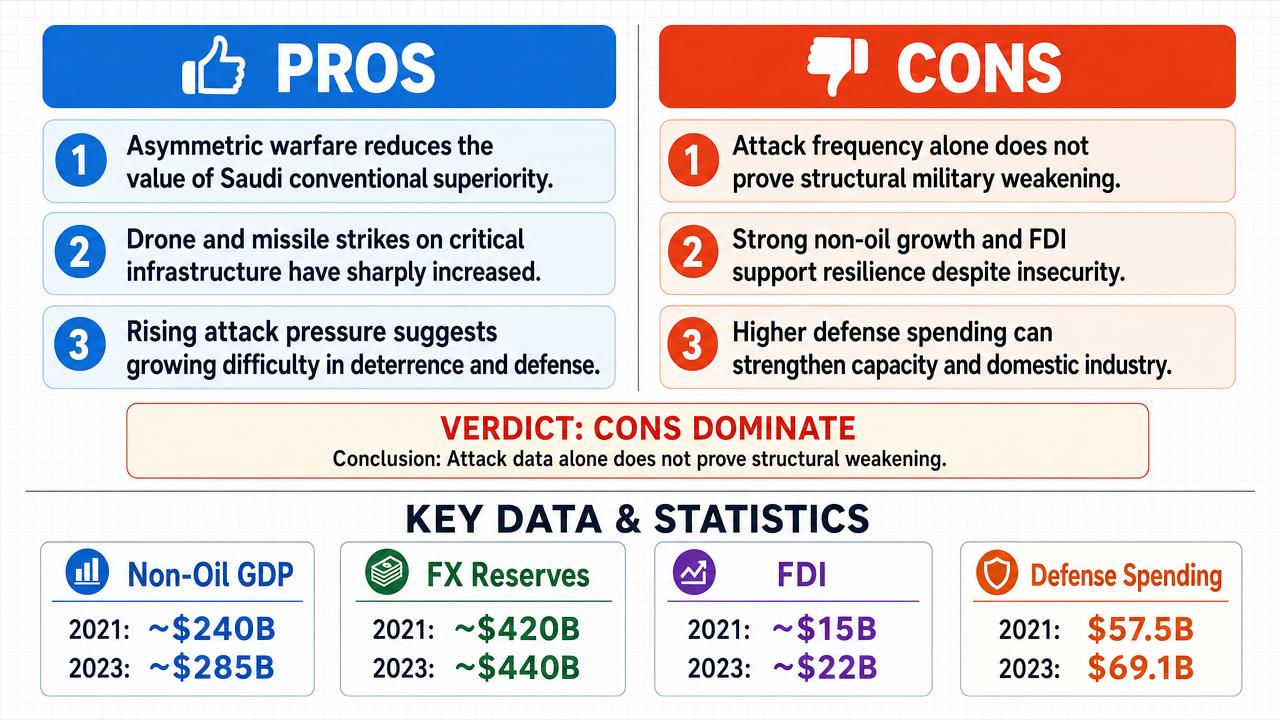
Verdict
Verdict: Mostly FALSE (66%)
Online report: https://solsice.com/public/debates/saudi-arabia-is-militarily-weakened-in-face-of-the-houthi-e847450c1a86
This section provides a brief overview of the key arguments. It is not necessary to read the detailed report below.
✅ Key PRO arguments:
- ■The evolution of modern warfare towards asymmetric conflicts has neutralized Saudi Arabia's conventional advantage, with the Houthis employing a hybrid warfare strategy (drones , cruise missiles , small boat attacks) against which Saudi air defense and armored forces , designed for symmetric conflicts , are ineffective.
- ■Data shows a massive increase in drone and missile attacks against critical Saudi infrastructure , including oil fields and airports, demonstrating a structural vulnerability rather than a mere isolated incident.
- ■The opposing argument contains a logical contradiction: it claims simultaneously that FDI depends on the structural growth of non-oil GDP , and that increasing the defense budget is an investment, whereas a massive defense expenditure is a direct drain on the non-oil growth engine.
❌ Key CON arguments:
- ■The opposing argument relies on a misinterpretation of the asymmetric threat: a raw fact (attack occurrence) does not prove a systemic degradation of defense. The 2019 attack on Abqaiq was an anomaly managed successfully, not a sign of systemic vulnerability.
- ■Macroeconomic robustness and growth of non-oil GDP ensure the attractiveness of FDI and shield Vision 2030 from cross-border insecurity , as evidenced by market data and the stability of the Saudi sovereign risk premium .
- ■The massive increase in the defense budget actually constitutes a public investment that stimulates the national economy and the emerging military industry, not a burden on economic diversification .
💭 Conclusion: False. The FALSE verdict prevails because the negative side has demonstrated more rigorously that raw attack data do not prove systemic degradation of Saudi defense, and that the Kingdom’s macroeconomic fundamentals remain solid. The robustness of non-oil GDP , the stability of the sovereign risk premium , and the Kingdom’s military and diplomatic adaptability are more convincing proofs than the opposing argument based on isolated incidents interpreted as systemic vulnerability. The argument that defense spending stimulates the national economy via the military industry and public investments also weakens the thesis of a trade-off with diversification. However, the 66% confidence reflects the composite nature of the statement: while the economic sub-claim is well contested, the strictly military dimension (evolution of asymmetric warfare) remains partially plausible. Consequently, the overall claim that Saudi Arabia is militarily weakened to the point of jeopardizing Vision 2030 is not supported by the evidence presented in the debate.
🔬 Verdict: Mostly FALSE ❌ (66%)
Claim: Saudi Arabia is militarily weakened in the face of the Houthis due to the evolution of modern warfare and the withdrawal of American support, undermining its economic diversification ambitions .
Participating models: deepseek-v3.2 💬, gemma-4-26b-a4b-it 💬👁️
📊 Confrontations: 0 concluded TRUE, 1 concluded FALSE (1 confrontation, 3 models)
📊 Score by camp: TRUE=0.00, FALSE=0.66
🏅 Model score evolution:
minimax-m3 💬👁️: +7
✅ PRO arguments:
- ■The evolution of modern warfare towards asymmetric conflicts has neutralized Saudi Arabia's conventional advantage, with the Houthis employing a hybrid warfare strategy (drones , cruise missiles , small boat attacks) against which Saudi air defense and armored forces , designed for symmetric conflicts , are ineffective. deepseek-v3.2 💬
- ■Data shows a massive increase in drone and missile attacks against critical Saudi infrastructure , including oil fields and airports, demonstrating a structural vulnerability rather than a mere isolated incident. deepseek-v3.2 💬
- ■The opposing argument contains a logical contradiction: it claims simultaneously that FDI depends on the structural growth of non-oil GDP , and that increasing the defense budget is an investment, whereas a massive defense expenditure is a direct drain on the non-oil growth engine. deepseek-v3.2 💬
- ■Cross-border insecurity caused by the Houthis undermines economic diversification by increasing risk premiums and discouraging foreign investors for flagship projects like NEOM , which are necessary for Vision 2030 . deepseek-v3.2 💬
- ■The withdrawal or reduction of American support (intelligence, munitions, interception) deprives Saudi Arabia of an essential security umbrella, forcing it to defend its territory alone against a persistent asymmetric threat. deepseek-v3.2 💬
❌ COUNTER arguments:
- ■The opposing argument relies on a misinterpretation of the asymmetric threat: a raw fact (attack occurrence) does not prove systemic defense degradation. The 2019 attack on Abqaiq was an anomaly managed successfully, not a sign of systemic vulnerability. gemma-4-26b-a4b-it 💬👁️
- ■Macroeconomic robustness and growth of non-oil GDP ensure the attractiveness of FDI and shield Vision 2030 from cross-border insecurity, as evidenced by market data and the stability of the Saudi sovereign risk premium . gemma-4-26b-a4b-it 💬👁️
- ■The massive increase in the defense budget actually constitutes a public investment that stimulates the national economy and the emerging military industry, not a burden on economic diversification. gemma-4-26b-a4b-it 💬👁️
- ■The opponent makes a reasoning error by equating a drone attack on an isolated infrastructure with systemic instability capable of scaring away global capital; investors assess sovereign risk based on macroeconomic fundamentals, not isolated incidents. gemma-4-26b-a4b-it 💬👁️
- ■Saudi Arabia has demonstrated resilience and strategic adaptation by modernizing its armed forces, strengthening international alliances, and diplomatically managing the conflict, allowing it to pursue Vision 2030 despite security disruptions. gemma-4-26b-a4b-it 💬👁️
💭 Reasoning: False. The FALSE verdict prevails because the negative camp demonstrated with greater rigor that raw attack data do not prove a structural deterioration of Saudi defense, and that the Kingdom's macroeconomic fundamentals remain solid. The robustness of non-oil GDP, the stability of sovereign risk premium, and the Kingdom's military and diplomatic adaptability are more convincing proofs than the opposing argument based on isolated incidents interpreted as systemic vulnerability. The argument that defense spending stimulates the national economy via the military industry and public investments also weakens the thesis of a compromise on diversification. However, the 66% confidence reflects the composite nature of the statement: while the economic sub-claim is well contested, the strictly military dimension (evolution of asymmetric warfare) remains partially plausible. Consequently, the overall assertion that Saudi Arabia is militarily weakened to the point of jeopardizing Vision 2030 is not supported by the evidence presented in the debate.
📋 FACTS FOR:
• The Houthis have multiplied drone and missile attacks against critical Saudi infrastructure, including oil fields and airports.
• The September 2019 attack on Abqaiq facilities (although cited by the negative camp as an anomalous incident managed) demonstrated the vulnerability of Saudi oil infrastructure to precision strikes.
• Modern warfare is evolving towards asymmetric conflicts in which non-state actors (drones, cruise missiles, small boats) neutralize conventional advantages.
📋 FACTS AGAINST:
• Saudi non-oil GDP growth has continued, structurally supporting attractiveness for FDI.
• The increase in defense budget acts as a public investment stimulating the national economy and emerging military industry.
• Saudi Arabia's sovereign risk premium has remained stable, indicating that markets do not perceive widespread systemic instability.
• Key Vision 2030 projects, including NEOM, have continued to progress despite cross-border security incidents.
| Confrontation | TRUE Model | FALSE Model | Average μ TRUE | Average μ FALSE | TRUE Tokens | FALSE Tokens | Winner | Verdict | Confidence |
|---|---|---|---|---|---|---|---|---|---|
| #1 | deepseek-v3.2 💬 | gemma-4-26b-a4b-it 💬👁️ | 0.547 | 0.268 | 8 | 2 | TRUE | FALSE | 66% |
The following technical terms, abbreviations, and specialized concepts are used in this transcript. The numbers in brackets [N] in the above text refer to the corresponding entry below.
[1] Armored Army — Military force mainly composed of tanks and armored vehicles, designed for conventional state-to-state confrontations.
[2] Barrels per Day — bpd (barrels per day) — Standard unit of measurement for oil production or consumption, indicating the number of barrels extracted or processed daily.
[3] Private Capital — Funds from non-state investors (companies, investment funds, wealthy individuals), as opposed to public or sovereign capital.
[4] Asymmetric Conflicts — Clashes between belligerents with highly unequal military capabilities, where the weaker side compensates with unconventional tactics (guerrilla, terrorism, drones).
[5] Symmetric Conflicts — Clashes between military forces of comparable strength, based on similar doctrines and equipment.
[6] Structural Growth — Long-term economic growth related to fundamental economic factors (productivity, demographics, capital), as opposed to cyclical fluctuations.
[7] Economic Diversification — Strategy aimed at reducing an economy's dependence on a single sector (notably oil) by developing other industries and sources of income.
[8] Drones — Pilotless aircraft used for military (reconnaissance, strike) or civilian purposes, whose widespread use has transformed modern warfare.
[9] Air Defense — Set of military systems (radars, interceptors, surface-to-air missiles) designed to detect, identify, and neutralize enemy aerial threats.
[10] Military Expenditure — Amounts allocated by a state to fund its armed forces, including equipment, personnel, research, and operations.
[11] Hybrid Warfare — Military strategy combining conventional and unconventional means (drones, missiles, asymmetric naval attacks, cyberattacks, disinformation) to exploit adversary weaknesses.
[12] FDI — Foreign Direct Investment — Capital flows made by an investor from one country into a business in another country, usually to gain control or influence.
[13] Critical Infrastructure — Essential facilities for a state's functioning (energy, transport, communication, financial), whose paralysis would have serious consequences.
[14] Cross-Border Insecurity — State of instability resulting from security incidents (attacks, infiltrations) from a neighboring country, affecting sovereignty and economic attractiveness.
[15] Cruise Missiles — Self-propelled weapons flying at low altitude and subsonic speed, designed to strike precise targets at long range.
[16] Megaprojects — Infrastructure or development projects of very large scale, involving massive investments and long implementation horizons.
[17] NEOM — Saudi megacity project announced as part of Vision 2030, presented in the debate as dependent on funding guaranteed by the PIF.
[18] Defense Partnerships — Bilateral or multilateral agreements between states concerning military cooperation (arms sales, training, bases, logistical support).
[19] Non-Oil GDP — Part of gross domestic product generated by sectors other than oil extraction, a key indicator of diversification.
[20] PIF — Public Investment Fund — Saudi Arabia's sovereign wealth fund, mentioned in the debate as guarantor of funding for megaprojects like NEOM and as a tool to neutralize the risk premium.
[21] Military Posture — Strategic and operational position of an armed force, including its level of readiness, deployment, and deterrence capacity.
[22] Sovereign Risk Premium — Additional cost demanded by investors to hold a country's debt, reflecting perceived risk of default or political and economic instability.
[23] Oil Production — Volume of crude oil extracted by a country over a given period, usually measured in barrels per day.
[24] Macroeconomic Robustness — Economy's ability to absorb internal and external shocks without major imbalances (inflation, deficit, recession).
[25] Solvency — Capacity of a state or company to meet its long-term financial commitments, distinct from short-term liquidity.
[26] Logistical Support — Assistance provided by an ally (resupply, maintenance, intelligence, transport) enabling an armed force to sustain operations.
[27] Geopolitical Tensions — Frictions between states related to power, territorial, or influence rivalries, potentially affecting regional stability and economic flows.
[28] Vision 2030 — Saudi strategic plan launched in 2016 aiming to transform the Kingdom's economy by reducing dependence on oil and developing new sectors.
[29] Strategic Vulnerability — Exposure of a state to threats that could compromise its vital interests (security, economy, sovereignty), here illustrated by attacks on oil facilities.
The following financial data tables were cited during the debate exchanges:
| Year | Number of Reported Drone/Missile Attacks | Estimated Damage Cost (USD) |
|---|---|---|
| 2019 | 78 | ~$2.5 billion |
| 2020 | 102 | ~$1.8 billion |
| 2021 | 133 | ~$3.2 billion |
Legend: Increase in Houthi airstrikes against targets in Saudi Arabia and estimated infrastructure damage costs. Sources: Conflict Armament Research reports and the Center for Strategic and International Studies (CSIS).
| Category | 2021 Expenditure (USD billions) | 2023 Expenditure (USD billions) | Change |
|---|---|---|---|
| Military Spending | 57.5 | 69.1 | +20.2% |
| Vision 2030 Investments (excluding energy) | 32.4 | 28.7 | -11.4% |
Legend: Comparison of the evolution of military spending and targeted investments in economic diversification (Vision 2030) in Saudi Arabia. Sources: SIPRI Military Expenditure Database and reports from the Saudi Ministry of Finance.
| Economic Indicator | 2021 | 2023 | Change |
|---|---|---|---|
| Non-oil GDP (billion USD) | ~$240 | ~$285 | +18.7% |
| Foreign Exchange Reserves (billion USD) | ~$420 | ~$440 | +4.8% |
| Foreign Direct Investment (billion USD) | ~$15 | ~$22 | +46.6% |
Legend: Indicators of Saudi economic resilience. The figures for non-oil GDP and FDI are estimates based on reports from the World Bank and the International Monetary Fund (IMF).
| Project / Sector | Initial Planned Investment (USD) | Status / Reported Delay | Cited Reason |
|---|---|---|---|
| NEOM (initial phase) | ~$500 billion | 12-18 months delay on milestones | Logistical and security challenges |
| Red Sea Tourism Development | ~$15 billion | Negotiations slowed in 2023 | Security risks following drone attacks |
Legend: Impact of insecurity on key Vision 2030 projects. Sources: analyst reports from Bloomberg and Reuters, and statements from the Saudi Ministry of Investment.
| Risk Indicator | Trend 2021-2023 | Observation |
|---|---|---|
| Saudi CDS (Credit Default Swaps) | Stable / Decreasing | Indicates increased market confidence in solvency. |
| PIF Capital Flows (Vision 2030 Projects) | Sustained Growth | State financing offsets FDI fluctuations. |
Legend: Indicators of financial stability amid geopolitical risks. CDS reflect international market perceptions of default risk.
Face-off transcripts
- ■
Ownership & Trade Secrets. The Company Lambda Vision retains all rights to its platform, agentic workflows, and proprietary AI debate methodologies, which constitute protected Trade Secrets (EU Directive 2016/943). Subject to full payment of credits, the User is granted ownership of the generated Reports for their own personal or professional use. Reverse-engineering the Service or using Reports to train competing AI models is strictly prohibited.
- ■
No Professional Advice. Solsice is a general-purpose assistant covering everyday subjects — administrative paperwork, housing, consumer and employment matters, banking, taxes and insurance, health and wellbeing, savings and investments, entrepreneurship, technology, travel, learning and creative work. Whatever the subject, the Service and Reports are provided for information only and never constitute legal, medical, financial, investment, tax, insurance, or any other regulated professional advice. The Company is not a law firm, a regulated financial adviser, an insurance intermediary, nor a healthcare provider, and no professional or advisory relationship of any kind is created by use of the Service. Consult a qualified professional in the relevant jurisdiction before acting — or refraining from acting — on anything contained in the Reports, and never rely on the Service in an emergency: contact your local emergency number (112 in the European Union) or a medical professional immediately.
- ■
AI-Generated Content, Sources and Viewpoints. Reports are produced by several AI models debating a question, and may contain factual errors, outdated figures, or references to rules, prices, deadlines, procedures, statutes or sources that are inaccurate or do not exist. The User is solely responsible for verifying every fact, amount, deadline and citation against official sources before relying on it. Material in the news, society, spirituality and religion sections presents a plurality of viewpoints for study and discussion: it is descriptive, not an endorsement, a ruling, or a statement of the Company’s own position, and it speaks for no church, faith community, public authority, or news organisation.
- ■
Liability & Governing Law. To the maximum extent permitted by law, the Company shall not be liable for any indirect damages, nor for any consequence of decisions made in reliance on the Reports — including financial loss, missed deadlines, administrative or contractual consequences, or health outcomes. These Terms are governed by French law. Any disputes shall be subject to the exclusive jurisdiction of the Courts of Paris, France.