
L'adhésion et la démonstration des 16 principes de leadership d'Amazon sont les raisons principales et les plus efficaces pour justifier la volonté de travailler chez Amazon lors d'un entretien.
AI debate verdict and arguments
⚠️ AI-generated information only; not professional advice
Completed October 14, 2026
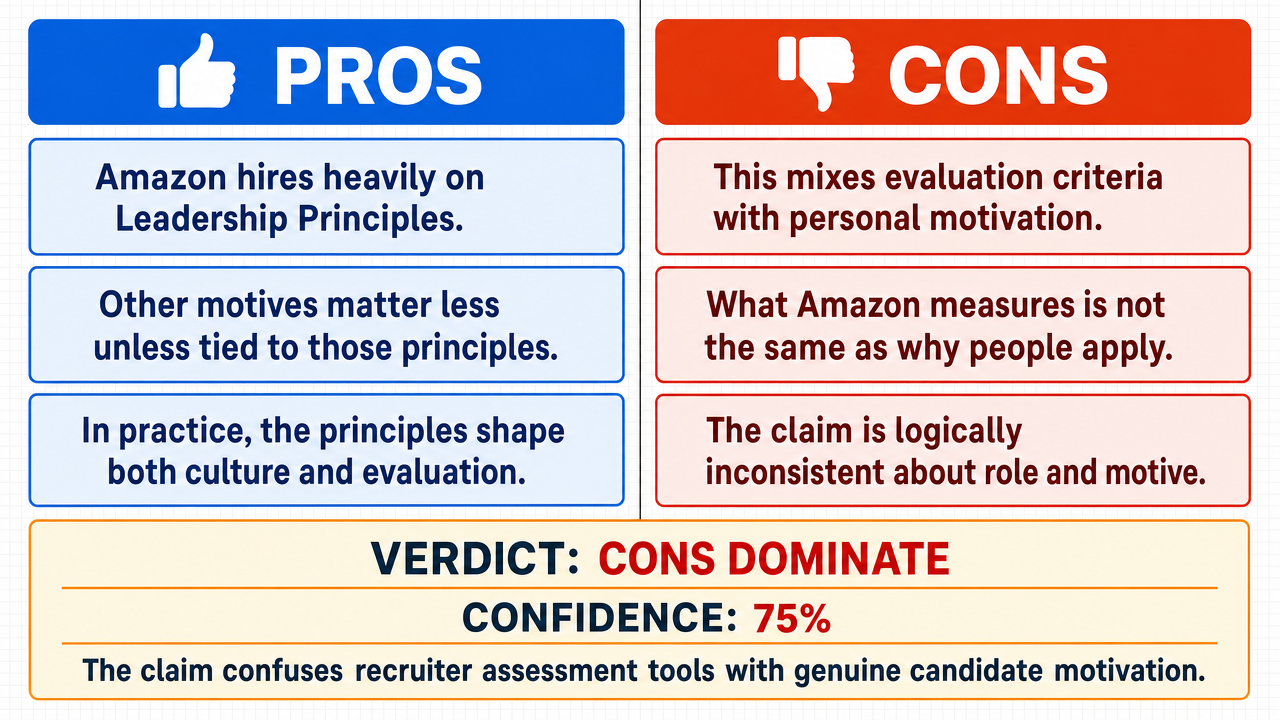
Verdict
Verdict: Mostly FALSE (75%)
Online report: https://solsice.com/public/debates/l-adhesion-et-la-demonstration-des-16-principes-de-leadershi-8ac2b728f7e2
This section provides a brief overview of the key arguments. It is not necessary to read the detailed report below.
✅ Key FOR arguments:
- ■Amazon explicitly evaluates candidates on their adherence to and ability to demonstrate its 16 leadership principles , which form the foundation of its decision-making and innovation mechanisms. During recruitment processes, evaluation criteria use these principles as the sole framework to assess long-term compatibility and potential contribution.
- ■Citing other motivations, such as compensation or employer branding , without linking them to these principles, misses the decisive selection criterion that Amazon has institutionalized through its bar raisers .
- ■The distinction between evaluation criteria and motivation blurs in Amazon’s practice: the principles embody the company's purpose and operating mode, so justifying one's desire by demonstrating how one embodies 'Customer Obsession ' or 'Bias for Action ' is the most effective lever.
❌ Key AGAINST arguments:
- ■The statement commits a category error: leadership principles are tools for measuring competence and cultural fit, not intrinsic motivation drivers . A candidate can demonstrate mastery of 'Customer Obsession ' while being primarily attracted to Amazon’s technical complexity of distributed systems or its market leadership position .
- ■Claiming that principles are the main reason for the desire to work at Amazon confuses what is evaluated with what truly motivates the candidate. Deep motivations (technical passion, career ambition, interest in the problem to solve) can perfectly coexist with an effective demonstration of principles during an interview.
- ■The pro argument is structurally invalid because it relies on a logical contradiction: it claims simultaneously that the principles are the “only selection framework” and the “main and most effective reasons.” If the framework is exclusive, any other justification is excluded, but by calling them “main,” the opponent implicitly admits they are not exclusive.
💭 Conclusion: False. The opposing side convincingly demonstrated that the statement confuses two distinct categories: the evaluation tools used by Amazon recruiters and the actual motivations that drive a candidate to want to work there. The 16 leadership principles indeed constitute the dominant evaluation framework during interviews, but they are not the source of the candidate’s intrinsic motivation . A candidate can perfectly adhere to and demonstrate these principles while being motivated by technical complexity , innovation, or Amazon’s market position. Moreover, the pro side contains an internal logical contradiction by describing the principles both as a “single framework” and as “main reasons,” which weakens the coherence of the affirmative argument. Finally, the effectiveness of an interview justification depends on its sincerity and congruence with the candidate’s background, not on a mechanical alignment with leadership principles.
🔬 Verdict: Mostly FALSE ❌ (75%)
Claim: Adherence to and demonstration of Amazon’s 16 leadership principles are the main and most effective reasons to justify the desire to work at Amazon during an interview.
Participating models: deepseek-v3.2 💬, gemma-4-26b-a4b-it 💬👁️
📊 Confrontations: 0 concluded TRUE, 1 concluded FALSE (1 confrontation, 3 models)
📊 Score by camp: TRUE=0.00, FALSE=0.80
🏅 Model score evolution:
minimax-m3 💬👁️: +8
✅ Arguments FOR:
- ■Amazon explicitly evaluates candidates on their adherence to and ability to demonstrate its 16 leadership principles, which form the foundation of its decision-making and innovation mechanisms. During recruitment processes, evaluation criteria use these principles as the sole framework to assess long-term compatibility and potential contribution. deepseek-v3.2 💬
- ■Citing other motivations, such as compensation or employer branding , without linking them to these principles, misses the decisive selection criterion that Amazon has institutionalized through its bar raisers . deepseek-v3.2 💬
- ■The distinction between evaluation criteria and motivation blurs in Amazon’s practice: the principles embody the company's purpose and operating mode, so justifying one’s desire by demonstrating how one embodies 'Customer Obsession ' or 'Bias for Action ' is the most effective lever. deepseek-v3.2 💬
❌ Arguments AGAINST:
- ■The statement commits a category error: leadership principles are tools for measuring competence and cultural fit, not intrinsic motivation drivers . A candidate can demonstrate mastery of 'Customer Obsession' while being mainly attracted to Amazon’s technical complexity of distributed systems or its market leadership position . gemma-4-26b-a4b-it 💬👁️
- ■Claiming that principles are the main reason for the desire to work at Amazon confuses what is evaluated with what truly motivates the candidate. Deep motivations (technical passion, career ambition, interest in the problem to solve) can perfectly coexist with an effective demonstration of principles during an interview. gemma-4-26b-a4b-it 💬👁️
- ■The pro argument is structurally invalid because it relies on a logical contradiction: it claims simultaneously that the principles are the “only selection framework” and the “main and most effective reasons.” If the framework is exclusive, any other justification is excluded, but by calling them “main,” the opponent implicitly admits they are not exclusive. gemma-4-26b-a4b-it 💬👁️
💭 Reasoning: False. The opposing side convincingly demonstrated that the statement confuses two distinct categories: the evaluation tools used by Amazon recruiters and the actual motivations that drive a candidate to want to work there. The 16 leadership principles indeed constitute the dominant evaluation framework during interviews, but they are not the source of the candidate’s intrinsic motivation . A candidate can perfectly adhere to and demonstrate these principles while being motivated by technical complexity, innovation, or Amazon’s market position. Moreover, the pro side contains an internal logical contradiction by describing the principles both as a “single framework” and as “main reasons,” which weakens the coherence of the affirmative argument. Finally, the effectiveness of an interview justification depends on its sincerity and congruence with the candidate’s background, not on a mechanical alignment with leadership principles.
📋 FACTS FOR:
• Amazon uses a 'bar raisers' system in its recruitment processes
• Amazon's 16 leadership principles include 'Customer Obsession' and 'Bias for Action'
• Leadership principles are used as an evaluation framework in Amazon interviews
📋 FACTS AGAINST:
• Leadership principles are assessment tools and not sources of intrinsic motivation
• A candidate can demonstrate mastery of the principles while being motivated by other factors (technical complexity, market position)
• The statement confuses evaluation criteria with actual motivation, which constitutes a logical category error
| Confrontation | TRUE Model | FALSE Model | Average μ TRUE | Average μ FALSE | TRUE Tokens | FALSE Tokens | Winner | Verdict | Conf. |
|---|---|---|---|---|---|---|---|---|---|
| #1 | deepseek-v3.2 💬 | gemma-4-26b-a4b-it 💬👁️ | 0.471 | 0.259 | 8 | 2 | TRUE | FALSE | 80% |
The following technical terms, abbreviations, and specialized concepts are used in this transcript. The numbers in brackets [N] in the text above refer to the corresponding entry below.
[1] Cultural Alignment — Degree of correspondence between an individual's values, behaviors, and goals and those of an organization; in the context of the debate, it is the criterion by which recruiters assess a candidate's suitability.
[2] Bar Raisers — Recruiters or Amazon employees responsible for evaluating candidates during interviews to ensure they exceed a predefined quality threshold for the position, notably through adherence to leadership principles.
[3] Bias for Action — Amazon leadership principle stating that making quick decisions, even with about 70% of the information, is preferable to waiting for certainty.
[4] Causality — Logical relationship whereby one event (the cause) produces another event (the effect); the debate contests establishing a cause-and-effect link between leadership principles and interview success.
[5] Technical Complexity — Degree of sophistication of the systems and infrastructures used; in the debate, contrasted with cultural motivations to explain Amazon's attractiveness.
[6] Internal Logical Contradiction — Argumentative structure in which a statement simultaneously affirms two propositions that mutually exclude each other, rendering the argument invalid.
[7] Decisive Selection Criterion — Element upon which the final hiring decision is based; in the debate, the identified criterion is adherence to Amazon's 16 leadership principles.
[8] Customer Obsession — Amazon leadership principle requiring placing the customer at the center of all decisions, starting with their needs and working backwards.
[9] Compliance Filter — Mechanism by which an organization verifies that a candidate meets a predefined set of standards; the debate discusses whether principles serve this sole role or express a deeper motivation.
[10] Invent and Simplify — Amazon leadership principle encouraging innovation while seeking to simplify existing solutions, rather than adding complexity.
[11] Operational Language — Vocabulary and conceptual frameworks used concretely within an organization to make decisions and evaluate behaviors; in the debate, it is the language of leadership principles.
[12] Market Leader — Dominant position of a company within its industry, often cited as an external motivation factor for candidates.
[13] Employer Brand — Image and reputation of a company as an employer, influencing its attractiveness to candidates.
[14] Intrinsic Motivation — Motivation coming from within the individual (personal interest, curiosity, meaning), as opposed to extrinsic motivation (compensation, prestige).
[15] Leadership Principles — Set of 16 behavioral and cultural rules formalized by Amazon that guide decision-making, employee evaluation, and recruitment.
[16] Compensation — All financial rewards (salary, bonus, stock options) paid to an employee; mentioned in the debate as a possible extrinsic motivation.
[17] Distributed Systems — Computer architectures where components spread across multiple machines cooperate to achieve a common goal; cited as a technical attraction of Amazon.
[18] Acceptance Rate — Proportion of candidates whose applications are retained after the recruitment process; mentioned to evaluate the effectiveness of interview justifications.
[19] Willingness to Work — Willingness to work at Amazon — Candidate's expressed intention to join a company; a central notion in the debate, whose nature (motivation vs. evaluative conformity) is disputed.
Face-off transcripts
- ■
Ownership & Trade Secrets. Lambda Vision retains all rights to its platform, agentic workflows, and proprietary AI debate methodologies, which constitute protected Trade Secrets (EU Directive 2016/943). Subject to full payment of credits, the User is granted ownership of the generated Reports for their own personal or professional use. Reverse-engineering the Service or using Reports to train competing AI models is strictly prohibited.
- ■
No Professional Advice. Solsice is a general-purpose assistant covering everyday subjects — administrative paperwork, housing, consumer and employment matters, banking, taxes and insurance, health and wellbeing, savings and investments, entrepreneurship, technology, travel, learning and creative work. Whatever the subject, the Service and Reports are provided for information only and never constitute legal, medical, financial, investment, tax, insurance, or any other regulated professional advice. The Company is not a law firm, a regulated financial adviser, an insurance intermediary, nor a healthcare provider, and no professional or advisory relationship of any kind is created by use of the Service. Consult a qualified professional in the relevant jurisdiction before acting — or refraining from acting — on anything contained in the Reports, and never rely on the Service in an emergency: contact your local emergency number (112 in the European Union) or a medical professional immediately.
- ■
AI-Generated Content, Sources and Viewpoints. Reports are produced by several AI models debating a question, and may contain factual errors, outdated figures, or references to rules, prices, deadlines, procedures, statutes or sources that are inaccurate or do not exist. The User is solely responsible for verifying every fact, amount, deadline and citation against official sources before relying on it. Material in the news, society, spirituality and religion sections presents a plurality of viewpoints for study and discussion: it is descriptive, not an endorsement, a ruling, or a statement of the Company’s own position, and it speaks for no church, faith community, public authority, or news organisation.
- ■
Liability & Governing Law. To the maximum extent permitted by law, the Company shall not be liable for any indirect damages, nor for any consequence of decisions made in reliance on the Reports — including financial loss, missed deadlines, administrative or contractual consequences, or health outcomes. These Terms are governed by French law. Any disputes shall be subject to the exclusive jurisdiction of the Courts of Paris, France.