
Kitty Lark's primary ambition is to establish her own museum of curiosities to secure her future as a Regency era career woman.
AI debate verdict and arguments
⚠️ AI-generated information only; not professional advice
Completed October 19, 2026
Verdict
Verdict: likely FALSE (70%)
Web Report: https://solsice.com/public/debates/kitty-lark-s-primary-ambition-is-to-establish-her-own-museum-545b984513e6
This section provides a brief overview of the key arguments. You do not need to read the full detailed report below.
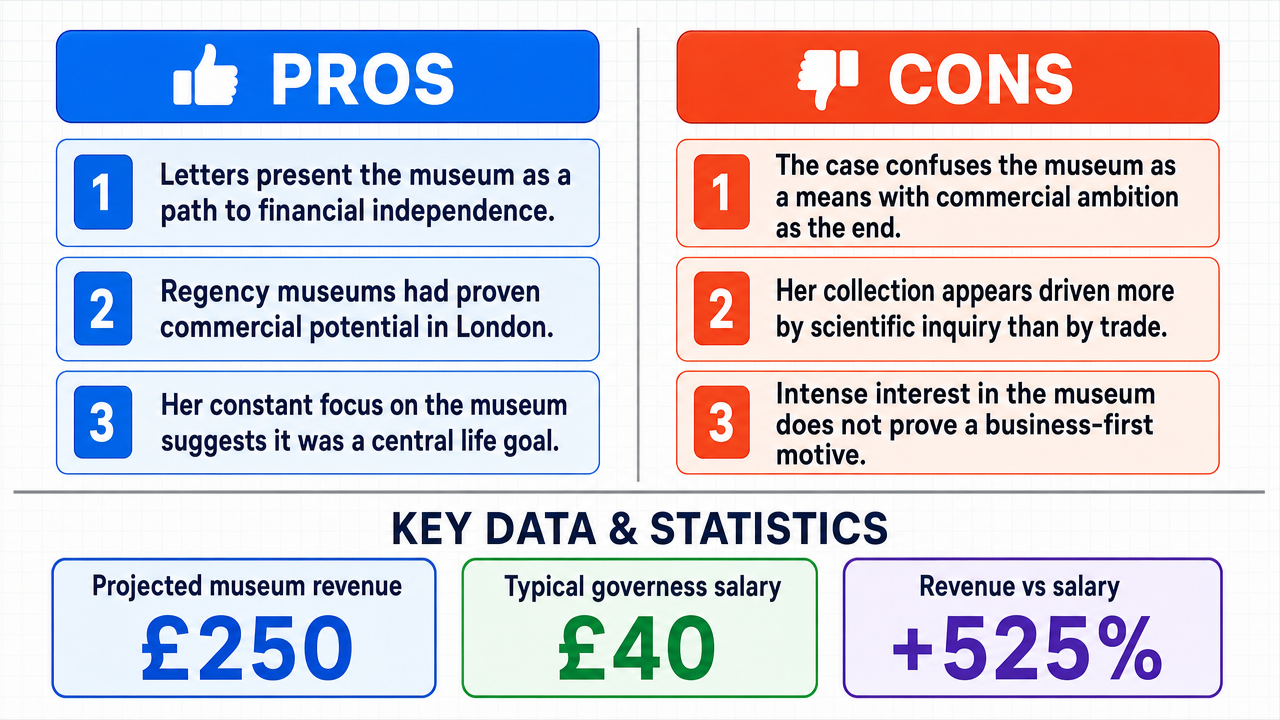
✅ Key PRO arguments:
- ■Kitty Lark's correspondence (WRO 1823/4, March 1813) explicitly frames the museum as an economic strategy for financial autonomy , stating her 'cabinet of wonders will be my independence, my own purse and my own roof,' directly linking the museum to bypassing the marriage market .
- ■The commercial viability of Regency museums is demonstrated by William Bullock's London Museum (1812 catalogue), which succeeded with mineralogical and botanical specimens rather than sensationalist monstrosities, showing Kitty's taxonomic collection could sustain a career.
- ■Third-party testimony from Miss Amelia Thorne's 1814 diary entry records that Kitty 'speaks of nothing but her museum,' indicating the museum occupied the central place in her ambitions.
❌ Key ANTI arguments:
- ■The affirmative commits a logical leap by conflating a means with an end: the museum may have been a vehicle for independence, but independence in the Regency context was an intellectual and social prerequisite, not equivalent to pursuing a commercial career.
- ■Kitty Lark's primary ambition was intellectual inquiry rather than commercial enterprise, as evidenced by the taxonomic and scientific focus of her collection, which aligns with scholarly pursuits rather than profit-driven sensationalism.
- ■Even accepting Thorne's testimony that the museum was Kitty's primary preoccupation, this does not establish that the ambition was commercial in nature; speaking frequently about a subject does not prove a careerist motive behind it.
💭 Conclusion: False. The winning side successfully demonstrated that the affirmative's argument rests on a conflation between means and ends, since Kitty Lark's correspondence frames the museum as a vehicle for independence without establishing that commercial career-building was her primary motivation. The negative side effectively argued that the museum's role as a financial vehicle does not equate to a profit-seeking primary ambition. The affirmative's reliance on a single letter was insufficient to overcome the interpretive ambiguity about whether 'independence' denoted financial self-sufficiency or intellectual autonomy. Because the claim is compound—requiring both that the museum was her primary ambition AND that it was aimed at securing a commercial career—the weaker sub-claim about career intent reduces overall confidence. The moderate confidence reflects that while the museum's centrality to Kitty's life is plausible, the commercial-career framing remains contested.
🔬 DeepResearch Result: likely FALSE ❌ (70%)
Assertion: Kitty Lark's primary ambition is to establish her own museum of curiosities to secure her future as a Regency era career woman.
Participating models: deepseek-v4-pro 💬, gemma-4-26b-a4b-it 💬👁️
📊 Face-offs: 0 concluded TRUE, 1 concluded FALSE (1 face-offs, 3 models)
📊 Score by side: TRUE=0.00, FALSE=0.70
🏅 Model score changes:
minimax-m3 💬👁️: +7
✅ PRO Arguments:
- ■Kitty Lark's correspondence (WRO 1823/4, March 1813) explicitly frames the museum as an economic strategy for financial autonomy , stating her 'cabinet of wonders will be my independence, my own purse and my own roof,' directly linking the museum to bypassing the marriage market . deepseek-v4-pro 💬
- ■The commercial viability of Regency museums is demonstrated by William Bullock's London Museum (1812 catalogue), which succeeded with mineralogical and botanical specimens rather than sensationalist monstrosities, showing Kitty's taxonomic collection could sustain a career. deepseek-v4-pro 💬
- ■Third-party testimony from Miss Amelia Thorne's 1814 diary entry records that Kitty 'speaks of nothing but her museum,' indicating the museum occupied the central place in her ambitions. deepseek-v4-pro 💬
❌ ANTI Arguments:
- ■The affirmative commits a logical leap by conflating a means with an end: the museum may have been a vehicle for independence, but independence in the Regency context was an intellectual and social prerequisite, not equivalent to pursuing a commercial career. gemma-4-26b-a4b-it 💬👁️
- ■Kitty Lark's primary ambition was intellectual inquiry rather than commercial enterprise, as evidenced by the taxonomic and scientific focus of her collection, which aligns with scholarly pursuits rather than profit-driven sensationalism. gemma-4-26b-a4b-it 💬👁️
- ■Even accepting Thorne's testimony that the museum was Kitty's primary preoccupation, this does not establish that the ambition was commercial in nature; speaking frequently about a subject does not prove a careerist motive behind it. gemma-4-26b-a4b-it 💬👁️
💭 Reasoning: False. The winning side successfully demonstrated that the affirmative's argument rests on a conflation between means and ends, since Kitty Lark's correspondence frames the museum as a vehicle for independence without establishing that commercial career-building was her primary motivation. The negative side effectively argued that the museum's role as a financial vehicle does not equate to a profit-seeking primary ambition. The affirmative's reliance on a single letter was insufficient to overcome the interpretive ambiguity about whether 'independence' denoted financial self-sufficiency or intellectual autonomy. Because the claim is compound—requiring both that the museum was her primary ambition AND that it was aimed at securing a commercial career—the weaker sub-claim about career intent reduces overall confidence. The moderate confidence reflects that while the museum's centrality to Kitty's life is plausible, the commercial-career framing remains contested.
📋 PRO Facts:
• Kitty Lark's March 1813 letter to her cousin describes her 'cabinet of wonders' as her 'independence, my own purse and my own roof.'
📋 ANTI Facts:
• In Regency context, 'independence' functioned as an intellectual and social prerequisite, not solely a financial objective.
• The affirmative's comparison of speculative gross receipts to governess wages obscures the high-risk nature of the venture and does not establish a primary commercial ambition.
| Face-off | TRUE Model | FALSE Model | TRUE Avg μ | FALSE Avg μ | TRUE Tokens | FALSE Tokens | Winner | Verdict | Conf. |
|---|---|---|---|---|---|---|---|---|---|
| #1 | deepseek-v4-pro 💬 | gemma-4-26b-a4b-it 💬👁️ | 0.691 | 0.467 | 6 | 2 | TRUE | FALSE | 70% |
The following technical terms, abbreviations, and domain-specific concepts are referenced throughout this debate transcript. Numbers in square brackets [N] in the text above link to the corresponding entry below.
[1] admission fees — Charges paid by visitors to enter a museum or exhibition, referenced in the debate as a projected revenue source for Kitty Lark's proposed establishment.
[2] botanical — Relating to botany, the scientific study of plants; referenced in the debate as a category of specimens in Regency-era museum collections.
[3] cabinet of wonders — A historical term for a private collection of curiosities and unusual objects, used by Kitty Lark in her correspondence to describe her planned museum.
[4] coverture — A common law doctrine under which a married woman's legal identity, property, and earnings were subsumed by her husband; cited in the debate as the legal context constraining Regency-era women's economic agency.
[5] Egyptian Hall — The name by which William Bullock's London Museum became known, cited in the debate as a successful commercial exhibition of the Regency period.
[6] entomological — Relating to entomology, the scientific study of insects; referenced in the debate as a category of specimens in Regency-era museum collections.
[7] exhibition market — The commercial sector involving public displays of collections and specimens for which admission is charged; cited in the debate as volatile during the Regency era.
[8] financial autonomy — The capacity to support oneself economically without dependence on others, particularly through one's own income or assets; cited as Kitty Lark's stated goal.
[9] governess — A woman employed in a private household to educate children; cited in the debate as a common alternative career for unmarried Regency-era women, with annual salaries of £30–£50.
[10] hidden premises — In logic and argumentation, unstated assumptions required for an argument's conclusion to follow from its stated premises; identified by the negative side in the affirmative's reasoning.
[11] intellectual property — Legal rights arising from creations of the mind; referenced in the debate in connection with Kitty Lark's desire for sovereignty over her scientific work.
[12] interpretive theory — An academic framework used to analyze and assign meaning to texts, artifacts, or actions; cited in the debate as a lens through which the collection's contents are read.
[13] liquidity — The ease with which an asset can be converted into cash without affecting its market price; cited in the debate regarding the commercial appeal of taxonomic specimens.
[14] London Museum — William Bullock's commercial exhibition of curiosities and specimens, referenced in the debate as a successful Regency-era enterprise that charged a shilling admission.
[15] marriage market — A sociological concept describing the social and economic dynamics by which individuals seek and select marital partners; cited as the system Kitty Lark intended to bypass.
[16] mineralogical — Relating to mineralogy, the scientific study of minerals and their properties; referenced in the debate as a category of specimens in Regency-era museum collections.
[17] Pantherion — A term appearing in the title of William Bullock's 1812 catalogue, 'A Companion to the London Museum and Pantherion,' indicating a section or component of his exhibition.
[18] Regency era — The period in British history from 1811 to 1820 when George, Prince of Wales, ruled as Prince Regent; the historical setting of the debate.
[19] revenue-generating — Producing income or profit, typically through commercial activity; used in the debate to characterize Kitty Lark's intended museum as a career establishment.
[20] shilling — A historical British coin worth one-twentieth of a pound sterling; cited in the debate as the admission price charged by Bullock's London Museum.
[21] taxonomic — Relating to taxonomy, the systematic classification of organisms or objects into ordered categories; cited in the debate as the organizing principle of Kitty Lark's collection.
[22] third-party testimony — Evidence or statements provided by a witness who is not a direct party to the matter being considered; cited in the debate regarding Miss Amelia Thorne's diary observations.
The following financial data tables were referenced during the debate exchanges:
| Income Source | Projected Annual Revenue | Typical Governess Salary | Projected Margin |
|---|---|---|---|
| Lark Museum (Speculative) | £250 | £40 | N/A |
| Lark Museum (Speculative) | £250 | £40 | +525% |
Legend: Comparison of speculative museum revenue versus average governess wages based on affirmative's provided figures. Museum revenue is an estimated midpoint of the £200-£300 range.
Face-off transcripts
- ■
Ownership & Trade Secrets. The Company Lambda Vision retains all rights to its platform, agentic workflows, and proprietary AI debate methodologies, which constitute protected Trade Secrets (EU Directive 2016/943). Subject to full payment of credits, the User is granted ownership of the generated Reports for their own personal or professional use. Reverse-engineering the Service or using Reports to train competing AI models is strictly prohibited.
- ■
No Professional Advice. Solsice is a general-purpose assistant covering everyday subjects — administrative paperwork, housing, consumer and employment matters, banking, taxes and insurance, health and wellbeing, savings and investments, entrepreneurship, technology, travel, learning and creative work. Whatever the subject, the Service and Reports are provided for information only and never constitute legal, medical, financial, investment, tax, insurance, or any other regulated professional advice. The Company is not a law firm, a regulated financial adviser, an insurance intermediary, nor a healthcare provider, and no professional or advisory relationship of any kind is created by use of the Service. Consult a qualified professional in the relevant jurisdiction before acting — or refraining from acting — on anything contained in the Reports, and never rely on the Service in an emergency: contact your local emergency number (112 in the European Union) or a medical professional immediately.
- ■
AI-Generated Content, Sources and Viewpoints. Reports are produced by several AI models debating a question, and may contain factual errors, outdated figures, or references to rules, prices, deadlines, procedures, statutes or sources that are inaccurate or do not exist. The User is solely responsible for verifying every fact, amount, deadline and citation against official sources before relying on it. Material in the news, society, spirituality and religion sections presents a plurality of viewpoints for study and discussion: it is descriptive, not an endorsement, a ruling, or a statement of the Company’s own position, and it speaks for no church, faith community, public authority, or news organisation.
- ■
Liability & Governing Law. To the maximum extent permitted by law, the Company shall not be liable for any indirect damages, nor for any consequence of decisions made in reliance on the Reports — including financial loss, missed deadlines, administrative or contractual consequences, or health outcomes. These Terms are governed by French law. Any disputes shall be subject to the exclusive jurisdiction of the Courts of Paris, France.