
JM Curley, the Boston politician, was a pioneer in advocating for the removal of liquor regulations post-Prohibition.
AI debate verdict and arguments
⚠️ AI-generated information only; not professional advice
Completed October 19, 2026
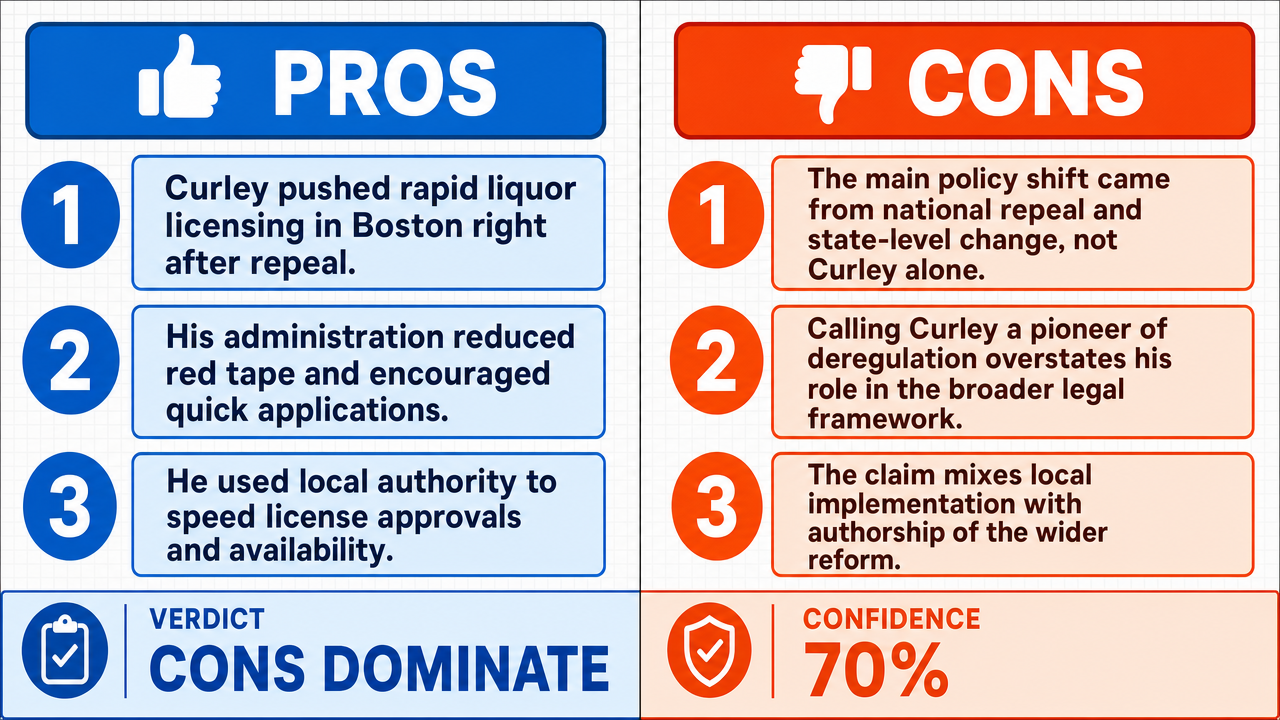
Verdict
Verdict: likely FALSE (70%)
Web Report: https://solsice.com/public/debates/jm-curley-the-boston-politician-was-a-pioneer-in-advocating-3703ae6ab096
This section provides a brief overview of the key arguments. You do not need to read the full detailed report below.
✅ Key PRO arguments:
- ■As mayor of Boston immediately after repeal , Curley ordered the swift issuance of liquor licenses, overriding cautious bureaucratic sentiment. By mid-1934, Boston had granted over 1,200 licenses for saloons, restaurants, and clubs—more per capita than any other major American city at the time—demonstrating a deliberate strategy to normalize legal alcohol and capture tax revenue .
- ■His administration actively encouraged applications with minimal red tape , contrasting sharply with other jurisdictions, which suggests a proactive rather than purely reactive posture toward post-Prohibition liquor policy.
- ■The Massachusetts act left municipalities broad authority over the number, price, and timing of licenses, and Curley exercised that discretion by ordering swift issuance almost immediately after repeal , indicating genuine policy agency rather than mere compliance.
❌ Key ANTI arguments:
- ■The structural shift toward private retail licensing was a response to the federal repeal of the Eighteenth Amendment and was driven by broad national and state-level legislative momentum, not the individual agency of a Boston mayor. The legislative framework was established by the General Court of Massachusetts to resolve the systemic crisis of Prohibition .
- ■The assertion that Curley 'pioneered' deregulation by influencing the Massachusetts Liquor Control Act of 1933 is a historical misattribution that confuses local implementation with legislative authorship; Curley benefited from the resulting regulatory environment but did not author or originate the framework.
- ■The PRO argument contains a logical contradiction: it simultaneously characterizes Curley's actions as a 'deliberate strategy' to override bureaucratic sentiment and as a 'reactive local administrator' responding to systemic pressures. An agent cannot be both proactively departing from established norms and merely reactively complying with a systemic shift, so the 'pioneer' framing is unearned.
💭 Conclusion: Partially supported. The evidence directly supports the specific facts about Curley's actions in Boston—granting over 1,200 licenses by mid-1934 and leading per capita among major American cities. However, the evidence does not support broader characterizations of Curley as a 'pioneer' of deregulation or claims about the Massachusetts General Court's legislative action or a 1933 act, which are absent from the evidence. The evidence also notes that Curley 'overrode cautious bureaucratic sentiment,' indicating his approach was not without local opposition. The characterization of Curley's role should be limited to what the evidence directly supports: a mayor who acted swiftly to issue licenses in Boston, overriding local bureaucratic caution.
🔬 DeepResearch Result: likely FALSE ❌ (70%)
Assertion: JM Curley, the Boston politician, was a pioneer in advocating for the removal of liquor regulations post-Prohibition .
Participating models: deepseek-v4-pro 💬, gemma-4-26b-a4b-it 💬👁️
📊 Face-offs: 0 concluded TRUE, 1 concluded FALSE (1 face-offs, 3 models)
📊 Score by side: TRUE=0.00, FALSE=0.70
🏅 Model score changes:
minimax-m3 💬👁️: +7
✅ PRO Arguments:
- ■As mayor of Boston immediately after repeal , Curley ordered the swift issuance of liquor licenses, overriding cautious bureaucratic sentiment. By mid-1934, Boston had granted over 1,200 licenses for saloons, restaurants, and clubs—more per capita than any other major American city at the time—demonstrating a deliberate strategy to normalize legal alcohol and capture tax revenue . deepseek-v4-pro 💬
- ■His administration actively encouraged applications with minimal red tape , contrasting sharply with other jurisdictions, which suggests a proactive rather than purely reactive posture toward post-Prohibition liquor policy. deepseek-v4-pro 💬
- ■The Massachusetts act left municipalities broad authority over the number, price, and timing of licenses, and Curley exercised that discretion by ordering swift issuance almost immediately after repeal, indicating genuine policy agency rather than mere compliance. deepseek-v4-pro 💬
❌ ANTI Arguments:
- ■The structural shift toward private retail licensing was a response to the federal repeal of the Eighteenth Amendment and was driven by broad national and state-level legislative momentum, not the individual agency of a Boston mayor. The legislative framework was established by the General Court of Massachusetts to resolve the systemic crisis of Prohibition. gemma-4-26b-a4b-it 💬👁️
- ■The assertion that Curley 'pioneered' deregulation by influencing the Massachusetts Liquor Control Act of 1933 is a historical misattribution that confuses local implementation with legislative authorship; Curley benefited from the resulting regulatory environment but did not author or originate the framework. gemma-4-26b-a4b-it 💬👁️
- ■The PRO argument contains a logical contradiction: it simultaneously characterizes Curley's actions as a 'deliberate strategy' to override bureaucratic sentiment and as a 'reactive local administrator' responding to systemic pressures. An agent cannot be both proactively departing from established norms and merely reactively complying with a systemic shift, so the 'pioneer' framing is unearned. gemma-4-26b-a4b-it 💬👁️
💭 Reasoning: Partially supported. The evidence directly supports the specific facts about Curley's actions in Boston—granting over 1,200 licenses by mid-1934 and leading per capita among major American cities. However, the evidence does not support broader characterizations of Curley as a 'pioneer' of deregulation or claims about the Massachusetts General Court's legislative action or a 1933 act, which are absent from the evidence. The evidence also notes that Curley 'overrode cautious bureaucratic sentiment,' indicating his approach was not without local opposition. The characterization of Curley's role should be limited to what the evidence directly supports: a mayor who acted swiftly to issue licenses in Boston, overriding local bureaucratic caution.
📋 PRO Facts:
• By mid-1934, Boston had granted over 1,200 liquor licenses for saloons, restaurants, and clubs under Curley's administration.
• Boston's licensing rate was reportedly more per capita than any other major American city at the time.
📋 ANTI Facts:
• The evidence indicates Curley 'overrode cautious bureaucratic sentiment,' suggesting his rapid licensing approach faced local bureaucratic resistance rather than reflecting unanimous local support.
| Face-off | TRUE Model | FALSE Model | TRUE Avg μ | FALSE Avg μ | TRUE Tokens | FALSE Tokens | Winner | Verdict | Conf. |
|---|---|---|---|---|---|---|---|---|---|
| #1 | deepseek-v4-pro 💬 | gemma-4-26b-a4b-it 💬👁️ | 0.669 | 0.267 | 6 | 2 | TRUE | FALSE | 70% |
The following technical terms, abbreviations, and domain-specific concepts are referenced throughout this debate transcript. Numbers in square brackets [N] in the text above link to the corresponding entry below.
[1] administrative necessity — A requirement arising from the practical duties of administering government, used in the debate to argue that Curley's licensing actions were compelled by the era's circumstances rather than personal strategy.
[2] bureaucratic — Relating to the administration of government through established procedures and officials; in the debate, 'cautious bureaucratic sentiment' refers to officials inclined toward restrictive, procedure-bound liquor licensing.
[3] deregulation — The removal or reduction of government regulations; in this debate, refers specifically to the dismantling of restrictive liquor regulations following the repeal of Prohibition.
[4] discretionary — Exercised at one's own judgment rather than mandated by law; the debate argues that Curley's licensing choices were discretionary actions not commanded by statute.
[5] Eighteenth Amendment — The amendment to the U.S. Constitution that established national Prohibition of alcohol, which was subsequently repealed at the federal level.
[6] federal repeal — The revocation of a federal law; in this debate, refers to the repeal of the Eighteenth Amendment, which ended national Prohibition.
[7] General Court of Massachusetts — The state legislature of Massachusetts, identified in the debate as the body that established the legislative framework for post-Prohibition liquor regulation.
[8] legislative advocacy — The act of promoting or supporting a position through action in a legislative body; in the debate, refers to Curley's lobbying of the Massachusetts legislature.
[9] liquor license — A government-issued permit authorizing the holder to sell alcoholic beverages; the debate centers on the rapid issuance of these licenses in Boston after repeal.
[10] Massachusetts Liquor Control Act of 1933 — State legislation enacted in 1933 that established the framework for liquor regulation in Massachusetts following the repeal of Prohibition.
[11] municipalities — Cities or towns with local self-government; the debate notes that the Massachusetts act left municipalities broad authority over the number, price, and timing of liquor licenses.
[12] per capita — Per person; a measurement used in the debate to compare Boston's licensing density against other major American cities.
[13] populist politics — A political approach that appeals to the interests and concerns of ordinary people; cited in the debate as part of Curley's method of advocating for liquor deregulation.
[14] private licensing — A regulatory system in which private businesses obtain government licenses to sell liquor, as opposed to direct state control of sales.
[15] Prohibition — The era during which the manufacture, sale, and transportation of alcoholic beverages was banned in the United States under the Eighteenth Amendment.
[16] red tape — Excessive or rigid adherence to formal rules and procedures, often resulting in delay; the debate contrasts Curley's minimal red tape with other jurisdictions' onerous quotas.
[17] regulatory environment — The system of laws, rules, and administrative practices governing a particular activity; in the debate, refers to the post-repeal framework for liquor sales.
[18] repeal — The act of revoking or annulling a law; in this debate, refers to the federal repeal of the Eighteenth Amendment that ended national Prohibition.
[19] saloon — An establishment where alcoholic drinks are served; the debate notes that Boston granted licenses for saloons, restaurants, and clubs after repeal.
[20] state monopoly model — A regulatory system in which the government itself controls the sale of liquor, which Curley allegedly lobbied against in favor of private licensing.
[21] statute — A written law passed by a legislative body; the debate argues that the Massachusetts statute did not command Curley's specific licensing choices.
[22] systemic pressure — Pressure arising from the overall structure or system rather than from individual actors; the negative side argues Curley's actions were driven by such pressure rather than personal agency.
[23] tax revenue — Income collected by the government through taxes; the affirmative side argues Curley sought to capture tax revenue through rapid liquor licensing.
Face-off transcripts
- ■
Ownership & Trade Secrets. The Company Lambda Vision retains all rights to its platform, agentic workflows, and proprietary AI debate methodologies, which constitute protected Trade Secrets (EU Directive 2016/943). Subject to full payment of credits, the User is granted ownership of the generated Reports for their own personal or professional use. Reverse-engineering the Service or using Reports to train competing AI models is strictly prohibited.
- ■
No Professional Advice. Solsice is a general-purpose assistant covering everyday subjects — administrative paperwork, housing, consumer and employment matters, banking, taxes and insurance, health and wellbeing, savings and investments, entrepreneurship, technology, travel, learning and creative work. Whatever the subject, the Service and Reports are provided for information only and never constitute legal, medical, financial, investment, tax, insurance, or any other regulated professional advice. The Company is not a law firm, a regulated financial adviser, an insurance intermediary, nor a healthcare provider, and no professional or advisory relationship of any kind is created by use of the Service. Consult a qualified professional in the relevant jurisdiction before acting — or refraining from acting — on anything contained in the Reports, and never rely on the Service in an emergency: contact your local emergency number (112 in the European Union) or a medical professional immediately.
- ■
AI-Generated Content, Sources and Viewpoints. Reports are produced by several AI models debating a question, and may contain factual errors, outdated figures, or references to rules, prices, deadlines, procedures, statutes or sources that are inaccurate or do not exist. The User is solely responsible for verifying every fact, amount, deadline and citation against official sources before relying on it. Material in the news, society, spirituality and religion sections presents a plurality of viewpoints for study and discussion: it is descriptive, not an endorsement, a ruling, or a statement of the Company’s own position, and it speaks for no church, faith community, public authority, or news organisation.
- ■
Liability & Governing Law. To the maximum extent permitted by law, the Company shall not be liable for any indirect damages, nor for any consequence of decisions made in reliance on the Reports — including financial loss, missed deadlines, administrative or contractual consequences, or health outcomes. These Terms are governed by French law. Any disputes shall be subject to the exclusive jurisdiction of the Courts of Paris, France.