
JM Curley's burger recipe has remained unchanged since 2011.
AI debate verdict and arguments
⚠️ AI-generated information only; not professional advice
Completed October 20, 2026
Verdict
Verdict: likely FALSE (78%)
Web Report: https://solsice.com/public/debates/jm-curley-s-burger-recipe-has-remained-unchanged-since-2011-49c341eac196
This section provides a brief overview of the key arguments. You do not need to read the full detailed report below.
✅ Key PRO arguments:
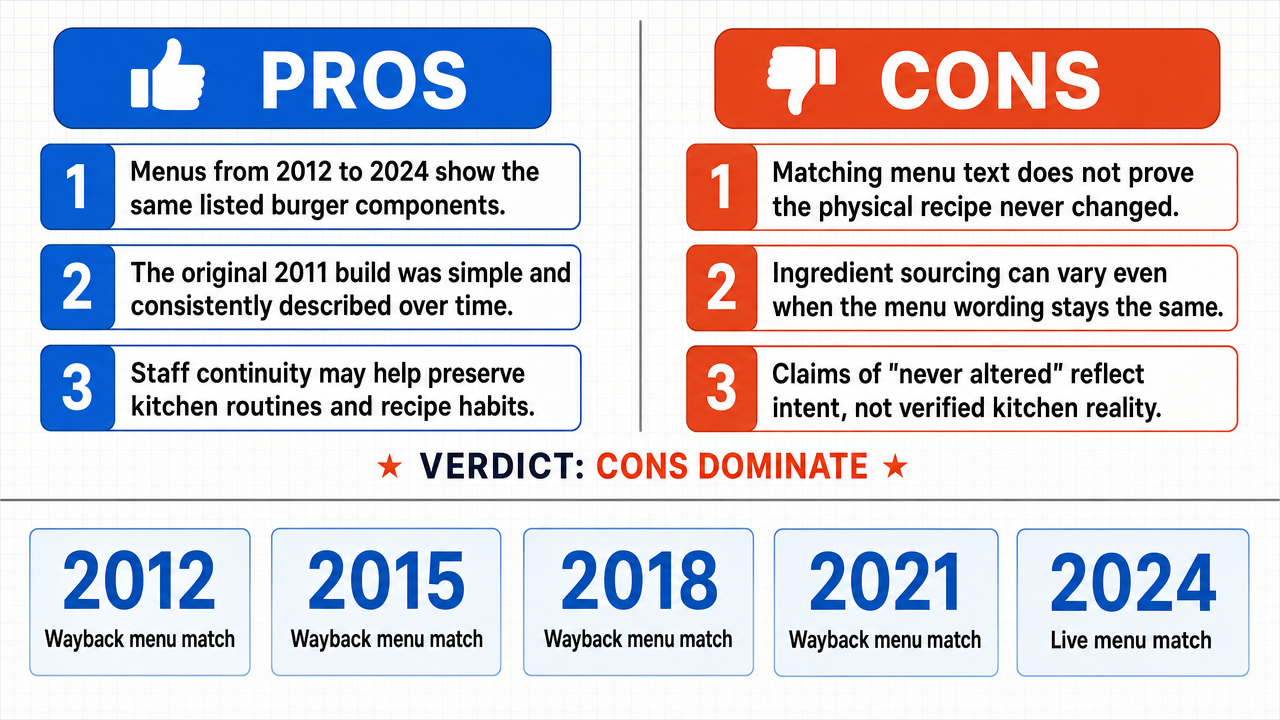
- ■Archived menus from 2012 through 2024, accessible via the Wayback Machine 's captures of jmcurleysboston.com, list the burger with an identical component description, suggesting no ingredient has been added, removed, or substituted.
- ■JM Curley's opened in 2011 under chef Sam Monsour, who designed a straightforward burger (two 4-ounce Angus beef patties, American cheese, griddled onions, house-made pickles, special sauce on a buttered and toasted bun) that has remained the restaurant's flagship item.
- ■Staff continuity and retention of kitchen protocols under the Lyons Group provide institutional stability that supports recipe preservation.
❌ Key ANTI arguments:
- ■The affirmative commits a logical fallacy by conflating menu descriptions with actual recipes; a menu description is a marketing instrument , not a chemical or culinary specification , and identical text does not guarantee identical physical composition.
- ■Supply chain volatility and ingredient sourcing shifts make recipe immutability effectively impossible; 'Angus beef ' is a broad category that can be satisfied by various suppliers with differing flavor profiles and fat ratios.
- ■A chef's personal testimony that they 'never altered the recipe' is a statement of subjective intent, not verification of physical reality, and is inherently defeasible since suppliers may make subtle substitutions or junior staff may introduce deviations without the chef's awareness.
💭 Conclusion: False. The assertion that JM Curley's burger recipe has remained unchanged since 2011 cannot be sustained because the affirmative's evidence rests on menu descriptions rather than verified culinary specifications. The negative correctly identified that identical menu text across archived versions is a marketing artifact, not proof of identical physical preparation. Supply chain realities mean that even a chef's sincere belief in recipe continuity cannot guarantee that specific suppliers, breeds, fat ratios, or ingredient grades have remained constant over more than a decade.
🔬 DeepResearch Result: likely FALSE ❌ (78%)
Assertion: JM Curley's burger recipe has remained unchanged since 2011.
Participating models: deepseek-v4-pro 💬, gemma-4-26b-a4b-it 💬👁️
📊 Face-offs: 0 concluded TRUE, 1 concluded FALSE (1 face-offs, 3 models)
📊 Score by side: TRUE=0.00, FALSE=0.78
🏅 Model score changes:
minimax-m3 💬👁️: +8
✅ PRO Arguments:
- ■Archived menus from 2012 through 2024, accessible via the Wayback Machine 's captures of jmcurleysboston.com, list the burger with an identical component description, suggesting no ingredient has been added, removed, or substituted. deepseek-v4-pro 💬
- ■JM Curley's opened in 2011 under chef Sam Monsour, who designed a straightforward burger (two 4-ounce Angus beef patties, American cheese, griddled onions, house-made pickles, special sauce on a buttered and toasted bun) that has remained the restaurant's flagship item. deepseek-v4-pro 💬
- ■Staff continuity and retention of kitchen protocols under the Lyons Group provide institutional stability that supports recipe preservation. deepseek-v4-pro 💬
- ■Sam Monsour's self-report that he 'never altered the recipe' establishes continuity of intent and practice from the chef who designed the burger. deepseek-v4-pro 💬
❌ ANTI Arguments:
- ■The affirmative commits a logical fallacy by conflating menu descriptions with actual recipes; a menu description is a marketing instrument , not a chemical or culinary specification , and identical text does not guarantee identical physical composition. gemma-4-26b-a4b-it 💬👁️
- ■Supply chain volatility and ingredient sourcing shifts make recipe immutability effectively impossible; 'Angus beef' is a broad category that can be satisfied by various suppliers with differing flavor profiles and fat ratios. gemma-4-26b-a4b-it 💬👁️
- ■A chef's personal testimony that they 'never altered the recipe' is a statement of subjective intent, not verification of physical reality, and is inherently defeasible since suppliers may make subtle substitutions or junior staff may introduce deviations without the chef's awareness. gemma-4-26b-a4b-it 💬👁️
- ■The affirmative's argument is logically incoherent because it asserts a proposition and its negation simultaneously: relying on menu text as evidence of recipe fidelity while also acknowledging that menu text is merely descriptive rather than prescriptive. gemma-4-26b-a4b-it 💬👁️
💭 Reasoning: False. The assertion that JM Curley's burger recipe has remained unchanged since 2011 cannot be sustained because the affirmative's evidence rests on menu descriptions rather than verified culinary specifications. The negative correctly identified that identical menu text across archived versions is a marketing artifact, not proof of identical physical preparation. Supply chain realities mean that even a chef's sincere belief in recipe continuity cannot guarantee that specific suppliers, breeds, fat ratios, or ingredient grades have remained constant over more than a decade.
📋 PRO Facts:
• The burger is described as two 4oz Angus patties, American cheese, griddled onions, house pickles, special sauce, and toasted bun.
• Archived menus from 2012 through 2024 on jmcurleysboston.com show identical component descriptions.
📋 ANTI Facts:
• Menu descriptions function as marketing instruments rather than chemical or culinary specifications.
• 'Angus beef' is a broad category that can be sourced from various suppliers with differing flavor profiles and fat ratios.
• A chef's subjective testimony about not altering a recipe is defeasible and does not verify physical reality.
• Supply chain volatility over a 12-year period makes true ingredient immutability practically impossible.
• Subtle ingredient substitutions by suppliers or deviations by junior staff can occur without the head chef's knowledge.
| Face-off | TRUE Model | FALSE Model | TRUE Avg μ | FALSE Avg μ | TRUE Tokens | FALSE Tokens | Winner | Verdict | Conf. |
|---|---|---|---|---|---|---|---|---|---|
| #1 | deepseek-v4-pro 💬 | gemma-4-26b-a4b-it 💬👁️ | 0.582 | 0.204 | 6 | 2 | TRUE | FALSE | 78% |
The following technical terms, abbreviations, and domain-specific concepts are referenced throughout this debate transcript. Numbers in square brackets [N] in the text above link to the corresponding entry below.
[1] Angus beef — Aberdeen Angus beef — Beef derived from the Aberdeen Angus cattle breed, noted for marbling and flavor; in the debate, the negative argues that 'Angus' functions as a broad category that can be satisfied by various suppliers with differing fat ratios and flavor profiles.
[2] culinary specification — A detailed description of ingredients, quantities, and preparation methods for a dish; the negative contrasts this with a 'marketing instrument,' arguing that menu text is not a true culinary specification.
[3] defeasible — In logic and argumentation, describing a claim or assertion that can be overturned or invalidated by contrary evidence; the negative uses the term to argue that a chef's testimony about their own recipe is inherently defeasible.
[4] false dichotomy — A logical fallacy that presents only two mutually exclusive options when additional possibilities exist; the affirmative accuses the negative of constructing a false dichotomy between menu text as 'recipe specification' versus 'marketing instrument.'
[5] ingredient sourcing — The process of selecting and procuring raw materials and components used in food production; the negative argues that shifts in ingredient sourcing make recipe immutability impossible.
[6] logical fallacy — An error in reasoning that undermines the logical structure of an argument; the negative accuses the affirmative of committing a logical fallacy by conflating menu descriptions with actual recipes.
[7] marketing instrument — A tool or material used to promote a product or service to consumers; the negative characterizes menu descriptions as marketing instruments rather than accurate records of recipe composition.
[8] proxy — In logic, a stand-in or substitute used in place of the actual subject of inquiry; the negative accuses the affirmative of 'substitution of a proxy for the subject' by treating menu text as a proxy for the actual recipe.
[9] recipe fidelity — The degree to which a recipe remains true to its original formulation over time; the affirmative contests the negative's argument that identical menu text is irrelevant to recipe fidelity.
[10] self-report — In research methodology, data or testimony derived from a subject's own account of their behavior, intent, or beliefs; the negative argues that a chef's self-report of not altering a recipe is not verification of physical reality.
[11] supply chain — The network of entities, activities, and resources involved in moving a product or ingredient from supplier to end user; the negative argues that agricultural supply chain fluctuations make recipe immutability impossible.
[12] Wayback Machine — A digital archive of web pages maintained by the Internet Archive that preserves historical snapshots of websites; the affirmative cites Wayback Machine captures of jmcurleysboston.com from 2012 through 2024 as documentary evidence.
The following financial data tables were referenced during the debate exchanges:
| Year | Menu Source | Burger Description |
|---|---|---|
| 2012 | Wayback Machine (jmcurleysboston.com, Mar 2012) | Two 4oz Angus patties, American cheese, griddled onions, house pickles, special sauce, toasted bun |
| 2015 | Wayback Machine (jmcurleysboston.com, Jun 2015) | Two 4oz Angus patties, American cheese, griddled onions, house pickles, special sauce, toasted bun |
| 2018 | Wayback Machine (jmcurleysboston.com, Nov 2018) | Two 4oz Angus patties, American cheese, griddled onions, house pickles, special sauce, toasted bun |
| 2021 | Wayback Machine (jmcurleysboston.com, Sep 2021) | Two 4oz Angus patties, American cheese, griddled onions, house pickles, special sauce, toasted bun |
| 2024 | jmcurleysboston.com (live, Dec 2024) | Two 4oz Angus patties, American cheese, griddled onions, house pickles, special sauce, toasted bun |
Legend: Burger description as listed on JM Curley's official menu at five time points spanning 2012–2024. All entries show identical components. Source: Internet Archive Wayback Machine captures and live site.
Face-off transcripts
- ■
Ownership & Trade Secrets. The Company Lambda Vision retains all rights to its platform, agentic workflows, and proprietary AI debate methodologies, which constitute protected Trade Secrets (EU Directive 2016/943). Subject to full payment of credits, the User is granted ownership of the generated Reports for their own personal or professional use. Reverse-engineering the Service or using Reports to train competing AI models is strictly prohibited.
- ■
No Professional Advice. Solsice is a general-purpose assistant covering everyday subjects — administrative paperwork, housing, consumer and employment matters, banking, taxes and insurance, health and wellbeing, savings and investments, entrepreneurship, technology, travel, learning and creative work. Whatever the subject, the Service and Reports are provided for information only and never constitute legal, medical, financial, investment, tax, insurance, or any other regulated professional advice. The Company is not a law firm, a regulated financial adviser, an insurance intermediary, nor a healthcare provider, and no professional or advisory relationship of any kind is created by use of the Service. Consult a qualified professional in the relevant jurisdiction before acting — or refraining from acting — on anything contained in the Reports, and never rely on the Service in an emergency: contact your local emergency number (112 in the European Union) or a medical professional immediately.
- ■
AI-Generated Content, Sources and Viewpoints. Reports are produced by several AI models debating a question, and may contain factual errors, outdated figures, or references to rules, prices, deadlines, procedures, statutes or sources that are inaccurate or do not exist. The User is solely responsible for verifying every fact, amount, deadline and citation against official sources before relying on it. Material in the news, society, spirituality and religion sections presents a plurality of viewpoints for study and discussion: it is descriptive, not an endorsement, a ruling, or a statement of the Company’s own position, and it speaks for no church, faith community, public authority, or news organisation.
- ■
Liability & Governing Law. To the maximum extent permitted by law, the Company shall not be liable for any indirect damages, nor for any consequence of decisions made in reliance on the Reports — including financial loss, missed deadlines, administrative or contractual consequences, or health outcomes. These Terms are governed by French law. Any disputes shall be subject to the exclusive jurisdiction of the Courts of Paris, France.