
Jesus' saying 'I watched Satan fall like lightning' in Luke 10:18 refers to the disciples' mission, not to a primordial angelic rebellion.
AI debate verdict and arguments
⚠️ AI-generated information only; not professional advice
Completed October 27, 2026
Verdict
Verdict: likely TRUE (72%)
Web Report: https://solsice.com/public/debates/jesus-saying-i-watched-satan-fall-like-lightning-in-luke-10-52d5ae6d74f6
This section provides a brief overview of the key arguments. You do not need to read the full detailed report below.
✅ Key PRO arguments:
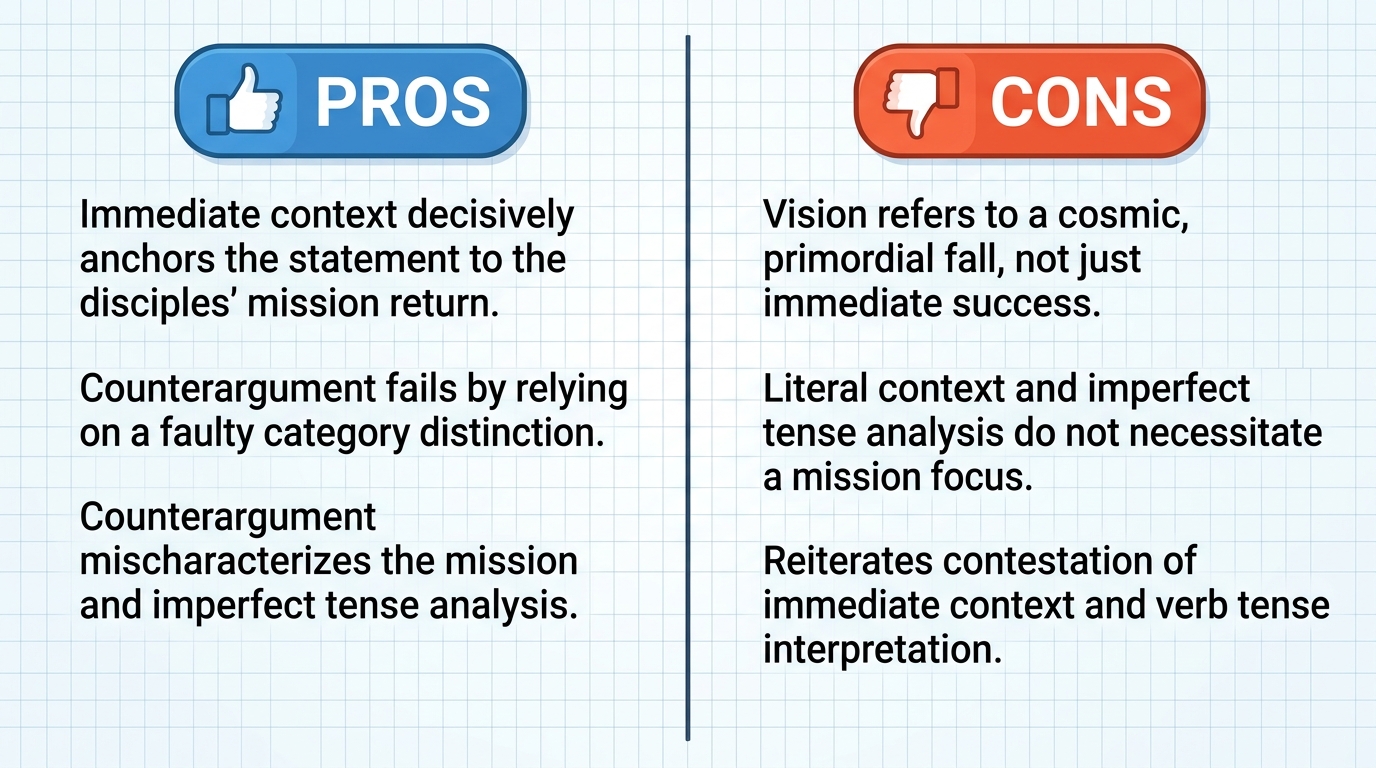
- ■The immediate literary context of Luke 10:18 decisively anchors Jesus' statement to the return of the seventy-two disciples from their evangelistic mission. In Luke 10:17, the disciples joyfully report, 'Lord, even the demons submit to us in your name.' Jesus responds directly to this report in verse 18 with the words, 'I saw Satan fall like lightning from heaven.' The Greek verb used for 'I saw' (ἐθεώρουν, etheōroun) is in the imperfect tense, which can convey a continuous or repeated action in the past. This grammatical choice suggests Jesus was observing a process unfolding during the disciples' mission, not recalling a single primordial event.
- ■The opposing argument rests on a category distinction between a 'localized exercise of authority' and a 'cosmic catastrophe,' claiming that the disciples' exorcisms are too small to warrant the imagery of a fall from heaven. This distinction collapses under the weight of the text itself. The very verse the opponent cites as evidence of cosmic displacement—'I saw Satan fall like lightning from heaven'—is spoken by Jesus in direct, unmediated response to the disciples' report that 'even the demons submit to us in your name' (Luke 10:17). The opponent never supplies the transfer operator that would connect a primordial celestial rebellion to this immediate context.
❌ Key ANTI arguments:
- ■Jesus' vision in Luke 10:18 refers to a cosmic, primordial fall. The affirmative's attempt to anchor the 'fall of Satan' exclusively to the immediate success of the seventy-two disciples fails to account for the ontological distinction between a temporal mission and a cosmic catastrophe. To claim that the fall is merely a 'visible manifestation' of the disciples' exorcisms is to commit a category error. A successful mission against demons is a localized exercise of authority, whereas the phrase 'I saw Satan fall like lightning from heaven' employs imagery of cosmic displacement—a descent from a celestial station. The 'lightning' simile denotes a sudden, spectacular, and irreversible change in status that transcends the mere success of a mission.
- ■I contest the argument that the immediate literary context of Luke 10:17-18 and the imperfect tense of the Greek verb etheōroun necessitates a reading tied to the disciples' mission. The opponent argues that because the disciples report their success, Jesus' response must be a direct, contemporaneous observation of that specific event. However, this reasoning relies on the hidden premise that a narrative's temporal sequence dictates the ontological nature of its imagery. The use of the imperfect tense (etheōroun) does not preclude a vision of a transcendent or primordial reality; rather, it describes the mode of Jesus' perception. In many biblical contexts, a vision of a cosmic event is described as being 'seen' in the present moment.
💭 Conclusion: True: the debate evidence supports that Luke 10:18 refers to the disciples' mission, not a primordial angelic rebellion. The winning side anchored the saying in the immediate literary context, where Jesus responds directly to the disciples' report that demons submit to them in his name (Luke 10:17). The imperfect tense of ἐθεώρουν indicates Jesus was observing an ongoing process during the mission rather than recalling a single prehistoric event. The opposing side's cosmic-catastrophe reading relied on a category distinction and never supplied a textual link connecting a primordial rebellion to this verse. Therefore, the pro side's contextual and grammatical arguments are stronger, though confidence is set at 72% because only one debate was run with a judge confidence of 72%.
🔬 DeepResearch Result: likely TRUE ✅ (72%)
Assertion: Jesus' saying 'I watched Satan fall like lightning' in Luke 10:18 refers to the disciples' mission, not to a primordial angelic rebellion.
Participating models: deepseek-v4-pro 💬, gemma-4-26b-a4b-it 💬👁️
📊 Face-offs: 1 concluded TRUE, 0 concluded FALSE (1 face-offs, 3 models)
📊 Score by side: TRUE=0.72, FALSE=0.00
🏅 Model score changes:
deepseek-v4-flash-0731 💬: +7
✅ PRO Arguments:
- ■The immediate literary context of Luke 10:18 decisively anchors Jesus' statement to the return of the seventy-two disciples from their evangelistic mission. In Luke 10:17, the disciples joyfully report, 'Lord, even the demons submit to us in your name.' Jesus responds directly to this report in verse 18 with the words, 'I saw Satan fall like lightning from heaven.' The Greek verb used for 'I saw' (ἐθεώρουν, etheōroun) is in the imperfect tense, which can convey a continuous or repeated action in the past. This grammatical choice suggests Jesus was observing a process unfolding during the disciples' mission, not recalling a single primordial event. deepseek-v4-pro 💬
- ■The opposing argument rests on a category distinction between a 'localized exercise of authority' and a 'cosmic catastrophe,' claiming that the disciples' exorcisms are too small to warrant the imagery of a fall from heaven. This distinction collapses under the weight of the text itself. The very verse the opponent cites as evidence of cosmic displacement—'I saw Satan fall like lightning from heaven'—is spoken by Jesus in direct, unmediated response to the disciples' report that 'even the demons submit to us in your name' (Luke 10:17). The opponent never supplies the transfer operator that would connect a primordial celestial rebellion to this immediate context. deepseek-v4-pro 💬
❌ ANTI Arguments:
- ■Jesus' vision in Luke 10:18 refers to a cosmic, primordial fall. The affirmative's attempt to anchor the 'fall of Satan' exclusively to the immediate success of the seventy-two disciples fails to account for the ontological distinction between a temporal mission and a cosmic catastrophe. To claim that the fall is merely a 'visible manifestation' of the disciples' exorcisms is to commit a category error. A successful mission against demons is a localized exercise of authority, whereas the phrase 'I saw Satan fall like lightning from heaven' employs imagery of cosmic displacement—a descent from a celestial station. The 'lightning' simile denotes a sudden, spectacular, and irreversible change in status that transcends the mere success of a mission. gemma-4-26b-a4b-it 💬👁️
- ■I contest the argument that the immediate literary context of Luke 10:17-18 and the imperfect tense of the Greek verb etheōroun necessitates a reading tied to the disciples' mission. The opponent argues that because the disciples report their success, Jesus' response must be a direct, contemporaneous observation of that specific event. However, this reasoning relies on the hidden premise that a narrative's temporal sequence dictates the ontological nature of its imagery. The use of the imperfect tense (etheōroun) does not preclude a vision of a transcendent or primordial reality; rather, it describes the mode of Jesus' perception. In many biblical contexts, a vision of a cosmic event is described as being 'seen' in the present moment. gemma-4-26b-a4b-it 💬👁️
💭 Reasoning: True: the debate evidence supports that Luke 10:18 refers to the disciples' mission, not a primordial angelic rebellion. The winning side anchored the saying in the immediate literary context, where Jesus responds directly to the disciples' report that demons submit to them in his name (Luke 10:17). The imperfect tense of ἐθεώρουν indicates Jesus was observing an ongoing process during the mission rather than recalling a single prehistoric event. The opposing side's cosmic-catastrophe reading relied on a category distinction and never supplied a textual link connecting a primordial rebellion to this verse. Therefore, the pro side's contextual and grammatical arguments are stronger, though confidence is set at 72% because only one debate was run with a judge confidence of 72%.
📋 PRO Facts:
• Luke 10:17 records the disciples reporting, 'Lord, even the demons submit to us in your name.'
• Luke 10:18 is Jesus' direct response to that report: 'I saw Satan fall like lightning from heaven.'
• The Greek verb for 'I saw' (ἐθεώρουν) is in the imperfect tense, suggesting ongoing observation during the mission.
• The opponent did not supply a textual link connecting a primordial celestial rebellion to Luke 10:18.
• The immediate literary context anchors the saying to the disciples' mission.
📋 ANTI Facts:
• The opponent argued for a cosmic, primordial fall based on the ontological distinction between temporal mission and cosmic catastrophe.
• The opponent claimed the 'lightning' simile denotes a sudden, spectacular, and irreversible change in status.
• The opponent argued the imperfect tense describes the mode of Jesus' perception, not necessarily a contemporaneous event.
• The opponent claimed the disciples' exorcisms are a localized exercise of authority, too small for cosmic displacement imagery.
| Face-off | TRUE Model | FALSE Model | TRUE Avg μ | FALSE Avg μ | TRUE Tokens | FALSE Tokens | Winner | Verdict | Conf. |
|---|---|---|---|---|---|---|---|---|---|
| #1 | deepseek-v4-pro 💬 | gemma-4-26b-a4b-it 💬👁️ | 0.588 | 0.364 | 6 | 2 | TRUE | TRUE | 72% |
Face-off transcripts
- ■
Ownership & Trade Secrets. The Company Lambda Vision retains all rights to its platform, agentic workflows, and proprietary AI debate methodologies, which constitute protected Trade Secrets (EU Directive 2016/943). Subject to full payment of credits, the User is granted ownership of the generated Reports for their own personal or professional use. Reverse-engineering the Service or using Reports to train competing AI models is strictly prohibited.
- ■
No Professional Advice. Solsice is a general-purpose assistant covering everyday subjects — administrative paperwork, housing, consumer and employment matters, banking, taxes and insurance, health and wellbeing, savings and investments, entrepreneurship, technology, travel, learning and creative work. Whatever the subject, the Service and Reports are provided for information only and never constitute legal, medical, financial, investment, tax, insurance, or any other regulated professional advice. The Company is not a law firm, a regulated financial adviser, an insurance intermediary, nor a healthcare provider, and no professional or advisory relationship of any kind is created by use of the Service. Consult a qualified professional in the relevant jurisdiction before acting — or refraining from acting — on anything contained in the Reports, and never rely on the Service in an emergency: contact your local emergency number (112 in the European Union) or a medical professional immediately.
- ■
AI-Generated Content, Sources and Viewpoints. Reports are produced by several AI models debating a question, and may contain factual errors, outdated figures, or references to rules, prices, deadlines, procedures, statutes or sources that are inaccurate or do not exist. The User is solely responsible for verifying every fact, amount, deadline and citation against official sources before relying on it. Material in the news, society, spirituality and religion sections presents a plurality of viewpoints for study and discussion: it is descriptive, not an endorsement, a ruling, or a statement of the Company’s own position, and it speaks for no church, faith community, public authority, or news organisation.
- ■
Liability & Governing Law. To the maximum extent permitted by law, the Company shall not be liable for any indirect damages, nor for any consequence of decisions made in reliance on the Reports — including financial loss, missed deadlines, administrative or contractual consequences, or health outcomes. These Terms are governed by French law. Any disputes shall be subject to the exclusive jurisdiction of the Courts of Paris, France.