
Jane Austen novels are fundamentally about the 'hard materialistic brass tacks' of marriage as a business arrangement for survival, and the fantasy lies in characters finding both wealth and love.
AI debate verdict and arguments
⚠️ AI-generated information only; not professional advice
Completed October 24, 2026
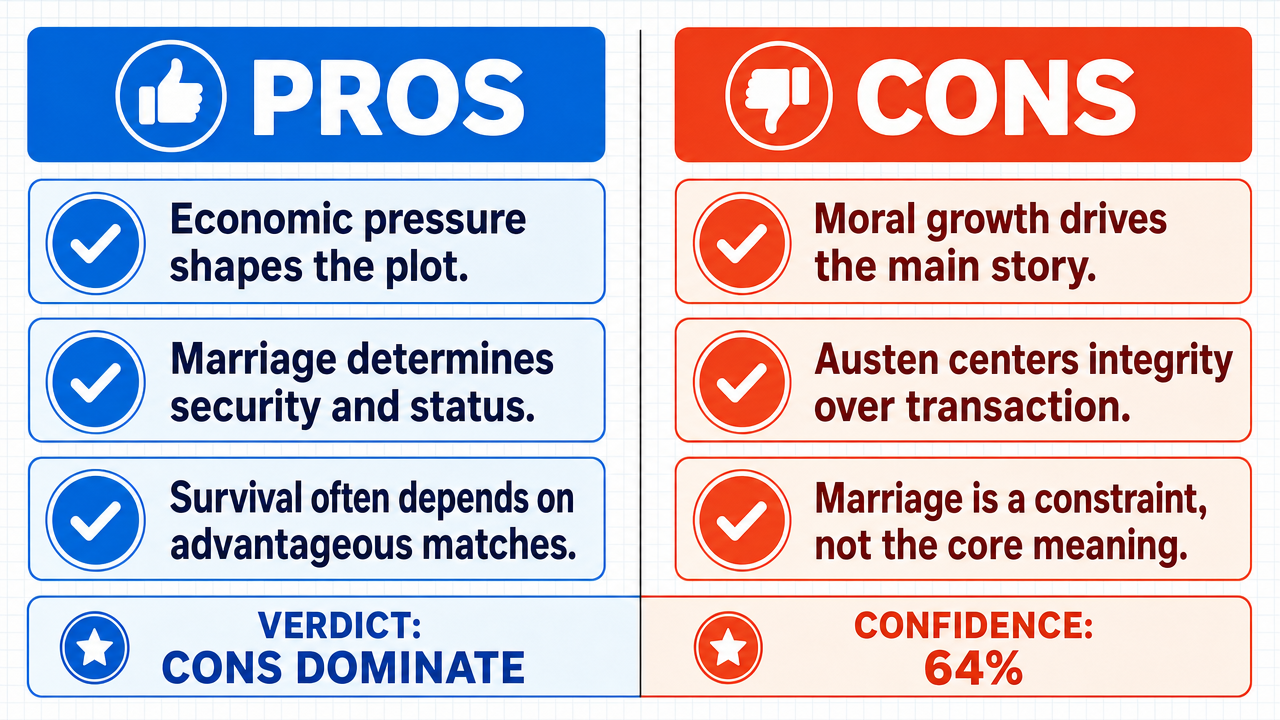
Verdict
Verdict: likely FALSE (64%)
Web Report: https://solsice.com/public/debates/jane-austen-novels-are-fundamentally-about-the-hard-material-0171eca3c0e7
This section provides a brief overview of the key arguments. You do not need to read the full detailed report below.
✅ Key PRO arguments:
- ■Austen's narratives are structurally founded on the precarious economic reality of the landed gentry , where primogeniture and entailment made marriage the primary mechanism for capital transfer and social security, making economic survival the central driver of plot.
- ■Elizabeth Bennet's rejection of Mr. Collins is not a departure from the 'brass tacks' of survival but a high-stakes gamble within them; her capacity to exercise 'moral agency ' is itself a luxury afforded by the structural necessity of the marriage market .
- ■The Bennet sisters' entire future is contingent upon marriage outcomes, demonstrating that economic necessity dictates character movement rather than being mere subtext .
❌ Key ANTI arguments:
- ■Austen's primary narrative engine is the moral and intellectual development of her protagonists, not the mechanics of capital transfer ; Elizabeth's rejection of Collins is driven by a desire for intellectual equality and respect, as she explicitly states she would rather be 'single' than marry without affection.
- ■Literary critic Claudia L. Johnson argues that Austen uses the marriage plot to explore the realization of self-knowledge and the triumph of personal integrity over social pressure, making the 'fantasy' one of moral development rather than economic convergence.
- ■Austen presents the transactional nature of marriage as a social constraint, but the narrative focus is on the moral and psychological development of characters who transcend these constraints; the fantasy is the restoration of social harmony through the correction of character flaws .
💭 Conclusion: False. The assertion that Austen's novels are fundamentally about marriage as a business arrangement for survival, with the fantasy being the convergence of wealth and love, is not supported by the stronger arguments in this debate. The negative side successfully demonstrated that Austen's primary narrative engine is moral and intellectual development, with Elizabeth Bennet's rejection of Mr. Collins driven by a desire for intellectual equality rather than mere economic calculation. The citation of literary critic Claudia L. Johnson reinforces that Austen uses the marriage plot as a vehicle for exploring self-knowledge and personal integrity . Furthermore, the analysis of Persuasion shows that even when financial restoration is necessary, the narrative fantasy centers on character reformation and emotional resolution rather than the mere convergence of wealth and love. While the affirmative side correctly identified that economic constraints shape the backdrop of Austen's world, the negative side more convincingly argued that these constraints are the setting against which moral agency operates, not the fundamental subject of the novels themselves.
🔬 DeepResearch Result: likely FALSE ❌ (64%)
Assertion: Jane Austen novels are fundamentally about the 'hard materialistic brass tacks' of marriage as a business arrangement for survival, and the fantasy lies in characters finding both wealth and love.
Participating models: gemma-4-26b-a4b-it 💬👁️, glm-4.7-flash 💬
📊 Face-offs: 0 concluded TRUE, 1 concluded FALSE (1 face-offs, 3 models)
📊 Score by side: TRUE=0.00, FALSE=0.64
🏅 Model score changes:
minimax-m3 💬👁️: +6
✅ PRO Arguments:
- ■Austen's narratives are structurally founded on the precarious economic reality of the landed gentry , where primogeniture and entailment made marriage the primary mechanism for capital transfer and social security, making economic survival the central driver of plot. gemma-4-26b-a4b-it 💬👁️
- ■Elizabeth Bennet's rejection of Mr. Collins is not a departure from the 'brass tacks' of survival but a high-stakes gamble within them; her capacity to exercise 'moral agency ' is itself a luxury afforded by the structural necessity of the marriage market . gemma-4-26b-a4b-it 💬👁️
- ■The Bennet sisters' entire future is contingent upon marriage outcomes, demonstrating that economic necessity dictates character movement rather than being mere subtext . gemma-4-26b-a4b-it 💬👁️
❌ ANTI Arguments:
- ■Austen's primary narrative engine is the moral and intellectual development of her protagonists, not the mechanics of capital transfer; Elizabeth's rejection of Collins is driven by a desire for intellectual equality and respect, as she explicitly states she would rather be 'single' than marry without affection. glm-4.7-flash 💬
- ■Literary critic Claudia L. Johnson argues that Austen uses the marriage plot to explore the realization of self-knowledge and the triumph of personal integrity over social pressure, making the 'fantasy' one of moral development rather than economic convergence. glm-4.7-flash 💬
- ■Austen presents the transactional nature of marriage as a social constraint, but the narrative focus is on the moral and psychological development of characters who transcend these constraints; the fantasy is the restoration of social harmony through the correction of character flaws . glm-4.7-flash 💬
- ■In Persuasion, while Wentworth's financial restoration is a necessary condition for the marriage, the narrative fantasy lies in the reformation of his character and the emotional resolution, not merely the convergence of wealth and love. glm-4.7-flash 💬
💭 Reasoning: False. The assertion that Austen's novels are fundamentally about marriage as a business arrangement for survival, with the fantasy being the convergence of wealth and love, is not supported by the stronger arguments in this debate. The negative side successfully demonstrated that Austen's primary narrative engine is moral and intellectual development, with Elizabeth Bennet's rejection of Mr. Collins driven by a desire for intellectual equality rather than mere economic calculation. The citation of literary critic Claudia L. Johnson reinforces that Austen uses the marriage plot as a vehicle for exploring self-knowledge and personal integrity. Furthermore, the analysis of Persuasion shows that even when financial restoration is necessary, the narrative fantasy centers on character reformation and emotional resolution rather than the mere convergence of wealth and love. While the affirmative side correctly identified that economic constraints shape the backdrop of Austen's world, the negative side more convincingly argued that these constraints are the setting against which moral agency operates, not the fundamental subject of the novels themselves.
📋 PRO Facts:
• Primogeniture and entailment legally restricted women's inheritance in Austen's era
• Women were largely barred from direct inheritance and professional employment in Regency England
• Marriage functioned as the primary mechanism for capital transfer and social security
📋 ANTI Facts:
• Elizabeth Bennet explicitly states she would rather be 'single' than marry without affection
• Literary critic Claudia L. Johnson argues Austen uses the marriage plot to explore self-knowledge and personal integrity
• In Persuasion, Wentworth's financial restoration is a necessary but not sufficient condition for the marriage resolution
| Face-off | TRUE Model | FALSE Model | TRUE Avg μ | FALSE Avg μ | TRUE Tokens | FALSE Tokens | Winner | Verdict | Conf. |
|---|---|---|---|---|---|---|---|---|---|
| #1 | gemma-4-26b-a4b-it 💬👁️ | glm-4.7-flash 💬 | 0.371 | 0.520 | 4 | 4 | FALSE | FALSE | 64% |
The following technical terms, abbreviations, and domain-specific concepts are referenced throughout this debate transcript. Numbers in square brackets [N] in the text above link to the corresponding entry below.
[1] autonomy — The capacity for self-direction and independent decision-making; in the debate, it refers to a character's ability to make choices about marriage and life independent of social or economic pressure.
[2] capital transfer — The movement of financial assets or wealth from one party to another; in the debate, it refers to how marriage functioned as a mechanism for transferring wealth between families.
[3] character flaws — Imperfections or moral weaknesses in a literary character's personality that drive narrative development and require correction; in the debate, the correction of such flaws is presented as the narrative fantasy.
[4] courtship — The period or process of romantic pursuit leading to engagement and marriage; in the debate, it is described as a 'high-stakes negotiation of solvency and assets.'
[5] destitution — Extreme poverty or lack of the means necessary for basic subsistence; in the debate, it refers to the economic fate threatening the Bennet sisters upon their father's death.
[6] entailment — entail — A legal restriction on the inheritance of property, limiting who may inherit and preventing the owner from selling or bequeathing the estate freely; in the debate, it is cited as the mechanism that disinherits the Bennet daughters in favor of a male heir.
[7] financial independence — The state of having sufficient personal wealth or income to support oneself without reliance on others; in the debate, it is linked to a woman's marital status and her capacity for autonomy.
[8] intellectual equality — A relationship dynamic in which partners are considered equals in mental capacity, education, and rational discourse; in the debate, it is cited as a motivation for Elizabeth Bennet's rejection of Mr. Collins.
[9] landed gentry — A social class consisting of landowners who derive income from their estates, ranking below the aristocracy; in the debate, it is the class whose precarious economic reality drives Austen's plots.
[10] marriage market — A sociological concept treating marriage as an economic exchange system in which individuals negotiate partnerships based on factors such as wealth, status, and compatibility.
[11] marriage plot — A literary narrative structure centered on the courtship, obstacles, and resolution of a romantic union; in the debate, it is described as a vehicle for exploring either economic or moral themes.
[12] moral agency — The capacity of an individual to make independent moral choices and be held accountable for them; in the debate, it is presented as either the primary focus of Austen's novels or a luxury dependent on economic security.
[13] narrative engine — The central driving force or core conflict that propels a story forward; in the debate, it is contested whether this is economic necessity or moral/intellectual development.
[14] personal integrity — Adherence to one's own moral and ethical principles; in the debate, it is cited as the motivation for Elizabeth Bennet's rejection of Mr. Collins.
[15] politics of the individual — A literary-critical concept, attributed in the debate to Claudia L. Johnson, emphasizing the moral and psychological development of characters over economic or social transactions.
[16] politics of the purse — A literary-critical concept, attributed in the debate to Claudia L. Johnson, referring to the economic and financial dimensions of social relations, particularly marriage.
[17] primogeniture — A legal inheritance system in which the entire estate passes to the eldest son, excluding daughters and younger sons from inheritance; in the debate, it is cited as a structural constraint on women's economic security.
[18] Regency period — The historical period in Britain from 1811 to 1820, during which the Prince Regent ruled in place of George III; in the debate, it is cited as the era in which intellectual and moral agency for women were linked to marital status.
[19] self-realization — The fulfillment of one's own potential and the development of a complete sense of self; in the debate, it is cited as the narrative fantasy of Persuasion.
[20] social harmony — A state of peaceful coexistence and agreement among members of a society; in the debate, it is presented as the ultimate fantasy of Austen's novels.
[21] solvency — The ability of an individual or entity to meet long-term financial obligations and maintain sufficient assets; in the debate, it is cited as a key concern in Austen's courtship narratives.
[22] subtext — An underlying or implicit meaning beneath the surface of a text; in the debate, it is argued that the economic dimension of marriage is not subtext but the central driver of plot.
[23] transactional nature — The quality of an interaction being structured as an exchange of goods, services, or value; in the debate, it describes how marriage is presented as a social constraint.
Face-off transcripts
- ■
Ownership & Trade Secrets. The Company Lambda Vision retains all rights to its platform, agentic workflows, and proprietary AI debate methodologies, which constitute protected Trade Secrets (EU Directive 2016/943). Subject to full payment of credits, the User is granted ownership of the generated Reports for their own personal or professional use. Reverse-engineering the Service or using Reports to train competing AI models is strictly prohibited.
- ■
No Professional Advice. Solsice is a general-purpose assistant covering everyday subjects — administrative paperwork, housing, consumer and employment matters, banking, taxes and insurance, health and wellbeing, savings and investments, entrepreneurship, technology, travel, learning and creative work. Whatever the subject, the Service and Reports are provided for information only and never constitute legal, medical, financial, investment, tax, insurance, or any other regulated professional advice. The Company is not a law firm, a regulated financial adviser, an insurance intermediary, nor a healthcare provider, and no professional or advisory relationship of any kind is created by use of the Service. Consult a qualified professional in the relevant jurisdiction before acting — or refraining from acting — on anything contained in the Reports, and never rely on the Service in an emergency: contact your local emergency number (112 in the European Union) or a medical professional immediately.
- ■
AI-Generated Content, Sources and Viewpoints. Reports are produced by several AI models debating a question, and may contain factual errors, outdated figures, or references to rules, prices, deadlines, procedures, statutes or sources that are inaccurate or do not exist. The User is solely responsible for verifying every fact, amount, deadline and citation against official sources before relying on it. Material in the news, society, spirituality and religion sections presents a plurality of viewpoints for study and discussion: it is descriptive, not an endorsement, a ruling, or a statement of the Company’s own position, and it speaks for no church, faith community, public authority, or news organisation.
- ■
Liability & Governing Law. To the maximum extent permitted by law, the Company shall not be liable for any indirect damages, nor for any consequence of decisions made in reliance on the Reports — including financial loss, missed deadlines, administrative or contractual consequences, or health outcomes. These Terms are governed by French law. Any disputes shall be subject to the exclusive jurisdiction of the Courts of Paris, France.