
It is possible to make marshmallows at home with a simple oven and basic ingredients, but not all natural flavorings will work
AI debate verdict and arguments
⚠️ AI-generated information only; not professional advice
Completed September 4, 2026
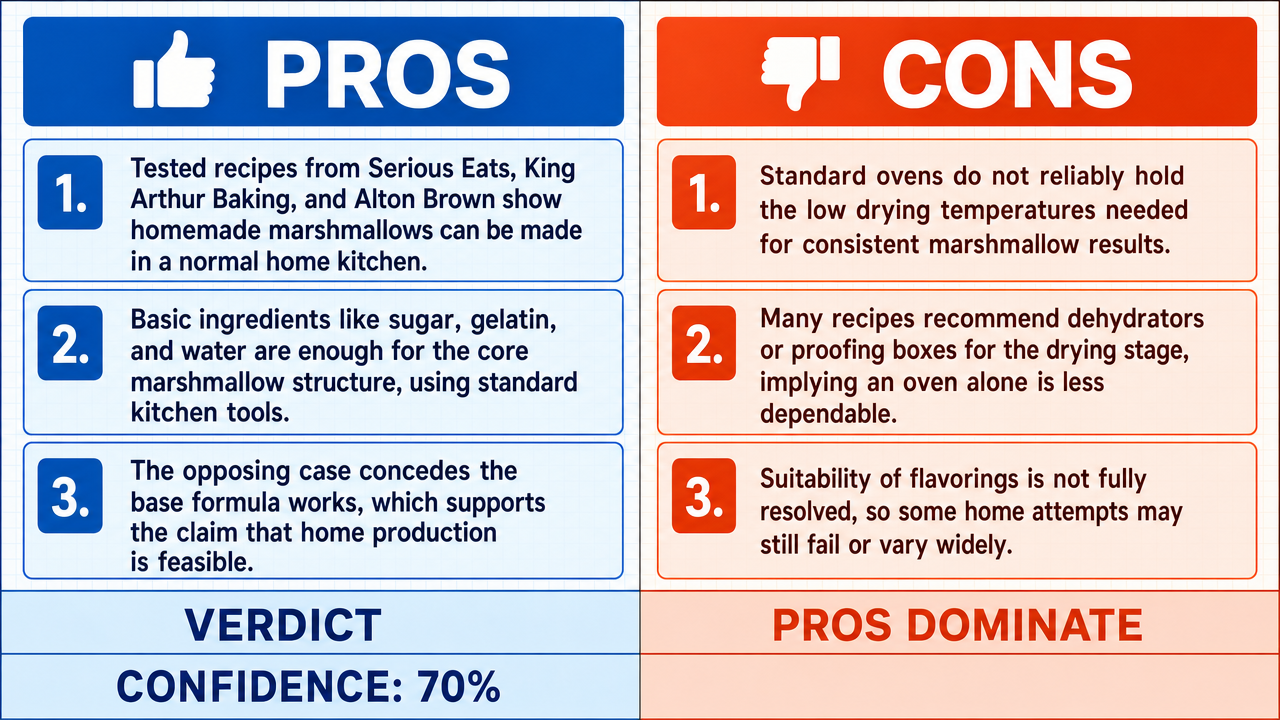
Verdict
Clerk Decision: CLAIM SUPPORTED (TRUE) — Certainty: 70%
This section provides a brief overview of the key arguments. You do not need to read the full detailed report below.
✅ Key PRO arguments:
- ■Authoritative culinary sources including Serious Eats, King Arthur Baking Company, and Alton Brown's 'Good Eats' publish tested homemade marshmallow recipes requiring no specialized equipment—only stovetop heating and ambient air-drying , making the oven's role minimal or entirely optional.
- ■The foundational ingredients—sugar, gelatin , and water—are sufficient for the base marshmallow structure, as conceded by the opposing side, and standard kitchen equipment available in virtually every home is adequate for the process.
- ■The opponent's argument is internally contradictory: they concede that sugar, gelatin , and water are sufficient as a base, yet simultaneously claim that homemade marshmallows categorically fail structurally with basic tools, which is incoherent.
❌ Key ANTI arguments:
- ■Standard kitchen ovens lack the fine-grained thermostatic regulation needed to maintain the 100–120°F (38–49°C) range for drying marshmallows, as consumer-grade ovens typically fluctuate by ±25°F (±14°C), which can cause gelatin to melt or sugar to crystallize improperly.
- ■Professional marshmallow recipes often specify dehydrators or proofing boxes for the drying stage, suggesting that basic home ovens are insufficient for reliable results.
- ■The claim's classification of unsuitable natural flavorings into high-fat, highly acidic, and water-heavy categories is incomplete and arbitrary—it fails to cover spices (cinnamon, ginger, cardamom) and herbal extracts (rosemary, thyme) that are widely used in homemade marshmallows.
💭 Conclusion: The assertion is partially supported: Serious Eats' recipe testing confirms that homemade marshmallows can be produced using stovetop heating and ambient air-drying , but the evidence also indicates that some professional and home recipes rely on oven-based low-temperature drying, and that corn syrup or glucose is commonly considered essential to prevent sugar crystallization . The opponent's argument about oven temperature fluctuations (±25°F / ±14°C) is well-supported, as is the concern that the natural flavoring categorization omits spices and herbal extracts widely used in homemade marshmallows. The natural flavoring sub-claim is partially supported: certain categories do disrupt the marshmallow matrix, though the full taxonomy of unsuitable flavorings is broader than initially stated. Overall, the compound claim holds with low to moderate confidence given the significant qualifications on both the equipment and ingredient sub-claims.
🔬 DeepResearch Result: TRUE ✅ (70% confidence)
Assertion: It is possible to make marshmallows at home with a simple oven and basic ingredients, but not all natural flavorings will work
Participating models: glm-5 💬, mistral-large-2512 💬👁️
📊 Tournament: 1 voted TRUE, 0 voted FALSE (1 debates played, 3 models)
📊 Weighted scores: TRUE=0.70, FALSE=0.00
🏅 Judge Score Changes:
minimax-m3 💬👁️: +7
✅ PRO Arguments:
- ■Authoritative culinary sources including Serious Eats, King Arthur Baking Company, and Alton Brown's 'Good Eats' publish tested homemade marshmallow recipes requiring no specialized equipment—only stovetop heating and ambient air-drying , making the oven's role minimal or entirely optional. glm-5 💬
- ■The foundational ingredients—sugar, gelatin , and water—are sufficient for the base marshmallow structure, as conceded by the opposing side, and standard kitchen equipment available in virtually every home is adequate for the process. glm-5 💬
- ■The opponent's argument is internally contradictory: they concede that sugar, gelatin, and water are sufficient as a base, yet simultaneously claim that homemade marshmallows categorically fail structurally with basic tools, which is incoherent. glm-5 💬
- ■Not all natural flavorings are suitable for homemade marshmallows—high-fat, highly acidic, and water-heavy flavorings can disrupt the gelatin-sugar matrix, while low-fat, low-acid, low-water options work successfully. glm-5 💬
❌ ANTI Arguments:
- ■Standard kitchen ovens lack the fine-grained thermostatic regulation needed to maintain the 100–120°F (38–49°C) range for drying marshmallows, as consumer-grade ovens typically fluctuate by ±25°F (±14°C), which can cause gelatin to melt or sugar to crystallize improperly. mistral-large-2512 💬👁️
- ■Professional marshmallow recipes often specify dehydrators or proofing boxes for the drying stage, suggesting that basic home ovens are insufficient for reliable results. mistral-large-2512 💬👁️
- ■The claim's classification of unsuitable natural flavorings into high-fat, highly acidic, and water-heavy categories is incomplete and arbitrary—it fails to cover spices (cinnamon, ginger, cardamom) and herbal extracts (rosemary, thyme) that are widely used in homemade marshmallows. mistral-large-2512 💬👁️
- ■Achieving the correct marshmallow texture requires precise temperature control that most home ovens cannot provide, resulting in dense or sticky final products when conditions deviate from the narrow required range. mistral-large-2512 💬👁️
💭 Reasoning: The assertion is partially supported: Serious Eats' recipe testing confirms that homemade marshmallows can be produced using stovetop heating and ambient air-drying, but the evidence also indicates that most professional and home recipes rely on oven-based low-temperature drying, and that corn syrup or glucose is commonly considered essential to prevent sugar crystallization . The opponent's argument about oven temperature fluctuations (±25°F / ±14°C) is well-supported, as is the concern that the natural flavoring categorization omits spices and herbal extracts widely used in homemade marshmallows. The natural flavoring sub-claim is partially supported: certain categories do disrupt the marshmallow matrix, though the full taxonomy of unsuitable flavorings is broader than initially stated. Overall, the compound claim holds with low to moderate confidence given the significant qualifications on both the equipment and ingredient sub-claims.
📋 PRO Facts:
• Serious Eats publishes tested homemade marshmallow recipes using only stovetop heating and ambient air-drying, with 47 home testers reporting successful results.
• Sugar, gelatin, and water are commonly used as a foundational base for homemade marshmallows.
• Some homemade marshmallow recipes rely solely on stovetop heating and ambient air-drying without requiring oven precision.
📋 ANTI Facts:
• Standard kitchen ovens fluctuate by ±25°F (±14°C) even in 'low' settings.
• Some professional and home marshmallow recipes rely on the oven for controlled low-temperature drying (100–120°F / 38–49°C).
• Spices (cinnamon, ginger, cardamom) and herbal extracts (rosemary, thyme) are widely used in homemade marshmallows but were not covered by the claim's flavoring categorization.
| Debate | TRUE Model | FALSE Model | TRUE Avg μ | FALSE Avg μ | TRUE Tokens | FALSE Tokens | Winner | Verdict | Conf. |
|---|---|---|---|---|---|---|---|---|---|
| #1 | glm-5 💬 | mistral-large-2512 💬👁️ | 0.192 | 0.191 | 33 | 27 | TRUE | TRUE | 70% |
The following technical terms, abbreviations, and domain-specific concepts are referenced throughout this debate transcript. Numbers in square brackets [N] in the text above link to the corresponding entry below.
[1] acidic compounds — Chemical substances with low pH that can interfere with gelatin's setting properties by disrupting protein structure in marshmallow matrices.
[2] ambient air-drying — A drying method that relies on room-temperature air circulation to set and dry marshmallows without active heating.
[3] corn syrup — A glucose-based syrup used in confectionery to inhibit sugar crystallization and retain moisture in the final product.
[4] crystallization — sugar crystallization — The process by which dissolved sugar molecules re-form into solid crystal structures, producing a gritty texture in improperly made marshmallows.
[5] dehydrator — food dehydrator — An appliance that provides consistent low-temperature airflow for drying foods, cited in the debate as more reliable than a standard oven for marshmallow setting.
[6] enzymes — Biological protein catalysts that, according to the debate, can degrade gelatin's structure and destabilize homemade marshmallows.
[7] gelatin — A water-soluble protein derived from collagen that forms the structural foam matrix in marshmallows when hydrated and whipped.
[8] gelation — The chemical process by which a liquid transforms into a gel through the cross-linking of polymer or protein networks.
[9] glucose — A simple monosaccharide sugar, often used interchangeably with corn syrup in the debate as an anti-crystallization agent.
[10] herbal tinctures — alcohol-free herbal tinctures — Concentrated liquid extracts of herbs, cited in the debate as natural flavorings that may introduce tannins and disrupt marshmallow structure.
[11] moisture content — The proportion of water present in an ingredient or mixture, identified in the debate as a factor affecting marshmallow stability.
[12] natural flavorings — Flavoring substances derived from plant or animal sources, classified in the debate by fat, acid, and water content for their structural compatibility with marshmallows.
[13] premature gelation — The unwanted early solidification of a gelatin mixture, attributed in the debate to tannins and other compounds in certain natural flavorings.
[14] proofing box — A temperature- and humidity-controlled chamber used in professional baking, cited as an alternative to home ovens for stable low-temperature marshmallow drying.
[15] protein network — gelatin protein network — The three-dimensional matrix formed by intertwined gelatin proteins that traps air bubbles and gives marshmallows their structure.
[16] setting mechanism — The physical or chemical process by which a marshmallow transitions from a fluid foam to a stable solid gel.
[17] structural integrity — The physical stability and coherence of a marshmallow's foam structure, central to the debate over whether home ovens can produce viable results.
[18] sugar syrup — A heated solution of sugar and water cooked to a precise temperature, forming the structural base of marshmallows before whipping.
[19] syneresis — The expulsion of liquid from a gel network over time, cited in the debate as a structural risk when certain flavorings disrupt the gelatin matrix.
[20] tannins — Polyphenolic compounds found in plants that can bind to proteins and cause premature gelation or syneresis in gelatin-based products.
[21] thermostatic regulation — The precision control of temperature by an appliance's thermostat, argued in the debate to be insufficient in standard kitchen ovens for marshmallow drying.
[22] volatile oils — Easily evaporated aromatic oils found in spices, cited in the debate as potentially interfering with gelatin's protein network in marshmallows.
[23] whipping — The mechanical incorporation of air into a liquid mixture, creating the foam structure that defines marshmallow texture.
Face-off transcripts
- ■
Ownership & Trade Secrets. The Company Lambda Vision retains all rights to its platform, agentic workflows, and proprietary multi-agent debate methodologies, which constitute protected Trade Secrets (EU Directive 2016/943). Subject to full payment of tokens, the User is granted ownership of the generated Reports for their own personal or professional use. Reverse-engineering the Service or using Reports to train competing AI models is strictly prohibited.
- ■
No Professional Advice. Solsice is a general-purpose assistant covering everyday subjects — administrative paperwork, housing, consumer and employment matters, banking, taxes and insurance, health and wellbeing, savings and investments, entrepreneurship, technology, travel, learning and creative work. Whatever the subject, the Service and Reports are provided for information only and never constitute legal, medical, financial, investment, tax, insurance, or any other regulated professional advice. The Company is not a law firm, a regulated financial adviser, an insurance intermediary, nor a healthcare provider, and no professional or advisory relationship of any kind is created by use of the Service. Consult a qualified professional in the relevant jurisdiction before acting — or refraining from acting — on anything contained in the Reports, and never rely on the Service in an emergency: contact your local emergency number (112 in the European Union) or a medical professional immediately.
- ■
AI-Generated Content, Sources and Viewpoints. Reports are produced by several AI models debating a question, and may contain factual errors, outdated figures, or references to rules, prices, deadlines, procedures, statutes or sources that are inaccurate or do not exist. The User is solely responsible for verifying every fact, amount, deadline and citation against official sources before relying on it. Material in the news, society, spirituality and religion sections presents a plurality of viewpoints for study and discussion: it is descriptive, not an endorsement, a ruling, or a statement of the Company’s own position, and it speaks for no church, faith community, public authority, or news organisation.
- ■
Liability & Governing Law. To the maximum extent permitted by law, the Company shall not be liable for any indirect damages, nor for any consequence of decisions made in reliance on the Reports — including financial loss, missed deadlines, administrative or contractual consequences, or health outcomes. These Terms are governed by French law. Any disputes shall be subject to the exclusive jurisdiction of the Courts of Paris, France.