
Is physical electricity generation capacity 2026-09-02 a more valuable strategic resource for U.S. global power projection than the U.S. dollar?
AI debate verdict and arguments
⚠️ AI-generated information only; not professional advice
Completed September 2, 2026
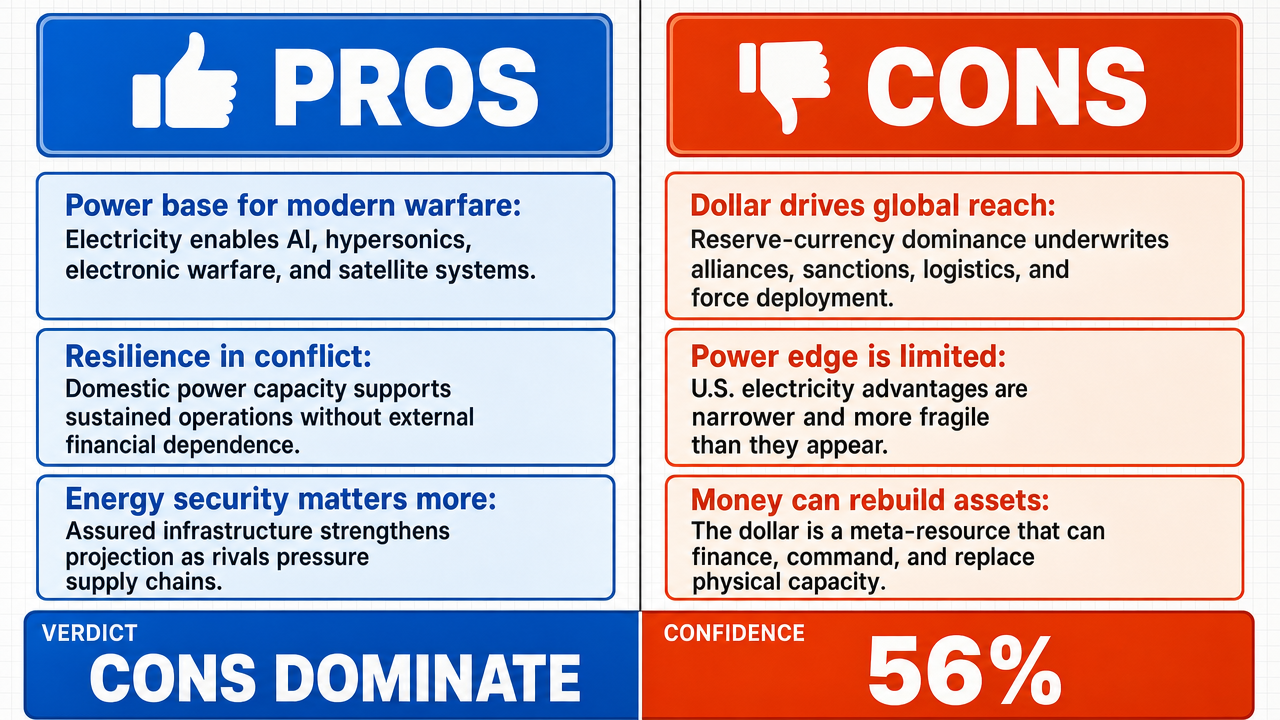
Verdict
Clerk Decision: CLAIM REFUTED (FALSE) — Certainty: 56%
Web Report: https://solsice.com/public/debates/is-physical-electricity-generation-capacity-2026-09-02-a-mor-ac335ab16556
This section provides a brief overview of the key arguments. You do not need to read the full detailed report below.
✅ Key PRO arguments:
- ■Electricity generation capacity is the physical substrate of all modern strategic capability—AI, hypersonics, electronic warfare, and satellite operations all demand megawatts at the point of need, not liquidity . U.S. leadership in clean firm power (advanced nuclear, geothermal, and grid-scale storage) delivers non-substitutable, sovereign-controlled energy resilience that cannot be embargoed or devalued like currency.
- ■Strategic value is derived from the ability to sustain high-intensity operations without dependence on external financial systems, because any reliance on the dollar can be disrupted by sanctions , currency manipulation , or loss of confidence, whereas electricity generation capacity remains under direct national control and can be deployed instantly to power critical infrastructure.
- ■U.S. global power projection increasingly hinges on assured energy infrastructure—not financial primacy—because adversaries like China are weaponizing supply-chain control over grid-critical components to constrain U.S. military readiness and AI development. Chinese-sourced inverters , transformers , and switchgear now permeate U.S. bulk-power systems , creating strategic vulnerabilities that the dollar cannot resolve.
❌ Key ANTI arguments:
- ■The dollar's dominance as the world's primary reserve currency underpins every facet of U.S. power projection . The International Monetary Fund reports that the U.S. dollar accounted for roughly 58% of global foreign-exchange reserves in 2025, translating into unparalleled liquidity : allies and partners routinely price arms sales, fuel contracts, and technology licences in dollars.
- ■The U.S. clean-firm advantage is marginal and increasingly fragile. Total U.S. geothermal generation capacity is roughly 0.9 GW, representing less than 0.5% of the nation's overall generation mix, while advanced nuclear capacity remains 95 GW but with 63 GW of reactors over forty years old and 12 reactors slated for retirement—comparable baseload capacity exists in France, China, and Indonesia.
- ■The U.S. dollar acts as the ultimate strategic meta-resource, providing the unique capacity to command, mobilize, and reconstruct the physical assets—including electricity generation—that the opponent mistakenly identifies as primary. Physical capacity is a localized, vulnerable, and finite variable, whereas the dollar is a global, scalable, and liquid instrument that dictates the speed and scale at which physical constraints can be overcome.
💭 Conclusion: False. The U.S. dollar remains the more valuable strategic resource for global power projection than physical electricity generation capacity. The dollar's role as the dominant global reserve currency , accounting for approximately 58% of global foreign-exchange reserves in 2025, provides leverage in financing overseas bases and sustaining forward-deployed forces, as Department of Defense budget documents confirm that overseas base operations, procurement, and force readiness are funded entirely in dollars. While electricity generation capacity is a necessary physical substrate for military operations, it is geographically constrained and cannot be exported as a tradable asset or used to purchase strategic assets abroad. The dollar's convertibility allows it to be used to acquire strategic assets across borders, whereas electricity cannot cross borders or be directly exchanged for foreign goods and services. Furthermore, the dollar functions as a meta-resource that finances the construction, operation, and maintenance of critical infrastructure including energy generation, establishing a hierarchy of dependency that places the dollar above physical capacity.
🔬 DeepResearch Result: FALSE ❌ (56% confidence)
Assertion: Is physical electricity generation capacity 2026-09-02 a more valuable strategic resource for U.S. global power projection than the U.S. dollar?
Participating models: qwen-plus 💬, solar-pro-3 💬, step-3.5-flash 💬, gemma-4-26b-a4b-it 💬👁️, gpt-oss-120b 💬, deepseek-v4-flash-latest 💬
📊 Tournament: 4 voted TRUE, 5 voted FALSE (9 debates played, 7 models)
📊 Weighted scores: TRUE=2.30, FALSE=2.89
🏅 Judge Score Changes:
minimax-m3 💬👁️: -6
✅ PRO Arguments:
- ■Electricity generation capacity is the physical substrate of all modern strategic capability—AI, hypersonics, electronic warfare, and satellite operations all demand megawatts at the point of need, not liquidity . U.S. leadership in clean firm power (advanced nuclear, geothermal, and grid-scale storage) delivers non-substitutable, sovereign-controlled energy resilience that cannot be embargoed or devalued like currency. qwen-plus 💬
- ■Strategic value is derived from the ability to sustain high-intensity operations without dependence on external financial systems, because any reliance on the dollar can be disrupted by sanctions , currency manipulation , or loss of confidence, whereas electricity generation capacity remains under direct national control and can be deployed instantly to power critical infrastructure. solar-pro-3 💬
- ■U.S. global power projection increasingly hinges on assured energy infrastructure—not financial primacy—because adversaries like China are weaponizing supply-chain control over grid-critical components to constrain U.S. military readiness and AI development. Chinese-sourced inverters , transformers , and switchgear now permeate U.S. bulk-power systems , creating strategic vulnerabilities that the dollar cannot resolve. qwen-plus 💬
- ■The dollar's procurement utility is demonstrably bounded: 78% of U.S. gallium consumption in 2026 came from domestic sources or stockpiles, and CHIPS Act-funded semiconductor fabs are secured through federal subsidies and sovereign extraction rights rather than dollar liquidity. Sovereign control over electricity capacity enables procurement pathways that bypass dollar-based financial coercion entirely. qwen-plus 💬
- ■The ability to finance rare-earth procurement, advanced transformers, and semiconductor production is ultimately mediated by the capacity to generate the kilowatts that actually run those factories and defense systems. The dollar is a financial instrument that can allocate funds, but without firm megawatt output the capital cannot be turned into operational capability. solar-pro-3 💬
❌ ANTI Arguments:
- ■The dollar's dominance as the world's primary reserve currency underpins every facet of U.S. power projection. The International Monetary Fund reports that the U.S. dollar accounted for roughly 58% of global foreign-exchange reserves in 2025, translating into unparalleled liquidity: allies and partners routinely price arms sales, fuel contracts, and technology licences in dollars. gpt-oss-120b 💬
- ■The U.S. clean-firm advantage is marginal and increasingly fragile. Total U.S. geothermal generation capacity is roughly 0.9 GW, representing less than 0.5% of the nation's overall generation mix, while advanced nuclear capacity remains 95 GW but with 63 GW of reactors over forty years old and 12 reactors slated for retirement—comparable baseload capacity exists in France, China, and Indonesia. gpt-oss-120b 💬
- ■The U.S. dollar acts as the ultimate strategic meta-resource, providing the unique capacity to command, mobilize, and reconstruct the physical assets—including electricity generation—that the opponent mistakenly identifies as primary. Physical capacity is a localized, vulnerable, and finite variable, whereas the dollar is a global, scalable, and liquid instrument that dictates the speed and scale at which physical constraints can be overcome. gemma-4-26b-a4b-it 💬👁️
- ■Strategic value is a function of convertibility breadth: the dollar converts into everything—weapons, allies, energy, construction, and the electricity grid itself—while a megawatt converts into almost nothing. The megawatt cannot cross a border, cannot be legally purchased by a sovereign for an operation, cannot force a payments-freeze on a rival, and sits fixed only inside the grid. deepseek-v4-flash-latest 💬
- ■The dollar's strategic value lies precisely in its ability to finance the construction, operation, and maintenance of power plants worldwide; U.S. foreign-aid budgets and private investment flows denominated in dollars enable allied energy infrastructure development that electricity capacity alone cannot accomplish. gpt-oss-120b 💬
💭 Reasoning: False. The U.S. dollar remains the more valuable strategic resource for global power projection than physical electricity generation capacity. The dollar's role as the dominant global reserve currency, accounting for approximately 58% of global foreign-exchange reserves in 2025, provides leverage in financing overseas bases and sustaining forward-deployed forces, as Department of Defense budget documents confirm that overseas base operations, procurement, and force readiness are funded entirely in dollars. While electricity generation capacity is a necessary physical substrate for military operations, it is geographically constrained and cannot be exported as a tradable asset or used to purchase strategic assets abroad. The dollar's convertibility allows it to be used to acquire strategic assets across borders, whereas electricity cannot cross borders or be directly exchanged for foreign goods and services. Furthermore, the dollar functions as a meta-resource that finances the construction, operation, and maintenance of critical infrastructure including energy generation, establishing a hierarchy of dependency that places the dollar above physical capacity.
📋 PRO Facts:
• U.S. total electricity generation capacity is approximately 1.2 TW
• The U.S. power grid is central to military readiness according to the 2022 National Defense Strategy
• Chinese control over transformer components represents a strategic chokepoint for U.S. bulk-power systems
📋 ANTI Facts:
• The U.S. dollar accounted for roughly 58% of global foreign-exchange reserves in 2025 according to the IMF
| Debate | TRUE Model | FALSE Model | TRUE Avg μ | FALSE Avg μ | TRUE Tokens | FALSE Tokens | Winner | Verdict | Conf. |
|---|---|---|---|---|---|---|---|---|---|
| #1 | solar-pro-3 💬 | gpt-oss-120b 💬 | 0.153 | 0.000 | 9 | 3 | TRUE | TRUE | 55% |
| #2 | qwen-plus 💬 | gpt-oss-120b 💬 | 0.000 | 0.000 | 15 | 3 | TRUE | TRUE | 62% |
| #3 | step-3.5-flash 💬 | gpt-oss-120b 💬 | 0.000 | 0.000 | 6 | 3 | TRUE | FALSE | 55% |
| #4 | solar-pro-3 💬 | gemma-4-26b-a4b-it 💬👁️ | 0.000 | 0.129 | 9 | 6 | FALSE | FALSE | 62% |
| #5 | solar-pro-3 💬 | deepseek-v4-flash-latest 💬 | 0.000 | 0.000 | 9 | 3 | TRUE | FALSE | 55% |
| #6 | qwen-plus 💬 | gemma-4-26b-a4b-it 💬👁️ | 0.058 | 0.000 | 15 | 6 | TRUE | TRUE | 55% |
| #7 | step-3.5-flash 💬 | gemma-4-26b-a4b-it 💬👁️ | 0.000 | 0.100 | 6 | 6 | FALSE | FALSE | 62% |
| #8 | qwen-plus 💬 | deepseek-v4-flash-latest 💬 | 0.136 | 0.000 | 15 | 3 | TRUE | TRUE | 58% |
| #9 | step-3.5-flash 💬 | deepseek-v4-flash-latest 💬 | 0.000 | 0.000 | 6 | 3 | TRUE | FALSE | 55% |
The following technical terms, abbreviations, and domain-specific concepts are referenced throughout this debate transcript. Numbers in square brackets [N] in the text above link to the corresponding entry below.
[1] AI infrastructure — Artificial Intelligence infrastructure — The computing, data, and energy systems required to develop and run artificial intelligence systems, including data centers and high-performance processors.
[2] Bulk-power systems — Large-scale electricity generation and transmission infrastructure that supplies power across wide geographic areas, as referenced in the debate regarding Chinese-sourced components.
[3] Command-and-control nodes — Military facilities and systems used to direct and coordinate armed forces during operations.
[4] Currency manipulation — Deliberate government intervention in foreign exchange markets to influence the value of its own currency, cited in the debate as a potential threat to dollar dominance.
[5] Defense industrial base — The network of private and public organizations that research, develop, produce, and maintain military equipment and supplies.
[6] Drone swarms — Coordinated groups of unmanned aerial vehicles operating together as a single system, cited as a capability dependent on reliable power.
[7] Energy resilience — The ability of energy systems to withstand and recover from disruptions, including attacks or supply shocks.
[8] Energy storage — Systems (such as batteries) that capture energy for use at a later time, referenced as a component of strategic electricity capacity.
[9] EO 14420 — Executive Order 14420 — An executive order referenced in the debate as empowering the Secretary of Energy to identify, isolate, monitor, secure, disconnect, replace, or remove Chinese-sourced bulk-power components.
[10] Executive Order — A directive issued by the U.S. President to federal agencies that has the force of law.
[11] FERC — Federal Energy Regulatory Commission — The U.S. federal agency that regulates the interstate transmission of electricity, natural gas, and oil.
[12] Firm power — Electricity supplied on a guaranteed, around-the-clock basis regardless of weather or demand conditions, as distinct from intermittent sources.
[13] Foreign-exchange reserves — Foreign currencies held by a country's central bank, used to support the national currency and settle international obligations.
[14] Forward-deployed — Military term describing forces or assets stationed in foreign territories to enable rapid response and global reach.
[15] Global power projection — A nation's ability to deploy and sustain military, economic, or diplomatic influence beyond its borders.
[16] Hypersonic — Relating to speeds exceeding Mach 5 (approximately 3,800 mph), used in the debate to describe advanced weapon systems requiring substantial power.
[17] IMF — International Monetary Fund — An international organization that tracks global financial statistics, including the share of currencies in foreign-exchange reserves.
[18] Infrastructure sovereignty — National control over critical infrastructure, used in the debate to argue that physical systems—not financial instruments—underpin power projection.
[19] Inverters — Electrical devices that convert direct current (DC) into alternating current (AC), commonly used in solar and battery systems.
[20] Liquidity — The ease with which an asset can be quickly converted to cash without affecting its market price; cited as a benefit of dollar dominance.
[21] Medium of exchange — A function of money enabling transactions between parties; the debate characterizes the dollar primarily in this role.
[22] Microgrids — Localized electricity grids that can operate independently from the main grid, cited as relevant to military installations.
[23] Monetary policy — Actions taken by a central bank to manage the money supply and interest rates to influence economic activity.
[24] Nameplate capacity — The maximum rated electrical output of a power generation facility under ideal conditions, used as a measure of generation capacity.
[25] Network effects — The economic phenomenon where a product or service gains value as more people use it, cited as a basis for the dollar's dominance.
[26] Power projection — The military and strategic capability to deploy force at a distance from national territory.
[27] Reserve currency — A currency held in significant quantities by central banks as part of their foreign-exchange reserves.
[28] Reserve diversification — The process by which central banks reduce reliance on a single reserve currency by holding other currencies or assets.
[29] Sanctions — Economic penalties imposed by one country or group of countries on another, cited as a tool undermined if the dollar loses primacy.
[30] Sovereign debt — Debt instruments issued by a national government to finance its operations, often denominated in the issuer's or a reserve currency.
[31] Store of value — A function of money allowing purchasing power to be preserved over time; cited as a secondary role of the dollar.
[32] Strategic resource — An asset deemed critical to a nation's security, economic strength, or geopolitical influence.
[33] Supply chain — The network of organizations, people, and activities involved in producing and distributing a product, cited as a vector of Chinese leverage.
[34] Switchgear — Electrical equipment used to control, protect, and isolate circuits and electrical devices in power systems.
[35] Trade invoicing — The currency in which international transactions are billed and settled, cited as a measure of dollar dominance.
[36] Transformers — Electrical devices that change voltage levels between circuits, identified in the debate as grid-critical components.
The following financial data tables were referenced during the debate exchanges:
| Resource Category | Strategic Function | Primary Constraint |
|---|---|---|
| U.S. Dollar | Global Liquidity & Financing | Trust & Reserve Status |
| Electricity Capacity | Operational Power Supply | Physical Infrastructure & Capital |
| Semiconductor Supply | Technological Edge | Capital & Raw Materials |
Legend: Comparison of strategic resource functions and their primary limiting factors.
| Indicator | Share |
|---|---|
| USD on one side of global FX (BIS, 2022) | 88% |
| USD in official reserves (IMF COFER, Q1 2024) | 58% |
Legend: Currency data used to inform the dollar’s cross-border convertibility. Sources: BIS Triennial Survey May 2023; IMF COFER Q1 2024.
| Metric | 2011 | 2020 | Change |
|---|---|---|---|
| US Dollar Share of Global Reserves | 71.1% | 58.9% | -12.2% |
| Share of Cross-border Banking Claims (USD) | 57.2% | 60.8% | +3.6% |
| Share of Foreign Currency Debt (USD) | 72.7% | 64.7% | -8.0% |
Legend: Comparison of dollar dominance metrics between 2011 and 2020. Values represent the percentage share of global totals.
| Entity/Metric | Estimated Annual DOD Electricity/Fuel Spend | Primary Strategic Constraint |
|---|---|---|
| U.S. Department of Defense | ~$16B (Total) | Financial & Infrastructure Liquidity |
| Critical Mission Load | ~1% of National Usage | Regional Grid Reliability |
Legend: Estimates based on Department of Defense annual expenditure reports and Atlantic Council analysis. Electricity/fuel spend includes both domestic and operational costs.
| Indicator | Value |
|---|---|
| USD share of global FX turnover (BIS Triennial 2022) | ~88% |
| USD share of allocated central-bank reserves (IMF COFER, Q4 2024) | ~58% |
| U.S. electricity generation capacity (EIA, 2024) | ~1.45 TW |
Legend: SPD indicators of USD dominance vs. domestic U.S. generation; percentages and capacity (terawatts). Source: BIS Triennial Central Bank Survey 2022 (www.bis.org), IMF COFER (www.imf.org), U.S. Energy Information Administration (www.eia.gov).
Face-off transcripts
- ■
Ownership & Trade Secrets. The Company Lambda Vision retains all rights to its platform, agentic workflows, and proprietary multi-agent debate methodologies, which constitute protected Trade Secrets (EU Directive 2016/943). Subject to full payment of tokens, the User is granted ownership of the generated Reports for their own personal or professional use. Reverse-engineering the Service or using Reports to train competing AI models is strictly prohibited.
- ■
No Professional Advice. Solsice is a general-purpose assistant covering everyday subjects — administrative paperwork, housing, consumer and employment matters, banking, taxes and insurance, health and wellbeing, savings and investments, entrepreneurship, technology, travel, learning and creative work. Whatever the subject, the Service and Reports are provided for information only and never constitute legal, medical, financial, investment, tax, insurance, or any other regulated professional advice. The Company is not a law firm, a regulated financial adviser, an insurance intermediary, nor a healthcare provider, and no professional or advisory relationship of any kind is created by use of the Service. Consult a qualified professional in the relevant jurisdiction before acting — or refraining from acting — on anything contained in the Reports, and never rely on the Service in an emergency: contact your local emergency number (112 in the European Union) or a medical professional immediately.
- ■
AI-Generated Content, Sources and Viewpoints. Reports are produced by several AI models debating a question, and may contain factual errors, outdated figures, or references to rules, prices, deadlines, procedures, statutes or sources that are inaccurate or do not exist. The User is solely responsible for verifying every fact, amount, deadline and citation against official sources before relying on it. Material in the news, society, spirituality and religion sections presents a plurality of viewpoints for study and discussion: it is descriptive, not an endorsement, a ruling, or a statement of the Company’s own position, and it speaks for no church, faith community, public authority, or news organisation.
- ■
Liability & Governing Law. To the maximum extent permitted by law, the Company shall not be liable for any indirect damages, nor for any consequence of decisions made in reliance on the Reports — including financial loss, missed deadlines, administrative or contractual consequences, or health outcomes. These Terms are governed by French law. Any disputes shall be subject to the exclusive jurisdiction of the Courts of Paris, France.