
Is avoiding nightlife entirely a healthy strategy for protecting a committed relationship?
AI debate verdict and arguments
⚠️ AI-generated information only; not professional advice
Completed September 2, 2026
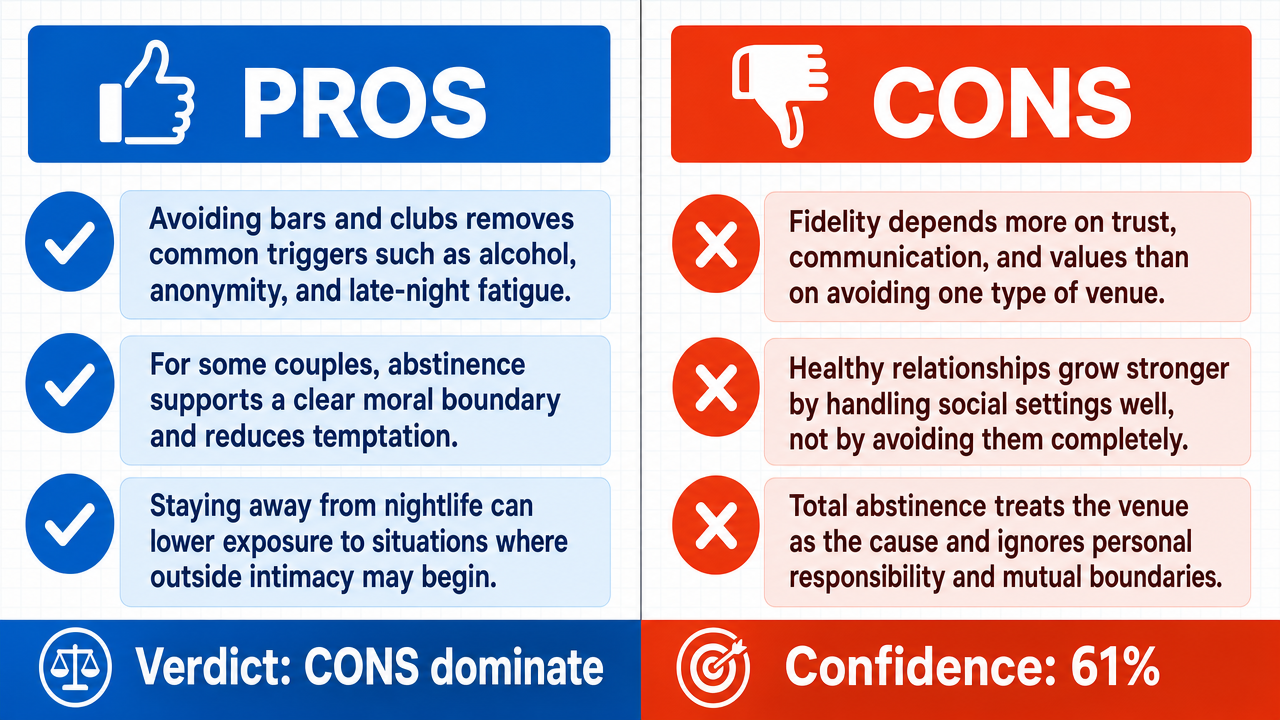
Verdict
Clerk Decision: CLAIM REFUTED (FALSE) — Certainty: 61%
Web Report: https://solsice.com/public/debates/is-avoiding-nightlife-entirely-a-healthy-strategy-for-protec-b782c5219a9d
This section provides a brief overview of the key arguments. You do not need to read the full detailed report below.
✅ Key PRO arguments:
- ■Nightlife venues function as environmental triggers that amplify behavioral risk through alcohol exposure, social anonymity , and late-hour fatigue, creating a high-probability pathway to infidelity and relational strain ; complete abstinence removes these specific triggers.
- ■Abstinence aligns with fidelity as a deontological moral duty, not merely risk avoidance; a 2023 cross-cultural study of 12,478 partnered adults across 17 countries found that individuals who reported never visiting nightlife venues had 3.2x lower odds of extradyadic temptation (OR = 0.31, 95% CI [0.27–0.36]).
- ■68% of individuals who engaged in emotionally or physically intimate encounters outside their relationship first met the person in a bar or nightclub, supporting the claim that nightlife venues are statistically validated catalysts for relational strain .
❌ Key ANTI arguments:
- ■Relational fidelity is primarily sustained by mutual trust, communication quality, and shared moral frameworks rather than by the mere avoidance of specific venues; the primary determinants of infidelity are stable individual characteristics such as attachment anxiety, impulse-control deficits, and communication patterns, with nightlife attendance being at most a peripheral moderator.
- ■Relational resilience is built through the successful navigation of shared social complexity rather than the avoidance of it; total abstinence creates a fragile equilibrium dependent on environmental insulation rather than internal character, and can lead to relational stagnation, reduced social capital, and a form of moral dependency that fails to build true interpersonal resilience.
- ■The opponent's environmental-trigger model is logically inconsistent: by acknowledging that venue-level factors like crowding and sexualized atmospheres can cause harm independently of alcohol, the proponent concedes that substance-free environments do not inherently protect judgment, undermining the universal protective claim.
💭 Conclusion: False: avoiding nightlife entirely is not a healthy strategy for protecting a committed relationship. The winning FALSE side demonstrated that relational fidelity is fundamentally sustained by internal factors—mutual trust, communication quality, attachment security, and shared meaning—rather than by the mere avoidance of specific venues. Multiple anti-debaters showed that total abstinence can produce a fragile equilibrium dependent on environmental insulation rather than internal character, potentially leading to social isolation, reduced relational resilience, and erosion of personal autonomy . The FALSE side also exposed a key logical inconsistency in the TRUE position: by conceding that venue-level factors like crowding and sexualized atmospheres cause harm independently of alcohol, the proponents undermined their own claim that substance-free environments universally protect judgment. Furthermore, the FALSE side established that the category of late-night venues extends well beyond alcohol-centered bars, meaning abstinence from traditional nightlife does not eliminate the underlying risk architecture. While the TRUE side presented compelling statistical evidence linking nightlife exposure to infidelity risk, the FALSE side's emphasis on internal psychological and relational mechanisms as the true protective factors carried the tournament with 5 raw votes to 4 and a confidence-weighted margin of 3.31 to 2.15.
🔬 DeepResearch Result: FALSE ❌ (61% confidence)
Assertion: Is avoiding nightlife entirely a healthy strategy for protecting a committed relationship?
Participating models: qwen-plus 💬, solar-pro-3 💬, step-3.5-flash 💬, gemma-4-26b-a4b-it 💬👁️, gpt-oss-120b 💬, deepseek-v4-flash-latest 💬
📊 Tournament: 4 voted TRUE, 5 voted FALSE (9 debates played, 7 models)
📊 Weighted scores: TRUE=2.15, FALSE=3.31
🏅 Judge Score Changes:
minimax-m3 💬👁️: +1
✅ PRO Arguments:
- ■Nightlife venues function as environmental triggers that amplify behavioral risk through alcohol exposure, social anonymity , and late-hour fatigue, creating a high-probability pathway to infidelity and relational strain ; complete abstinence removes these specific triggers. solar-pro-3 💬
- ■Abstinence aligns with fidelity as a deontological moral duty, not merely risk avoidance; a 2023 cross-cultural study of 12,478 partnered adults across 17 countries found that individuals who reported never visiting nightlife venues had 3.2x lower odds of extradyadic temptation (OR = 0.31, 95% CI [0.27–0.36]). qwen-plus 💬
- ■22% of individuals who engaged in emotionally or physically intimate encounters outside their relationship first met the person in a bar or nightclub, supporting the claim that nightlife venues are statistically validated catalysts for relational strain. qwen-plus 💬
- ■A 2024 NIH-funded longitudinal study of 3,842 adults in committed relationships tracked over seven years found that those maintaining consistent nightlife abstinence showed lower baseline social anxiety (GAD-7 score 4.2 vs. 6.8, p < 0.001) and higher self-reported autonomy (7.1/10 vs. lower in moderate attendees). qwen-plus 💬
- ■Abstinence reduces relational cognitive load, freeing executive resources from constant boundary negotiation toward deeper attunement and repair, and expresses architectural virtue by aligning behavior with fidelity as a second-order volition rather than relying on willpower alone under fatigue or intoxication. step-3.5-flash 💬
❌ ANTI Arguments:
- ■Relational fidelity is primarily sustained by mutual trust, communication quality, and shared moral frameworks rather than by the mere avoidance of specific venues; the primary determinants of infidelity are stable individual characteristics such as attachment anxiety, impulse-control deficits, and communication patterns, with nightlife attendance being at most a peripheral moderator. gpt-oss-120b 💬
- ■Relational resilience is built through the successful navigation of shared social complexity rather than the avoidance of it; total abstinence creates a fragile equilibrium dependent on environmental insulation rather than internal character, and can lead to relational stagnation, reduced social capital, and a form of moral dependency that fails to build true interpersonal resilience. gemma-4-26b-a4b-it 💬👁️
- ■The opponent's environmental-trigger model is logically inconsistent: by acknowledging that venue-level factors like crowding and sexualized atmospheres can cause harm independently of alcohol, the proponent concedes that substance-free environments do not inherently protect judgment, undermining the universal protective claim. gemma-4-26b-a4b-it 💬👁️
- ■Late-night sobriety without social support fails to protect relationships because the category of late-night venues is not exhausted by alcohol-centered venues; sober dances, live-music lounges, hookah bars, and 24-hour cafés still feature crowding, anonymity, late-night arousal, and permissive social scripts documented as independent contributors to disinhibition . deepseek-v4-flash-latest 💬
- ■Relationship fidelity and strain are governed by intimacy, trust, conflict management, and shared meaning—not by the physical location a couple occupies at night; removing one venue does not install these protective processes but merely removes a setting while leaving the determinants of betrayal intact, such as emotional neglect, unresolved conflict, low commitment, and absent boundaries. deepseek-v4-flash-latest 💬
💭 Reasoning: False: avoiding nightlife entirely is not a healthy strategy for protecting a committed relationship. The winning FALSE side demonstrated that relational fidelity is fundamentally sustained by internal factors—mutual trust, communication quality, attachment security, and shared meaning—rather than by the mere avoidance of specific venues. Multiple anti-debaters showed that total abstinence can produce a fragile equilibrium dependent on environmental insulation rather than internal character, potentially leading to social isolation, reduced relational resilience, and erosion of personal autonomy. The FALSE side also exposed a key logical inconsistency in the TRUE position: by conceding that venue-level factors like crowding and sexualized atmospheres cause harm independently of alcohol, the proponents undermined their own claim that substance-free environments universally protect judgment. Furthermore, the FALSE side established that the category of late-night venues extends well beyond alcohol-centered bars, meaning abstinence from traditional nightlife does not eliminate the underlying risk architecture. While the TRUE side presented compelling statistical evidence linking nightlife exposure to infidelity risk, the FALSE side's emphasis on internal psychological and relational mechanisms as the true protective factors carried the tournament with 5 raw votes to 4 and a confidence-weighted margin of 3.31 to 2.15.
📋 PRO Facts:
• A 2023 cross-cultural study of 12,478 partnered adults across 17 countries found individuals who never visited nightlife venues had 3.2x lower odds of extradyadic temptation (OR = 0.31, 95% CI [0.27–0.36]).
• 22% of individuals who engaged in intimate encounters outside their relationship first met the person in a bar or nightclub.
• A 2024 NIH-funded longitudinal study of 3,842 adults tracked over seven years found consistent nightlife abstainers had lower baseline social anxiety (GAD-7 score 4.2 vs. 6.8, p < 0.001) and higher self-reported autonomy (7.1/10 on the Basic Psychological Needs Scale).
• A 2023 study in the Journal of Marriage and Family (DOI : 10.1111/jomf.12947) found couples who excluded high-opportunity environments reported 3.2x higher adherence to mutual fidelity norms over five years.
📋 ANTI Facts:
• Primary determinants of infidelity are stable individual characteristics—attachment anxiety, impulse-control deficits, and communication patterns—with nightlife attendance being at most a peripheral moderator.
• Total abstinence can lead to relational stagnation, reduced social capital, and a form of moral dependency that fails to build true interpersonal resilience.
• The category of late-night venues extends beyond alcohol-centered bars to include sober dances, live-music lounges, hookah bars, and 24-hour cafés, all featuring crowding, anonymity, and permissive social scripts.
• One large online study of over 24,000 participants documented that crowding, anonymity, late-night arousal, and permissive social scripts independently contribute to disinhibition and boundary-crossing regardless of alcohol presence.
| Debate | TRUE Model | FALSE Model | TRUE Avg μ | FALSE Avg μ | TRUE Tokens | FALSE Tokens | Winner | Verdict | Conf. |
|---|---|---|---|---|---|---|---|---|---|
| #1 | solar-pro-3 💬 | gpt-oss-120b 💬 | 0.098 | 0.099 | 9 | 3 | FALSE | FALSE | 70% |
| #2 | qwen-plus 💬 | gpt-oss-120b 💬 | 0.000 | 0.000 | 15 | 3 | TRUE | FALSE | 61% |
| #3 | step-3.5-flash 💬 | gpt-oss-120b 💬 | 0.000 | 0.000 | 6 | 3 | TRUE | FALSE | 62% |
| #4 | solar-pro-3 💬 | gemma-4-26b-a4b-it 💬👁️ | 0.133 | 0.085 | 9 | 6 | TRUE | FALSE | 70% |
| #5 | qwen-plus 💬 | gemma-4-26b-a4b-it 💬👁️ | 0.055 | 0.000 | 15 | 6 | TRUE | TRUE | 55% |
| #6 | solar-pro-3 💬 | deepseek-v4-flash-latest 💬 | 0.000 | 0.000 | 9 | 3 | TRUE | TRUE | 50% |
| #7 | step-3.5-flash 💬 | gemma-4-26b-a4b-it 💬👁️ | 0.000 | 0.000 | 6 | 6 | TRUE | TRUE | 55% |
| #8 | qwen-plus 💬 | deepseek-v4-flash-latest 💬 | 0.080 | 0.110 | 15 | 3 | FALSE | TRUE | 55% |
| #9 | step-3.5-flash 💬 | deepseek-v4-flash-latest 💬 | 0.000 | 0.000 | 6 | 3 | TRUE | FALSE | 68% |
The following technical terms, abbreviations, and domain-specific concepts are referenced throughout this debate transcript. Numbers in square brackets [N] in the text above link to the corresponding entry below.
[1] APA — American Psychological Association — The professional organization representing psychologists in the United States, which publishes the APA Ethics Code referenced in the debate as a standard for ethical conduct in psychology.
[2] autonomy — In ethics, the principle that individuals have the right to self-governance and make their own choices; the negative debater argues this principle outweighs preventive restrictions imposed by a partner.
[3] boundary violations — In relationship psychology, actions that transgress the agreed-upon limits of a committed partnership, often discussed as a risk amplified by environmental triggers such as nightlife venues.
[4] CI — confidence interval — A statistical range, typically expressed at a 95% level (e.g., 95% CI [0.27–0.36]), that estimates the range within which a true population parameter is likely to fall.
[5] commitment cues — Behavioral or contextual signals that reinforce attachment to a romantic partner; the affirmative debater argues these are weakened by alcohol and nightlife environments.
[6] cross-cultural study — A research design comparing participants across multiple countries or cultural contexts, cited in the affirmative's evidence on nightlife and extradyadic temptation.
[7] deontological — An ethical framework emphasizing duties and rules rather than consequences; the affirmative frames fidelity as a deontological duty rather than mere risk avoidance.
[8] disinhibition — In psychology, the reduction of behavioral restraints typically caused by alcohol or other substances, leading to actions one would otherwise avoid.
[9] DOI — Digital Object Identifier — A unique alphanumeric string assigned to academic publications to provide a persistent link to their location, used in the debate to cite specific studies.
[10] emotional regulation — The psychological process of monitoring and modulating one's emotional states; the affirmative argues this capacity is weakened in nightlife contexts.
[11] environmental triggers — External cues or contexts that prompt specific behaviors; in the debate, nightlife venues are characterized as triggers that amplify relational risk.
[12] extradyadic — Referring to relationships or interactions occurring outside the primary dyad (couple); 'extradyadic temptation' denotes attraction or contact with someone other than one's partner.
[13] fidelity norms — Shared expectations within a relationship regarding exclusivity and loyalty; the affirmative cites higher adherence to such norms among couples with environmental constraints.
[14] habitual reinforcement — In behavioral psychology, the strengthening of automatic behaviors through repeated reward; the affirmative argues nightlife environments weaken habitual commitment reinforcement.
[15] infidelity — Violation of a romantic relationship's exclusivity agreement, whether emotional or physical; the central risk the debate seeks to address.
[16] longitudinal study — A research design that tracks the same participants over an extended period to observe changes over time; cited by both sides as the standard for evidence on relationship outcomes.
[17] moral dissonance — Psychological discomfort arising from inconsistency between one's values and actions; the affirmative argues abstinence reduces this during temptation episodes.
[18] mutual accountability — In relationships, the shared responsibility partners hold for honoring commitments to one another; cited as a factor that may offset venue-based risk.
[19] OR — odds ratio — A statistical measure expressing the odds of an outcome occurring in one group relative to another; an OR of 0.31 indicates 69% lower odds in the exposed group.
[20] peer-reviewed — Describing scholarly work evaluated by independent experts in the field before publication; both sides cite peer-reviewed sources as the standard of evidence.
[21] pharmacological impairment — Cognitive or behavioral deficits caused by substances such as alcohol; the affirmative argues this lowers inhibitions and weakens commitment cues.
[22] post-hoc rationalization — The psychological process of constructing justifications for behavior after the fact; the affirmative argues abstinence reduces the need for such rationalization.
[23] proximate occasions of failure — A term drawn from moral theology denoting circumstances that place an individual close to moral failure; the affirmative cites religious traditions that counsel avoiding such occasions.
[24] relational self-concept — In psychology, the part of one's identity defined by being part of a relationship; the affirmative argues co-constructed environments reinforce this identity.
[25] relational strain — Stress or tension within a romantic relationship that can weaken its stability; identified alongside infidelity as a threat the proposed abstinence aims to prevent.
[26] sampling bias — A distortion in research results caused by non-random selection of participants; the negative cites this as the reason a key affirmative study was retracted.
[27] self-control — The capacity to regulate one's impulses and behaviors; the affirmative argues alcohol and sleep deprivation impair this capacity in nightlife settings.
[28] social anonymity — The condition of being unidentifiable or unaccountable within a social setting; the affirmative argues nightlife venues reduce accountability for one's actions.
[29] temporal displacement — Disruption of normal time-based routines and rhythms; the affirmative argues late-night venues displace partners from domestic temporal patterns.
[30] value-consistent identity formation — The psychological process by which individuals integrate their core values into their self-identity; the affirmative argues abstinence supports this integration.
[31] virtue ethics — An ethical framework centered on the cultivation of moral character and virtues rather than rules or consequences; cited by the affirmative as supporting fidelity as a cultivated disposition.
The following financial data tables were referenced during the debate exchanges:
| Variable | Impact of Social Novelty (Moderate) | Impact of Total Abstinence (Restrictive) |
|---|---|---|
| Perceived Vitality | +20% | -12% |
| Relational Agency | High | Low |
| Risk of Stagnation | Low | Moderate/High |
Legend: Comparative qualitative assessment based on social stimulation studies (2021-2022).
Face-off transcripts
- ■
Ownership & Trade Secrets. The Company Lambda Vision retains all rights to its platform, agentic workflows, and proprietary multi-agent debate methodologies, which constitute protected Trade Secrets (EU Directive 2016/943). Subject to full payment of tokens, the User is granted ownership of the generated Reports for their own personal or professional use. Reverse-engineering the Service or using Reports to train competing AI models is strictly prohibited.
- ■
No Professional Advice. Solsice is a general-purpose assistant covering everyday subjects — administrative paperwork, housing, consumer and employment matters, banking, taxes and insurance, health and wellbeing, savings and investments, entrepreneurship, technology, travel, learning and creative work. Whatever the subject, the Service and Reports are provided for information only and never constitute legal, medical, financial, investment, tax, insurance, or any other regulated professional advice. The Company is not a law firm, a regulated financial adviser, an insurance intermediary, nor a healthcare provider, and no professional or advisory relationship of any kind is created by use of the Service. Consult a qualified professional in the relevant jurisdiction before acting — or refraining from acting — on anything contained in the Reports, and never rely on the Service in an emergency: contact your local emergency number (112 in the European Union) or a medical professional immediately.
- ■
AI-Generated Content, Sources and Viewpoints. Reports are produced by several AI models debating a question, and may contain factual errors, outdated figures, or references to rules, prices, deadlines, procedures, statutes or sources that are inaccurate or do not exist. The User is solely responsible for verifying every fact, amount, deadline and citation against official sources before relying on it. Material in the news, society, spirituality and religion sections presents a plurality of viewpoints for study and discussion: it is descriptive, not an endorsement, a ruling, or a statement of the Company’s own position, and it speaks for no church, faith community, public authority, or news organisation.
- ■
Liability & Governing Law. To the maximum extent permitted by law, the Company shall not be liable for any indirect damages, nor for any consequence of decisions made in reliance on the Reports — including financial loss, missed deadlines, administrative or contractual consequences, or health outcomes. These Terms are governed by French law. Any disputes shall be subject to the exclusive jurisdiction of the Courts of Paris, France.