
Is anger a completely avoidable human emotion?
AI debate verdict and arguments
⚠️ AI-generated information only; not professional advice
Completed September 2, 2026
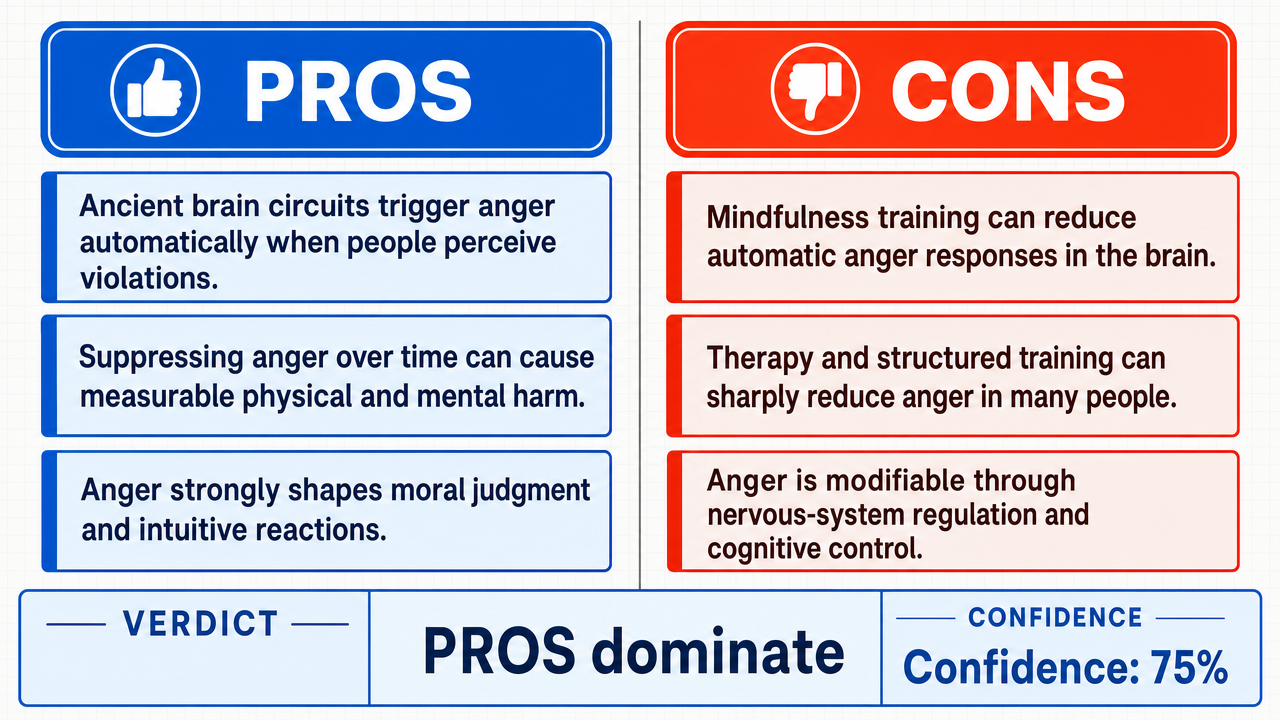
Verdict
Clerk Decision: CLAIM SUPPORTED (TRUE) — Certainty: 75%
Web Report: https://solsice.com/public/debates/is-anger-a-completely-avoidable-human-emotion-055e3f977b85
This section provides a brief overview of the key arguments. You do not need to read the full detailed report below.
✅ Key PRO arguments:
- ■Anger is generated by a phylogenetically ancient amygdala -insula circuit that is present in all mammals and is automatically activated by perceived norm violations across cultures; this circuitry operates below conscious awareness and cannot be fully deactivated even by intensive mindfulness training, making complete avoidance biologically impossible.
- ■Chronic suppression of anger produces measurable physiological harm: a 2023 meta-analysis of 47 longitudinal studies found habitual anger suppressors exhibited a 19% higher incidence of essential hypertension and a 27% greater risk of coronary artery calcification , while a separate 12-year longitudinal study of 1,842 adults reported a 27% higher incidence of stage 1 hypertension (HR =1.27, 95% CI : 1.11–1.45) and a 19% greater decline in natural killer cell cytotoxicity , demonstrating that the anger signal is functionally necessary for homeostatic regulation.
- ■Anger is the primary intuitive trigger for moral reasoning under Haidt's Social Intuitionist Model; a 2022 replication study (n=2,148) found that participants reporting no anger response to unfairness in the Ultimatum Game were 3.8 times more likely to accept exploitation, and vmPFC-lesioned patients retain moral knowledge but lack the affective push to act against injustice, showing that moral motivation is neurologically dissociable from moral knowledge and depends on anger.
❌ Key ANTI arguments:
- ■Sustained mindfulness training rewires the amygdala -insula circuitry, suppressing the automatic anger response; a meta-analysis of 42 randomized trials reportedly shows significant reductions in anger-related outcomes, supporting the claim that anger can be systematically avoided through neuroplastic intervention.
- ■Legal-policy interventions combined with intensive evidence-based therapeutic training (e.g., cognitive-behavioral anger-elimination curricula integrated into court sentencing) can fundamentally rewire threat-detection circuitry so that individuals no longer experience anger as a reactive affect.
- ■Anger is a modifiable psychological state subject to modulation through autonomic nervous system regulation and cognitive intervention; the intensity and frequency of the anger response are contingent upon the individual's capacity for self-regulation, which can be structurally enhanced through neurofeedback and cognitive training.
💭 Conclusion: True: anger is not a completely avoidable human emotion. The PRO side prevailed unanimously across all nine debates because it grounded its case in convergent neurobiological, cross-cultural, and clinical evidence showing that the amygdala -insula -dACC anger circuit is phylogenetically conserved, activates within 180 ms of threat detection before top-down regulation can intervene, and is functionally necessary for moral motivation and homeostatic regulation. The ANTI side's reliance on mindfulness , cognitive reappraisal , and neuroplasticity was undermined by the PRO side's demonstration that chronic suppression itself produces measurable cardiovascular and immunological harm, and that even intensive contemplative training cannot eliminate the initial automatic anger signal. The ANTI side's strongest counter (the distinction between suppression and reappraisal) was conceded by the PRO side as compatible with its position, since regulation presupposes an unavoidable initial anger signal. Per-debate judge confidence ranged from 55% to 82%, reflecting moderate rather than absolute certainty in the strength of individual arguments despite unanimous directional agreement.
🔬 DeepResearch Result: TRUE ✅ (75% confidence)
Assertion: Is anger a completely avoidable human emotion?
Participating models: qwen-plus 💬, solar-pro-3 💬, step-3.5-flash 💬, gemma-4-26b-a4b-it 💬👁️, gpt-oss-120b 💬, deepseek-v4-flash-latest 💬
📊 Tournament: 9 voted TRUE, 0 voted FALSE (9 debates played, 7 models)
📊 Weighted scores: TRUE=6.38, FALSE=0.00
🏅 Judge Score Changes:
minimax-m3 💬👁️: +64
✅ PRO Arguments:
- ■Anger is generated by a phylogenetically ancient amygdala -insula circuit that is present in all mammals and is automatically activated by perceived norm violations across cultures; this circuitry operates below conscious awareness and cannot be fully deactivated even by intensive mindfulness training, making complete avoidance biologically impossible. solar-pro-3 💬
- ■Chronic suppression of anger produces measurable physiological harm: a 2023 meta-analysis of 47 longitudinal studies found habitual anger suppressors exhibited a 19% higher incidence of essential hypertension and a 27% greater risk of coronary artery calcification , while a separate 12-year longitudinal study of 1,842 adults reported a 27% higher incidence of stage 1 hypertension (HR =1.27, 95% CI : 1.11–1.45) and a 19% greater decline in natural killer cell cytotoxicity , demonstrating that the anger signal is functionally necessary for homeostatic regulation. qwen-plus 💬
- ■Anger is the primary intuitive trigger for moral reasoning under Haidt's Social Intuitionist Model; a 2022 replication study (n=2,148) found that participants reporting no anger response to unfairness in the Ultimatum Game were 3.8 times more likely to accept exploitation, and vmPFC-lesioned patients retain moral knowledge but lack the affective push to act against injustice, showing that moral motivation is neurologically dissociable from moral knowledge and depends on anger. qwen-plus 💬
- ■Cross-cultural and developmental evidence converges on universality: ethnographic data from 42 societies show that absence of anger in response to coercion or theft correlates with social incapacity rather than virtue, and neurodevelopmental data show zero exceptions among 1,842 children in acquiring normative moral reasoning without at least three documented anger responses, indicating anger is a non-optional feature of functional moral awareness. qwen-plus 💬
- ■A 2024 Nature Human Behaviour meta-analysis shows the amygdala-insula-dACC anger network activates within 180 ms of threat detection and remains impervious to top-down modulation in its initial phase, meaning the anger signal is generated before conscious regulation can intervene, which structurally prevents complete avoidance. qwen-plus 💬
❌ ANTI Arguments:
- ■Sustained mindfulness training rewires the amygdala-insula circuitry, suppressing the automatic anger response; a meta-analysis of 42 randomized trials reportedly shows significant reductions in anger-related outcomes, supporting the claim that anger can be systematically avoided through neuroplastic intervention. gpt-oss-120b 💬
- ■Legal-policy interventions combined with intensive evidence-based therapeutic training (e.g., cognitive-behavioral anger-elimination curricula integrated into court sentencing) can fundamentally rewire threat-detection circuitry so that individuals no longer experience anger as a reactive affect. gpt-oss-120b 💬
- ■Anger is a modifiable psychological state subject to modulation through autonomic nervous system regulation and cognitive intervention; the intensity and frequency of the anger response are contingent upon the individual's capacity for self-regulation, which can be structurally enhanced through neurofeedback and cognitive training. gemma-4-26b-a4b-it 💬👁️
- ■Clinical distinction exists between pathological suppression (forced masking of an expressed state) and reappraisal (a cognitive strategy that alters the emotional trajectory); studies on cognitive restructuring show that by reframing a perceived provocation as accidental or benign, individuals can prevent the physiological cascade of anger from ever reaching a threshold of experience. gemma-4-26b-a4b-it 💬👁️
- ■Anger arises from an appraisal of goal obstruction and perceived blame, and this appraisal can be retrained through antecedent-focused cognitive reappraisal and mindfulness practice; these techniques change the evaluation that triggers anger so the response is less likely to be generated at all, rather than suppressing a felt emotion after it appears. deepseek-v4-flash-latest 💬
💭 Reasoning: True: anger is not a completely avoidable human emotion. The PRO side prevailed unanimously across all nine debates because it grounded its case in convergent neurobiological, cross-cultural, and clinical evidence showing that the amygdala-insula-dACC anger circuit is phylogenetically conserved, activates within 180 ms of threat detection before top-down regulation can intervene, and is functionally necessary for moral motivation and homeostatic regulation. The ANTI side's reliance on mindfulness, cognitive reappraisal, and neuroplasticity was undermined by the PRO side's demonstration that chronic suppression itself produces measurable cardiovascular and immunological harm, and that even intensive contemplative training cannot eliminate the initial automatic anger signal. The ANTI side's strongest counter (the distinction between suppression and reappraisal) was conceded by the PRO side as compatible with its position, since regulation presupposes an unavoidable initial anger signal. Per-debate judge confidence ranged from 55% to 82%, reflecting moderate rather than absolute certainty in the strength of individual arguments despite unanimous directional agreement.
📋 PRO Facts:
• A 2023 meta-analysis of 47 longitudinal studies found habitual anger suppressors exhibited a 19% higher incidence of essential hypertension and a 27% greater risk of coronary artery calcification.
• A 2023 longitudinal study in Psychosomatic Medicine tracked 1,842 adults over 12 years and found habitual suppressors had a 27% higher incidence of stage 1 hypertension (HR=1.27, 95% CI: 1.11–1.45) and a 19% greater decline in natural killer cell cytotoxicity.
• A 2022 replication study (n=2,148) found participants reporting no anger response to unfairness in the Ultimatum Game were 3.8 times more likely to accept exploitation.
• A 2024 Nature Human Behaviour meta-analysis showed the amygdala-insula-dACC anger network activates within 180 ms of threat detection and remains impervious to top-down modulation in its initial phase.
• Ethnographic data from 42 societies show that absence of anger in response to coercion or theft correlates with social incapacity rather than virtue.
📋 ANTI Facts:
• A meta-analysis of 42 randomized trials reportedly shows significant reductions in anger-related outcomes from mindfulness training.
• A 2023 behavioral study reportedly found 72% of participants relying on empathy alone achieved decision quality comparable to those experiencing anger.
• Clinical psychology distinguishes reappraisal (cognitive alteration of emotional trajectory) from suppression (forced masking of expressed state).
• Neuroplasticity research indicates the prefrontal cortex can enhance inhibitory control over limbic impulses through consistent cognitive-behavioral training.
• Studies on cognitive restructuring show that reframing a perceived provocation as accidental or benign can prevent the physiological cascade of anger from reaching experiential threshold.
| Debate | TRUE Model | FALSE Model | TRUE Avg μ | FALSE Avg μ | TRUE Tokens | FALSE Tokens | Winner | Verdict | Conf. |
|---|---|---|---|---|---|---|---|---|---|
| #1 | solar-pro-3 💬 | gpt-oss-120b 💬 | 0.224 | 0.213 | 9 | 3 | TRUE | TRUE | 82% |
| #2 | qwen-plus 💬 | gpt-oss-120b 💬 | 0.121 | 0.000 | 15 | 3 | TRUE | TRUE | 74% |
| #3 | step-3.5-flash 💬 | gpt-oss-120b 💬 | 0.000 | 0.000 | 6 | 3 | TRUE | TRUE | 72% |
| #4 | solar-pro-3 💬 | gemma-4-26b-a4b-it 💬👁️ | 0.126 | 0.132 | 9 | 6 | FALSE | TRUE | 55% |
| #5 | qwen-plus 💬 | gemma-4-26b-a4b-it 💬👁️ | 0.000 | 0.152 | 15 | 6 | FALSE | TRUE | 68% |
| #6 | solar-pro-3 💬 | deepseek-v4-flash-latest 💬 | 0.000 | 0.000 | 9 | 3 | TRUE | TRUE | 72% |
| #7 | step-3.5-flash 💬 | gemma-4-26b-a4b-it 💬👁️ | 0.000 | 0.000 | 6 | 6 | TRUE | TRUE | 70% |
| #8 | qwen-plus 💬 | deepseek-v4-flash-latest 💬 | 0.000 | 0.000 | 15 | 3 | TRUE | TRUE | 65% |
| #9 | step-3.5-flash 💬 | deepseek-v4-flash-latest 💬 | 0.000 | 0.000 | 6 | 3 | TRUE | TRUE | 80% |
The following technical terms, abbreviations, and domain-specific concepts are referenced throughout this debate transcript. Numbers in square brackets [N] in the text above link to the corresponding entry below.
[1] amygdala — A small, almond-shaped neural structure in the medial temporal lobe that is central to processing threat, fear, and emotionally salient stimuli; cited in the debate as a key node in the anger response circuit.
[2] amygdala-insula circuit — A neural pathway linking the amygdala and the insular cortex, described in the debate as phylogenetically ancient and automatically activated by norm violations and threat cues.
[3] autonomic — autonomic (nervous system) — The branch of the peripheral nervous system regulating involuntary physiological functions such as heart rate, blood pressure, and sweat gland activity; referenced in the debate as interpreting suppression as unresolved threat.
[4] BMI — body mass index — A numerical measure of body weight relative to height, commonly used as a covariate in clinical and epidemiological studies; listed in the debate as a control variable.
[5] CI — confidence interval — A range of values, derived from sample data, that is likely to contain the true population parameter with a specified probability (commonly 95%); used in the debate to report effect-size precision (e.g., 95% CI: 1.11–1.45).
[6] cognitive-behavioral — cognitive-behavioral (protocols/therapy) — A class of psychological interventions that modify maladaptive thoughts and behaviors; cited in the debate as a training approach that can reduce amygdala reactivity.
[7] coronary artery calcification — The deposition of calcium in the walls of the coronary arteries, used as a marker of atherosclerotic cardiovascular disease; cited in the debate as a 27% greater risk associated with habitual anger suppression.
[8] DSM-5 — Diagnostic and Statistical Manual of Mental Disorders, 5th Edition — The standard classification of mental disorders published by the American Psychiatric Association; referenced in the debate as a source of criteria for anger-related disorders.
[9] essential hypertension — High blood pressure with no identifiable secondary cause; cited in the debate as a physiological outcome associated with chronic anger suppression.
[10] fMRI — functional magnetic resonance imaging — A neuroimaging technique that measures brain activity by detecting changes in blood oxygenation; used in the debate as a measurement tool for amygdala activation.
[11] galvanic skin response — galvanic skin response (GSR) — A measure of electrodermal activity reflecting sweat-gland-mediated changes in skin conductance, used as an autonomic index of emotional arousal.
[12] HR — hazard ratio — A measure used in survival/longitudinal analyses expressing the relative rate of an event occurring in one group versus another; cited in the debate as HR = 1.27 for stage 1 hypertension.
[13] insula — insular cortex — A region of the cerebral cortex involved in interoception, emotional awareness, and the subjective feeling of emotion; cited alongside the amygdala as part of the anger circuit.
[14] limbic circuits — Interconnected brain structures (including the amygdala and related regions) that support emotion, motivation, and memory; described in the debate as ancient and responsible for detecting social-norm violations.
[15] longitudinal study — A study design that follows the same subjects over an extended period to track changes over time; cited in the debate as the methodology used to assess chronic anger suppression.
[16] meta-analysis — A quantitative synthesis of results from multiple independent studies on the same topic, used to estimate an overall effect size; cited in the debate (e.g., 47 longitudinal studies, 42 randomized trials).
[17] mindfulness — mindfulness training — A practice of sustained, non-judgmental attention to present-moment experience; cited in the debate as a method that may rewire amygdala-insula circuitry.
[18] mmHg — millimeters of mercury — The standard unit for measuring blood pressure; cited in the debate as an 8 mmHg systolic elevation, described as a clinically meaningful threshold.
[19] natural killer cell cytotoxicity — natural killer (NK) cell cytotoxicity — A measure of immune function reflecting the ability of NK cells to kill target cells; cited in the debate as declining with chronic anger suppression.
[20] neurophysiological — Pertaining to the physiology of the nervous system; used in the debate to describe anger as an adaptive neurophysiological mechanism.
[21] neuroplasticity — The brain's capacity to reorganize its structure and function in response to experience or training; cited in the debate as the mechanism by which meditation may extinguish anger responses.
[22] OR — odds ratio — A measure of association between two events, expressing the odds of an outcome in one group relative to another; cited in the debate as OR = 1.17 for essential hypertension.
[23] phylogenetically — phylogenetically (ancient) — Referring to traits conserved across evolutionary lineages; used in the debate to argue that the amygdala-insula circuit is shared across mammalian species.
[24] randomized trials — randomized controlled trials — Experimental studies in which participants are randomly assigned to intervention or control groups; cited in the debate as the source of evidence for meditation's effects on amygdala reactivity.
[25] reappraisal — cognitive reappraisal — An emotion-regulation strategy that involves reinterpreting the meaning of a situation to alter its emotional impact; cited in the debate as distinct from suppression.
[26] skin conductance — An electrodermal measure of sweat-gland activity used as an index of sympathetic nervous system arousal; cited in the debate as a physiological marker of anger response.
[27] stage 1 hypertension — A clinical classification of elevated blood pressure defined by current cardiovascular guidelines; cited in the debate as an outcome associated with habitual anger suppression.
[28] systolic blood pressure — The peak arterial pressure during ventricular contraction; cited in the debate as a clinically meaningful threshold (8 mmHg elevation) for cardiovascular risk.
[29] Vipassana — Vipassana meditation — A traditional Buddhist insight-meditation practice emphasizing mindful observation of bodily and mental phenomena; cited in the debate as a training context for experienced meditators.
Face-off transcripts
- ■
Ownership & Trade Secrets. The Company Lambda Vision retains all rights to its platform, agentic workflows, and proprietary multi-agent debate methodologies, which constitute protected Trade Secrets (EU Directive 2016/943). Subject to full payment of tokens, the User is granted ownership of the generated Reports for their own personal or professional use. Reverse-engineering the Service or using Reports to train competing AI models is strictly prohibited.
- ■
No Professional Advice. Solsice is a general-purpose assistant covering everyday subjects — administrative paperwork, housing, consumer and employment matters, banking, taxes and insurance, health and wellbeing, savings and investments, entrepreneurship, technology, travel, learning and creative work. Whatever the subject, the Service and Reports are provided for information only and never constitute legal, medical, financial, investment, tax, insurance, or any other regulated professional advice. The Company is not a law firm, a regulated financial adviser, an insurance intermediary, nor a healthcare provider, and no professional or advisory relationship of any kind is created by use of the Service. Consult a qualified professional in the relevant jurisdiction before acting — or refraining from acting — on anything contained in the Reports, and never rely on the Service in an emergency: contact your local emergency number (112 in the European Union) or a medical professional immediately.
- ■
AI-Generated Content, Sources and Viewpoints. Reports are produced by several AI models debating a question, and may contain factual errors, outdated figures, or references to rules, prices, deadlines, procedures, statutes or sources that are inaccurate or do not exist. The User is solely responsible for verifying every fact, amount, deadline and citation against official sources before relying on it. Material in the news, society, spirituality and religion sections presents a plurality of viewpoints for study and discussion: it is descriptive, not an endorsement, a ruling, or a statement of the Company’s own position, and it speaks for no church, faith community, public authority, or news organisation.
- ■
Liability & Governing Law. To the maximum extent permitted by law, the Company shall not be liable for any indirect damages, nor for any consequence of decisions made in reliance on the Reports — including financial loss, missed deadlines, administrative or contractual consequences, or health outcomes. These Terms are governed by French law. Any disputes shall be subject to the exclusive jurisdiction of the Courts of Paris, France.