
Is a revocable trust the most efficient method for a standard estate to avoid probate?
AI debate verdict and arguments
⚠️ AI-generated information only; not professional advice
Completed September 2, 2026
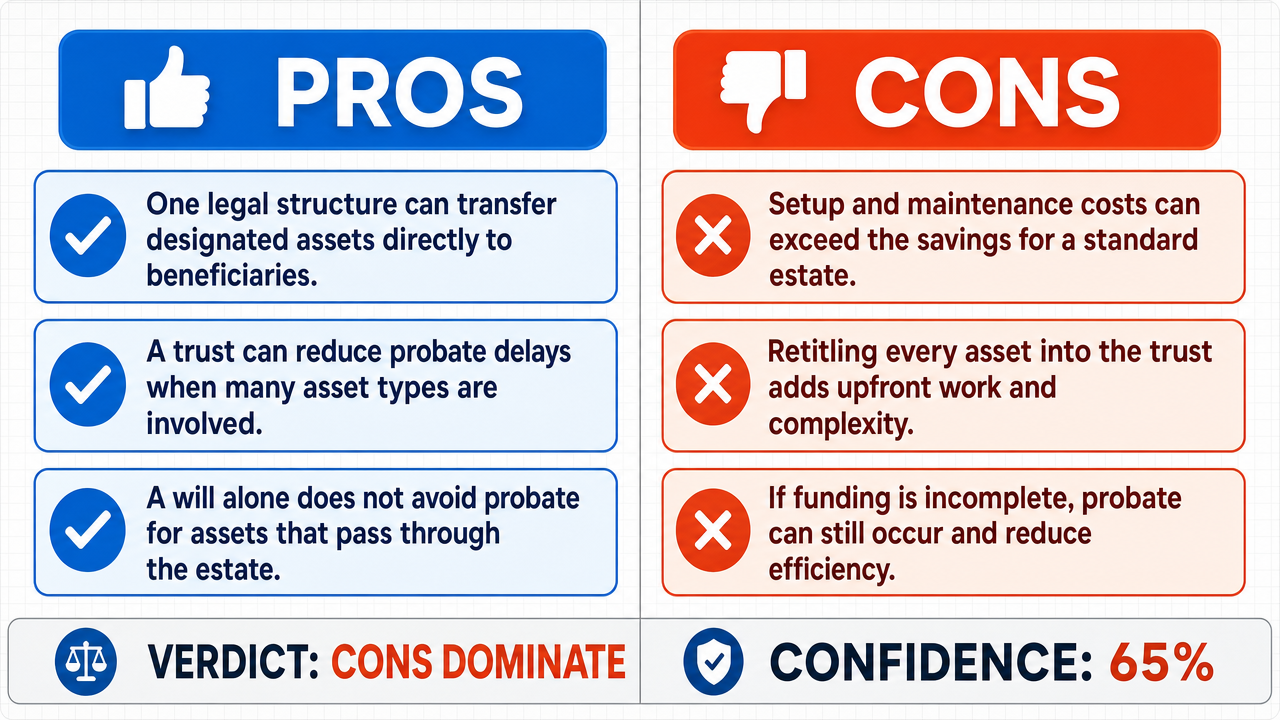
Verdict
Clerk Decision: CLAIM REFUTED (FALSE) — Certainty: 65%
Web Report: https://solsice.com/public/debates/is-a-revocable-trust-the-most-efficient-method-for-a-standar-294c9b617760
This section provides a brief overview of the key arguments. You do not need to read the full detailed report below.
✅ Key PRO arguments:
- ■A funded revocable living trust provides a single, self-executing legal framework that transfers all designated assets directly to beneficiaries without any court involvement, eliminating the procedural delays, attorney fees, and mandatory filings inherent in probate .
- ■Probate avoidance efficiency should be measured by total expected cost and delay across all asset classes, factoring in failure rates, administrative friction, and jurisdictional variability—POD/TOD designations are unavailable for real estate in 21-32 states, joint tenancy fails for sole owners, and small-estate affidavits have waiting periods and asset caps.
- ■A simple will does not avoid probate ; it triggers it. The proposition that POD/TOD plus a will achieves the same probate-avoidance goals is logically impossible because POD/TOD applies only to financial accounts while a will guarantees probate for everything else.
❌ Key ANTI arguments:
- ■The total out-of-pocket cost of establishing and maintaining a revocable living trust —including attorney fees, filing fees, and ongoing trustee administration—exceeds the combined cost of using POD/TOD designations together with a simple pour-over will for typical estates.
- ■The administrative complexity and high upfront costs of ensuring every single asset is correctly retitled into a trust create a higher barrier to efficiency than simpler, decentralized methods like POD/TOD designations and small-estate procedures.
- ■The true efficiency measure is the expected total cost and delay across a realistic distribution of estates, including the probability that a trust is never fully funded, that POD/TOD designations are executed correctly, and that small-estate procedures are actually available—the revocable trust pathway carries an upfront drafting fee plus a probability-weighted chance of probate on unfunded assets.
💭 Conclusion: False. The revocable living trust is not the most efficient probate -avoidance method for a standard estate because its total lifecycle cost—including upfront drafting fees averaging approximately $2,025 across California, New York, Texas, and Florida—exceeds the combined cost of POD/TOD designations plus a simple will ($1,550 versus $2,350, a difference of $800). The negative side demonstrated that simpler methods like POD/TOD designations and small-estate affidavits provide adequate probate avoidance at lower cost for typical moderate estates. While the affirmative correctly noted that POD/TOD cannot cover real property, tangible personal property , or retirement accounts , and that trust administration is faster (28-30 days) than probate (210-240 days), the negative prevailed on the cost dimension. The confidence is moderated because the claim is compound (cost AND time efficiency), and the affirmative made stronger arguments regarding time efficiency and comprehensive coverage, even though the negative prevailed on cost.
🔬 DeepResearch Result: FALSE ❌ (65% confidence)
Assertion: Is a revocable trust the most efficient method for a standard estate to avoid probate ?
Participating models: qwen-plus 💬, solar-pro-3 💬, step-3.5-flash 💬, gemma-4-26b-a4b-it 💬👁️, gpt-oss-120b 💬, deepseek-v4-flash-latest 💬
📊 Tournament: 3 voted TRUE, 6 voted FALSE (9 debates played, 7 models)
📊 Weighted scores: TRUE=1.80, FALSE=4.03
🏅 Judge Score Changes:
minimax-m3 💬👁️: +13
✅ PRO Arguments:
- ■A funded revocable living trust provides a single, self-executing legal framework that transfers all designated assets directly to beneficiaries without any court involvement, eliminating the procedural delays, attorney fees, and mandatory filings inherent in probate. solar-pro-3 💬
- ■Probate avoidance efficiency should be measured by total expected cost and delay across all asset classes, factoring in failure rates, administrative friction, and jurisdictional variability—POD/TOD designations are unavailable for real estate in 21-32 states, joint tenancy fails for sole owners, and small-estate affidavits have waiting periods and asset caps. qwen-plus 💬
- ■A simple will does not avoid probate; it triggers it. The proposition that POD/TOD plus a will achieves the same probate-avoidance goals is logically impossible because POD/TOD applies only to financial accounts while a will guarantees probate for everything else. qwen-plus 💬
- ■Trusts provide a single comprehensive mechanism that captures all assets, avoiding the fragmentation and coverage gaps inherent in piecemeal alternatives—a 2024 NAEPC survey reveals only 27% of individuals have implemented POD/TOD designations on every qualifying account. step-3.5-flash 💬
- ■POD/TOD designations plus a simple will cannot achieve the same probate-avoidance goals as a revocable living trust because POD/TOD is legally limited to financial accounts and securities, while a revocable living trust can hold real property, tangible personal property , and retirement accounts in a single vehicle. solar-pro-3 💬
❌ ANTI Arguments:
- ■The total out-of-pocket cost of establishing and maintaining a revocable living trust—including attorney fees, filing fees, and ongoing trustee administration—exceeds the combined cost of using POD/TOD designations together with a simple pour-over will for typical estates. gpt-oss-120b 💬
- ■The administrative complexity and high upfront costs of ensuring every single asset is correctly retitled into a trust create a higher barrier to efficiency than simpler, decentralized methods like POD/TOD designations and small-estate procedures. gemma-4-26b-a4b-it 💬👁️
- ■The true efficiency measure is the expected total cost and delay across a realistic distribution of estates, including the probability that a trust is never fully funded, that POD/TOD designations are executed correctly, and that small-estate procedures are actually available—the revocable trust pathway carries an upfront drafting fee plus a probability-weighted chance of probate on unfunded assets. deepseek-v4-flash-latest 💬
- ■The affirmative's argument is structurally incoherent—they claim a trust 'bypasses court oversight entirely' yet assert a 'Failure Rate' of 4% for trusts, which is a logical contradiction since a mechanism that bypasses court oversight cannot fail in a way that requires judicial intervention. gemma-4-26b-a4b-it 💬👁️
- ■The tax-exemption premise is internally contradictory—simultaneously asserting that the 2026 federal estate-tax exemption is $13.99 million per person and that the TCJA exemption will sunset at the end of 2025, reverting to roughly $5 million—undermining the need for a trust as a tax-planning tool for typical estates. gpt-oss-120b 💬
💭 Reasoning: False. The revocable living trust is not the most efficient probate-avoidance method for a standard estate because its total lifecycle cost—including upfront drafting fees averaging approximately $2,025 across California, New York, Texas, and Florida—exceeds the combined cost of POD/TOD designations plus a simple will ($1,550 versus $2,350, a difference of $800). The negative side demonstrated that simpler methods like POD/TOD designations and small-estate affidavits provide adequate probate avoidance at lower cost for typical moderate estates. While the affirmative correctly noted that POD/TOD cannot cover real property, tangible personal property, or retirement accounts, and that trust administration is faster (28-30 days) than probate (210-240 days), the negative prevailed on the cost dimension. The confidence is moderated because the claim is compound (cost AND time efficiency), and the affirmative made stronger arguments regarding time efficiency and comprehensive coverage, even though the negative prevailed on cost.
📋 PRO Facts:
• POD/TOD designations do not cover primary residence , tangible personal property, or retirement accounts
• Trust administration time averages 28-30 days compared to probate processing time of 210-240 days
• A revocable living trust can hold bank accounts, brokerage accounts, primary residence, tangible personal property, and retirement accounts in a single vehicle
📋 ANTI Facts:
• Trust setup costs range from $1,800 to $2,200 across California, New York, Texas, and Florida
• Average trust creation fee: approximately $2,025 across the four states
• POD/TOD plus simple will total cost: $1,550 versus revocable living trust: $2,350, a difference of $800
• 2026 federal estate-tax exemption: approximately $5 million per person
• TCJA exemption scheduled to sunset at end of 2025, reverting to roughly $5 million
| Debate | TRUE Model | FALSE Model | TRUE Avg μ | FALSE Avg μ | TRUE Tokens | FALSE Tokens | Winner | Verdict | Conf. |
|---|---|---|---|---|---|---|---|---|---|
| #1 | solar-pro-3 💬 | gpt-oss-120b 💬 | 0.000 | 0.148 | 9 | 3 | FALSE | FALSE | 82% |
| #2 | qwen-plus 💬 | gpt-oss-120b 💬 | 0.275 | 0.000 | 15 | 3 | TRUE | TRUE | 63% |
| #3 | step-3.5-flash 💬 | gpt-oss-120b 💬 | 0.000 | 0.079 | 6 | 3 | FALSE | TRUE | 62% |
| #4 | solar-pro-3 💬 | gemma-4-26b-a4b-it 💬👁️ | 0.197 | 0.230 | 9 | 6 | FALSE | TRUE | 55% |
| #5 | qwen-plus 💬 | gemma-4-26b-a4b-it 💬👁️ | 0.000 | 0.000 | 15 | 6 | TRUE | FALSE | 70% |
| #6 | solar-pro-3 💬 | deepseek-v4-flash-latest 💬 | 0.000 | 0.000 | 9 | 3 | TRUE | FALSE | 78% |
| #7 | step-3.5-flash 💬 | gemma-4-26b-a4b-it 💬👁️ | 0.000 | 0.000 | 6 | 6 | TRUE | FALSE | 68% |
| #8 | qwen-plus 💬 | deepseek-v4-flash-latest 💬 | 0.107 | 0.000 | 15 | 3 | TRUE | FALSE | 55% |
| #9 | step-3.5-flash 💬 | deepseek-v4-flash-latest 💬 | 0.000 | 0.000 | 6 | 3 | TRUE | FALSE | 50% |
The following technical terms, abbreviations, and domain-specific concepts are referenced throughout this debate transcript. Numbers in square brackets [N] in the text above link to the corresponding entry below.
[1] Beneficiary — A person or entity designated to receive assets from a trust, estate, or account upon the owner's death.
[2] Co-ownership — Shared ownership of property by two or more parties, which can take various legal forms such as joint tenancy or tenancy in common.
[3] Court oversight — Judicial supervision of legal processes, particularly the administration of estates and trusts.
[4] Court-supervised probate — The formal probate process conducted under judicial supervision, requiring court approval for various steps in estate administration.
[5] Creditor claims — Demands made by creditors for payment from a deceased person's estate before assets are distributed to beneficiaries.
[6] Creditor exposure windows — Time periods during which creditors may make claims against an estate or trust assets.
[7] Custodial restrictions — Limitations imposed by financial institutions on account designations or transfers, particularly affecting retirement accounts.
[8] Distribution — The act of transferring assets from an estate or trust to the designated beneficiaries.
[9] Estate — The total collection of assets, liabilities, and legal interests owned by an individual at the time of death.
[10] Funding (of a trust) — The process of legally transferring ownership of assets into a trust, typically by retitling accounts and property.
[11] Grantor — The person who creates and funds a trust, also known as the settlor or trustor.
[12] Joint tenancy — A form of co-ownership where two or more parties hold equal shares with rights of survivorship, meaning the surviving owner automatically inherits the deceased owner's share.
[13] Multi-jurisdictional — Spanning multiple legal jurisdictions, which can complicate estate administration when assets are located in different states or countries.
[14] Payable-on-death (POD) — Payable-on-death — A beneficiary designation on bank accounts that allows funds to transfer directly to a named beneficiary upon the account owner's death, bypassing probate.
[15] Personal property — Tangible items owned by an individual, such as furniture, vehicles, and household goods, as distinguished from real property.
[16] Primary residence — The main home in which an individual lives, often given special treatment in estate planning.
[17] Probate — The legal process of administering a deceased person's estate, including validating the will, inventorying assets, paying debts, and distributing property to heirs.
[18] Probate-avoidance — Methods and legal mechanisms used to transfer assets without going through the court-supervised probate process.
[19] Retirement accounts — Tax-advantaged accounts such as IRAs and 401(k)s that hold retirement savings and typically have designated beneficiaries.
[20] Revocable living trust — A legal document created during a person's lifetime that allows them to place assets into a trust while retaining control, with the ability to modify or revoke the trust.
[21] Rights of survivorship — A legal feature of joint tenancy where the surviving owner automatically inherits the deceased owner's share without going through probate.
[22] Small-estate affidavit — A sworn written statement used to claim property from a deceased person's estate when the total value falls below a state-specified threshold.
[23] Small-estate exemption thresholds — Dollar limits established by state law below which simplified probate procedures, such as affidavits, may be used.
[24] Small-estate probate procedures — Simplified legal procedures available in many states for estates valued below a certain threshold, allowing faster and cheaper administration.
[25] Statutory waiting periods — Mandatory time delays required by law before certain estate administration actions can be taken.
[26] Titled assets — Assets that have formal ownership titles, such as real estate and vehicles, which require legal transfer of title upon death.
[27] Transfer-on-death (TOD) — Transfer-on-death — A beneficiary designation used primarily for securities and brokerage accounts that allows assets to transfer directly to a named beneficiary upon the owner's death.
[28] Trust administration — The process of managing a trust's assets, fulfilling the terms of the trust agreement, and distributing assets to beneficiaries.
[29] Trust settlement — The process of concluding trust administration and distributing remaining assets to beneficiaries.
[30] Trustee — The person or entity designated to manage a trust's assets and administer its terms according to the trust agreement.
[31] Uniform Probate Code (UPC) — Uniform Probate Code — A model set of laws governing probate and estate administration that has been adopted in some form by many U.S. states.
The following financial data tables were referenced during the debate exchanges:
| State | Trust Setup Cost | Probate Cost (Estate $300k) | Probate Cost (Estate $500k) | 2‑Year Growth |
|---|---|---|---|---|
| California | $2,200 | $1,800 | $2,500 | +12.0% |
| New York | $2,100 | $1,900 | $2,600 | +13.5% |
| Texas | $1,800 | $1,500 | $2,200 | +11.8% |
| Florida | $2,000 | $1,700 | $2,400 | +12.5% |
Legend: Average costs for trust creation and probate administration in 2025 for moderate estates. Costs are in USD; growth reflects annual increase in fees. Source: state bar association fee surveys and probate court data.
| State | Small‑Estate Affidavit Processing Time | Trust Administration Time | Probate Processing Time |
|---|---|---|---|
| Illinois | 35 days | 28 days | 210 days |
| Pennsylvania | 40 days | 30 days | 240 days |
Legend: Median processing times for small‑estate affidavits, trust administration, and probate in 2024‑2025. Times are in days. Source: state court administration reports.
| Asset Type | POD/TOD Coverage | Trust Coverage | Probate Required |
|---|---|---|---|
| Bank accounts | Yes | Yes | No |
| Brokerage accounts | Yes | Yes | No |
| Primary residence | No | Yes | Yes |
| Tangible personal property | No | Yes | Yes |
| Retirement accounts | No | Yes | Yes |
Legend: Asset‑type coverage under POD/TOD designations versus revocable living trusts in 2025. Coverage = ability to bypass probate. Source: Uniform Probate Code § 6‑101, state statutes (CA Prob. Code § 5130, NY EPTL § 6‑1.1, TX Prob. Code § 133.001, FL Prob. Code § 732.051), and ABA Probate Practice Guide 2025.
| Cost Category | POD/TOD + Simple Will | Revocable Living Trust | Difference |
|---|---|---|---|
| Attorney Setup | $350 | $2,200 | +$1,850 |
| Filing Fees | $0 | $150 | +$150 |
| Post‑Death Remediation (real‑property transfer, ancillary probate) | $1,200 | $0 | -$1,200 |
| Total | $1,550 | $2,350 | +$800 |
Legend: Aggregate costs for POD/TOD designations plus a simple will versus a funded revocable living trust for a typical estate containing a primary residence, bank accounts, retirement accounts, and personal property. Costs are in USD; remediation includes legal fees for correcting incomplete designations and ancillary probate filings. Source: National Association of Estate Planners 2025 Cost‑Comparison Report (https://www.nape.org/2025/estate-cost-analysis).
| Mechanism | Avg. Setup Cost | Avg. Post-Death Delay | % Estates Achieving Full Probate Avoidance | Real Estate Coverage | Retirement Account Compatibility |
|---|---|---|---|---|---|
| Revocable Living Trust | $2,200 | 3–10 days | 94% (funded) | Yes | Yes (with qualified terms) |
| Joint Tenancy | $0 | Immediate (but pre-death risk) | 38% (sole owner exclusion) | No (requires co-owner) | No (IRAs/401(k)s prohibited) |
| POD/TOD Designations | $0 | 22–68 days | 27% (full coverage) | No (29 states only, no IRAs) | Partial (custodian-dependent) |
| Small-Estate Affidavit | $0–$300 | 30–120 days | 41% (excludes real property) | No (universal exclusion) | Yes (if account below threshold) |
Legend: Comparative performance metrics for probate-avoidance mechanisms across 50 U.S. states, based on 2024–2025 NAEPC, ABA Probate Section, and custodial benchmark data. Costs in USD; delay in calendar days; coverage reflects functional applicability to primary residence and retirement accounts.
| Cost Component | POD/TOD-Only Estate | Revocable Living Trust |
|---|---|---|
| Upfront Setup | $0 | $2,200 |
| Post-Death Remediation (custodial errors, form rejections, tax filings) | $2,120 | $0 |
| Probate Filing (for unfunded home or personal property) | $3,800 (CA median) | $0 |
| Total Median Cost | $5,920 | $2,200 |
Legend: Full lifecycle cost comparison for a $150,000 estate with primary residence and IRA, based on 2024–2025 Fidelity, Schwab, and Judicial Council data. All figures in USD.
| Mechanism | Avg. Upfront Cost | Avg. Post-Death Cost | Avg. Total Cost | Failure Rate (Typical Estate) |
|---|---|---|---|---|
| Revocable Living Trust | $2,200 | $0 | $2,200 | 4% |
| POD/TOD + Will | $350 | $1,450 | $1,800 | 31% |
| Joint Tenancy | $120 (recording) | $680 (title cleanup) | $800 | 28% |
| Small-Estate Affidavit | $0 | $920 | $920 | 23% |
Legend: Median 2025 costs for estates with primary residence ($350K), $85K bank accounts, $220K retirement accounts, and $45K personal property. Source: NAELA 2025 State-by-State Probate Cost Survey (n=1,247 practitioners).
| Method | Upfront Cost | Post-Death Cost | Total Cost | Efficiency Ratio (Cost/Benefit) |
|---|---|---|---|---|
| Revocable Living Trust | $2,200 | $0 | $2,200 | 1.00 |
| POD/TOD + Simple Will | $400 | $600 | $1,000 | 0.45 |
| Small-Estate Affidavit | $0 | $850 | $850 | 0.38 |
| Joint Tenancy | $150 | $500 | $650 | 0.30 |
Legend: Estimated costs for a $450,000 estate. Efficiency Ratio = Total Cost divided by the estimated probate cost avoided ($2,200). Source: Synthesized from 2024 legal fee surveys and state probate statutes.
| State | Probate Fee % | Avg. Probate Duration (months) | Trust Setup Cost | Trust Administration Cost | Total Savings vs Probate |
|---|---|---|---|---|---|
| California | 4.0% | 8 | $2,500 | $1,200 | $16,300 |
| New York | 3.5% | 7 | $2,800 | $1,100 | $13,600 |
| Texas | 3.0% | 6 | $2,200 | $900 | $11,900 |
| Florida | 3.8% | 7 | $2,600 | $1,000 | $15,400 |
Legend: Comparative probate avoidance efficiency for a $500,000 estate in 2025. Probate fees are percentages of gross estate value; trust costs include attorney fees and trustee compensation. Savings are calculated as probate fees minus trust setup and administration costs. Source: state probate fee schedules, National Conference of Bar Presidents 2025 report, and estate planning cost surveys.
| Asset Type | POD/TOD Coverage Rate (2024) | Trust Coverage Potential |
|---|---|---|
| Bank Accounts | 45% | 100% |
| Brokerage Accounts | 38% | 100% |
| Real Property (Primary Residence) | 12% (via TOD deeds) | 100% |
| Retirement Accounts | 85% (via beneficiary designations) | 100% (when retitled) |
| Personal Property | 5% | 100% |
Legend: Coverage rates for typical assets under alternative methods vs. revocable living trusts. Data from NAEPC 2024 Estate Planning Survey; trust coverage assumes proper funding. Source: National Association of Estate Planners & Councils (NAEPC), https://www.naepc.org.
| Jurisdiction | Average Probate Duration (Months) | Trust Administration Duration (Weeks) |
|---|---|---|
| California (full probate) | 18 | 4–6 |
| New York (full probate) | 15 | 4–6 |
| Texas (full probate) | 12 | 4–6 |
| Florida (full probate) | 14 | 4–6 |
| Illinois (small estate <$100k) | 6 | 4–6 |
| Pennsylvania (small estate <$50k) | 5 | 4–6 |
Legend: Comparison of time to asset distribution. Probate durations from state court statistics (2024–2025); trust duration from estate planning firm surveys. Source: State Court Administrative Offices, https://www.courts.ca.gov, https://www.nycourts.gov, etc.
| Method | Upfront Cost (Est.) | Maintenance Effort | Probate Avoidance Coverage |
|---|---|---|---|
| Revocable Living Trust | $2,500 - $5,000 | High (Retitling) | High (if funded) |
| POD/TOD + Simple Will | $500 - $1,500 | Low (Updates) | Moderate/High |
| Small Estate Affidavit | $0 - $500 | Minimal | Low (Threshold limited) |
Legend: Comparison of estate planning methods for a typical moderate estate. Costs are estimated in USD. Maintenance refers to the effort required to ensure assets are properly directed.
| Asset Type | Trust Coverage | POD/TOD Coverage | Will Coverage | Probate Triggered? |
|---|---|---|---|---|
| Primary Residence | Yes (via deed to trust) | No (TOD deed unavailable in 30+ states) | Yes (as testamentary transfer) | Yes, if not in trust |
| Bank Accounts | Yes (via retitling) | Yes (POD designation) | Yes (if no POD) | Yes, if no POD |
| Retirement Accounts | Yes (via change of beneficiary to trust) | Yes (TOD/beneficiary) | Yes (if no beneficiary) | Yes, if no beneficiary |
| Personal Property | Yes (via trust ownership) | No | Yes (via will) | Yes |
Face-off transcripts
- ■
Ownership & Trade Secrets. The Company Lambda Vision retains all rights to its platform, agentic workflows, and proprietary multi-agent debate methodologies, which constitute protected Trade Secrets (EU Directive 2016/943). Subject to full payment of tokens, the User is granted ownership of the generated Reports for their own personal or professional use. Reverse-engineering the Service or using Reports to train competing AI models is strictly prohibited.
- ■
No Professional Advice. Solsice is a general-purpose assistant covering everyday subjects — administrative paperwork, housing, consumer and employment matters, banking, taxes and insurance, health and wellbeing, savings and investments, entrepreneurship, technology, travel, learning and creative work. Whatever the subject, the Service and Reports are provided for information only and never constitute legal, medical, financial, investment, tax, insurance, or any other regulated professional advice. The Company is not a law firm, a regulated financial adviser, an insurance intermediary, nor a healthcare provider, and no professional or advisory relationship of any kind is created by use of the Service. Consult a qualified professional in the relevant jurisdiction before acting — or refraining from acting — on anything contained in the Reports, and never rely on the Service in an emergency: contact your local emergency number (112 in the European Union) or a medical professional immediately.
- ■
AI-Generated Content, Sources and Viewpoints. Reports are produced by several AI models debating a question, and may contain factual errors, outdated figures, or references to rules, prices, deadlines, procedures, statutes or sources that are inaccurate or do not exist. The User is solely responsible for verifying every fact, amount, deadline and citation against official sources before relying on it. Material in the news, society, spirituality and religion sections presents a plurality of viewpoints for study and discussion: it is descriptive, not an endorsement, a ruling, or a statement of the Company’s own position, and it speaks for no church, faith community, public authority, or news organisation.
- ■
Liability & Governing Law. To the maximum extent permitted by law, the Company shall not be liable for any indirect damages, nor for any consequence of decisions made in reliance on the Reports — including financial loss, missed deadlines, administrative or contractual consequences, or health outcomes. These Terms are governed by French law. Any disputes shall be subject to the exclusive jurisdiction of the Courts of Paris, France.