
International adoption becomes inherently flawed when financial incentives are introduced.
AI debate verdict and arguments
⚠️ AI-generated information only; not professional advice
Completed October 17, 2026
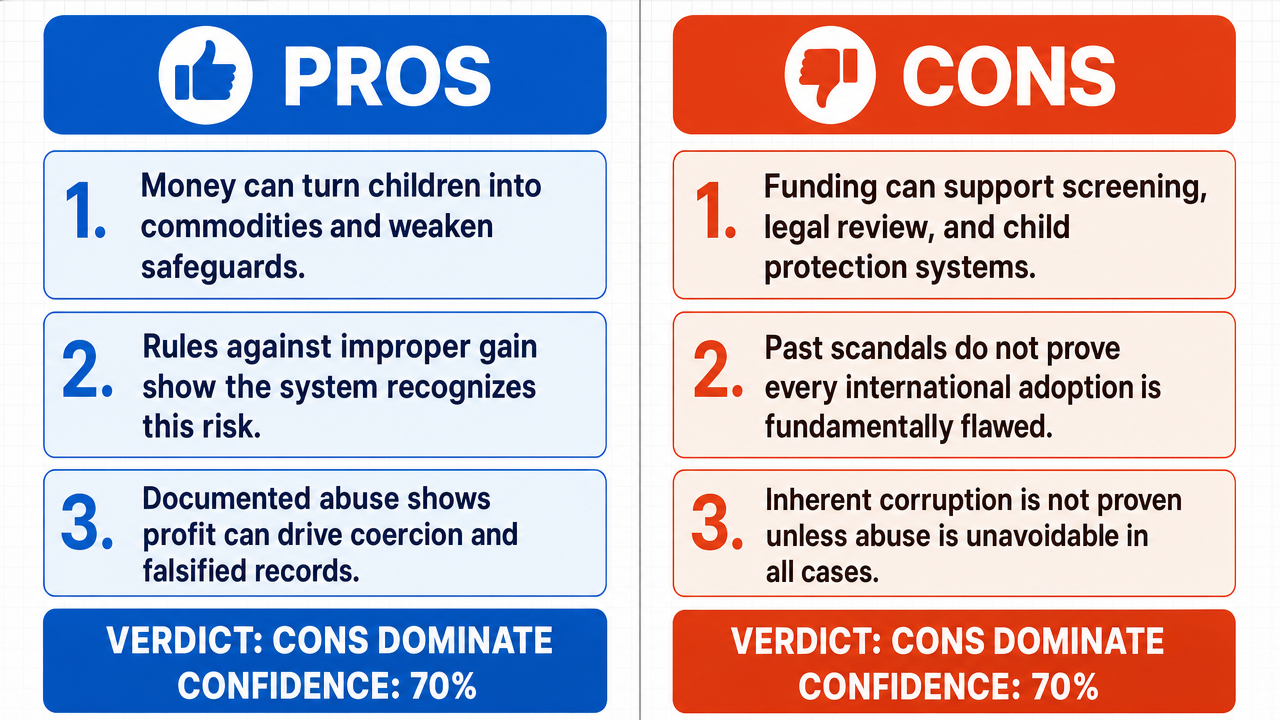
Verdict
Verdict: likely FALSE (70%)
Web Report: https://solsice.com/public/debates/international-adoption-becomes-inherently-flawed-when-financ-806c91aa3ede
This section provides a brief overview of the key arguments. You do not need to read the full detailed report below.
✅ Key PRO arguments:
- ■Financial incentives corrupt international adoption by commodifying children, undermining legal safeguards, and harming child welfare — when money enters the process, children become commodities traded on a market.
- ■The Hague Convention explicitly prohibits improper financial gain in intercountry adoption , yet documented cases (e.g., Guatemala) show adoption fees reaching $30,000–$40,000 with much going to intermediaries , demonstrating systemic corruption .
- ■E.J. Graff's 2008 Foreign Policy investigation documented how 'the baby business' operates, with lawyers paying birth mothers and falsifying documents to facilitate profit-driven adoptions.
❌ Key ANTI arguments:
- ■Financial mechanisms facilitate the necessary infrastructure and oversight required for safe international adoption, and the existence of fraudulent intermediaries in specific jurisdictions identifies points of failure, not the essential nature of the practice.
- ■The affirmative commits a fallacy of composition by treating specific historical anomalies (Guatemala, Cambodia) as self-evident proof that the entire process is inherently flawed.
- ■To prove the claim 'inherently' true, the opponent must demonstrate corruption is a necessary outcome in every possible branch of the incentive structure , yet they only address a subset of cases involving direct profit-driven fraud.
💭 Conclusion: False: the assertion is not supported because the anti side successfully exposed a fallacy of composition in the pro's reasoning. The pro side presented compelling evidence of specific corrupt practices — such as Guatemala's $30,000–$40,000 fees and documented intermediary abuse — but failed to demonstrate that financial incentives necessarily and universally corrupt international adoption. The anti side correctly noted that regulatory frameworks depend on administrative fees to fund oversight, meaning financial mechanisms are not inherently corrupting but can either strengthen or undermine safeguards depending on design. The pro's strongest point, the Hague Convention 's prohibition on improper financial gain , actually supports the anti position by showing the system already contains built-in anti-corruption provisions rather than being inherently flawed. The confidence of 70% reflects that while the anti side won on logical structure, the pro side presented credible historical evidence that financial incentives have produced serious harm in real cases.
🔬 DeepResearch Result: likely FALSE ❌ (70%)
Assertion: International adoption becomes inherently flawed when financial incentives are introduced.
Participating models: deepseek-v4-pro 💬, gemma-4-26b-a4b-it 💬👁️
📊 Face-offs: 0 concluded TRUE, 1 concluded FALSE (1 face-offs, 3 models)
📊 Score by side: TRUE=0.00, FALSE=0.70
🏅 Model score changes:
minimax-m3 💬👁️: +7
✅ PRO Arguments:
- ■Financial incentives corrupt international adoption by commodifying children, undermining legal safeguards, and harming child welfare — when money enters the process, children become commodities traded on a market. deepseek-v4-pro 💬
- ■The Hague Convention explicitly prohibits improper financial gain in intercountry adoption , yet documented cases (e.g., Guatemala) show adoption fees reaching $30,000–$40,000 with much going to intermediaries , demonstrating systemic corruption . deepseek-v4-pro 💬
- ■E.J. Graff's 2008 Foreign Policy investigation documented how 'the baby business' operates, with lawyers paying birth mothers and falsifying documents to facilitate profit-driven adoptions. deepseek-v4-pro 💬
- ■The pro side distinguishes 'financial mechanisms' in the abstract (which fund infrastructure) from the specific per-adoption fees paid to agencies and intermediaries that create corrupting monetary motivations directed at parties in the process. deepseek-v4-pro 💬
❌ ANTI Arguments:
- ■Financial mechanisms facilitate the necessary infrastructure and oversight required for safe international adoption, and the existence of fraudulent intermediaries in specific jurisdictions identifies points of failure, not the essential nature of the practice. gemma-4-26b-a4b-it 💬👁️
- ■The affirmative commits a fallacy of composition by treating specific historical anomalies (Guatemala, Cambodia) as self-evident proof that the entire process is inherently flawed. gemma-4-26b-a4b-it 💬👁️
- ■To prove the claim 'inherently' true, the opponent must demonstrate corruption is a necessary outcome in every possible branch of the incentive structure , yet they only address a subset of cases involving direct profit-driven fraud. gemma-4-26b-a4b-it 💬👁️
- ■Regulatory frameworks — including those implementing the Hague Convention — are themselves funded and maintained through the very administrative fees the opponent decries, so the financial structure is inseparable from the safeguards. gemma-4-26b-a4b-it 💬👁️
💭 Reasoning: False: the assertion is not supported because the anti side successfully exposed a fallacy of composition in the pro's reasoning. The pro side presented compelling evidence of specific corrupt practices — such as Guatemala's $30,000–$40,000 fees and documented intermediary abuse — but failed to demonstrate that financial incentives necessarily and universally corrupt international adoption. The anti side correctly noted that regulatory frameworks depend on administrative fees to fund oversight, meaning financial mechanisms are not inherently corrupting but can either strengthen or undermine safeguards depending on design. The pro's strongest point, the Hague Convention's prohibition on improper financial gain, actually supports the anti position by showing the system already contains built-in anti-corruption provisions rather than being inherently flawed. The confidence of 70% reflects that while the anti side won on logical structure, the pro side presented credible historical evidence that financial incentives have produced serious harm in real cases.
📋 PRO Facts:
• The Hague Convention explicitly states that intercountry adoption shall not be a source of improper financial gain.
• In Guatemala, before reforms, adoption fees reached $30,000–$40,000, with much going to intermediaries.
• E.J. Graff's reporting documented the commodification of children and intermediary-driven abuse in intercountry adoption.
• Profit-driven intermediaries have been documented in specific jurisdictions including Guatemala and Cambodia.
📋 ANTI Facts:
• Regulatory frameworks implementing adoption safeguards are often funded and maintained through administrative fees paid in the process.
• Specific historical anomalies of fraud (Guatemala, Cambodia) represent identifiable points of failure within the system, not evidence of universal corruption.
• The Hague Convention's anti-corruption provisions demonstrate that the existing framework already contains mechanisms to address improper financial gain.
| Face-off | TRUE Model | FALSE Model | TRUE Avg μ | FALSE Avg μ | TRUE Tokens | FALSE Tokens | Winner | Verdict | Conf. |
|---|---|---|---|---|---|---|---|---|---|
| #1 | deepseek-v4-pro 💬 | gemma-4-26b-a4b-it 💬👁️ | 0.436 | 0.394 | 6 | 2 | TRUE | FALSE | 70% |
The following technical terms, abbreviations, and domain-specific concepts are referenced throughout this debate transcript. Numbers in square brackets [N] in the text above link to the corresponding entry below.
[1] administrative fees — Charges levied to cover the operational and processing costs of running a program or service, referenced in the debate as the funding mechanism for international adoption oversight infrastructure.
[2] adoption agency — An organization, either public or private, that facilitates the adoption process by coordinating between birth parents, adoptive parents, and legal authorities; in the debate context, agencies are cited as parties that may receive per-adoption fees.
[3] best interests (of the child) — best interests of the child — A legal principle in child welfare and family law requiring that decisions regarding a child prioritize the child's well-being over other considerations; cited in the debate as the standard adoption should serve rather than financial interests.
[4] child welfare — A field of policy and practice concerned with the well-being, protection, and interests of children, often referenced in debates about adoption ethics and outcomes.
[5] commodification — The treatment of something not normally bought and sold as if it were a market commodity or commercial product; in the debate, the affirmative argues financial incentives lead to the commodification of children.
[6] equivocation — A logical fallacy in which a word or phrase is used in different senses within an argument, causing confusion between distinct concepts; cited in the debate regarding the term 'financial mechanisms.'
[7] fallacy of composition — A logical fallacy in which one assumes that what is true of parts of a whole must be true of the whole itself; cited by the negative to argue that corruption in specific cases does not prove the entire adoption system is inherently flawed.
[8] fee-for-service model — A payment structure in which compensation is tied to the completion of specific services or transactions; referenced in the debate as the neutral-sounding framing the negative allegedly uses to discuss per-adoption payments.
[9] GAO — Government Accountability Office — The U.S. federal government's auditing and investigative arm, which reports to Congress and reviews government programs; the affirmative references a 2015 GAO report in their argument.
[10] Hague Convention — Hague Convention on Protection of Children and Co-operation in Respect of Intercountry Adoption — An international treaty governing intercountry adoption, which the transcript states explicitly requires that intercountry adoption shall not be a source of improper financial gain.
[11] improper financial gain — A standard drawn from the Hague Convention prohibiting parties from deriving undue or improper profit from intercountry adoption, cited in the debate as a key safeguard against corruption.
[12] incentive structure — The arrangement of financial or other rewards that shapes how parties behave within a system; in the debate, it refers to the configuration of payments across the adoption process.
[13] intercountry adoption — The legal adoption of a child by individuals from a country other than the child's country of birth, also referred to in the debate as international adoption.
[14] intermediaries — Third parties such as lawyers, facilitators, or notaries who act between birth parents and adoptive parents during the adoption process; cited in the debate as recipients of large portions of adoption fees.
[15] per-adoption fees — Payments structured as a fixed amount charged for each completed adoption, which the affirmative argues create a per-transaction profit motive that encourages agencies to cut corners.
[16] profit motive — The economic incentive to generate financial gain from an activity, cited in the debate as the corrupting force embedded in per-adoption payments to agencies and intermediaries.
[17] regulatory frameworks — Systems of laws, rules, and oversight mechanisms designed to govern a process or industry; in the debate, these are the safeguards the negative argues administrative fees help fund.
[18] reimbursements — Repayments made to adoptive parents for documented legal and medical expenses incurred during the adoption process, characterized in the debate as a form of financial incentive directed at parents.
[19] straw man — straw man fallacy — A logical fallacy in which an opponent's argument is misrepresented as a weaker version in order to be more easily refuted; cited in the debate as the tactic the negative allegedly uses.
[20] subsidies — Financial support provided by governments or institutions to reduce the cost of adoption for adoptive parents, listed in the debate as a financial incentive directed at parents.
[21] systemic corruption — Corruption that is embedded within and enabled by the structure of a system rather than arising from isolated bad actors; the affirmative argues financial incentives produce this in international adoption.
[22] tax credits — Reductions in tax liability offered to adoptive parents by some jurisdictions, identified in the debate as a financial incentive directed at the parent side of the adoption process.
The following financial data tables were referenced during the debate exchanges:
| Adoption Component | Primary Function | Funding Requirement |
|---|---|---|
| Accreditation & Oversight | Ensuring agency compliance | High |
| Social Work & Home Studies | Verifying adoptive parent suitability | Moderate/High |
| Legal & Judicial Processing | Formalizing legal parentage | Moderate |
| Post-Placement Support | Monitoring child welfare | Moderate |
Legend: Functional categories of the international adoption infrastructure. Funding requirements reflect the necessity of professional, regulated service delivery to maintain safety standards.
Face-off transcripts
- ■
Ownership & Trade Secrets. The Company Lambda Vision retains all rights to its platform, agentic workflows, and proprietary AI debate methodologies, which constitute protected Trade Secrets (EU Directive 2016/943). Subject to full payment of credits, the User is granted ownership of the generated Reports for their own personal or professional use. Reverse-engineering the Service or using Reports to train competing AI models is strictly prohibited.
- ■
No Professional Advice. Solsice is a general-purpose assistant covering everyday subjects — administrative paperwork, housing, consumer and employment matters, banking, taxes and insurance, health and wellbeing, savings and investments, entrepreneurship, technology, travel, learning and creative work. Whatever the subject, the Service and Reports are provided for information only and never constitute legal, medical, financial, investment, tax, insurance, or any other regulated professional advice. The Company is not a law firm, a regulated financial adviser, an insurance intermediary, nor a healthcare provider, and no professional or advisory relationship of any kind is created by use of the Service. Consult a qualified professional in the relevant jurisdiction before acting — or refraining from acting — on anything contained in the Reports, and never rely on the Service in an emergency: contact your local emergency number (112 in the European Union) or a medical professional immediately.
- ■
AI-Generated Content, Sources and Viewpoints. Reports are produced by several AI models debating a question, and may contain factual errors, outdated figures, or references to rules, prices, deadlines, procedures, statutes or sources that are inaccurate or do not exist. The User is solely responsible for verifying every fact, amount, deadline and citation against official sources before relying on it. Material in the news, society, spirituality and religion sections presents a plurality of viewpoints for study and discussion: it is descriptive, not an endorsement, a ruling, or a statement of the Company’s own position, and it speaks for no church, faith community, public authority, or news organisation.
- ■
Liability & Governing Law. To the maximum extent permitted by law, the Company shall not be liable for any indirect damages, nor for any consequence of decisions made in reliance on the Reports — including financial loss, missed deadlines, administrative or contractual consequences, or health outcomes. These Terms are governed by French law. Any disputes shall be subject to the exclusive jurisdiction of the Courts of Paris, France.