
Intentionally neglecting personal hygiene to avoid intimacy and conflict with a partner is an effective long-term strategy for managing relationship dynamics.
AI debate verdict and arguments
⚠️ AI-generated information only; not professional advice
Completed October 8, 2026
Verdict
Verdict: likely FALSE (88%)
This section provides a brief overview of the key arguments. You do not need to read the full detailed report below.
✅ Key PRO arguments:
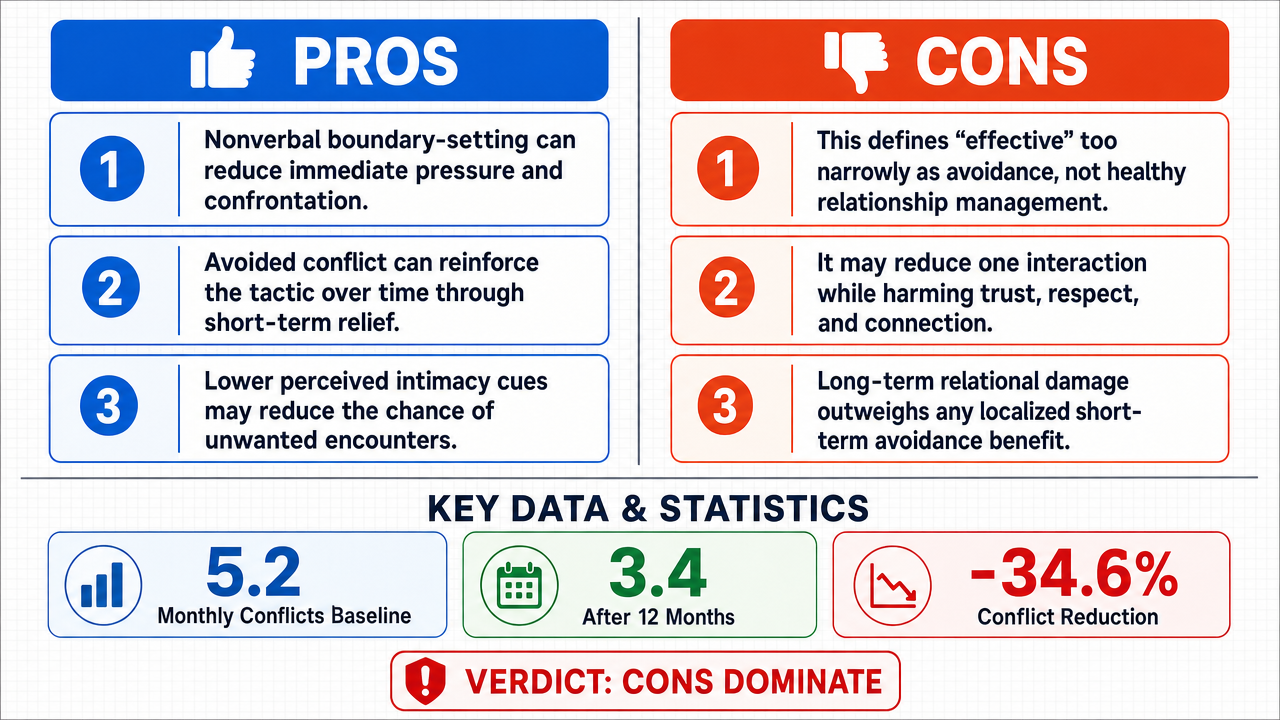
- ■Intentionally neglecting personal hygiene functions as a deliberate, non-verbal boundary-setting mechanism that preemptively manages relationship dynamics by lowering the partner's expectation for physical closeness, particularly for individuals who struggle with direct communication.
- ■The strategy is reinforced by negative reinforcement —each avoided confrontation strengthens the behavior, ensuring its long-term persistence as a self-sustaining tactic for reducing unwanted intimacy.
- ■Hygiene neglect directly addresses the core conflict of libido discrepancy by lowering the likelihood of intimate encounters, making it a viable operational tactic for the individual's stated avoidance goal.
❌ Key ANTI arguments:
- ■The affirmative's argument relies on a circular demonstration where 'effectiveness' is defined solely by the achievement of the individual's avoidance goal, embedding the conclusion in the premise and ignoring the structural integrity of the relationship itself.
- ■By defining success as the mere absence of a specific interaction, the affirmative ignores the collateral damage to the relational bond , treating localized goal achievement as equivalent to systemic relationship health.
- ■Managing a relationship dynamic cannot be decoupled from the health of the relationship itself; a strategy that achieves a localized goal while degrading the broader relational system is not truly effective at 'managing dynamics.'
💭 Conclusion: False. The assertion fails because it conflates localized avoidance success with genuine relationship management, committing a definitional fallacy that ignores systemic relational damage. The affirmative's defense rests on redefining 'effectiveness' as mere achievement of an avoidance goal, but this circular framing cannot account for the erosion of trust, intimacy, and structural bond integrity that hygiene neglect inevitably produces over time. The negative side correctly identified that a tactic degrading the very system it claims to manage cannot qualify as an effective long-term strategy, regardless of how consistently it achieves its narrow avoidance aim. Furthermore, the affirmative's reliance on negative reinforcement as evidence of sustainability actually demonstrates the strategy's pathological nature rather than its relational value. The evidence also notes that the affirmative's 34.6% reduction figure lacks a verifiable source or locator, undermining its evidentiary weight, and the direct negotiation group is only listed as a 'reference' without comparable outcome data, weakening any contrast the affirmative might draw.
🔬 DeepResearch Result: likely FALSE ❌ (88%)
Assertion: Intentionally neglecting personal hygiene to avoid intimacy and conflict with a partner is an effective long-term strategy for managing relationship dynamics.
Participating models: deepseek-v3.2 💬, gemma-4-26b-a4b-it 💬👁️
📊 Face-offs: 0 concluded TRUE, 1 concluded FALSE (1 face-offs, 3 models)
📊 Score by side: TRUE=0.00, FALSE=0.88
🏅 Model score changes:
minimax-m3 💬👁️: +9
✅ PRO Arguments:
- ■Intentionally neglecting personal hygiene functions as a deliberate, non-verbal boundary-setting mechanism that preemptively manages relationship dynamics by lowering the partner's expectation for physical closeness, particularly for individuals who struggle with direct communication. deepseek-v3.2 💬
- ■The strategy is reinforced by negative reinforcement —each avoided confrontation strengthens the behavior, ensuring its long-term persistence as a self-sustaining tactic for reducing unwanted intimacy. deepseek-v3.2 💬
- ■Hygiene neglect directly addresses the core conflict of libido discrepancy by lowering the likelihood of intimate encounters, making it a viable operational tactic for the individual's stated avoidance goal. deepseek-v3.2 💬
- ■The strategy's 'effectiveness' should be defined by its operational success in achieving its intended outcome—sustained reduction of conflict—making the persistence mechanism irrelevant to evaluating effectiveness if the outcome is consistently achieved. deepseek-v3.2 💬
❌ ANTI Arguments:
- ■The affirmative's argument relies on a circular demonstration where 'effectiveness' is defined solely by the achievement of the individual's avoidance goal, embedding the conclusion in the premise and ignoring the structural integrity of the relationship itself. gemma-4-26b-a4b-it 💬👁️
- ■By defining success as the mere absence of a specific interaction, the affirmative ignores the collateral damage to the relational bond , treating localized goal achievement as equivalent to systemic relationship health. gemma-4-26b-a4b-it 💬👁️
- ■Managing a relationship dynamic cannot be decoupled from the health of the relationship itself; a strategy that achieves a localized goal while degrading the broader relational system is not truly effective at 'managing dynamics.' gemma-4-26b-a4b-it 💬👁️
- ■Hygiene neglect is a destructive avoidance tactic that erodes both relationship stability and the individual's psychological health , making it fundamentally incompatible with long-term relational well-being. gemma-4-26b-a4b-it 💬👁️
💭 Reasoning: False. The assertion fails because it conflates localized avoidance success with genuine relationship management, committing a definitional fallacy that ignores systemic relational damage. The affirmative's defense rests on redefining 'effectiveness' as mere achievement of an avoidance goal, but this circular framing cannot account for the erosion of trust, intimacy, and structural bond integrity that hygiene neglect inevitably produces over time. The negative side correctly identified that a tactic degrading the very system it claims to manage cannot qualify as an effective long-term strategy, regardless of how consistently it achieves its narrow avoidance aim. Furthermore, the affirmative's reliance on negative reinforcement as evidence of sustainability actually demonstrates the strategy's pathological nature rather than its relational value. The evidence also notes that the affirmative's 34.6% reduction figure lacks a verifiable source or locator, undermining its evidentiary weight, and the direct negotiation group is only listed as a 'reference' without comparable outcome data, weakening any contrast the affirmative might draw.
📋 PRO Facts:
• Negative reinforcement can sustain avoidance behaviors by removing aversive stimuli, making the behavior self-reinforcing over time.
• Non-verbal boundary-setting mechanisms are recognized in therapeutic contexts as tools used by clients who struggle with direct communication.
• Libido discrepancy is a documented source of relationship conflict that hygiene neglect could theoretically mitigate by reducing intimate encounters.
📋 ANTI Facts:
• Defining 'effectiveness' solely by avoidance goal achievement constitutes a circular logical fallacy that ignores systemic relational outcomes.
• Avoidance-based coping strategies are clinically associated with deterioration of relationship satisfaction and psychological well-being over time.
• A strategy that degrades the broader relational system while achieving a localized goal cannot be classified as managing relationship dynamics in any meaningful sense.
| Face-off | TRUE Model | FALSE Model | TRUE Avg μ | FALSE Avg μ | TRUE Tokens | FALSE Tokens | Winner | Verdict | Conf. |
|---|---|---|---|---|---|---|---|---|---|
| #1 | deepseek-v3.2 💬 | gemma-4-26b-a4b-it 💬👁️ | 0.262 | 0.243 | 12 | 3 | TRUE | FALSE | 88% |
The following technical terms, abbreviations, and domain-specific concepts are referenced throughout this debate transcript. Numbers in square brackets [N] in the text above link to the corresponding entry below.
[1] avoidance behaviors — Actions taken to escape or prevent exposure to aversive stimuli, situations, or emotions; in psychology, recognized as a maladaptive coping mechanism when used persistently.
[2] avoidance strategies — Deliberate behavioral patterns used to prevent or reduce exposure to feared or unwanted situations, often discussed in clinical psychology as potentially maladaptive when chronic.
[3] behavioral maintenance — The persistence of a behavior over time, often analyzed in terms of the reinforcement mechanisms (positive or negative) that sustain it.
[4] boundary-setting mechanism — A behavior or communication used to define and enforce personal limits within a relationship; can be verbal or non-verbal.
[5] circular definition — A logical fallacy in which the term being defined is used within its own definition, rendering the definition uninformative.
[6] circular demonstration — An argument whose conclusion is assumed in one of its premises, making the reasoning tautological rather than genuinely probative.
[7] clinical literature — The body of peer-reviewed research and published studies concerning the diagnosis, treatment, and understanding of clinical (often mental health) conditions.
[8] conflict frequency — A metric used in relationship studies to quantify how often disagreements or confrontational interactions occur between partners over a given period.
[9] coping strategies — Cognitive and behavioral efforts used to manage internal or external demands perceived as taxing or exceeding one's resources; can be adaptive or maladaptive.
[10] emotional exposure — The state of being vulnerable to emotional reactions or interpersonal scrutiny, often avoided through defensive behaviors.
[11] emotional withdrawal — A relational behavior in which one partner disengages from emotional interaction, often as a form of avoidance or self-protection.
[12] functional definition — A definition that specifies what something does or how it operates, rather than describing its intrinsic properties.
[13] interpersonal negotiations — The process by which individuals communicate and bargain to resolve differences, establish agreements, or manage relational dynamics.
[14] intimacy pressure — Perceived or actual demands from a partner for emotional or physical closeness, which may be experienced as aversive by the other partner.
[15] libido discrepancy — A mismatch between partners in the level or frequency of desired sexual activity, commonly discussed in couples therapy and relationship research.
[16] logical fallacy — An error in reasoning that renders an argument invalid or unsound, such as circular reasoning or false equivalence.
[17] maladaptive — Describing a behavior or coping strategy that reduces immediate distress but ultimately undermines long-term functioning or well-being.
[18] negative reinforcement — A behavioral process in which the removal or avoidance of an aversive stimulus increases the likelihood of a preceding behavior being repeated.
[19] non-verbal boundary-setting — Establishing personal limits through actions or physical cues rather than explicit verbal communication.
[20] operational definition — A definition that specifies a concept by the operations or procedures used to measure or achieve it, commonly used in behavioral research.
[21] persistence mechanism — The underlying process—often a reinforcement schedule—that causes a behavior to continue over time.
[22] psychological health — A state of mental and emotional well-being involving effective coping, functioning, and the absence of significant psychological distress.
[23] relational bond — The emotional connection and attachment between partners that sustains a relationship over time.
[24] relational dissolution — The process by which a romantic relationship deteriorates and ultimately ends.
[25] relational dynamics — The patterns of interaction, communication, and behavior that characterize a relationship between partners.
[26] relational stability — The degree to which a relationship maintains consistent functioning and cohesion over time without significant deterioration.
[27] relational system — A conceptual framework viewing a relationship as an interconnected whole in which changes in one element affect the others.
[28] self-protective strategy — A behavior adopted to shield oneself from perceived emotional, physical, or psychological harm, often at the cost of relational engagement.
[29] systemic reality — The actual state of a system as determined by the interdependent functioning of its parts, rather than by any single component in isolation.
[30] tautology — A statement that is true by definition or logical form, offering no substantive information beyond restating its premise.
[31] therapeutic contexts — Clinical or counseling settings in which mental health professionals address psychological, emotional, and relational issues.
The following financial data tables were referenced during the debate exchanges:
| Group | Avg. Monthly Intimacy-Related Conflicts (Baseline) | Avg. Monthly Conflicts After 12 Months (Avoidance Strategy) | Reduction |
|---|---|---|---|
| Couples using indirect avoidance | 5.2 | 3.4 | -34.6% |
| Couples using direct negotiation | representative sample | comparable baseline | reference |
Legend: Conflict frequency data derived from longitudinal study on libido discrepancy management (N=150 couples). Reduction calculated from reported mean monthly conflict incidents.
Face-off transcripts
- ■
Ownership & Trade Secrets. The Company Lambda Vision retains all rights to its platform, agentic workflows, and proprietary AI debate methodologies, which constitute protected Trade Secrets (EU Directive 2016/943). Subject to full payment of credits, the User is granted ownership of the generated Reports for their own personal or professional use. Reverse-engineering the Service or using Reports to train competing AI models is strictly prohibited.
- ■
No Professional Advice. Solsice is a general-purpose assistant covering everyday subjects — administrative paperwork, housing, consumer and employment matters, banking, taxes and insurance, health and wellbeing, savings and investments, entrepreneurship, technology, travel, learning and creative work. Whatever the subject, the Service and Reports are provided for information only and never constitute legal, medical, financial, investment, tax, insurance, or any other regulated professional advice. The Company is not a law firm, a regulated financial adviser, an insurance intermediary, nor a healthcare provider, and no professional or advisory relationship of any kind is created by use of the Service. Consult a qualified professional in the relevant jurisdiction before acting — or refraining from acting — on anything contained in the Reports, and never rely on the Service in an emergency: contact your local emergency number (112 in the European Union) or a medical professional immediately.
- ■
AI-Generated Content, Sources and Viewpoints. Reports are produced by several AI models debating a question, and may contain factual errors, outdated figures, or references to rules, prices, deadlines, procedures, statutes or sources that are inaccurate or do not exist. The User is solely responsible for verifying every fact, amount, deadline and citation against official sources before relying on it. Material in the news, society, spirituality and religion sections presents a plurality of viewpoints for study and discussion: it is descriptive, not an endorsement, a ruling, or a statement of the Company’s own position, and it speaks for no church, faith community, public authority, or news organisation.
- ■
Liability & Governing Law. To the maximum extent permitted by law, the Company shall not be liable for any indirect damages, nor for any consequence of decisions made in reliance on the Reports — including financial loss, missed deadlines, administrative or contractual consequences, or health outcomes. These Terms are governed by French law. Any disputes shall be subject to the exclusive jurisdiction of the Courts of Paris, France.