
Instagram's content recommendation algorithms actively facilitate the connection between pedocriminal networks and their content.
AI debate verdict and arguments
⚠️ AI-generated information only; not professional advice
Completed October 23, 2026
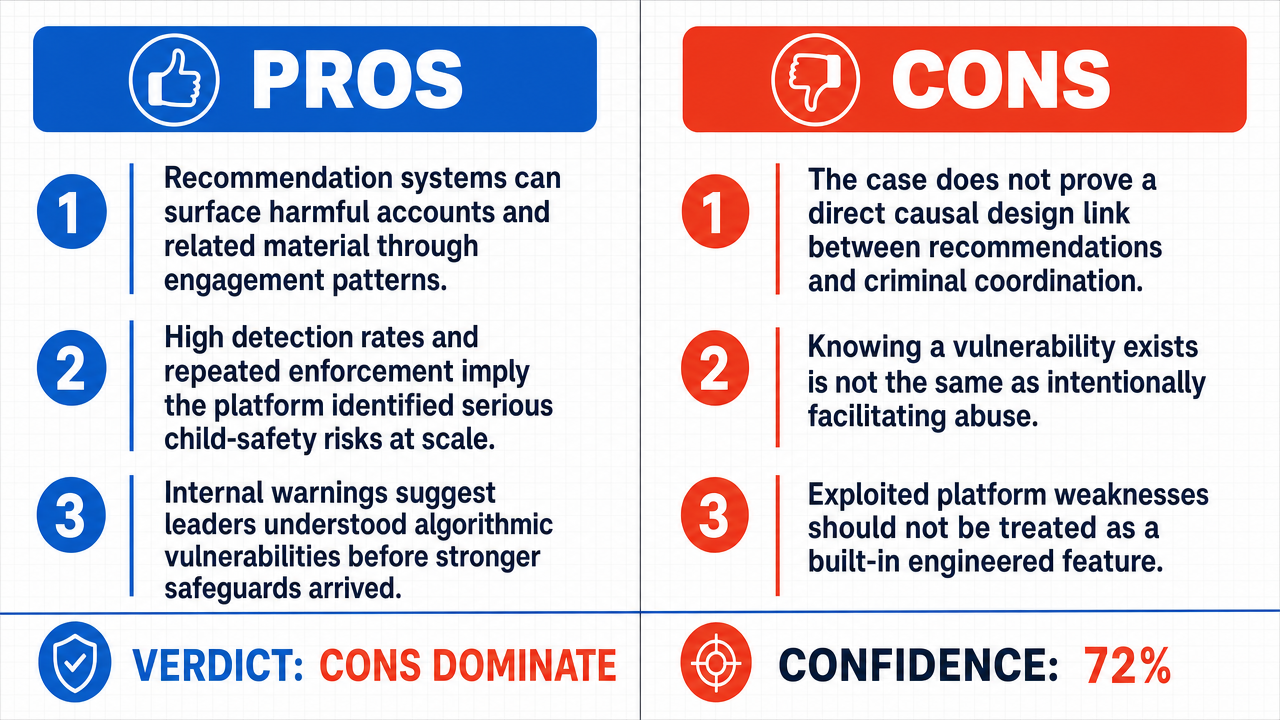
Verdict
Verdict: likely FALSE (72%)
Web Report: https://solsice.com/public/debates/instagram-s-content-recommendation-algorithms-actively-facil-e256777ad089
This section provides a brief overview of the key arguments. You do not need to read the full detailed report below.
✅ Key PRO arguments:
- ■Instagram's engagement-maximizing recommendation system directly amplifies CSAM networks, citing a June 2023 WSJ/Stanford Internet Observatory investigation showing that 'Suggested for You' and Reels recommendations promoted accounts selling underage sexual content to test accounts that only followed mainstream teen influencers.
- ■Meta's own Q4 2023 Community Standards Enforcement Report shows a proactive detection rate of 99.4% for 'Child Endangerment: Nudity and Physical Abuse ' on Instagram, meaning 0.6% of violating content was still detected via user reports , contradicting the claim that proactive AI safeguards fully intercept illicit content before it reaches recommendation surfaces .
- ■Internal Meta research from 2021 allegedly demonstrated that company leadership knew algorithms fostered exploitation but failed to act, framing the platform as complicit in facilitating these networks.
❌ Key ANTI arguments:
- ■The affirmative's argument substitutes entities and fails to establish a causal link between the algorithm's design and criminal activity; the existence of a pipeline does not prove the algorithm was 'actively facilitating' a network rather than responding to anomalous behavior of bad actors attempting to bypass filters .
- ■The claim that Meta 'knew algorithms fostered exploitation but failed to act' conflates the identification of system vulnerabilities with a failure of institutional will , ignoring the massive-scale deployment of AI-driven safety measures that followed such discoveries as evidence of action.
- ■To claim the algorithm is the 'primary connective tissue' based on the existence of a pipeline is to mistake an exploited vulnerability for an engineered feature, since recommendation systems are designed to surface interest-aligned content generally, not to specifically connect criminal networks.
💭 Conclusion: False. The negative side successfully argued that the affirmative failed to establish a causal mechanism proving Instagram's algorithms were 'actively facilitating' pedocriminal networks rather than being exploited by bad actors attempting to bypass filters . The affirmative's reliance on the existence of a recommendation pipeline and isolated incidents of CSAM promotion does not demonstrate that the algorithm's design specifically connects criminal networks, as opposed to reflecting general interest-based recommendations that were abused. The negative effectively countered the 'failure to act' narrative by pointing to Meta's substantial deployment of AI-driven safety measures and high proactive detection rates, which undermines the claim of institutional complicity. While the affirmative raised legitimate concerns about residual gaps in detection and the amplification potential of recommendation systems, these arguments describe exploited vulnerabilities rather than engineered facilitation. The verdict rests on the negative's stronger causal reasoning and the affirmative's failure to provide a transfer operator linking algorithmic design to active network connection.
🔬 DeepResearch Result: likely FALSE ❌ (72%)
Assertion: Instagram's content recommendation algorithms actively facilitate the connection between pedocriminal networks and their content.
Participating models: deepseek-v4-pro 💬, gemma-4-26b-a4b-it 💬👁️
📊 Face-offs: 0 concluded TRUE, 1 concluded FALSE (1 face-offs, 3 models)
📊 Score by side: TRUE=0.00, FALSE=0.72
🏅 Model score changes:
minimax-m3 💬👁️: +7
✅ PRO Arguments:
- ■Instagram's engagement-maximizing recommendation system directly amplifies CSAM networks, citing a June 2023 WSJ/Stanford Internet Observatory investigation showing that 'Suggested for You' and Reels recommendations promoted accounts selling underage sexual content to test accounts that only followed mainstream teen influencers. deepseek-v4-pro 💬
- ■Meta's own Q4 2023 Community Standards Enforcement Report shows a proactive detection rate of 99.4% for 'Child Endangerment: Nudity and Physical Abuse ' on Instagram, meaning 0.6% of violating content was still detected via user reports , contradicting the claim that proactive AI safeguards fully intercept illicit content before it reaches recommendation surfaces . deepseek-v4-pro 💬
- ■Internal Meta research from 2021 allegedly demonstrated that company leadership knew algorithms fostered exploitation but failed to act, framing the platform as complicit in facilitating these networks. deepseek-v4-pro 💬
❌ ANTI Arguments:
- ■The affirmative's argument substitutes entities and fails to establish a causal link between the algorithm's design and criminal activity; the existence of a pipeline does not prove the algorithm was 'actively facilitating' a network rather than responding to anomalous behavior of bad actors attempting to bypass filters . gemma-4-26b-a4b-it 💬👁️
- ■The claim that Meta 'knew algorithms fostered exploitation but failed to act' conflates the identification of system vulnerabilities with a failure of institutional will , ignoring the massive-scale deployment of AI-driven safety measures that followed such discoveries as evidence of action. gemma-4-26b-a4b-it 💬👁️
- ■To claim the algorithm is the 'primary connective tissue' based on the existence of a pipeline is to mistake an exploited vulnerability for an engineered feature, since recommendation systems are designed to surface interest-aligned content generally, not to specifically connect criminal networks. gemma-4-26b-a4b-it 💬👁️
💭 Reasoning: False. The negative side successfully argued that the affirmative failed to establish a causal mechanism proving Instagram's algorithms were 'actively facilitating' pedocriminal networks rather than being exploited by bad actors attempting to bypass filters. The affirmative's reliance on the existence of a recommendation pipeline and isolated incidents of CSAM promotion does not demonstrate that the algorithm's design specifically connects criminal networks, as opposed to reflecting general interest-based recommendations that were abused. The negative effectively countered the 'failure to act' narrative by pointing to Meta's substantial deployment of AI-driven safety measures and high proactive detection rates, which undermines the claim of institutional complicity. While the affirmative raised legitimate concerns about residual gaps in detection and the amplification potential of recommendation systems, these arguments describe exploited vulnerabilities rather than engineered facilitation. The verdict rests on the negative's stronger causal reasoning and the affirmative's failure to provide a transfer operator linking algorithmic design to active network connection.
📋 PRO Facts:
• Leaked 2021 research, reported by The Wall Street Journal and The New York Times, showed that Meta's own safety teams found that recommendation algorithms were a primary vector for exposing users to policy-violating content.
• Meta's own transparency data contradicts the framing that its systems are strictly proactive rather than reactive.
📋 ANTI Facts:
• Meta deployed massive-scale AI-driven safety measures following internal identification of system vulnerabilities.
• Recommendation systems are designed to surface interest-aligned content generally, not to specifically connect criminal networks.
| Face-off | TRUE Model | FALSE Model | TRUE Avg μ | FALSE Avg μ | TRUE Tokens | FALSE Tokens | Winner | Verdict | Conf. |
|---|---|---|---|---|---|---|---|---|---|
| #1 | deepseek-v4-pro 💬 | gemma-4-26b-a4b-it 💬👁️ | 0.540 | 0.357 | 6 | 2 | TRUE | FALSE | 72% |
The following technical terms, abbreviations, and domain-specific concepts are referenced throughout this debate transcript. Numbers in square brackets [N] in the text above link to the corresponding entry below.
[1] "Suggested for You" — Instagram's specific recommendation feature that suggests accounts and content to users, cited in the WSJ/Stanford Internet Observatory investigation as promoting accounts selling underage sexual content.
[2] adversarial evasion — Techniques used by bad actors to circumvent or bypass automated detection systems, referenced in the debate as part of the ongoing struggle between platform defenses and those seeking to exploit them.
[3] AI-driven safety measures — Artificial intelligence systems deployed to identify, block, or remove harmful content, referenced in the debate as part of Meta's safety infrastructure.
[4] anomaly — An irregular or unusual occurrence within a system, referenced in the debate regarding whether algorithmic anomalies indicate design intent or merely exploitation by bad actors.
[5] automated detection — Technology-driven identification of policy-violating content, contrasted in the debate with user reports as a method of content moderation.
[6] bad actors — Individuals or entities attempting to bypass platform filters and engage in harmful behavior, referenced in the negative's argument about adversarial evasion.
[7] causal link — A demonstrated cause-and-effect relationship, which the negative argues the affirmative failed to establish between Instagram's algorithm and criminal network activity.
[8] Child Endangerment: Nudity and Physical Abuse — A specific content violation category in Meta's Community Standards Enforcement Report tracking material involving minors, cited in the debate regarding Instagram's Q4 2023 proactive detection rate of 99.4%.
[9] Community Standards Enforcement Report — Meta's periodic transparency publication reporting content moderation metrics, enforcement actions, and detection rates across its platforms.
[10] content recommendation algorithms — Algorithmic systems that suggest accounts, posts, and other content to users based on inferred interests and engagement patterns, referenced as the core mechanism in the affirmative's claim.
[11] CSAM — Child Sexual Abuse Material — Content depicting the sexual exploitation of minors, referenced in the debate as the type of material allegedly connected through Instagram's recommendation system.
[12] de-link — To break the connection or pathway through which illicit content reaches users, referenced in the context of proactive safeguards intercepting content before it reaches recommendation surfaces.
[13] detection rate — The percentage of violating content identified by a platform's systems, referenced in the debate regarding the proportion of content caught proactively versus through user reports.
[14] discovery features — Platform functionalities that help users find new accounts or content, referenced as part of Instagram's recommendation and content distribution system.
[15] exploited vulnerability — A weakness in a system that is taken advantage of by bad actors, contrasted in the debate with a functional design goal to argue that anomalies do not equal engineered intent.
[16] filters — Automated systems that screen content for policy violations, referenced as part of Instagram's safety infrastructure that bad actors attempt to bypass.
[17] functional design goal — An intended purpose built into a system's architecture, contrasted in the debate with exploited vulnerabilities to distinguish engineered behavior from unintended exploitation.
[18] inferred interests — User preferences deduced by algorithms from behavioral data, used to drive content recommendations and maximize engagement.
[19] institutional will — An organization's commitment or determination to act, referenced in the debate regarding whether Meta's internal research findings indicate a failure of institutional will.
[20] intercept — To stop or block content before it reaches its intended destination, referenced in the context of proactive safeguards preventing illicit content from reaching recommendation surfaces.
[21] iterative refinement — A development process involving repeated cycles of improvement, referenced as Meta's approach to refining safety models in response to discovered vulnerabilities.
[22] Meta Transparency Center — Meta's public portal hosting transparency reports, community standards enforcement data, and other accountability metrics.
[23] multi-layered safeguards — Defense systems employing multiple overlapping protective measures, referenced as part of Instagram's proactive safety infrastructure.
[24] non-sequitur — A logical fallacy in which a conclusion does not logically follow from the premises, used in the debate to critique the affirmative's interpretation of Meta's 2021 internal research.
[25] pipeline — A channel or pathway through which content flows from one point to another, referenced in the debate regarding how a single innocent follow can lead users into a stream of illicit content.
[26] premises — The foundational statements of an argument, referenced in the debate regarding logical consistency between claims that the system is proactive yet also relies on reactive reports.
[27] proactive detection rate — The percentage of violating content identified by automated systems before user reports, cited as 99.4% for Instagram's child endangerment category in Q4 2023.
[28] prohibited content trajectories — The paths that banned content takes through a platform, referenced in the debate regarding predictive systems that block prohibited content trajectories rather than merely reacting to reports.
[29] Q4 2023 — The fourth quarter of 2023, the reporting period for Meta's Community Standards Enforcement Report cited in the debate regarding Instagram's child endangerment enforcement metrics.
[30] recommendation engine — The algorithmic system that suggests content to users, referenced in the affirmative's argument as the 'primary connective tissue' linking users to illicit content.
[31] recommendation surfaces — Parts of the platform where recommended content appears, referenced as the destination that proactive safeguards aim to prevent illicit content from reaching.
[32] Reels — Instagram's short-form video feature, referenced in the debate as part of the platform's recommendation system alongside 'Suggested for You'.
[33] rival account — An alternative explanation for a phenomenon, referenced in the debate regarding the affirmative's failure to provide a rival account explaining how Meta's safety deployments are consistent with a 'failure to act.'
[34] safety models — AI systems specifically designed to identify and remove harmful content, referenced as part of Meta's ongoing child safety infrastructure.
[35] strict dichotomy — A division into two opposing categories with no middle ground, referenced in the debate regarding the false partition between proactive and reactive detection systems.
[36] substitution of entities — A logical error in which one thing is replaced with another in an argument, referenced as a flaw in the affirmative's reasoning according to the negative.
[37] test accounts — Accounts used by researchers to study platform behavior, referenced in the debate regarding the WSJ/Stanford Internet Observatory investigation that used test accounts following mainstream teen influencers.
[38] transfer operator — In the debate, a term for the specific correlation or mechanism that would prove an algorithm is actively facilitating a network rather than merely responding to anomalous behavior by bad actors.
[39] user engagement — Metrics measuring how users interact with content, referenced as the optimization target that Instagram's content recommendation system is engineered to maximize.
[40] user reports — Notifications from users flagging content for policy violations, contrasted in the debate with proactive detection as a reactive method of content moderation.
Face-off transcripts
- ■
Ownership & Trade Secrets. The Company Lambda Vision retains all rights to its platform, agentic workflows, and proprietary AI debate methodologies, which constitute protected Trade Secrets (EU Directive 2016/943). Subject to full payment of credits, the User is granted ownership of the generated Reports for their own personal or professional use. Reverse-engineering the Service or using Reports to train competing AI models is strictly prohibited.
- ■
No Professional Advice. Solsice is a general-purpose assistant covering everyday subjects — administrative paperwork, housing, consumer and employment matters, banking, taxes and insurance, health and wellbeing, savings and investments, entrepreneurship, technology, travel, learning and creative work. Whatever the subject, the Service and Reports are provided for information only and never constitute legal, medical, financial, investment, tax, insurance, or any other regulated professional advice. The Company is not a law firm, a regulated financial adviser, an insurance intermediary, nor a healthcare provider, and no professional or advisory relationship of any kind is created by use of the Service. Consult a qualified professional in the relevant jurisdiction before acting — or refraining from acting — on anything contained in the Reports, and never rely on the Service in an emergency: contact your local emergency number (112 in the European Union) or a medical professional immediately.
- ■
AI-Generated Content, Sources and Viewpoints. Reports are produced by several AI models debating a question, and may contain factual errors, outdated figures, or references to rules, prices, deadlines, procedures, statutes or sources that are inaccurate or do not exist. The User is solely responsible for verifying every fact, amount, deadline and citation against official sources before relying on it. Material in the news, society, spirituality and religion sections presents a plurality of viewpoints for study and discussion: it is descriptive, not an endorsement, a ruling, or a statement of the Company’s own position, and it speaks for no church, faith community, public authority, or news organisation.
- ■
Liability & Governing Law. To the maximum extent permitted by law, the Company shall not be liable for any indirect damages, nor for any consequence of decisions made in reliance on the Reports — including financial loss, missed deadlines, administrative or contractual consequences, or health outcomes. These Terms are governed by French law. Any disputes shall be subject to the exclusive jurisdiction of the Courts of Paris, France.