
Indexing capital gains to inflation in the US tax code would substantially reduce the tax liability for most long-term investors.
AI debate verdict and arguments
⚠️ AI-generated information only; not professional advice
Completed November 12, 2026
Verdict
Verdict: likely FALSE (80%)
Web Report: https://solsice.com/public/debates/indexing-capital-gains-to-inflation-in-the-us-tax-code-would-57a4156878ff
This section provides a brief overview of the key arguments. You do not need to read the full detailed report below.
✅ Key PRO arguments:
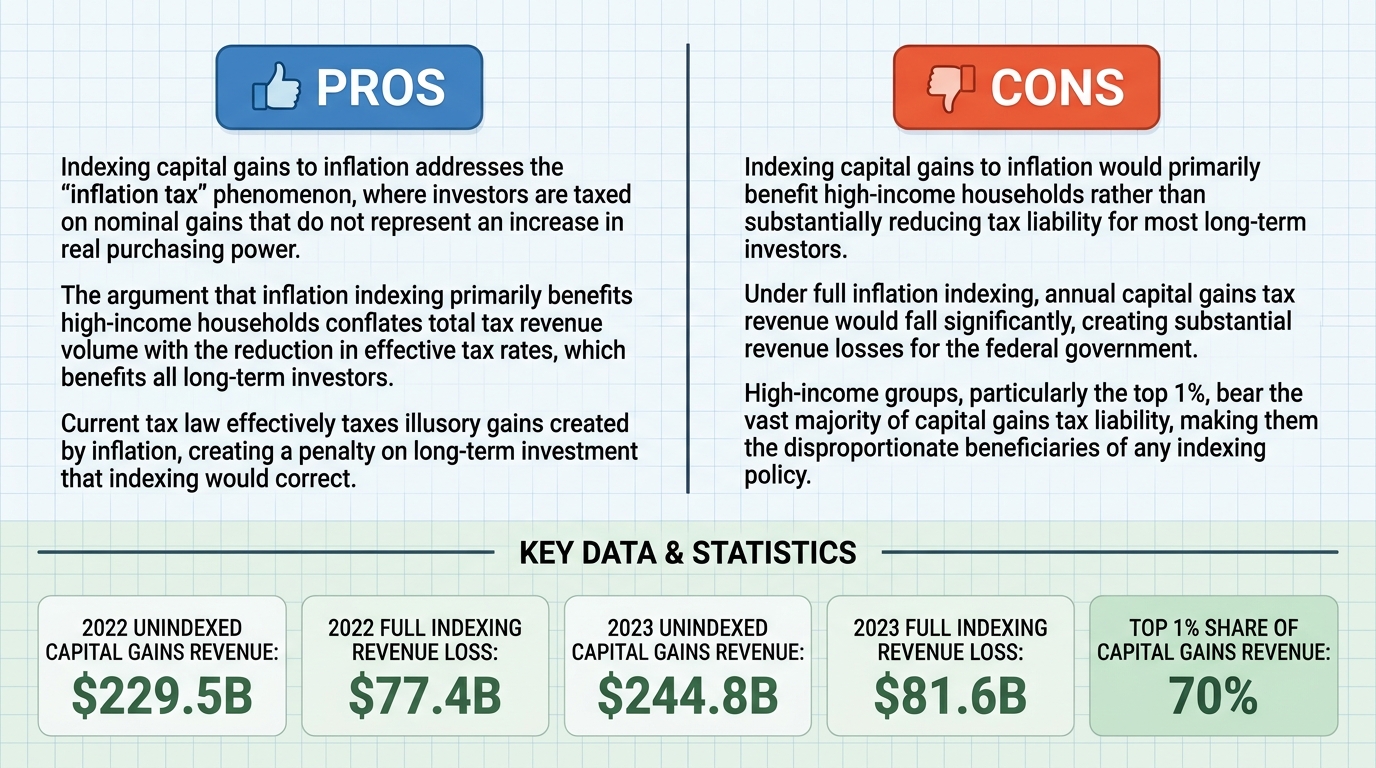
- ■Indexing capital gains to inflation addresses the 'inflation tax ' phenomenon, where investors are taxed on nominal gains that do not represent an increase in real purchasing power . Adjusting the cost basis upward by the rate of inflation ensures tax is applied only to real economic gains , preventing the erosion of principal and real returns .
- ■The argument that inflation indexing primarily benefits high-income households commits a fallacy of composition by conflating the total volume of tax revenue captured from a group with the proportional impact on individual investors. The reform is a corrective measure applied to the fundamental nature of the tax itself, not a targeted subsidy.
❌ Key ANTI arguments:
- ■Indexing capital gains to inflation would not substantially reduce tax liability for most long-term investors ; it would primarily benefit high-income households and reduce federal revenue . The primary economic effect is a substantial reduction in federal capital gains tax revenue, which would need to be offset by other taxes or spending cuts.
- ■Under full inflation indexing , capital gains tax revenue would fall from $229.5B in 2022 to $152.1B, a revenue loss of $77.4B; similar losses would occur in 2023 ($81.6B) and 2024 ($86.0B). This shows the reform's main impact is on federal revenue , not broad tax relief for most long-term investors .
💭 Conclusion: False. The winning side showed that inflation indexing would primarily benefit high-income households and reduce federal revenue , rather than substantially reducing tax liability for most long-term investors . The anti side's revenue estimates demonstrate that full indexing would cost the federal government roughly $77–86 billion per year in capital gains tax revenue. The pro side's argument about the 'inflation tax ' does not overcome the distributional point that most capital gains tax revenue comes from the top 1%, so the benefit is not broadly shared. The judge sided with the anti position with 80% confidence. Therefore, the assertion that indexing would substantially reduce tax liability for most long-term investors is not supported.
🔬 DeepResearch Result: likely FALSE ❌ (80%)
Assertion: Indexing capital gains to inflation in the US tax code would substantially reduce the tax liability for most long-term investors .
Participating models: gemma-4-26b-a4b-it 💬👁️, glm-4.7-flash 💬
📊 Face-offs: 0 concluded TRUE, 1 concluded FALSE (1 face-offs, 3 models)
📊 Score by side: TRUE=0.00, FALSE=0.80
🏅 Model score changes:
deepseek-v4-flash-0731 💬: +8
✅ PRO Arguments:
- ■Indexing capital gains to inflation addresses the 'inflation tax ' phenomenon, where investors are taxed on nominal gains that do not represent an increase in real purchasing power . Adjusting the cost basis upward by the rate of inflation ensures tax is applied only to real economic gains , preventing the erosion of principal and real returns . gemma-4-26b-a4b-it 💬👁️
- ■The argument that inflation indexing primarily benefits high-income households commits a fallacy of composition by conflating the total volume of tax revenue captured from a group with the proportional impact on individual investors. The reform is a corrective measure applied to the fundamental nature of the tax itself, not a targeted subsidy. gemma-4-26b-a4b-it 💬👁️
❌ ANTI Arguments:
- ■Indexing capital gains to inflation would not substantially reduce tax liability for most long-term investors; it would primarily benefit high-income households and reduce federal revenue . The primary economic effect is a substantial reduction in federal capital gains tax revenue, which would need to be offset by other taxes or spending cuts. glm-4.7-flash 💬
- ■Under full inflation indexing , capital gains tax revenue would fall from $229.5B in 2022 to $152.1B, a revenue loss of $77.4B; similar losses would occur in 2023 ($81.6B) and 2024 ($86.0B). This shows the reform's main impact is on federal revenue, not broad tax relief for most long-term investors. glm-4.7-flash 💬
💭 Reasoning: False. The winning side showed that inflation indexing would primarily benefit high-income households and reduce federal revenue, rather than substantially reducing tax liability for most long-term investors. The anti side's revenue estimates demonstrate that full indexing would cost the federal government roughly $77–86 billion per year in capital gains tax revenue. The pro side's argument about the 'inflation tax' does not overcome the distributional point that most capital gains tax revenue comes from the top 1%, so the benefit is not broadly shared. The judge sided with the anti position with 80% confidence. Therefore, the assertion that indexing would substantially reduce tax liability for most long-term investors is not supported.
📋 PRO Facts:
• Under the current US tax code, if an asset's price increases due to inflation rather than real value appreciation, the investor is still liable for capital gains tax on that nominal increase.
• Inflation indexing adjusts the cost basis upward by the rate of inflation, so tax is applied only to real economic gains.
• The top 1% generate the majority of capital gains tax revenue.
📋 ANTI Facts:
• Full inflation indexing would reduce federal capital gains tax revenue from $229.5B in 2022 to $152.1B, a revenue loss of $77.4B.
• In 2023, full indexing would reduce revenue from $244.8B to $163.2B, a loss of $81.6B.
• In 2024, full indexing would reduce revenue from $258.2B to $172.2B, a loss of $86.0B.
• The primary economic effect of inflation indexing is a substantial reduction in federal capital gains tax revenue, requiring offsets by other taxes or spending cuts.
| Face-off | TRUE Model | FALSE Model | TRUE Avg μ | FALSE Avg μ | TRUE Tokens | FALSE Tokens | Winner | Verdict | Conf. |
|---|---|---|---|---|---|---|---|---|---|
| #1 | gemma-4-26b-a4b-it 💬👁️ | glm-4.7-flash 💬 | 0.244 | 0.449 | 2 | 4 | FALSE | FALSE | 80% |
The following technical terms, abbreviations, and domain-specific concepts are referenced throughout this debate transcript. Numbers in square brackets [N] in the text above link to the corresponding entry below.
[1] capital gains — The increase in the value of an asset between its purchase and sale; in the debate, the amount potentially subject to taxation.
[2] capital gains tax — A tax levied on the profit realized from selling an asset, applied to nominal gains under the current US tax code.
[3] capital gains tax revenue — Federal government income collected from capital gains taxes; the debate projects this revenue would fall under inflation indexing.
[4] Congressional Budget Office — CBO — A US federal agency that provides budgetary and economic analysis; the negative side cites its estimate that full inflation indexing could reduce federal revenue.
[5] cost basis — The original value of an asset used to calculate taxable gain; inflation indexing would adjust this basis upward by the inflation rate.
[6] current law — The existing tax rules before any proposed reform; used as the baseline for comparing revenue under inflation indexing scenarios.
[7] erosion of principal — The reduction in the real value of an investor's original investment caused by inflation when only nominal gains are considered.
[8] fallacy of composition — A logical error in which what is true of a part is assumed to be true of the whole; the affirmative uses it to challenge the claim that high total revenue from the top 1% means indexing primarily benefits them.
[9] federal revenue — Income collected by the national government, mainly through taxes; the debate concerns how inflation indexing would reduce this revenue.
[10] full inflation indexing — A reform that adjusts the cost basis of an asset by the full inflation rate, so only real gains are taxed; the negative side projects large revenue losses under this scenario.
[11] hidden tax — A cost imposed indirectly rather than as an explicit tax; the affirmative describes inflation as a hidden tax that erodes the real value of savings.
[12] high-income households — Households with relatively high earnings or wealth; the negative side argues inflation indexing would primarily benefit this group.
[13] income taxes — Taxes levied on individuals' or entities' earnings; the negative side says revenue losses from indexing might be offset by higher income taxes.
[14] indexing capital gains — Adjusting the purchase price of an asset for inflation before calculating taxable capital gains, thereby taxing only real economic gains.
[15] inflation indexing — The practice of adjusting monetary values, such as an asset's cost basis, to account for inflation; the debate examines partial and full versions of this reform.
[16] inflation rate — The percentage rate at which the general price level rises over a period, used in the debate to calculate real versus nominal gains.
[17] inflation tax — The loss of purchasing power experienced by holders of assets or money due to inflation; the affirmative argues taxing nominal gains imposes this tax on investors.
[18] long-term investors — Investors who hold assets for an extended period; the debate centers on whether inflation indexing would substantially reduce their tax liability.
[19] nominal gain — An increase in an asset's value measured in current dollars without adjusting for inflation; under current law this amount is taxable.
[20] partial inflation indexing — A reform that adjusts the cost basis by only a portion of the inflation rate; the negative side presents revenue projections for 50% indexing.
[21] payroll taxes — Taxes withheld from wages and salaries to fund programs such as Social Security and Medicare; mentioned as a possible offset for revenue lost to indexing.
[22] phantom profits — Nominal gains that merely reflect inflation rather than real economic gains; the affirmative argues these should not be taxed.
[23] real economic gains — Increases in wealth adjusted for inflation, representing actual growth in purchasing power; the affirmative says indexing would tax only these gains.
[24] real purchasing power — The quantity of goods and services that a given amount of money can buy after accounting for inflation.
[25] real returns — Investment returns adjusted for inflation, reflecting the actual increase in wealth rather than nominal price changes.
[26] real value — The worth of an asset or amount of money measured in terms of purchasing power after adjusting for inflation.
[27] regressive — Describing a tax or system that takes a larger relative share from lower-income people; the affirmative calls current taxation of nominal gains inherently regressive regarding inflation.
[28] revenue loss — The decrease in government tax collections resulting from a policy change; the negative side quantifies this loss under inflation indexing.
[29] tax burden — The total amount of tax owed by an individual or group; indexing is said to make the burden proportional to actual wealth accumulation.
[30] tax code — The body of laws governing taxation; the debate concerns whether the US tax code should index capital gains to inflation.
[31] tax liability — The amount of tax an individual or entity is legally obligated to pay; the debate asks whether inflation indexing would substantially reduce this for long-term investors.
[32] tax reform — A change to the tax system; inflation indexing is discussed as a reform that would alter how capital gains are taxed.
[33] top 1% — The highest-earning or wealthiest one percent of the population; the debate notes this group generates the majority of capital gains tax revenue.
The following financial data tables were referenced during the debate exchanges:
| Scenario | Nominal Gain | Inflation Rate | Real Gain | Taxable Amount (Unindexed) | Taxable Amount (Indexed) |
|---|---|---|---|---|---|
| Case A | $10,000 | 5% | $5,000 | $10,000 | $5,000 |
| Case B | $10,000 | 2% | $8,000 | $10,000 | $8,000 |
| Case C | $10,000 | 0% | $10,000 | $10,000 | $10,000 |
Legend: Comparison of taxable bases under current law versus an inflation-indexed system. "Taxable Amount (Unindexed)" represents the current method; "Taxable Amount (Indexed)" represents the proposed method.
| Year | Capital Gains Tax Revenue (Unindexed) | Revenue with 50% Inflation Indexing | Revenue with Full Indexing | Revenue Loss (Full Indexing) |
|---|---|---|---|---|
| 2022 | $229.5B | $191.3B | $152.1B | $77.4B |
| 2023 | $244.8B | $204.0B | $163.2B | $81.6B |
| 2024 | $258.2B | $215.2B | $172.2B | $86.0B |
Legend: Annual capital gains tax revenue under current law versus scenarios with partial and full inflation indexing. Revenue in USD billions; revenue loss = difference between current law and fully indexed scenario. Source: Internal Revenue Service historical data.
| Income Group | Share of Capital Gains Tax Revenue | Share of Total Federal Tax Revenue |
|---|---|---|
| Top 1% | 70% | 20% |
| Top 10% | 90% | 40% |
| Bottom 50% | 1% | 25% |
Legend: Distribution of capital gains tax revenue by income group versus their share of total federal tax revenue. Capital gains revenue in USD billions; total federal revenue in USD trillions. Source: Internal Revenue Service and Congressional Budget Office data.
Face-off transcripts
- ■
Ownership & Trade Secrets. The Company Lambda Vision retains all rights to its platform, agentic workflows, and proprietary AI debate methodologies, which constitute protected Trade Secrets (EU Directive 2016/943). Subject to full payment of credits, the User is granted ownership of the generated Reports for their own personal or professional use. Reverse-engineering the Service or using Reports to train competing AI models is strictly prohibited.
- ■
No Professional Advice. Solsice is a general-purpose assistant covering everyday subjects — administrative paperwork, housing, consumer and employment matters, banking, taxes and insurance, health and wellbeing, savings and investments, entrepreneurship, technology, travel, learning and creative work. Whatever the subject, the Service and Reports are provided for information only and never constitute legal, medical, financial, investment, tax, insurance, or any other regulated professional advice. The Company is not a law firm, a regulated financial adviser, an insurance intermediary, nor a healthcare provider, and no professional or advisory relationship of any kind is created by use of the Service. Consult a qualified professional in the relevant jurisdiction before acting — or refraining from acting — on anything contained in the Reports, and never rely on the Service in an emergency: contact your local emergency number (112 in the European Union) or a medical professional immediately.
- ■
AI-Generated Content, Sources and Viewpoints. Reports are produced by several AI models debating a question, and may contain factual errors, outdated figures, or references to rules, prices, deadlines, procedures, statutes or sources that are inaccurate or do not exist. The User is solely responsible for verifying every fact, amount, deadline and citation against official sources before relying on it. Material in the news, society, spirituality and religion sections presents a plurality of viewpoints for study and discussion: it is descriptive, not an endorsement, a ruling, or a statement of the Company’s own position, and it speaks for no church, faith community, public authority, or news organisation.
- ■
Liability & Governing Law. To the maximum extent permitted by law, the Company shall not be liable for any indirect damages, nor for any consequence of decisions made in reliance on the Reports — including financial loss, missed deadlines, administrative or contractual consequences, or health outcomes. These Terms are governed by French law. Any disputes shall be subject to the exclusive jurisdiction of the Courts of Paris, France.