
Independent publishers consistently produce more in-depth and 'off the beaten path' content in the esoteric and occult book market compared to mainstream publishers.
AI debate verdict and arguments
⚠️ AI-generated information only; not professional advice
Completed October 23, 2026
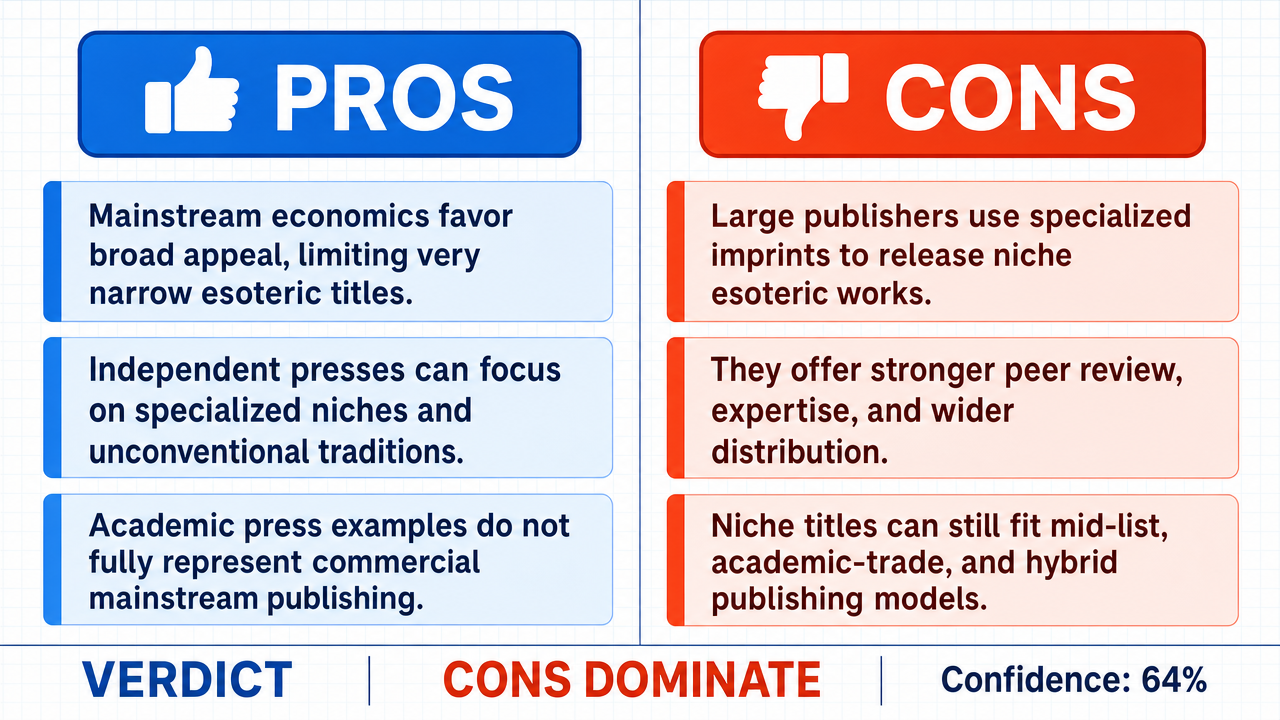
Verdict
Verdict: likely FALSE (64%)
Web Report: https://solsice.com/public/debates/independent-publishers-consistently-produce-more-in-depth-an-fd5c2c8446a1
This section provides a brief overview of the key arguments. You do not need to read the full detailed report below.
✅ Key PRO arguments:
- ■The TRUE side argued that mainstream publishing's high-volume, low-margin economics impose a profitability threshold that discourages narrow esoteric works whose audiences may number only in the hundreds or low thousands.
- ■It contended that independent presses are better positioned to serve specialized subjects such as Enochian magic, Left-Hand Path Tantra, particular grimoire traditions, regional folk magic, and works centered on texts such as the Picatrix.
- ■In round two, it disputed the use of university-press series as evidence about mainstream publishers, arguing that academic presses operate under different economic and institutional models.
❌ Key ANTI arguments:
- ■The FALSE side argued that large publishing groups are internally segmented and can use specialized academic and nonfiction imprints to publish esoteric material that mass-market divisions avoid.
- ■It said these channels provide philological expertise, rigorous peer review, and global distribution, resources that independent presses often lack.
- ■It rejected a universal 3,000–5,000-copy minimum for niche esoteric titles, pointing instead to mid-list programs, academic-trade imprints, and hybrid publishing models.
💭 Conclusion: False is the tournament verdict, based on the winning side's case that specialized publishing structures within large organizations prevent a categorical independent-publisher advantage. The FALSE side's strongest argument was that large publishing groups are segmented, allowing specialized academic and nonfiction imprints to pursue narrow subjects that mass-market divisions avoid. It also showed that deep specialist output can benefit from philological expertise, rigorous review, and global distribution, and that a single high print-run threshold does not describe the whole market. The TRUE side reasonably challenged the classification of university presses as mainstream and identified genuine economic pressure on niche titles, but it did not demonstrate consistent independent-publisher superiority on either depth or path-breaking coverage. Because the record contains one debate, only general structural assertions rather than comparative market data, and a 64% judge confidence, the result supports rejecting the broad assertion without proving the opposite universal claim.
🔬 DeepResearch Result: likely FALSE ❌ (64%)
Assertion: Independent publishers consistently produce more in-depth and 'off the beaten path' content in the esoteric and occult book market compared to mainstream publishers.
Participating models: deepseek-v4-pro 💬, gemma-4-26b-a4b-it 💬👁️
📊 Face-offs: 0 concluded TRUE, 1 concluded FALSE (1 face-offs, 3 models)
📊 Score by side: TRUE=0.00, FALSE=0.64
🏅 Model score changes:
minimax-m3 💬👁️: +6
✅ PRO Arguments:
- ■The TRUE side argued that mainstream publishing's high-volume, low-margin economics impose a profitability threshold that discourages narrow esoteric works whose audiences may number only in the hundreds or low thousands. deepseek-v4-pro 💬
- ■It contended that independent presses are better positioned to serve specialized subjects such as Enochian magic, Left-Hand Path Tantra, particular grimoire traditions, regional folk magic, and works centered on texts such as the Picatrix. deepseek-v4-pro 💬
- ■In round two, it disputed the use of university-press series as evidence about mainstream publishers, arguing that academic presses operate under different economic and institutional models. deepseek-v4-pro 💬
❌ ANTI Arguments:
- ■The FALSE side argued that large publishing groups are internally segmented and can use specialized academic and nonfiction imprints to publish esoteric material that mass-market divisions avoid. gemma-4-26b-a4b-it 💬👁️
- ■It said these channels provide philological expertise, rigorous peer review, and global distribution, resources that independent presses often lack. gemma-4-26b-a4b-it 💬👁️
- ■It rejected a universal 3,000–5,000-copy minimum for niche esoteric titles, pointing instead to mid-list programs, academic-trade imprints, and hybrid publishing models. gemma-4-26b-a4b-it 💬👁️
- ■It cited Oxford University Press's Religion and Esotericism series and Cambridge University Press's Studies in Western Esotericism as examples of specialized, in-depth output. gemma-4-26b-a4b-it 💬👁️
💭 Reasoning: False is the tournament verdict, based on the winning side's case that specialized publishing structures within large organizations prevent a categorical independent-publisher advantage. The FALSE side's strongest argument was that large publishing groups are segmented, allowing specialized academic and nonfiction imprints to pursue narrow subjects that mass-market divisions avoid. It also showed that deep specialist output can benefit from philological expertise, rigorous review, and global distribution, and that a single high print-run threshold does not describe the whole market. The TRUE side reasonably challenged the classification of university presses as mainstream and identified genuine economic pressure on niche titles, but it did not demonstrate consistent independent-publisher superiority on either depth or path-breaking coverage. Because the record contains one debate, only general structural assertions rather than comparative market data, and a 64% judge confidence, the result supports rejecting the broad assertion without proving the opposite universal claim.
📋 PRO Facts:
• Mainstream publishing was described as a high-volume, low-margin business in which profitability generally requires sales measured in the thousands.
• The audience for specialized esoteric subjects was described as potentially numbering only in the hundreds or low thousands.
• The debate identified Enochian magic, Left-Hand Path Tantra, specific grimoire traditions, regional folk magic, and Picatrix-centered scholarship as examples of narrow fields that may be neglected by large publishers.
• No title-by-title sales, catalog-depth, or comparative quality data were supplied to establish consistent independent-publisher superiority.
• The affirmative distinguished academic or university presses from commercial mainstream publishers on the grounds that they operate under different economic and institutional models.
📋 ANTI Facts:
• Specialized academic and nonfiction imprints within large publishing organizations were presented as counterexamples to the claim that large publishers systematically avoid niche esoteric works.
• Philological expertise, rigorous peer review, and global distribution were identified as resources available through specialized publishing channels and often unavailable to small presses.
• Mid-list programs, academic-trade imprints, and hybrid publishing models were identified as alternatives to a single mass-market print-run rule.
• Oxford University Press's Religion and Esotericism series and Cambridge University Press's Studies in Western Esotericism were cited as examples of specialized scholarly output.
• The anti side argued that a 3,000–5,000-copy threshold is not a universal rule for publishing esoteric titles.
| Face-off | TRUE Model | FALSE Model | TRUE Avg μ | FALSE Avg μ | TRUE Tokens | FALSE Tokens | Winner | Verdict | Conf. |
|---|---|---|---|---|---|---|---|---|---|
| #1 | deepseek-v4-pro 💬 | gemma-4-26b-a4b-it 💬👁️ | 0.525 | 0.405 | 6 | 2 | TRUE | FALSE | 64% |
The following technical terms, abbreviations, and domain-specific concepts are referenced throughout this debate transcript. Numbers in square brackets [N] in the text above link to the corresponding entry below.
[1] academic and non-fiction imprints — Specialized publishing divisions within large publishers, described by the negative side as having philological expertise, peer review, and global distribution. The affirmative disputes treating such divisions as part of the trade publishers labeled mainstream.
[2] academic imprints — Imprints within major university presses that the negative cites as evidence of scholarly esoteric publishing. The affirmative classifies university presses separately from mainstream trade publishers, so their relevance to the claim is disputed.
[3] academic publishers —
The following financial data tables were referenced during the debate exchanges:
| Publisher Type | Primary Content Focus | Resource Allocation (Research/Editing) | Distribution Reach |
|---|---|---|---|
| Mainstream Academic | Scholarly/Primary Sources | High | Global/Institutional |
| Mainstream Trade | Mass-market/Lifestyle | Moderate | Global/Retail |
| Independent/Niche | Practitioner/Specialized | Low to Moderate | Niche/Direct |
| Small Press | Enthusiast/Derivative | Low | Very Limited |
Legend: Comparative analysis of publishing models in the esoteric/academic sectors. Resource Allocation refers to the relative budget dedicated to scholarly vetting and philological accuracy.
Face-off transcripts
- ■
Ownership & Trade Secrets. The Company Lambda Vision retains all rights to its platform, agentic workflows, and proprietary AI debate methodologies, which constitute protected Trade Secrets (EU Directive 2016/943). Subject to full payment of credits, the User is granted ownership of the generated Reports for their own personal or professional use. Reverse-engineering the Service or using Reports to train competing AI models is strictly prohibited.
- ■
No Professional Advice. Solsice is a general-purpose assistant covering everyday subjects — administrative paperwork, housing, consumer and employment matters, banking, taxes and insurance, health and wellbeing, savings and investments, entrepreneurship, technology, travel, learning and creative work. Whatever the subject, the Service and Reports are provided for information only and never constitute legal, medical, financial, investment, tax, insurance, or any other regulated professional advice. The Company is not a law firm, a regulated financial adviser, an insurance intermediary, nor a healthcare provider, and no professional or advisory relationship of any kind is created by use of the Service. Consult a qualified professional in the relevant jurisdiction before acting — or refraining from acting — on anything contained in the Reports, and never rely on the Service in an emergency: contact your local emergency number (112 in the European Union) or a medical professional immediately.
- ■
AI-Generated Content, Sources and Viewpoints. Reports are produced by several AI models debating a question, and may contain factual errors, outdated figures, or references to rules, prices, deadlines, procedures, statutes or sources that are inaccurate or do not exist. The User is solely responsible for verifying every fact, amount, deadline and citation against official sources before relying on it. Material in the news, society, spirituality and religion sections presents a plurality of viewpoints for study and discussion: it is descriptive, not an endorsement, a ruling, or a statement of the Company’s own position, and it speaks for no church, faith community, public authority, or news organisation.
- ■
Liability & Governing Law. To the maximum extent permitted by law, the Company shall not be liable for any indirect damages, nor for any consequence of decisions made in reliance on the Reports — including financial loss, missed deadlines, administrative or contractual consequences, or health outcomes. These Terms are governed by French law. Any disputes shall be subject to the exclusive jurisdiction of the Courts of Paris, France.