
In the game, the conflict between humanity's compulsion to seek knowledge and the destructive nature of truth is a central theme of Call of Cthulhu.
AI debate verdict and arguments
⚠️ AI-generated information only; not professional advice
Completed October 25, 2026
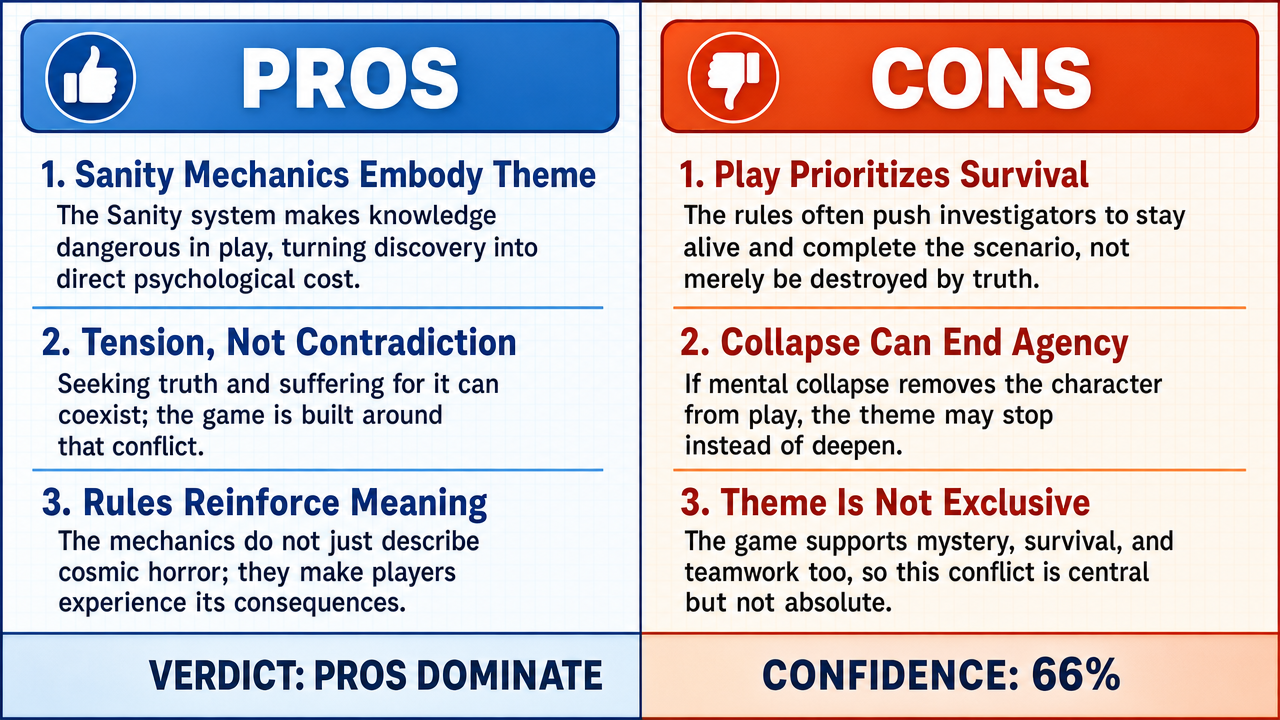
Verdict
Verdict: likely TRUE (66%)
Web Report: https://solsice.com/public/debates/in-the-game-the-conflict-between-humanity-s-compulsion-to-se-688b2f311d1e
This section provides a brief overview of the key arguments. You do not need to read the full detailed report below.
✅ Key PRO arguments:
- ■The mechanical implementation of the Sanity system serves as a direct structural manifestation of the theme that truth is inherently destructive. As investigators uncover forbidden lore or witness cosmic horrors, they must succeed in Sanity rolls ; failure results in a loss of mental stability. This creates a gameplay loop where the primary driver of progress—the acquisition of information—is the exact same mechanism that facilitates the character's psychological collapse. The game does not reward knowledge with power in a traditional sense, but rather punishes the character for the burden of knowing.
- ■The opposing argument relies on a logical contradiction by treating preservation/agency and the destructive nature of truth as mutually exclusive when they are actually inextricable. If the game's core is defined by the struggle for preservation, it does not logically follow that the destruction resulting from the pursuit of truth is absent; rather, the two concepts are intertwined, with the cost of truth being precisely what makes preservation meaningful.
❌ Key ANTI arguments:
- ■The fundamental objective of the Call of Cthulhu ruleset is the preservation of the investigators ' lives and the successful completion of the scenario 's plot, not their inevitable psychological or existential destruction. The Sanity system is a mechanic for tracking the psychological toll of the investigation and simulating the character's state, rather than a predetermined outcome that punishes knowledge-seeking. The rules explicitly provide methods for recovery and stabilization, such as the Sanity check and subsequent treatment, suggesting a system designed to manage the cost of horror rather than to enforce a cycle of inevitable doom.
- ■The opponent's argument is logically incoherent because it describes a 'permanent mental collapse' as a terminal state that ends the character's involvement, yet simultaneously characterizes the mechanic as a 'gameplay loop '—an iterative cycle where the character continues to participate. If the collapse were truly permanent, the character could not continue to play, and the mechanic would not be a loop. The rules explicitly distinguish between temporary Sanity loss (the primary function) and permanent loss, undermining the claim that knowledge-seeking inevitably leads to destruction.
💭 Conclusion: True, the conflict between humanity's compulsion to seek knowledge and the destructive nature of truth is a central theme of Call of Cthulhu . The Sanity mechanic structurally embodies this tension by mechanically penalizing the acquisition of forbidden knowledge with psychological deterioration, making the cost of truth a core gameplay experience rather than incidental flavor. The anti-side's argument that preservation and recovery mechanics negate the destructive theme is undermined by the fact that these recovery systems exist precisely because the destructive cost of truth is assumed as a baseline—they manage, rather than eliminate, the inherent harm of cosmic knowledge. The anti-side's logical critique about 'permanent collapse' versus 'gameplay loop ' conflates temporary Sanity loss with terminal outcomes, missing that even recoverable damage reinforces the theme that truth exacts a toll. The moderate confidence reflects that while the theme is clearly present, the debate acknowledged nuance around whether the destruction is 'inevitable' versus 'probable,' and whether recovery mechanics partially mitigate the central tension.
🔬 DeepResearch Result: likely TRUE ✅ (66%)
Assertion: In the game, the conflict between humanity's compulsion to seek knowledge and the destructive nature of truth is a central theme of Call of Cthulhu .
Participating models: gemma-4-26b-a4b-it 💬👁️, glm-4.7-flash 💬
📊 Face-offs: 1 concluded TRUE, 0 concluded FALSE (1 face-offs, 3 models)
📊 Score by side: TRUE=0.66, FALSE=0.00
🏅 Model score changes:
minimax-m3 💬👁️: +7
✅ PRO Arguments:
- ■The mechanical implementation of the Sanity system serves as a direct structural manifestation of the theme that truth is inherently destructive. As investigators uncover forbidden lore or witness cosmic horrors, they must succeed in Sanity rolls ; failure results in a permanent loss of mental stability. This creates a gameplay loop where the primary driver of progress—the acquisition of information—is the exact same mechanism that facilitates the character's psychological collapse. The game does not reward knowledge with power in a traditional sense, but rather punishes the character for the burden of knowing. gemma-4-26b-a4b-it 💬👁️
- ■The opposing argument relies on a logical contradiction by treating preservation/agency and the destructive nature of truth as mutually exclusive when they are actually inextricable. If the game's core is defined by the struggle for preservation, it does not logically follow that the destruction resulting from the pursuit of truth is absent; rather, the two concepts are intertwined, with the cost of truth being precisely what makes preservation meaningful. gemma-4-26b-a4b-it 💬👁️
❌ ANTI Arguments:
- ■The fundamental objective of the Call of Cthulhu ruleset is the preservation of the investigators' lives and the successful completion of the scenario 's plot, not their inevitable psychological or existential destruction. The Sanity system is a mechanic for tracking the psychological toll of the investigation and simulating the character's state, rather than a predetermined outcome that punishes knowledge-seeking. The rules explicitly provide methods for recovery and stabilization, such as the Sanity check and subsequent treatment, suggesting a system designed to manage the cost of horror rather than to enforce a cycle of inevitable doom. glm-4.7-flash 💬
- ■The opponent's argument is logically incoherent because it describes a 'permanent mental collapse' as a terminal state that ends the character's involvement, yet simultaneously characterizes the mechanic as a 'gameplay loop'—an iterative cycle where the character continues to participate. If the collapse were truly permanent, the character could not continue to play, and the mechanic would not be a loop. The rules explicitly distinguish between temporary Sanity loss (the primary function) and permanent loss, undermining the claim that knowledge-seeking inevitably leads to destruction. glm-4.7-flash 💬
💭 Reasoning: True, the conflict between humanity's compulsion to seek knowledge and the destructive nature of truth is a central theme of Call of Cthulhu. The Sanity mechanic structurally embodies this tension by mechanically penalizing the acquisition of forbidden knowledge with psychological deterioration, making the cost of truth a core gameplay experience rather than incidental flavor. The anti-side's argument that preservation and recovery mechanics negate the destructive theme is undermined by the fact that these recovery systems exist precisely because the destructive cost of truth is assumed as a baseline—they manage, rather than eliminate, the inherent harm of cosmic knowledge. The anti-side's logical critique about 'permanent collapse' versus 'gameplay loop' conflates temporary Sanity loss with terminal outcomes, missing that even recoverable damage reinforces the theme that truth exacts a toll. The moderate confidence reflects that while the theme is clearly present, the debate acknowledged nuance around whether the destruction is 'inevitable' versus 'probable,' and whether recovery mechanics partially mitigate the central tension.
📋 PRO Facts:
• The Sanity system mechanically penalizes investigators who uncover forbidden lore or witness cosmic horrors through failed Sanity rolls.
• Failure on Sanity rolls results in loss of mental stability, structurally linking knowledge acquisition to psychological damage.
• The game's design treats the acquisition of information as the same mechanism that facilitates character collapse, making the cost of truth a core gameplay loop.
📋 ANTI Facts:
• The rules explicitly provide methods for recovery and stabilization, such as the Sanity check and subsequent treatment.
• The rules distinguish between temporary Sanity loss (the primary function) and permanent loss, indicating the system manages horror rather than enforcing inevitable doom.
• The fundamental objective of the ruleset is the preservation of investigators' lives and successful completion of the scenario's plot.
| Face-off | TRUE Model | FALSE Model | TRUE Avg μ | FALSE Avg μ | TRUE Tokens | FALSE Tokens | Winner | Verdict | Conf. |
|---|---|---|---|---|---|---|---|---|---|
| #1 | gemma-4-26b-a4b-it 💬👁️ | glm-4.7-flash 💬 | 0.402 | 0.486 | 2 | 4 | FALSE | TRUE | 66% |
The following technical terms, abbreviations, and domain-specific concepts are referenced throughout this debate transcript. Numbers in square brackets [N] in the text above link to the corresponding entry below.
[1] 7th Edition — Seventh Edition — The seventh edition of the Call of Cthulhu rulebook, cited in the debate as the source for the game's stated purpose of telling a story about people trying to survive a nightmarish situation.
[2] Call of Cthulhu — A tabletop role-playing game in which players take on the roles of investigators confronting supernatural horrors rooted in Lovecraftian cosmic horror fiction.
[3] Catatonia — A state of immobility and unresponsiveness; cited in the debate as a possible outcome when a character's Sanity reaches zero, ending the scenario.
[4] Cosmic horror — A subgenre of horror fiction emphasizing the insignificance of humanity within a vast, uncaring universe; identified in the debate as the narrative framework of Call of Cthulhu.
[5] Cosmic indifference — The philosophical concept that the universe is unconcerned with human affairs; cited in the debate as a thematic element establishing the conflict between human agency and the cosmos in Call of Cthulhu.
[6] Dialectical tension — A philosophical concept describing the relationship between opposing forces that are inextricably linked; used in the debate to argue that preservation and the destructive nature of truth coexist in Call of Cthulhu.
[7] Forbidden lore — In-game knowledge that is dangerous or taboo for characters to acquire; in Call of Cthulhu, uncovering such lore triggers Sanity loss.
[8] Gameplay loop — An iterative cycle of game mechanics that repeats during play; in the debate, used to argue whether the Sanity system creates a cycle of inevitable destruction or a manageable toll.
[9] Investigators — The player characters in Call of Cthulhu, who investigate supernatural phenomena and face psychological consequences from their discoveries.
[10] Keeper — The game master role in Call of Cthulhu, responsible for running scenarios, narrating the story, and adjudicating rules.
[11] Keeper's Rulebook — The rulebook used by the Keeper to run Call of Cthulhu games; cited in the debate as the authoritative source for the game's stated purpose.
[12] Lovecraftian — Pertaining to the horror fiction of H.P. Lovecraft, characterized by cosmic horror themes; used in the debate to describe the narrative framework of Call of Cthulhu.
[13] Recovery mechanics — Game rules that allow characters to restore lost attributes or abilities; cited in the debate as evidence that the Sanity system manages psychological toll rather than enforcing inevitable destruction.
[14] Ruleset — The complete set of rules governing a game; in the debate, refers to the Call of Cthulhu ruleset and its stated purpose of preserving investigators' lives.
[15] SAN — Sanity — Abbreviation for the Sanity stat in Call of Cthulhu, tracking a character's psychological stability.
[16] Sanity check — A game mechanic in Call of Cthulhu used to determine whether a character loses Sanity from exposure to traumatic events; cited in the debate as a method for recovery and stabilization.
[17] Sanity rolls — Dice rolls made to determine if a character loses Sanity when encountering cosmic horrors or forbidden lore; failure results in a loss of mental stability.
[18] Sanity system — The game mechanic in Call of Cthulhu that tracks a character's psychological stability and penalizes exposure to traumatic knowledge; the debate disputes whether it enforces inevitable destruction or manages a recoverable toll.
[19] Scenario — A pre-written adventure or story framework for a tabletop role-playing game; in Call of Cthulhu, the basic unit of play whose successful completion is the game's objective.
[20] Tabletop role-playing game — A type of game played in person around a table where players assume fictional roles and collaboratively narrate stories; the category to which Call of Cthulhu belongs.
[21] Zero SAN — Zero Sanity — The state when a character's Sanity stat reaches zero; cited in the debate as resulting in catatonia or death and ending the character's involvement in the scenario.
Face-off transcripts
- ■
Ownership & Trade Secrets. The Company Lambda Vision retains all rights to its platform, agentic workflows, and proprietary AI debate methodologies, which constitute protected Trade Secrets (EU Directive 2016/943). Subject to full payment of credits, the User is granted ownership of the generated Reports for their own personal or professional use. Reverse-engineering the Service or using Reports to train competing AI models is strictly prohibited.
- ■
No Professional Advice. Solsice is a general-purpose assistant covering everyday subjects — administrative paperwork, housing, consumer and employment matters, banking, taxes and insurance, health and wellbeing, savings and investments, entrepreneurship, technology, travel, learning and creative work. Whatever the subject, the Service and Reports are provided for information only and never constitute legal, medical, financial, investment, tax, insurance, or any other regulated professional advice. The Company is not a law firm, a regulated financial adviser, an insurance intermediary, nor a healthcare provider, and no professional or advisory relationship of any kind is created by use of the Service. Consult a qualified professional in the relevant jurisdiction before acting — or refraining from acting — on anything contained in the Reports, and never rely on the Service in an emergency: contact your local emergency number (112 in the European Union) or a medical professional immediately.
- ■
AI-Generated Content, Sources and Viewpoints. Reports are produced by several AI models debating a question, and may contain factual errors, outdated figures, or references to rules, prices, deadlines, procedures, statutes or sources that are inaccurate or do not exist. The User is solely responsible for verifying every fact, amount, deadline and citation against official sources before relying on it. Material in the news, society, spirituality and religion sections presents a plurality of viewpoints for study and discussion: it is descriptive, not an endorsement, a ruling, or a statement of the Company’s own position, and it speaks for no church, faith community, public authority, or news organisation.
- ■
Liability & Governing Law. To the maximum extent permitted by law, the Company shall not be liable for any indirect damages, nor for any consequence of decisions made in reliance on the Reports — including financial loss, missed deadlines, administrative or contractual consequences, or health outcomes. These Terms are governed by French law. Any disputes shall be subject to the exclusive jurisdiction of the Courts of Paris, France.